
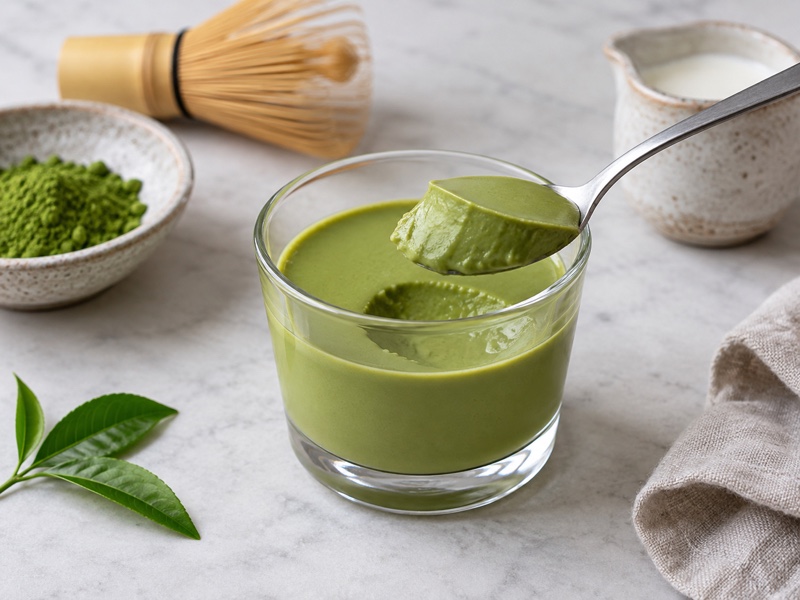
Matcha pudding looks uncomplicated until a café has to produce hundreds of cups with the same spoon texture. Starch can turn pasty, gelatin can set too firmly, and a thin skin or dark green surface can make a fresh cup look old. The RecipeTin Japan matcha pudding recipe shows a home interpretation. A commercial team needs to choose a set system, measure the cooling route, and test the dessert in its final cup after distribution. Those decisions matter more than a single photograph taken just after filling.
1. What texture should the pudding have?
Start by defining the eating experience. A spoonable custard that slowly levels after a scoop differs from a molded jelly that holds its edge. Both can be called pudding, but they require different formulas and packaging. Specify the serving temperature, cup depth, spoon type, and whether toppings will sit on the surface. A crisp cookie crumble may sink into a loose base. A tightly set pudding may taste less creamy even if it contains the same dairy.
Build a sensory scale using physical references. One sample can mark “too loose,” another the target, and a third “too firm.” Taste after full chilling and again after the intended display period. Record whether tea is recognizable before the dairy sweetness and whether any powder grit remains. Evaluate the first spoon and the bottom of the cup; sediment can make the last bite stronger than the first. The approved texture must survive normal handling, not only a careful bench sample.
| Target | How to observe it | Common failure |
|---|---|---|
| Spoon entry | Resistance on first scoop | Rubbery surface |
| Mouthfeel | Smoothness after swallowing | Starch paste or tea grit |
| Set | Shape after a spoonful | Watery pool |
| Tea profile | Flavor across cup | Top-to-bottom gradient |
2. Should a producer choose starch or gelatin?
Starch thickens during cooking and can give an opaque, custard-like body. Gelatin forms a chilled gel and can produce a cleaner, more delicate set. Agar and other hydrocolloids add further options, each with its own process and texture. The decision should reflect the desired bite, ingredient claims, manufacturing equipment, and distribution conditions. A vegetarian brief rules out conventional animal gelatin; a warm display may rule out a soft gel. Do not replace one system with another by weight and expect the same pudding.
Make separate pilot formulas and keep the matcha, milk, sugar, and cup constant. Compare process complexity: starch needs complete cooking and shear control; gelatin requires proper hydration and temperature handling. Both can be damaged by a rushed fill or an uneven cool. Taste after the same chilled hold. Cost the whole operation, including cook time, filling losses, and rejected cups. A less expensive ingredient that causes inconsistent set can raise the actual cost per saleable dessert.
Test the eating moment
Serve blind samples at the same temperature with the intended spoon. Ask tasters to describe whether the product feels creamy, clean, bouncy, or pasty. A simple preference vote is less helpful than a description tied to the menu brief. Choose the system that creates the desired texture under the available production conditions.
3. How can matcha be dispersed without specks?
Matcha powder readily forms small clumps when it meets a large volume of liquid. Pre-blend it with another dry ingredient or make a smooth slurry with a small amount of liquid, depending on the chosen process. Pass the mixture through a suitable screen if needed, but measure whether straining removes meaningful tea solids. A smooth batter at the top of a tank can hide dry powder along the wall or near the outlet. Scrape and inspect during pilot production.
Test dispersion in the actual dairy or plant base. Fat level and viscosity change how quickly powder wets. Record the mixing sequence, temperature, speed, and duration rather than telling operators to whisk “until smooth.” Sample the fill at the start, middle, and end of a run. If color or flavor shifts, the tank may not keep the powder evenly distributed. Check the bottom of filled cups after chilling. A concentrated green layer there means that the formula or fill process still needs work.
| Dispersion check | When | Pass condition to define |
|---|---|---|
| Wetting | During premix | No dry islands |
| Screen residue | Before filling | Acceptable retained solids |
| Fill gradient | Across batch | Similar color and flavor |
| Cup bottom | After chilling | No gritty tea layer |
4. How much sweetness lets the tea remain clear?
Dairy, sugar, vanilla, and toppings can make a pudding taste comforting while erasing the matcha. Compare several sweetness levels with the same powder dose and the same chilled serving temperature. Taste plain before adding whipped cream or fruit. If the tea tastes harsh at a lower sugar level, a different powder may be better than adding more sweetener. Conversely, a powder that tastes gentle in water may vanish in a rich cream base.
Treat a sauce or topping as part of the final formula. Sweet red bean, white chocolate, and fruit puree each change the perceived balance. A dessert buyer should taste a spoonful that includes all layers, then a spoonful of plain pudding. If the tea is detectable only in the plain bite, the menu may overstate the matcha experience. Keep sweetness evaluation separate from color: a vivid green sample can still taste mostly of sugar. Write the accepted sensory target in a way a production team can repeat.
Compare powder by finished-cup cost
Use equal dose trials first, then adjust to equal perceived tea strength. The lower price per kilogram may not be the lower cost per serving. Include any color change after holding in that comparison. A final decision needs flavor, appearance, and procurement terms together.
5. What causes a surface skin or water layer?
A skin can form as the hot surface dries, while a water layer can signal a set or handling problem. Covering strategy, fill temperature, cooling airflow, cup shape, and formula all influence the surface. Run a small factorial test rather than changing several variables at once. For example, compare two fill temperatures in one cup type, then compare covered and uncovered cooling using the winning temperature. Inspect the surface under the same light used in the display case.
A thin natural film may be acceptable for a rustic spoon dessert, but a sealed retail cup usually needs a clean top. A garnish can hide a skin in a photograph while leaving an unpleasant first spoon. Remove the garnish during evaluation. If water appears after transport, check vibration and temperature cycling. A cup that stays smooth in the development refrigerator may separate during delivery. Keep sample cups from each fill point and inspect them after the same route.
| Symptom | Process question | Next trial |
|---|---|---|
| Dry skin | Was hot surface exposed? | Compare cover timing |
| Water on top | Did gel contract or cup warm? | Hold and transport test |
| Lumpy center | Was starch fully cooked? | Check cook endpoint |
| Bubbles | Was fill too turbulent? | Change fill height |
6. How should the pudding be cooled and held?
Cooling affects both texture and safety. Large hot batches cool differently from small cups, and a deep cup may hold warmth at its center. Measure a representative product temperature during the actual fill and cooling path. Do not assume that a refrigerator set point proves the pudding cooled quickly enough. The FDA Food Code provides a US model for cooling and cold holding of foods that need time and temperature control; follow the adopted local rules and a product-specific hazard plan.
Chill the dessert in its final package for sensory tests, because lid condensation can mark the surface. Check whether stacking warm cups slows cooling or deforms lids. If the recipe contains milk or eggs, the operation must also manage allergens and sanitary handling. The FDA food allergen page explains US major-allergen labeling; requirements differ by market. A proposed shelf life should come from validated microbiological, sensory, and pack testing, not from a home-recipe storage note.
Build a cooling record
Record batch size, cup fill weight, rack layout, time stamps, and measured core temperature. Use the same layout in later production or revalidate the change. This record helps distinguish a formula defect from a cooling bottleneck when a customer reports separation.
7. Which cup and topping work in distribution?
Transparent cups display green color and surface quality, but they also reveal water separation and light-driven color change. An opaque sleeve protects the dessert but hides the product. Test the cup in the store’s lighting and during the real delivery route. Open it with the intended spoon. A lid that peels roughly can splash condensation onto the top. A deep narrow cup may make the last spoon awkward even when it saves shelf space.
Toppings should be evaluated after holding. Crispy inclusions soften if placed directly on pudding; fruit can bleed; whipped cream may collapse or obscure the tea aroma. A separate topping sachet can preserve texture but adds labor and packaging cost. Photograph and taste a complete portion immediately after packing and at the end of the proposed selling period. The point is to see what the guest receives, not what the production kitchen intended.
| Pack element | Test | Buyer tradeoff |
|---|---|---|
| Clear cup | Color under display light | Visual appeal versus exposure |
| Peel lid | Opening and condensation | Seal strength versus presentation |
| Attached topping | Texture after hold | Speed versus crispness |
| Separate topping | Missing-item rate | Quality versus labor |
8. How can production control fill weight and set?
A pudding line needs repeatable mixing, fill, and cool steps. Set a target fill mass and check cups from the beginning, middle, and end of the run. Verify that the deposit nozzle does not separate liquid from thicker material. If the mix waits in a hopper, observe whether it thickens before the last cup. A small bench batch may fill easily while a larger batch sets in the pipe. Map the usable filling window before a full production day.
Inspect cup levels after chilling, not only at fill. A lower level can be normal contraction or evidence of inconsistent deposits; quantify it. Establish a defect reference for bubbles, skin, streaks, unset centers, and damaged seals. Staff need clear rejection decisions. If several cups fail, retain a sample and trace the raw-material lots and process log. Avoid adjusting matcha dose to fix a texture issue unless evidence shows powder addition changed the set.
9. What should the matcha supplier provide?
Request lot-linked samples, a product specification, origin and traceability information, storage guidance, pack size, and quality documentation required by the destination market. Taste the powder in the approved pudding base at the approved dose. Compare color after the full chilled hold, not only immediately after mixing. A grade description can help short-list powders, but it does not predict performance in a sweet dairy gel. Keep retained powder and finished cups as controls for a replacement lot.
Matcha Village provides pure matcha powder for food and beverage development. A useful inquiry states the dairy system, desired tea intensity, manufacturing volume, and packaging route. Ask for documents specific to the offered lot. Procurement should check lead time and supply continuity as carefully as color. A beautiful pilot cup is not a reliable menu item if the accepted powder cannot be replenished during the selling season.
| Supplier input | Production use |
|---|---|
| Lot-linked sample | Side-by-side pudding trial |
| Specification | Ingredient approval |
| Pack and storage advice | Inventory plan |
| Change-notice process | Replacement-lot review |
10. When is a matcha pudding ready to sell?
Run a production-representative batch with the final cup, lid, filling equipment, rack layout, and cold chain. Test cups across the filling run. Judge texture with the intended spoon at the expected selling age. Transport a case through the normal route and inspect the seal, surface, color, and bottom of each cup. Have a panel taste plain pudding and the finished topped version. If one version wins only because the topping masks a weak tea base, revise the base.
Approve a written sensory range and defect photos. Assign owners for food safety validation, allergen review, label copy, and lot change approval. Calculate cost per saleable cup, including overfill, rejects, toppings, and cold distribution. Launch with one set system and one service format, then revise only when measured results identify a problem. Ask powder suppliers for a sample tied to a lot and test it after the same chilled journey the dessert will travel.
FAQs
Q1: Can starch and gelatin be swapped directly? No. They set through different processes and yield different textures. Reformulate and retest the whole cup.
Q2: Why is the last bite stronger in matcha? Tea particles may settle during filling or chilling. Check mixing and sample cups across the batch.
Q3: Can matcha pudding be displayed at room temperature? Use a product-specific safety plan and the local code. A chilled dairy pudding generally needs controlled cold holding.
Q4: What causes a dark surface? Exposure, concentration at the top, or processing conditions may contribute. Compare protected controls and filling samples.
Q5: How should a buyer compare powders? Compare finished pudding after holding, alongside supplier specifications, cost per cup, and reliable lot supply.