
The matcha production process runs from tea cultivation through tencha preparation, milling and packing. For a food or beverage buyer, a process chart alone cannot show whether the sampled powder matches future deliveries. Use each stage as a decision gate: identify what enters it, what the operator controls and which record follows the material. The Japanese agriculture ministry’s Uji tea guide describes the tencha route; supplier records establish what happened to your proposed product. The matcha manufacturer guide helps connect these stages to accountable facilities.
Contents
- 1. What product should the process review start with?
- 2. What can cultivation and shading records tell a buyer?
- 3. How are harvested leaves identified and received?
- 4. Why do steaming and drying routes matter?
- 5. How is tencha sorted and stored before milling?
- 6. What should a buyer ask about blending?
- 7. How does milling change the acceptance question?
- 8. Which checks release the finished powder?
- 9. How does packing preserve product identity?
- 10. How can a buyer approve the full route?
1. What product should the process review start with?
Define the intended use
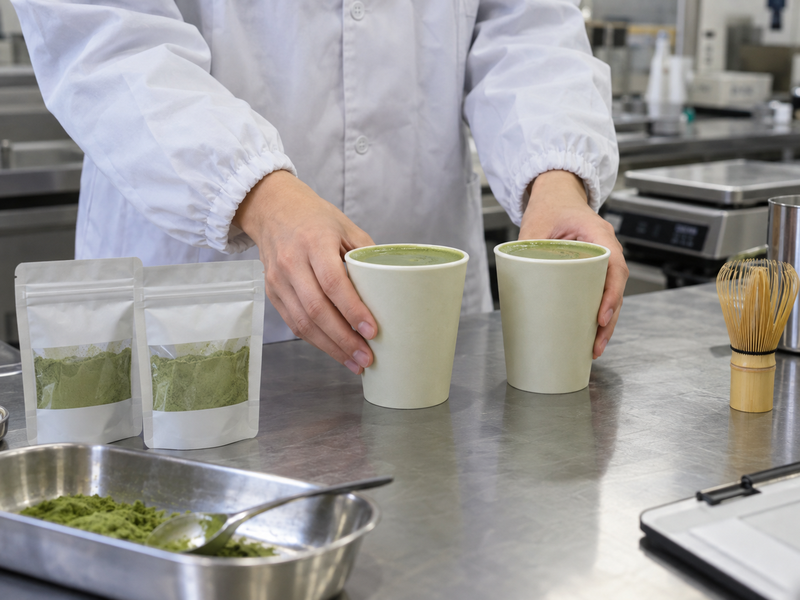
A supplier may make several grades of pure matcha and separate tea blends. Start with the item proposed for your application. Give the team a recipe, preparation method and the characteristics that would cause rejection. A café group may care about dispersion in cold milk and cup color. A dry-blend manufacturer may care about powder handling and ingredient declarations. A straight-tea brand may place more weight on aroma and texture. Each application calls for a different sample trial, even when the broad process steps look similar.
Set a reference point. Request a coded sample and a current specification before studying equipment. Ask which lot or trial produced the sample and which sites handled it. Write down what the supplier means by matcha, tencha and any grade label used in its offer. Do not assume “premium” carries a shared technical meaning. Once the product is defined, the process discussion can focus on controls that protect the result you actually plan to sell. Without that anchor, a production tour becomes interesting but commercially inconclusive.
2. What can cultivation and shading records tell a buyer?
Keep farming claims specific
Tea plant, site, harvest and shading choices can affect the material entering processing. Ask whether the supplier grows tea, contracts farms or buys prepared tencha. For any cultivation claim that matters to your product, request the source definition and records available for the offered lot. You need not demand every farm notebook. You do need a credible route from the claimed leaf source to the material used in the sampled powder. If several sources are blended, ask how that is controlled and represented.
Avoid treating a photograph as a record. A shaded field can explain a method but cannot identify your lot. Discuss how harvest timing and material acceptance work for the specific grade. Ask what happens when leaf supply changes or when a source does not meet the intended product criteria. Origin, shade duration and farm practice should be described at the precision the supplier can document. Product marketing may tell a broader story; your purchasing file should hold the narrower, testable version. That protects both label accuracy and future supplier conversations.
| Field question | Record to seek | Buyer decision |
|---|---|---|
| Source | Approved supplier or site | Origin claim |
| Harvest | Lot date or season | Material identity |
| Shading | Defined practice | Process claim |
| Change | Alternate source rule | Continuity |
3. How are harvested leaves identified and received?
Find the intake gate
Fresh leaves and prepared tencha have different receiving routes. Ask what actually enters the supplier’s facility. If fresh leaves arrive, how are they coded, checked and moved into processing? If tencha arrives, which characteristics and documents determine acceptance? A receiving gate should make it possible to hold material that does not match the intended grade or source. Staff should know where held material sits and who may release it. An intake log matters only if codes stay with material after bins and containers change.
Follow one container. Select a recent received lot and track its code toward production. Ask how mixed deliveries are handled, particularly when several farms or processors supply a single day. Check whether the seller can identify the source of a later finished pack without relying on memory. Where the receiving site differs from the milling site, request the transfer record between them. This stage often exposes the difference between a simple marketing flowchart and the actual commercial chain. Record any uncertainty before it becomes a label or traceability problem.
4. Why do steaming and drying routes matter?
Understand the tencha route
The agriculture ministry describes tencha as covered-grown tea leaves steamed and dried without rolling. Ask the proposed processor to explain its own route from incoming leaf to dry tencha. The purpose of this question is product identity and repeatability, not a demand for proprietary machine settings. Learn which stages it performs, which partner handles any outsourced stage and how deviations are recorded. A plant that purchases tencha should not be asked to demonstrate steaming equipment it never uses; it should demonstrate supplier control instead.
Ask about interruptions. What happens if incoming leaf waits longer than planned, a dryer pauses or material fails an in-process check? Operators should be able to identify affected lots and show how quality decides their status. Look for production dates, material codes and stage signatures. Buyers should avoid copying broad processing claims from a reference article into their own specification. The supplier’s route, agreed product definition and application test together form the relevant evidence. A process can be traditional, automated or mixed and still require the same disciplined product check.
| Stage | Practical buyer question | Record |
|---|---|---|
| Steaming | Which site performs it? | Batch route |
| Drying | How are deviations handled? | Run record |
| Transfer | How is identity maintained? | Material code |
| Acceptance | Who releases tencha? | Status decision |
5. How is tencha sorted and stored before milling?
Review material preparation
Tencha may be cut, sorted or refined before milling, depending on the supplier’s route. Ask what the offered product requires and how staff separate material that does not meet the grade. Storage deserves attention because milled powder quality begins with the material held for that run. Request the storage condition in the supplier’s specification and ask how containers stay sealed, identified and protected from mix-up. Avoid assigning a universal storage period or temperature without the product’s own data.
Check a live label. It should tell an operator what the container holds, its lot and whether it may be used. Ask what happens when two tencha lots are opened for one blend or when a partial container returns to storage. The trace should show which material entered each milling order. A buyer’s application team may not care about every sorting step, yet quality needs confidence that the material reaching the mill matches the approved route. Document the answer in plain language so future orders can be checked against it.
6. What should a buyer ask about blending?
Make consistency visible
Blending may help a supplier meet a sensory target across source lots. Ask whether your proposed grade uses a fixed recipe, a sensory target with adjustable inputs or a single source. Each can be legitimate if the seller describes it honestly and controls changes. Buyers should know which claims remain valid after blending, especially an origin or single-estate claim. The purchase specification should describe the outcome you approve and the material boundaries that cannot change without review.
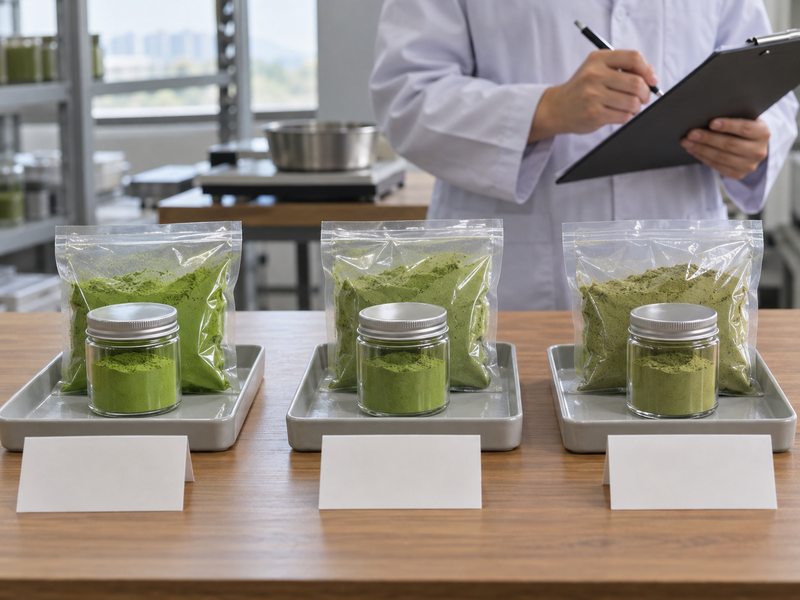
Use two sample lots. Compare them in the same recipe and ask what source or blend changes explain any difference. Do not demand confidential percentages when a controlled source list and method can answer your risk question. Ask who authorizes a new ingredient stream and whether the buyer receives notice. A blend sheet should connect every input lot with the finished powder code. If the supplier offers a substitute when one input runs short, treat that as a new approval question. A stable-looking powder can still represent a meaningful change in source identity.
| Blend model | Buyer needs to know | Approval risk |
|---|---|---|
| Single source | Source definition | Availability |
| Fixed recipe | Allowed inputs | Change control |
| Target blend | Performance limits | Source drift |
| Substitute | New input identity | Requalification |
7. How does milling change the acceptance question?
Test powder, not a machine label
Grinding turns prepared tea into the powder your production staff handle. Ask which milling method made the sample and which would make the order. Request the supplier’s particle-size method if fineness is a specification field. Then test actual performance: wetting, mouthfeel, sediment, color and flavor in the intended application. A stated micron value may not predict how a complex beverage system behaves. Similarly, a mill type cannot prove that one powder tastes better than another.
Watch for process changes. Ask how the factory manages mill condition, heat, cleaning and any screen or sieve used after grinding. What does it do with powder produced during a stop or adjustment? Can it link a production lot to the equipment run? Keep a retained approved sample and a defined method for comparing future lots. A purchaser seeking a second source should test both powders blind under identical preparation. Milling matters because it changes the final product, not because a particular machine photograph wins a sales argument.

8. Which checks release the finished powder?
Separate results from permission to ship
Ask quality to show the release path for the offered SKU. The specification should identify which characteristics are checked, by whom and with what methods. A certificate of analysis can carry the reported results for a lot, but it does not answer whether all relevant reviews were completed unless the release procedure says so. Where an outside laboratory performs testing, clarify who takes the sample, sends it and evaluates the report. Match the lot code on every document with the physical product.
Ask about a failed result. The supplier should explain how material is held, investigated and either accepted under an approved disposition or rejected. Retesting should follow a documented rule rather than an ad hoc search for a passing number. Your quality team must set destination and application requirements; do not inherit another buyer’s test panel blindly. Record any pending report before issuing an order. The goal is a clear statement of which lot may ship and who had authority to make that decision.
| Release input | Check | Outcome |
|---|---|---|
| Specification | Correct revision | Agreed limits |
| Sample | Correct lot | Representative test |
| Report | Method and units | Interpretable result |
| Status | Signed decision | Ship or hold |
9. How does packing preserve product identity?
Check the last material handoff
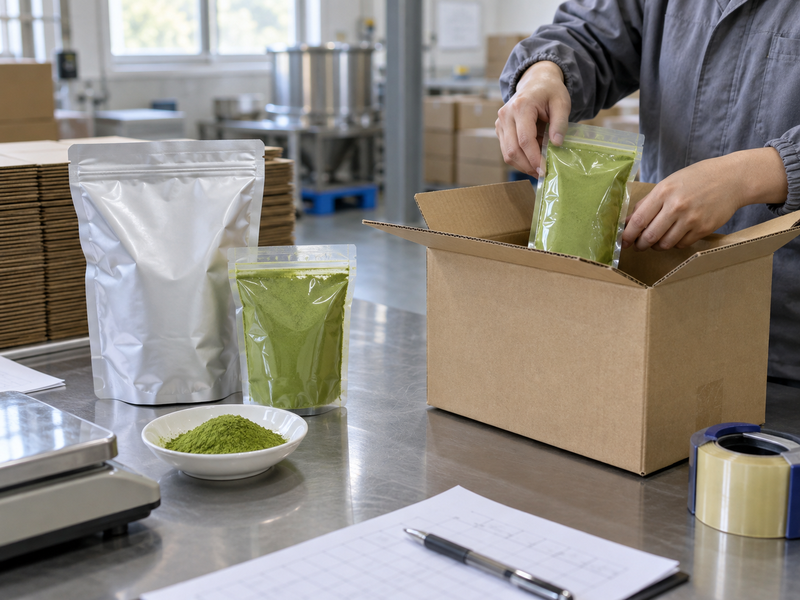
After release, a powder still needs correct packaging. Ask whether it moves directly into packs or waits in an identified intermediate container. Review how the packer confirms material code, packaging material, artwork version and finished lot code at startup. The receiving team needs a code it can read and reconcile with the supplier’s documents. If a third-party packer handles the product, request the same clarity across company boundaries. A good milling record loses value if packed cartons cannot be traced back to it.
Open the right questions before artwork approval. Check barrier and closure choices against the proposed storage conditions, pack size and use pattern. A café using many small packs has different handling needs from a manufacturer opening a large bag. Ask for a packing sample in the format you intend to order, not just a retail display pouch. Verify label fields with your market specialist and receiving requirements with logistics. Record damaged-pack handling and in-process checks. Once the product arrives, its package is part of the quality system your buyer actually uses.
10. How can a buyer approve the full route?
Build a stage-gate record
List each stage, its operator, its record and its buyer decision. A long tour report becomes useful only when it identifies the proposed product and open actions. Ask for the source route, a coded sample, the specification, lot records, a packing format and a written offer. Let quality review technical evidence while operations runs the application test and purchasing reviews commercial terms. An unresolved origin claim may prevent one label concept while still allowing an unlabeled development trial.
Approve a defined configuration. Record the grade, production sites, allowed material sources, pack and sample code. Ask for notice before changes to any condition that matters to your product. Matcha Village’s supplied profile describes managed tea sourcing, automated processing and several raw matcha and blend formats; those are starting points for a product-specific discussion, not substitutes for the proposed SKU’s records. A complete process review leaves the next order with fewer unknowns and a clear path for handling normal variation.
| Gate | Supplier evidence | Buyer action |
|---|---|---|
| Material | Source and intake link | Verify claim |
| Process | Site and batch route | Review controls |
| Product | Coded trial and results | Test application |
| Supply | Pack and offer | Approve purchase |
FAQ
Q1: Does every matcha supplier grow its own tea? No. Some buy prepared tencha or use partner processors. Ask for the actual chain and its controls.
Q2: Is stone milling required for every B2B application? The relevant question is whether the proposed powder meets your specification and performs in your recipe.
Q3: Can a process diagram prove traceability? No. Trace a real finished code backward through material and production records.
Q4: Why test more than one lot? Repeated tests show whether a proposed grade remains usable as source material and production runs change.
Q5: What should an approval name? The approved SKU, route, sample reference, specification revision, pack format and any conditions for change notice.
Final thought
The matcha production process is useful to buyers when each stage connects to a record and a product decision. Keep your questions tied to a coded sample, test that powder in the intended use and approve only the route your evidence covers.