
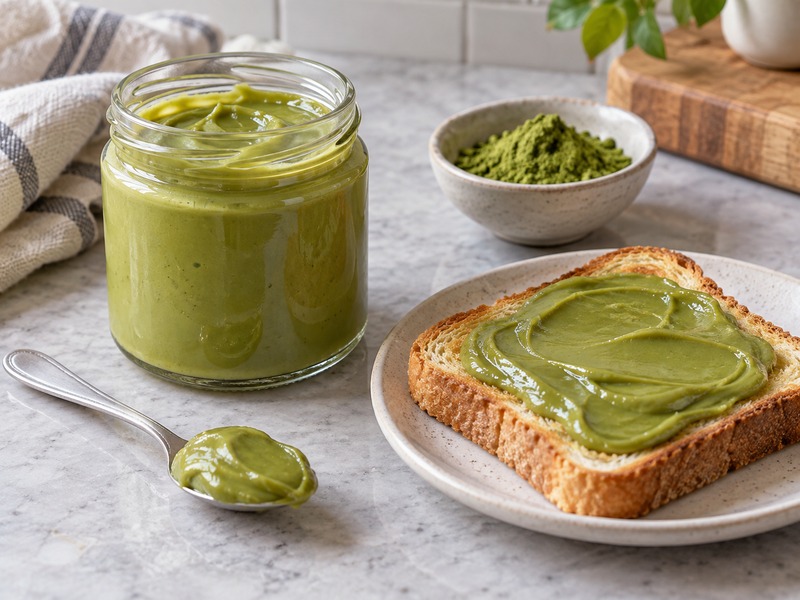
Matcha milk jam is a sweet, concentrated dairy spread flavored with powdered green tea. It can work on toast or inside baked goods, but a spoonable home batch does not automatically become a safe, stable retail jar. Reduction changes solids and flavor; matcha can clump or taste harsh; the spread thickens further as it cools. Sift & Simmer’s matcha milk jam illustrates the consumer idea and cautions against room-temperature storage for its home preparation. A commercial team needs its own formula, process and refrigerated shelf validation.
For: bakery teams, café operators, spread developers and ingredient buyers. Decision: how to deliver a smooth tea-flavored spread in the intended use and pack.
1. What should the finished spread do?
Define the use before thickness
A toast spread should lift easily from a jar and stay on bread. A bun filling needs to remain inside a pastry. A sauce for plated desserts may be pourable when warmed. Those are different endpoints. Set the sale format, serving temperature, sweetness, tea intensity and expected holding route. Decide whether the product is made fresh for café service or packed for distribution. The latter requires a distinct safety and shelf-life program.
Write a texture description. Taste and spread the product after it has fully cooled, not only while warm in the kettle. A warm mixture may look thin but set too stiff overnight. Check whether it tears bread, pipes cleanly, or leaks from the intended bun. Record an approved spoon test or flow measurement alongside a sensory note: clear matcha flavor, creamy dairy body and no cooked-milk scorch.
| Use | Desired behavior | First trial |
|---|---|---|
| Toast jar | Spoonable and spreadable | Cold spoon and bread |
| Bakery filling | Holds within crumb | Filled-bun hold |
| Dessert sauce | Controlled pour | Warm service test |
2. Which dairy or plant base fits the product?
Compare composition, not names
Milk, cream and milk powder contribute water, fat, protein and solids. Changing their proportions changes both reduction time and cooled texture. A plant-based version is a new formula, not a direct ingredient swap; different oat or coconut products vary in sweetness, fat and stabilizers. Start with a defined base and weigh every ingredient. Trial only one substitution at a time. Taste the result at the actual service temperature, because a rich warm spread can feel waxy or heavy when cold.
Review labels early. Dairy, coconut and other bases have different allergen and ingredient-statement implications. Ask suppliers for specifications and a change-notification process. If the menu promises a dairy-free option, verify the complete formula and production controls. The sale name “milk jam” may need explanation when the product uses a plant base.
3. How should matcha be selected?
Judge it after reduction
Milk sweetness can soften matcha, but a long heat process may mute aroma or make a poor powder taste coarse. Request identified, food-grade samples and compare them at equal measured doses in the same base. Taste after cooling and after the planned hold. Look for a tea note that remains clear in a small serving, not simply a green color in the kettle. A lower-priced matcha that needs twice the dose can increase unit cost and bitterness.
Keep purchasing evidence. Record lot number, product description, pack size, storage guidance and the documents required by the buying program. Retain a sample from the approved lot. When a new lot arrives, run a small standard jam trial before committing it to production. Dry color alone cannot predict its behavior with cooked milk and sugar.
| Tea check | Test condition | Decision |
|---|---|---|
| Flavor | Fully cooled spread | Dose and lot |
| Color | Final pack after hold | Sale appearance |
| Grit | Thin spread on bread | Powder fit |
| Traceability | Supplier file | Reorder control |
4. When should matcha enter the process?
Disperse before the large batch
Matcha can form dark clumps when added dry to hot, thick milk. A small pre-dispersion with a measured compatible liquid can make mixing easier. Include that liquid in the full recipe mass. Compare adding the tea early with adding it later in the reduction, keeping all other factors fixed. Early addition may be simpler for production; later addition may preserve more aroma or color, but the viscosity can make complete dispersion harder. The chosen method must fit the actual mixer and kettle.
Inspect the filled jar. Sample early and late fills and spread each thinly on a white plate. Dark flecks, color differences or an uneven tea taste reveal problems that a deep jar can hide. Record mixing tool, speed and duration. A high-speed method may remove clumps but introduce air, which can affect fill weights or surface appearance. Fix process distribution before increasing the tea dose.
5. What reduction endpoint gives the target texture?
Measure more than elapsed minutes
Evaporation depends on pan area, heat input and batch size. A home recipe’s cook time cannot simply be multiplied for a production kettle. Record starting and finished mass, process temperature where appropriate, time and an observable viscosity or solids endpoint. Cool a small sample fully before deciding whether the batch is thick enough. A warm spoon line can be useful as a process cue, but it should be linked to the finished texture rather than treated as the only test.
Watch scorching. Milk solids can catch on hot surfaces. Note agitation and scraping, especially at the kettle edge and during the thick final stage. A slight burnt note can make matcha seem bitter. If a large batch tastes rougher than the bench sample, inspect heat distribution before blaming the tea. Do not keep reducing solely to make a filling firmer; the extra heat may darken color and flatten tea flavor.
| Endpoint observation | Possible issue | Next check |
|---|---|---|
| Thin after chilling | Insufficient concentration | Finished mass and solids |
| Too stiff | Excess reduction | Cooling sample earlier |
| Scorched note | Hot spots | Heat and agitation |
| Uneven green | Tea dispersion | Addition and mixing |
6. How should sweetness be balanced?
Taste after cooling
Sugar contributes flavor, solids and perceived thickness. Lowering it may make tea bitterness more obvious and change the reduction endpoint. Increasing it can make the spread appealing in a tiny spoon taste yet cloying on toast. Run a controlled sweetness trial with matcha and process held constant. Taste the portion size customers will use on the intended carrier. A filling in a sweet bun may need a different balance from a spread eaten on plain bread.
Consider other flavors carefully. Vanilla, salt or a roasted note can support matcha, but each addition should solve a named sensory problem. If vanilla hides the tea, the product becomes a generic green milk spread. If the dairy flavor is too cooked, fix the heat route before adding aroma. Record ingredients by weight and check label implications. The goal is a coherent spread, not a long list of flavor additions.
7. What defects appear during chilling and holding?
Test the actual container
Matcha milk jam may thicken, form a skin, separate or change color during chilled holding. Fill the proposed jar or pastry at the intended temperature and mass. Observe the surface, lid, texture and flavor at scheduled intervals. Taste from top and bottom. A jar that looks uniform can contain a firmer layer below; a filling may migrate moisture into pastry. Set the proposed sale period only through product-specific safety and quality work.
Keep the storage message clear. The cited home recipe explicitly does not support room-temperature storage for its product. A commercial shelf-stable claim would need a separately designed and validated process. Do not assume that cooking until thick creates a safe ambient preserve. Handle dairy-containing spreads under the applicable food-safety program and train staff on refrigeration, opening and discard rules.
| Hold defect | Inspect first | Evidence |
|---|---|---|
| Surface skin | Fill temperature and headspace | Timed pack photos |
| Water release | Formula and cooling | Top and bottom samples |
| Darkening | Heat, light and time | Fixed-light color record |
| Stiff texture | Reduction endpoint | Cold spread test |
8. Which pack and portion format work?
Choose by use and hygiene
A retail jar allows a visual look at the color but brings repeated consumer opening. Single-serve cups protect portions but cost more and may be hard to empty. A bakery piping bag can speed filling but needs a controlled working period and clear labeling. Test each format with the finished spread. Check fill weights, lid clearance, seal, spoon or nozzle access and residue left in the pack. A pretty glass jar is only useful if the product remains appealing when opened.
Include the carrier. Spread the jam on the intended toast, biscuit or pastry after the normal holding time. A filling that tastes balanced alone can make a sweet bun excessive. A jar spread may need to be softer than a cake filling. If one formula cannot serve both well, two specifications may be clearer than a compromise that disappoints both uses.
9. How should cost and supply be calculated?
Use finished yield
Reduction removes water, so cost per starting kilogram hides the actual sale-unit cost. Weigh finished yield and kettle loss. Include milk, cream or plant base, matcha, sugar, jar, lid, label, labor and discarded product. Compare matcha powders at the dose needed for finished flavor. A low-cost powder that fades during reduction may create more cost than it saves.
Plan for supplier variation. Dairy solids, cream fat and tea lots can shift texture and flavor. Ask for specifications, lot identity, pack size, lead time and change notice. A new milk powder or matcha lot deserves a confirmation batch. Keep evidence for any origin or certification claim. Do not use matcha as a shortcut to unsupported health language in a sweet spread.
| Cost item | Pilot measurement | Why it matters |
|---|---|---|
| Base dairy | Starting mass and price | Main input |
| Evaporation | Finished yield | True spread cost |
| Matcha | Grams per sale jar | Flavor at accepted dose |
| Filling loss | Product left in kettle and nozzle | Saleable yield |
| Pack | Jar, lid and label | Retail margin |
Build the cost sheet from a real filled batch rather than an estimated reduction ratio. Then compare two possible sale formats at the same finished quality: a small premium jar and a larger bakery filling pack. The jar may have a higher packaging cost per gram but a better retail presentation. The bakery pack may reduce filling labor while demanding tighter cold-chain handling after opening. Neither choice should be made from ingredient cost alone. Include the labor of scraping, cooling, filling and cleaning because the thick final spread can slow the line.
10. What pilot makes the product saleable?
Run the full process and holding route
Make a pilot in the intended kettle at a size that exposes heating, agitation, reduction and filling limits. Record starting and final mass, temperatures, mixing, fill weight and rejects. Chill in the planned pack. Taste at release and through the proposed sale period, including the product on its intended toast or pastry. Have multiple tasters assess tea clarity, sweetness, cooked notes and texture. A successful warm kettle sample is only the beginning.
Set release criteria. Approve the exact tea and dairy specifications, recipe, reduction endpoint, cooling, fill, pack and food-safety controls. Define what prompts retesting, including a new tea lot or different jar. The useful next step is a small chilled pilot placed into the real café or retail route, with a formal shelf-life review before any date code is promised.
Reference: Matcha Milk Jam/Green Tea Milk Spread is a home-recipe reference. Its preparation and storage notes are not a commercial process validation.
FAQ
Q1: Is matcha milk jam the same as a shelf-stable preserve? No. Shelf stability requires a separately validated formula and process.
Q2: Why does the spread become thick after chilling? Cooling changes the texture of the concentrated milk system; assess the endpoint after full cooling.
Q3: Can plant milk replace dairy directly? Treat it as a new formulation with separate texture, label and shelf tests.
Q4: How should matcha be added? A measured pre-dispersion can reduce clumps; validate the liquid and addition point in the full process.
Q5: What should a bakery test before using it as filling? Check leakage, moisture movement, flavor balance and the intended holding route.