
Matcha powder bulk density describes powder mass within a measured bulk volume, including spaces between particles. Buyers need it for hopper capacity, volumetric dosing and package fill. Reports become comparable when the method and powder state match. USP distinguishes bulk and mechanically tapped density; a buyer trial should retain that distinction. USP density chapter.
Contents
- 1. What does matcha powder bulk density measure?
- 2. How do loose and tapped results differ?
- 3. Which method details make results comparable?
- 4. How should samples be taken for density checks?
- 5. How can density inform hopper volume?
- 6. What does density mean for volumetric dosing?
- 7. How should package fill be evaluated?
- 8. How do you interpret variation between repeats?
- 9. What should go into the purchasing specification?
- 10. How do you turn the results into a supplier decision?
1. What does matcha powder bulk density measure?

Describe the powder bed
Bulk density relates a measured powder mass to the volume it occupies under a defined preparation method. The volume includes spaces within the powder bed. It differs from a density measurement concerned with particle material itself. A procurement specification should identify which measurement the supplier reports and the conditions used to obtain it.
For matcha powder bulk density, a number without a method can mislead a buyer sizing a hopper. Powder poured gently into a cylinder can occupy a different volume after handling or tapping. Ask the laboratory to state how it filled the vessel, whether the powder received preparation and how it read the volume. Retain those details beside the result.
Identify the measured state. If your production question concerns freshly transferred powder, ask which laboratory state best represents that question. A density result supports a volume estimate under stated conditions. Confirm the actual usable capacity in your equipment rather than fill a hopper from a report alone.
| Density description | Powder state | Buyer use |
|---|---|---|
| Loose bulk | Defined untapped preparation | Initial volume estimate |
| Tapped bulk | Defined mechanical settling | Settling comparison |
| Particle material | Different measurement principle | Separate technical question |
2. How do loose and tapped results differ?
Keep the procedures distinct
Ask for separate loose and tapped results when both matter to the application. USP describes tapped density as the increased bulk density obtained after mechanically tapping the container holding the sample. USP bulk and tapped density. Record the named method and its current version; the chapter’s procedures should not become an unqualified matcha purchasing requirement.
Your matcha powder bulk density review should ask for tapping equipment, endpoint and any sample preparation. Hand knocking a jar against a bench is not an interchangeable method unless your company has deliberately defined and evaluated that procedure. Compare supplier results using the same agreed approach before ranking powders.
Request both labels on the report. If a supplier provides one density value, ask which state it represents. Do not guess that the higher number is tapped or that a particular numerical difference predicts your filling line. Trial evidence should connect the measurement with your process and package.
3. Which method details make results comparable?

Specify the report fields
Agree the sample mass, vessel, filling procedure, volume reading and reporting units. Ask whether the sample was sieved, mixed or conditioned before measurement. These activities can change the state examined. The laboratory should identify any method deviation so the buyer can decide whether a report belongs in the same comparison set.
For matcha powder bulk density, sample history deserves a field beside the method. Record lot, package opening and time between preparation and measurement when relevant. Powder tested directly after transfer may differ in packing state from material that has rested. Ask your technical team which conditions represent the intended operation.
Compare like procedures. An illustrative review might receive one report in grams per milliliter and another in kilograms per cubic meter. Those units can be converted, but differing preparation methods still need resolution. A unit conversion cannot remove a difference in the powder state measured by the laboratories.
| Method field | Agree before testing | Why retain it? |
|---|---|---|
| Vessel and filling | Named setup | Defines initial volume |
| Preparation | Treatment and conditions | Identifies sample state |
| Reporting | Units and method revision | Supports comparison |
4. How should samples be taken for density checks?
Connect the sample with the lot
Ask the supplier how the submitted sample represents the offered lot and package. Record its identity, quantity and handling before testing. A small spoonful from an opened bag may answer a preliminary question, but its relationship to a production delivery needs explanation. Choose a sampling approach through your company’s technical review. Matcha powder bulk density checks should preserve the material state required by the agreed method. Avoid squeezing or compacting a sample merely to fit the shipping container. If the laboratory prepares the sample before measurement, record that step. Keep a suitable retained portion where your company’s sampling process calls for one.
Document handling before measurement. For an illustrative comparison, the buyer can send matched portions from approved and candidate lots to one laboratory. This reduces differences between reporting procedures, though it does not prove the portions represent every bag. Ask the supplier about lot variation and request more evidence if the application needs it.
5. How can density inform hopper volume?
Calculate a starting estimate
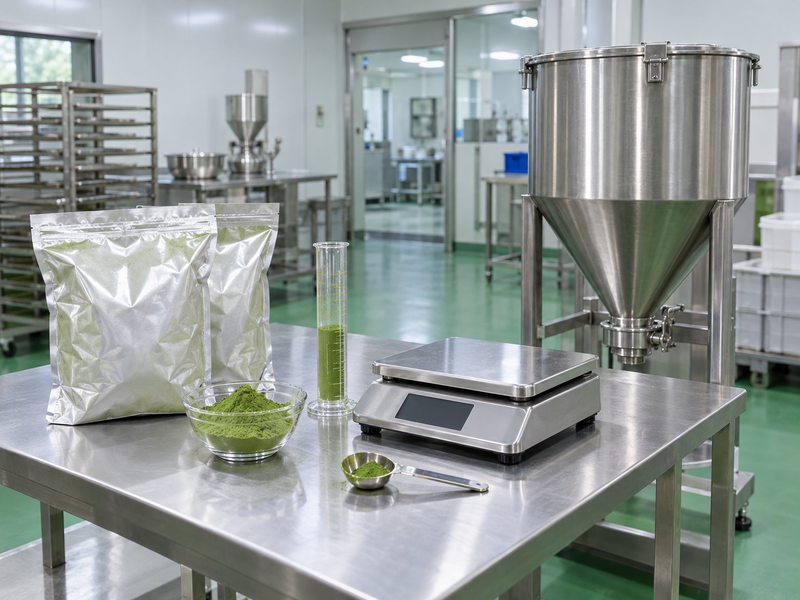
Divide powder mass by the applicable bulk density to estimate occupied volume under that measurement state. In a hypothetical example, 1,000 grams at 0.25 grams per milliliter occupy 4,000 milliliters, or four liters. These values illustrate arithmetic; they are not measured matcha properties or a recommended hopper fill.
Your matcha powder bulk density trial must also account for the hopper’s usable operating volume, transfer behavior and the equipment supplier’s limits. Keep room needed for the actual feeding arrangement in the equipment assessment. A density calculation does not address every effect of refill, settling or discharge. Record the trial conditions alongside the estimate.
Use the estimate to plan the trial. Ask production to measure actual mass loaded and remaining material at defined points. Compare the observation with the calculation and identify which powder state best matches the operation. Keep a clear distinction between an estimated geometric volume and demonstrated feeding performance.
| Hypothetical input | Value | Calculation role |
|---|---|---|
| Powder mass | 1,000 g | Required material |
| Bulk density | 0.25 g/mL | Assumed measured state |
| Occupied volume | 4,000 mL | Mass divided by density |
6. What does density mean for volumetric dosing?
Weigh the delivered dose
A fixed volume can deliver different powder masses when the bulk density changes. Test the actual dosing device rather than rely on the nominal scoop or chamber size. Record the powder preparation, fill method and measured mass. Production staff need a procedure that works at their normal pace with the intended equipment.
For matcha powder bulk density, a hypothetical ten-milliliter volume at 0.25 grams per milliliter contains 2.5 grams. The calculation assumes that density applies to the filled chamber. Compaction, leveling and refill can change the actual delivered mass. Use a suitable balance and repeated observations to determine what the device does in practice.
Measure doses through the run. Include beginning, routine operation and low-fill conditions where they apply. Record individual masses rather than only an average that hides the spread. If your team adjusts equipment settings, preserve the original and adjusted trial results so the supplier comparison remains readable.
7. How should package fill be evaluated?
Check the intended container
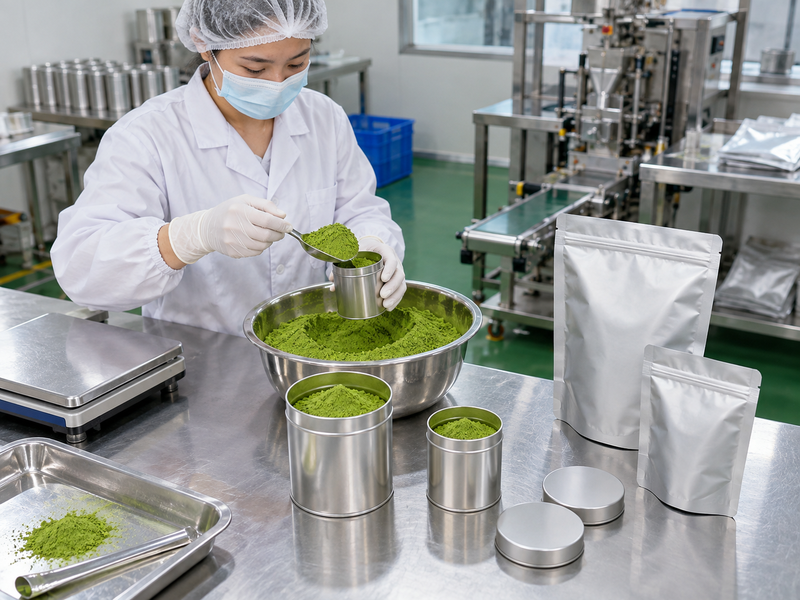
Test the ordered mass in the actual bag, tin or other package. Record occupied height or volume where useful, alongside sealing and handling observations. A package that holds the mass in one powder state may behave differently after transfer or settling. Ask packaging staff to evaluate the configuration using the intended filling process.
Matcha powder bulk density supports that trial but does not determine package performance alone. Discuss the actual package configuration with the supplier. The private label guide covers the wider packaging brief. Include opening dimensions, usable fill space and how the filling equipment introduces powder. A photograph of a filled sample cannot replace a recorded trial on the chosen container.
Check fill and seal conditions together. In an illustrative review, a buyer might find that powder leaves too little room for its normal sealing operation. Record the package dimensions, mass and filling conditions before changing the container. This describes a development question, not a reported failure or a universal package allowance.
| Package observation | Record | Decision question |
|---|---|---|
| Initial fill | Mass and occupied space | Fits filling operation? |
| After handling | Settled appearance | Acceptable presentation? |
| Seal area | Condition after filling | Suitable closing process? |
8. How do you interpret variation between repeats?
Retain individual measurements
Agree how many observations your technical team needs for the comparison and keep each result. Ask the laboratory how it reports repeatability and handles a questionable measurement. The buyer should see whether a reported average represents closely grouped readings or conceals a wide spread. Avoid assigning an acceptance range from an unrelated powder guide. For matcha powder bulk density, investigate differences in preparation, mass and volume reading before attributing every difference to the supplier’s material. Repeat measurements under the agreed method when your reviewer identifies a procedural question. Preserve the earlier result and the reason for repeating it rather than replace an unfavorable number without explanation.
Read the range with the method. A hypothetical comparison may show two lots with similar averages but different repeat spreads. That finding calls for a review of sampling and procedure, then an application decision. It does not establish which lot will dose better until the actual equipment trial provides relevant evidence.
9. What should go into the purchasing specification?

Write a method-linked requirement
State the agreed density description, method, units and reporting fields. Add an acceptance range only when your application and technical review support it. Identify whether the requirement concerns loose density, tapped density or both. Ask how the supplier will notify changes in the analytical method or powder preparation affecting comparability.
Matcha powder bulk density belongs beside the product identity and intended handling conditions. A specification cannot be transferred unchanged between a manual dosing operation and an automated filling line without review. Keep the application trial reference so later staff can understand how the purchasing requirement was selected.
Request evidence for the ordered configuration. Ask Matcha Village about bulk ingredients and packaging support. Ask for the available density method and representative sample for your product. Do not infer a density range from its grade name, milling claim or a general company capability statement.
| Specification field | Suggested content | Evidence source |
|---|---|---|
| Density state | Loose or tapped | Agreed method |
| Reporting units | Defined units | Laboratory report |
| Acceptance basis | Application-supported range | Buyer trial and review |
10. How do you turn the results into a supplier decision?
Compare the operation you intend to run
Put matched laboratory results beside the hopper, dosing and package observations that matter to your application. Identify where the candidate powder meets your requirements and where it needs an equipment or package change. Keep sensory and analytical requirements separate so density does not become a proxy for every aspect of matcha quality.
Your matcha powder bulk density decision should state the product, lot, method and trial configuration. A buyer may accept one powder for a particular line while another arrangement requires more work. Record that boundary rather than describe the material as universally suitable. Preserve settings and handling instructions used in the successful trial.
Release a defined product and process. Give purchasing the approved product code and method-linked specification. Give production the relevant setup record. Ask the supplier for the agreed update route when product or method changes. That combination makes the result usable when a new lot reaches the operation.
FAQ
Q1: What is matcha powder bulk density?
It is measured powder mass divided by its occupied bulk volume under a defined preparation method.
Q2: Are loose and tapped density interchangeable?
They describe different powder states. Record the applicable method and label each result separately.
Q3: Can density predict scoop mass exactly?
It supports an estimate. Weigh actual doses because filling, leveling and compaction affect the delivered mass.
Q4: Should buyers require one universal density range?
Set requirements from the intended equipment, package and supporting trials rather than an unsupported matcha benchmark.
Q5: What should a supplier report include?
Request lot identity, density state, preparation, method, units and individual or summarized repeat results as agreed.
Send the supplier your hopper, dosing and package questions with an agreed density method. Request a representative sample and report fields before comparing results. Run the relevant equipment trial, then retain its settings and the method-linked purchasing requirement beside the approved product code for future orders.