
Matcha peanut butter combines powdered green tea with a nut spread or uses the pairing in a filled snack. Peanut richness can soften tea bitterness, but it can also hide a weak matcha. The spread may separate, green color may shift, and the peanut allergen has to be handled throughout production. Cooking Therapy’s matcha peanut butter cups show one consumer application. A food brand should decide whether it is developing a jarred spread, a cup filling or a bakery inclusion before setting a formula.
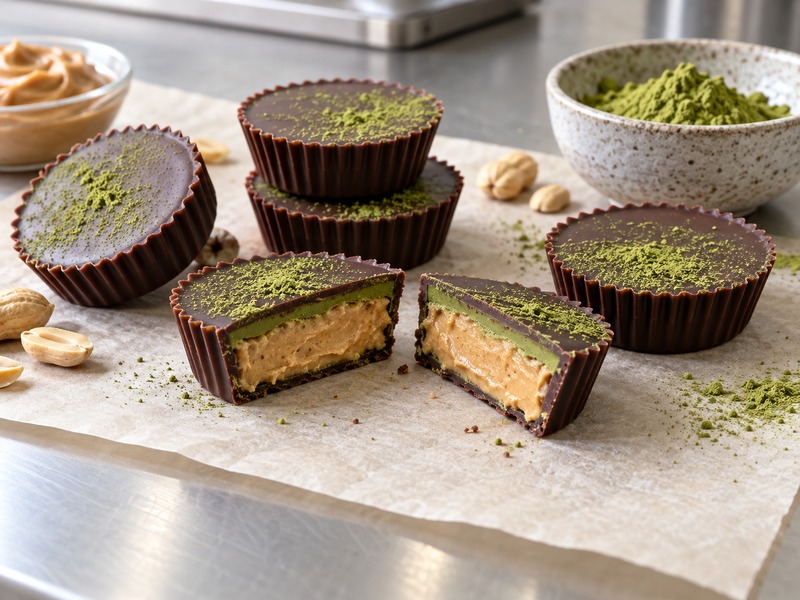
For: snack developers, confectionery makers, bakeries and ingredient buyers. Decision: how to keep tea flavor clear and texture stable in a peanut-rich product.
1. What form should the product take?
Define the consumer use
A spoonable jar spread needs easy stirring and a clean eating texture. A chocolate cup filling needs to hold its shape, resist oil migration and remain centered through depositing. A cookie filling must tolerate a different heat and moisture route. Write the intended format, serving size, package, sale channel and storage conditions. The word “peanut butter” can also carry composition or labeling implications in some markets; verify the final product name with the label team.
Start with a flavor description. The product should taste like peanut and tea, with neither reduced to a label decoration. Decide whether matcha arrives first or after the nut flavor, and whether sweetness is intended to be modest or confection-like. Taste the finished unit, not just a spoon of filling. Chocolate shells, bakery dough and toppings change the balance. A small reference batch and a few plain-language sensory notes will keep later trials focused.
| Product form | Main performance target | First stress test |
|---|---|---|
| Jar spread | Spoonable, uniform | Standing and re-stirring |
| Cup filling | Stable center | Deposit and storage |
| Bakery inclusion | Flavor after heat | Bake and cut check |
2. Which peanut base gives matcha room to show?
Compare nut intensity and texture
Peanut butters differ in roast, particle size, sweetness, salt and added fats. A deeply roasted base can overpower delicate tea; a lightly roasted base may leave more room for matcha but lack the peanut character customers expect. Compare two candidate bases with the same measured matcha dose. Taste at the intended serving temperature. A filling that feels smooth when warm can become stiff or gritty after refrigeration, while a jar spread can loosen at room temperature.
Record the actual base. Do not develop with one retail peanut butter and switch suppliers at scale without a new trial. Ask for ingredient and allergen information, specification, pack size and lot change procedures. If a “natural” base separates by design, decide whether the finished product permits stirring. A chocolate cup cannot rely on the customer to re-mix its filling. The base choice is a process decision as well as a flavor decision.
3. How should matcha be selected?
Judge it in the peanut matrix
Matcha screened in water may rank differently in peanut fat and sugar. Request identified, food-grade samples and make equal-dose trials in the selected peanut base. Compare tea clarity, bitterness, green color and visible specks after the product has rested. For a filled cup, taste the complete cup. A green center that cannot be identified as tea beside the shell is not delivering the intended ingredient experience.
Ask for repeatability. A purchasing file should include lot identity, product description, storage guidance, package size and required food-safety documents. Keep a retained sample of the approved powder and one finished-product standard. When a new tea lot arrives, compare it at the same dose in the peanut product. Price per kilogram alone does not reveal the cost per unit at an acceptable tea flavor.
| Matcha sample check | Record | Buying implication |
|---|---|---|
| Flavor in filling | Tea and bitterness | Dose required |
| Color after hold | Fixed-light photo | Pack presentation |
| Mixing behavior | Specks or grit | Process time |
| Lot documents | Specification and traceability | Continuity |
4. How can tea powder be mixed without clumps?
Use a measured dry route
Matcha is a fine powder, but it can compact in storage. If a trial shows dry pockets, sift it or preblend it with a small amount of the peanut base before mixing into the full batch. Avoid adding a water slurry to a low-moisture spread without a separate safety and stability review. Water can change the filling’s texture and shelf behavior. Record the order of addition, mixer, speed and time. Overmixing can warm the nut fat and change the deposited texture.
Sample the vessel. Take portions from top, middle and bottom and compare early and late deposits. Cut a finished cup to inspect the center. Dark green spots or uneven flavor suggest a distribution problem. If the spread looks uniform but tastes gritty, compare tea particle behavior and peanut grind before adding more mixing time. A smooth visual is helpful, but the customer’s mouthfeel is the release criterion.
5. How much tea belongs in the formula?
Build a dose ladder by mass
Define matcha as grams per kilogram of finished filling or spread. Trial several levels while keeping the peanut base, salt, sugar and process constant. Taste blind after the product has reached its normal serving temperature and again after storage. The minimum useful dose is the one at which tea is clearly present in the complete snack, not merely visible in the bowl. The maximum is limited by bitterness, dryness, color and cost. A chocolate shell may require a different dose from a jar spread.
Keep the denominator clear. If a cup filling is only one third of the sale unit, a percentage based on filling mass is not the same as a percentage of total cup mass. Record both. This protects comparisons between recipes and helps the buyer forecast tea demand. If the team lowers sugar, retaste tea: bitterness may appear more strongly even though the powder dose has not changed.
| Trial result | Interpretation to test | Possible next step |
|---|---|---|
| Green but no tea taste | Peanut or shell masks tea | Change base or dose |
| Bitter finish | Dose or powder mismatch | Compare another lot |
| Dry texture | High solids load | Rebalance fat and solids |
6. What controls oil separation and texture?
Observe a real holding period
Peanut oil can separate over time. Matcha adds solids but does not automatically stabilize the spread. Prepare samples in the intended container and hold them under likely conditions. Inspect oil on the surface, the ease of re-stirring, spoon texture and flavor through the jar. For a cup filling, check oil movement into the shell and any pale bloom on the outside. A fresh cup may be attractive while a stored cup becomes greasy or develops a void.
Change one variable at a time. Base grind, added fat, sugar, processing temperature and matcha load can all affect texture. If separation appears, compare the unflavored peanut base alongside the matcha version; that reveals whether the problem predates the tea. If an emulsifier or stabilizer is considered, treat it as a new formulation and label decision. Do not disguise a structural defect with a thicker chocolate shell without testing the full eating quality.
7. How should allergen and cross-contact controls be planned?
Design the line for peanuts
Peanuts are a major allergen in many markets. A maker handling peanut butter must apply its established allergen program, including supplier documentation, segregated storage, cleaning, line scheduling and accurate labeling. The matcha supplier’s controls matter too: assess the documents required by the buying program. If other nuts, dairy or soy appear in the shell or toppings, review the finished ingredient statement and cross-contact risk as a whole.
Keep the marketing precise. A green center may look like a wellness product, but it remains a peanut-containing confection or spread. Avoid health claims inferred from the matcha ingredient. If a “natural,” “organic” or origin claim is planned, collect the required evidence for all relevant ingredients and the selling market. A clean label statement is more durable than copy built around unsupported benefits.
| Control point | Owner | Evidence to keep |
|---|---|---|
| Peanut supplier | Purchasing | Specification and allergen file |
| Production line | Quality | Cleaning validation record |
| Finished label | Regulatory | Approved ingredient statement |
| New tea lot | Receiving | Lot identity and acceptance |
8. Which package and shelf tests fit the format?
Test the final assembly
A jar, wrapped cup and bakery pack expose different risks. A jar may show oil separation through clear walls. A chocolate cup may develop bloom or shell cracks. A cookie can soften as fat migrates from the filling. Pack pilot units in the intended material and assess them at planned intervals for appearance, flavor, texture, seal and allergen label accuracy. Use appropriate product-specific food-safety work to set the sale period; a home recipe’s storage note is not a commercial shelf-life study.
Test transport. Shake and handle packs in a realistic route, then inspect leakage, crushed cups, smear on the wrapper and distribution of filling. Compare units from early and late production. If the product is sold chilled, include the ordinary handoff interval. If it is ambient, include the temperature variation expected in distribution. A packaging choice is validated by the condition of the opened product.
9. How should cost and supplier continuity be judged?
Calculate the sellable unit
Include peanuts, matcha, chocolate or pastry, sweetener, packaging, process loss and labor. Weigh rejected cups and residual filling left in the depositor. A cheaper tea powder can require a larger dose to survive peanut flavor. Compare suppliers at the flavor target, not equal powder weight. A low-cost peanut base that separates may create more rework than it saves.
Plan for two changing ingredients. Both nut roast and tea lot can shift the flavor. Agree with suppliers on specifications, lead times, minimum order, pack sizes and change notification. Keep approved reference samples, then run a small confirmation batch when either core ingredient changes. If one ingredient cannot be sourced reliably, resolve that before committing to printed retail packaging.
| Cost line | Pilot measurement | Decision |
|---|---|---|
| Tea | Grams per sale unit | Compare powders at equal flavor |
| Nut base | Usable yield per pack | Account for separation loss |
| Filling | Material left in equipment | Set true batch yield |
| Wrapper | Damaged units after handling | Choose pack structure |
This calculation should use sellable units, not theoretical output from a perfectly scraped mixer. It gives purchasing a defensible basis for negotiating volume and gives development a clear reason to retest when a core ingredient changes.
10. What pilot shows the product is ready?
Make the complete sale format
Run the intended mixer, depositor or bakery process at a meaningful pilot size. Measure fill weight, tea distribution, texture and waste across the run. Pack the units as sold, then taste and inspect them after the planned holding and handling route. Ask tasters to name what they perceive without seeing the concept name. If they report only peanut and chocolate, the matcha has not earned its label prominence.
Set release checks. Approve the ingredient identities and doses, mixing order, acceptable appearance, texture, allergen controls and pack. Define a response when a tea or peanut lot differs from the reference. The useful next step is a complete packed pilot with the final shell or bakery base, not another spoon tasting of green filling. That is where the product’s real tradeoffs become visible.
Reference: Matcha Peanut Butter Cups is a consumer format example. The product-development checks above are independent.
FAQ
Q1: Does matcha peanut butter need added water? A low-moisture spread can be trialed with dry matcha; water additions require separate texture and safety evaluation.
Q2: Can any peanut butter be used? No. Roast, sugar, grind and fat balance affect tea flavor and product stability.
Q3: Why does a cup filling look oily after storage? Check the base and fat migration through the final shell and pack before changing matcha dose.
Q4: How should the tea dose be stated? Record grams per kilogram of filling and, for filled snacks, grams per finished sale unit.
Q5: Is a green peanut snack a health product? The color or presence of matcha does not establish a health benefit; claims need applicable evidence and review.