
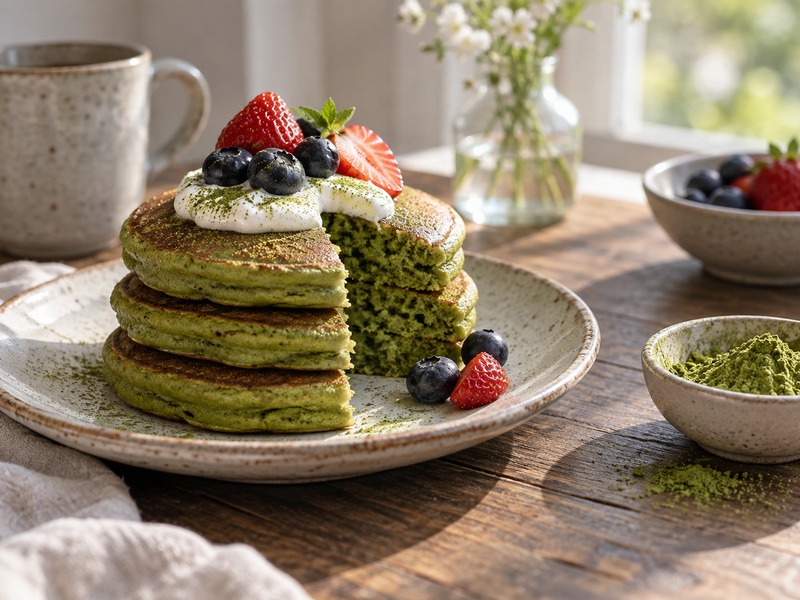
Matcha pancakes add powdered green tea to a familiar breakfast batter. The result should still be tender and fluffy, with a tea note that survives the griddle and toppings. A bright green batter can bake into dull, bitter or uneven pancakes if the powder, heat and batch hold are not controlled. Sula and Spice’s home recipe uses matcha and vanilla in an almond-milk pancake. A café or packaged-mix brand needs to test its own batter, equipment and service window before turning the concept into a menu item.
This guide is for breakfast operators, bakery developers and ingredient buyers. Formulation choices below are pilot questions, not validated commercial specifications.
1. What should a matcha pancake deliver?
Set a breakfast target, not a color target
A good pancake needs a tender crumb, even rise and a clean bite. Matcha adds tea flavor and green color, but neither compensates for a gummy center or dry edge. Define the product as a tea-forward pancake or a lightly flavored version for toppings. Write down portion size, stack height, internal texture and the intended color after cooking. Taste plain pancakes before syrup or cream. A topping can hide a bitter batter during development, then expose it when a customer orders a simpler plate.
Check the plated wait. Pancakes leave the griddle and may sit while other breakfast items finish. Taste immediately and after the expected pass or takeaway delay. A moist pancake can become leathery as steam escapes; a very soft one may collapse under syrup. Photograph an accepted stack in the actual dining light. The green should look like cooked food, not an artificial neon promise that the griddle cannot deliver without additional color.
| Product trait | Target to define | Failure |
|---|---|---|
| Rise | Even, tender crumb | Flat or gummy center |
| Tea flavor | Recognizable after cooking | Bitter or absent |
| Color | Consistent cooked green | Brown patches or pale interior |
2. Which matcha works in a hot batter?
Select after the griddle, not from the bag
Heat, flour, sugar and vanilla change what matcha contributes. Compare powders at the same mass in the complete batter and cook them under the same griddle conditions. A powder that tastes delicate in water may disappear in pancakes. Another can become harsh at the dose needed for visible color. Ask suppliers for lot-linked specifications, relevant safety records and samples from likely production supply. A grade label alone does not tell a buyer how the tea will perform after cooking.
Separate color and flavor decisions. If the team raises matcha just to make the pancakes greener, it may also raise bitterness and cost. Check whether griddle temperature or excessive holding is responsible for dull color before changing powder. Keep a cooked reference pancake or controlled photo, plus a written sensory description. Incoming lots should be trialed in the approved batter. Staff should not add extra matcha by eye whenever a new bag looks a little lighter.
| Powder test | Observe | Buying implication |
|---|---|---|
| Dry blend | Clumps and flow | Mixing efficiency |
| Cooked pancake | Tea and color | Accepted dose |
| Held pancake | Bitter change | Service suitability |
3. How should matcha enter the batter?
Prevent green streaks and dry pockets
Matcha is fine powder and can clump when wet. One route is to sift it with flour and other dry ingredients before liquid is added. Another is to premix it with a small amount of liquid, then combine with the batter. Trial the method that gives even color without overmixing. Pancake batter can become tough when mixed too aggressively, so a smooth green appearance is not the only goal. Use a consistent order of addition and record any extra liquid used in a tea slurry.
Inspect the cooked cross section. Cut pancakes from different points in a batch. Dark streaks or pockets suggest poor distribution, while a dense crumb may suggest overmixing. Check the first and last pancakes from a batter bowl; powder or solids may settle during a service period. If the product is a dry mix, evaluate distribution after transportation and repeated scooping. A formula that works only when a developer hand-sifts every single serving may not fit a high-volume breakfast line.
4. What batter balance protects tenderness?
Keep liquid, flour and leavening coordinated
Adding matcha changes the dry load, even if it is a small part of the formula. Test a baseline pancake first, then add matcha in measured steps while keeping portion and griddle method fixed. Watch batter viscosity, spread and rise. Too much liquid can create thin pancakes that brown quickly; too little can leave dry centers. Leavening should be chosen and measured for the final batter, not assumed from the plain version. Vanilla and sugar can soften matcha’s edge, but too much can make the pancake taste like a sweet cake.
Measure the pour. Use a defined batter weight or scoop volume and track finished diameter and height. A thick batter may appear premium yet create undercooked centers at the same cook time. Resting can change hydration and flow, so check the batter at opening and after a realistic service hold. If dairy-free or egg-free versions are planned, develop them as separate formulas with their own cooking tests. A simple ingredient swap can alter browning and structure.
| Batter symptom | First check | Trial response |
|---|---|---|
| Spreads too far | Liquid and rest time | Adjust one variable |
| Gummy center | Thickness and cook profile | Cut test pancakes |
| Uneven green | Matcha distribution | Review dry mixing |
| Tough bite | Mixing and flour | Reduce overwork |
5. What griddle conditions keep color and texture?
Control heat before increasing tea dose
Pancakes need enough heat to set and brown, but a very hot plate can darken the surface before the center cooks. Matcha makes that darkening more noticeable. Establish a target griddle setting and confirm the real surface temperature across the plate, because edges and center can differ. Test batter deposit size, turn point and total cook time. Do not rely on color alone: a green pancake may look done outside while remaining wet inside.
Run a tray sequence. Cook several batches as the griddle heats and as it becomes crowded. Inspect top, bottom and cross section. Record whether oil or butter changes the surface color. A nonstick pan at home and a commercial flattop can produce different results with the same batter. Provide cooks with a visual cue and a measured portion, then test whether staff can reproduce the result during breakfast volume. A cook who must adjust every pancake by intuition slows the line and raises waste.
6. Can the pancakes be held or reheated?
Test the service window honestly
Some restaurants cook to order; others need a short hot hold or a reheated product. These are different recipes in practice. Steam trapped in a stack can soften edges and darken the green surface. A dry hot hold can make pancakes leathery. Test the actual pass, tray, cover and time. If reheating is planned, compare griddle, oven and other permitted methods for texture and color. The quality team should validate safe holding and handling for the final product under local rules.
Inspect the plate customers receive. Add the intended syrup or fruit after the same wait a guest will experience. A pancake that is fine plain may collapse under topping after a hold. Record accepted texture and a clear reject example. If a frozen packaged version is intended, it needs its own freezing, reheat and shelf-life work. Do not treat a fresh café batter trial as evidence for a frozen retail product.
7. Which toppings support the tea flavor?
Avoid burying the matcha
Maple syrup, berries, whipped cream and white chocolate each pull the product in a different direction. A small amount of syrup can round the tea; a heavy pour can make matcha seem like a colorant. Test toppings with an approved plain pancake and taste the complete plate. Fruit acidity may brighten a rich stack but bleed into a held pancake. Decide whether topping is included in the menu price or offered separately, because portion variance affects both flavor and cost.
Write the plate standard. Specify number of pancakes, topping mass and placement. A photograph helps, but a scale check during development is more reliable than visual estimation. Consider allergen and ingredient declarations for any cream, nut or chocolate component. A simple tea-forward stack can be distinctive without multiple decorative extras. If the toppings require delicate assembly during a breakfast rush, a faster presentation may offer a better customer experience.
| Topping | Benefit | Risk |
|---|---|---|
| Maple syrup | Familiar sweetness | Masks tea at high dose |
| Berries | Bright contrast | Moisture migration |
| Cream | Softens bitterness | Extra cold handling |
| Matcha dust | Strong visual cue | Bitter first bite and mess |
8. What should buyers request from suppliers?
Keep the batter and tea traceable
Request matcha specifications, lot-linked analysis and traceability data required by the buyer’s program. Flour, leavening, milk and egg suppliers need relevant ingredient, allergen and functional specifications. If a premix partner makes the batter base, ask how matcha is distributed and how uniformity is tested. A powder that changes particle behavior can leave green specks even when its taste is within the supplier’s broad range.
Test lot changes on the griddle. Compare incoming matcha with the approved lot in finished pancakes cooked under fixed conditions. Keep an accepted cooked-color reference. If the pancake rises differently, inspect the batter and leavening before blaming tea. A clear change-control process should state which ingredient substitutions need a bench test and which require a full service run. Buying on a price sheet alone cannot show how many pancakes will be rejected at breakfast.
| Input | Evidence | Finished-product check |
|---|---|---|
| Matcha | Lot and sensory records | Cooked tea flavor and color |
| Flour and leavening | Functional specification | Rise and crumb |
| Milk and egg | Ingredients and allergens | Texture and label |
| Packaging | Contact and hold data | Takeaway quality |
9. How should cost per plate be calculated?
Count griddle loss and toppings
Calculate the approved batter grams per pancake, matcha dose, cooking yield and topping portions. Add labor, utilities, takeaway packaging and pancakes rejected for undercooked centers or dark surfaces. A lower-cost powder may require more grams to remain noticeable after cooking. A very thick premium plate may use more batter and longer griddle time. Compare cost per accepted serving, not just ingredient cost per mixing bowl.
Model a busy shift. A pancake that looks easy in a test kitchen can occupy griddle space needed for standard menu items. Measure cycle time and the number of plates staff can produce while maintaining the tea standard. If the item is seasonal, plan a modest initial tea order and track repeat demand. The price should reflect a breakfast plate customers enjoy, not a green novelty that photographs well once and disappoints on return.
10. What should a launch pilot prove?
Test from mixing bowl to finished plate
Shortlist matcha powders in a fixed batter, then cook on the actual griddle. Have several staff members portion, flip and plate consecutive orders. Measure diameter, cook time, internal doneness, tea flavor, color, held texture and topping performance. Use a second tea lot if repeat supply matters. Trial the intended takeaway pack separately. Record defects and their likely causes instead of changing powder, batter and heat together.
Release a kitchen card. State ingredient masses, dry-mix method, batter hold, portion, griddle setting, turn cue, plate standard and supplier records. Include an accepted and rejected pancake photograph. The first order should support a limited breakfast run with normal staff and a real service queue. Wider rollout follows a pancake that remains tender and recognizably matcha when it reaches a guest’s fork.
Reference
Sula and Spice, “Matcha Pancakes” is a consumer recipe using matcha and vanilla in an almond-milk batter. The commercial controls above are proposed kitchen tests.
FAQ
Q1: Why do matcha pancakes turn brown?
Check griddle heat, cooking time and powder performance before adding more tea.
Q2: Can a café make batter in advance?
Only after testing leavening, color, texture and safe handling over the planned hold.
Q3: How much matcha should be added?
Find the dose through cooked-pancake tasting at a fixed batter and griddle profile.
Q4: Can these be made dairy-free?
Yes, but test the complete alternative formula and review ingredients and service claims.
Q5: What should be checked after a new tea lot?
Cooked color, flavor, batter flow and accepted-plate yield.