
Matcha packaging barrier film is the material between a powder’s color and aroma and the oxygen, moisture, and light it meets during distribution. A B2B buyer may receive three attractive pouch quotes with no comparable test conditions, seal data, or filled-pack evidence. Request a material specification for each candidate, compare transmission measurements under the same conditions, and run a controlled fill and storage trial before approval. The matcha packaging reference describes pack formats and flushing. This guide concentrates on the film decision. ASTM F1249 and ASTM F1927 describe methods for water-vapor and oxygen transmission testing; their values must be interpreted with stated conditions and the actual finished package.
Contents
- What must matcha packaging barrier film protect?
- Which film constructions should buyers compare?
- How should oxygen transmission data be read?
- How should moisture transmission data be read?
- What light protection does the pack need?
- Will the film seal on the intended line?
- Which supplier documents belong in approval?
- How should a filled-pack trial be designed?
- What trade-offs affect cost and recyclability?
- What final decision record should buyers keep?
1. What must matcha packaging barrier film protect?
Translate product risk into pack checks
Green tea powder can change color, aroma, and flow under storage conditions. For the intended matcha SKU, name the attributes the pack must help preserve and how the buyer will measure them. An opaque retail tin with a sealed inner pouch faces a different light path from a clear stand-up pouch on a bright shelf. A bulk bag opened quickly by a café faces a different use period from a small unopened export pack. Define fill mass, distribution route, expected unopened period, display conditions, and post-opening instructions before asking for a barrier value.
| Exposure path | Product observation | Pack question |
|---|---|---|
| Oxygen | Aroma or color drift | Film plus seal integrity |
| Water vapor | Caking or moisture change | WVTR and closure |
| Light | Visible green change | Opacity and outer carton |
| Handling | Pinhole or seal failure | Flex and drop trial |
Start with the whole pack. Film transmission is only one path. Zippers, seals, folds, valves, and pinholes can dominate a weak finished package. The trial plan should include those features, not only a supplier’s flat-film data sheet.
2. Which film constructions should buyers compare?
Compare function rather than appearance
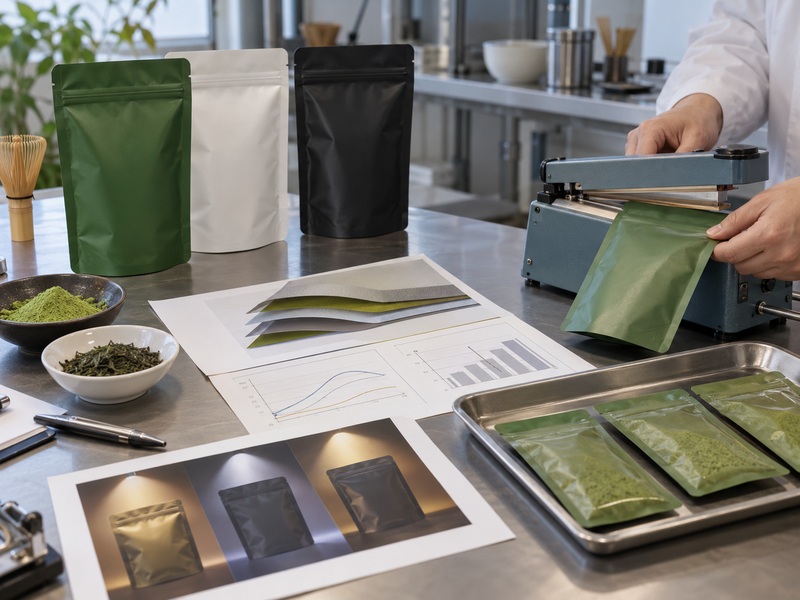
Compare exact structures. Foil laminate, metallized film, and transparent high-barrier film are three useful candidates. A foil layer can offer strong light blocking and low permeation when intact, while flex cracks and seal design still need evaluation. A metallized film has a thin deposited metal layer; its performance depends on substrate, deposition quality, and conversion. A clear coated structure can preserve a product window but exposes matcha to light unless another layer or carton controls it. Ask for a full layer structure, nominal thicknesses, contact layer, and documented test values.
| Candidate | Potential benefit | Buyer verification |
|---|---|---|
| Foil laminate | Opaque barrier layer | Flex damage and seal fit |
| Metallized film | Opaque, often lighter structure | Actual OTR/WVTR and pinholes |
| Clear high-barrier | Product visibility | Light exposure and coating damage |
Do not infer that all films within a category perform alike. A pouch converter may change adhesive, thickness, or sealant while retaining a familiar marketing name. Request the exact construction and revision number quoted for production. If a supplier offers a “sustainable” replacement, test it as a new structure. The relevant comparison uses converted pouches filled with the same matcha, on the same line, under the same storage plan.
3. How should oxygen transmission data be read?
Keep method and conditions beside the number
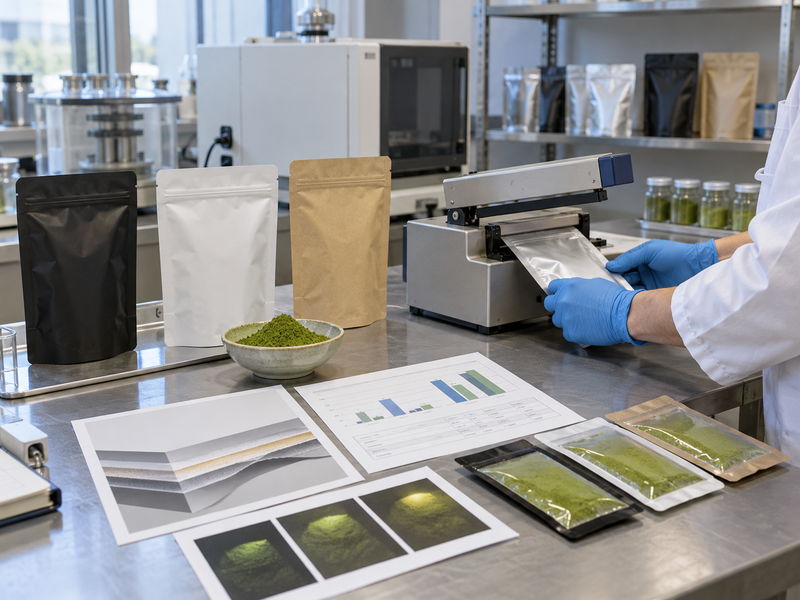
Oxygen transmission rate, often called OTR, describes oxygen passing through a defined film area over time under test conditions. Compare units, temperature, relative humidity, and test method before comparing numbers. ASTM F1927 covers oxygen transmission through barrier materials at controlled relative humidity using a coulometric detector. A dry-condition result from one supplier should not be ranked against a humid-condition result from another without further testing. Ask whether a value is a typical result, maximum specification, or one laboratory measurement.
| Data-sheet field | What to request | Why it matters |
|---|---|---|
| OTR | Value and units | Enables calculation |
| Conditions | Temperature and humidity | Enables fair comparison |
| Method | Standard and revision | Identifies procedure |
| Basis | Typical or guaranteed limit | Defines purchasing control |
Measure the right object. Flat-film OTR does not measure oxygen entering through a faulty heat seal. Ask the converter how it checks finished pouches and how converting or flexing affects the barrier. If the pack uses gas flushing, residual headspace oxygen is another separate measurement. Set acceptance criteria after a pilot with the intended fill, rather than treating one OTR threshold as a universal matcha specification.
4. How should moisture transmission data be read?
Ask what crosses the film in service
Read the test conditions. Water-vapor transmission rate, or WVTR, estimates vapor transfer through film under defined temperature and humidity differences. ASTM F1249 covers plastic films and multilayer materials, including foils and coated structures. Its scope stresses agreed sampling, standardization, test conditions, and acceptance criteria when using results between purchaser and seller. Confirm units such as grams per square meter per day and whether the reported value is a maximum. A number without conditions is not an engineering comparison.
| Trial question | Evidence | Decision |
|---|---|---|
| Does powder cake? | Appearance and sieve observation | Compare candidate packs |
| Does moisture change? | Defined lab method | Check against specification |
| Does closure leak? | Seal and package test | Investigate separately |
The pouch’s exposed surface area and pack geometry also affect the amount entering over time. A small sachet and a large bulk pouch with the same film can yield different product outcomes. For a suggested trial, weigh identical filled packs and test moisture at planned intervals under actual and challenging storage conditions. Set intervals and limits with the product quality team; this example is a study design, not a proven shelf-life claim.
5. What light protection does the pack need?
Observe the display conditions
Opaque packaging blocks a direct view of matcha but may not be required for every product concept if a carton or secondary container provides protection. Conversely, a clear window that shows bright green powder in marketing photographs may leave part of a retail pouch exposed for weeks. Map which sides face store lighting, daylight, or warehouse conditions. Ask the converter for light-transmission information where available and examine the full printed pouch, including unprinted windows and seams. A printed outer design is not automatically a light barrier.
| Display design | Exposure question | Suggested trial comparison |
|---|---|---|
| Fully opaque pouch | Can light enter at seams? | Filled pack inspection |
| Clear window | How long is powder displayed? | Window facing light / dark control |
| Cartoned pouch | Is carton always present? | Packed / uncartoned control |
Watch the actual shelf. Use matched batches in candidate packs and compare color by a defined instrument method or trained sensory panel after specified exposure. Document illuminance, duration, and temperature if possible. Any accelerated light trial is a screening exercise until its relationship to normal distribution is shown. Do not convert a short demonstration into a promised retail life.

6. Will the film seal on the intended line?
Verify a stable process window
Run the real line. A strong barrier layer does little if powder contaminates a seal or the line cannot produce consistent closure. Ask for the intended sealant material, seal-temperature range, dwell time, pressure conditions, and recommended machine setup. These are supplier starting points; the packer must qualify settings on the actual equipment. Run empty and filled pouches at the intended speed. Inspect wrinkles, channels, burn-through, weak corners, zipper interfaces, and coding legibility. Challenge the process at startup, normal run, and after a stop.
| Seal check | Record | Failure signal |
|---|---|---|
| Visual | Every trial sample group | Powder or channel in seal |
| Strength | Defined test method | Low or variable force |
| Leak | Agreed package test | Air or dye path |
| Runability | Speed and reject count | Frequent jams |
Relevant ASTM packaging standards include methods for barrier and package testing; choose a method appropriate to the pouch and its intended use. Keep a signed sample from the approved run for comparison when commercial film arrives. A change in roll supplier or sealant layer should trigger review, even if the outer pouch looks identical.
7. Which supplier documents belong in approval?
Freeze a controlled specification
Freeze the revision. Request a material specification with layer structure, total and layer thickness, roll width, core size, print version, food-contact declarations for target markets, OTR and WVTR limits with conditions, and sealant description. Obtain a certificate or test report for the quoted construction, then confirm how the supplier controls changes. A broad “food grade” claim does not identify a jurisdiction, intended use, or test basis. Regulatory review belongs with the buyer’s qualified team and the exact material and market.
| Document | Revision field | Who checks it? |
|---|---|---|
| Film specification | Material code | Packaging engineer |
| Barrier test report | Method and date | Quality |
| Contact declaration | Market and use | Regulatory lead |
| Print proof | Artwork version | Brand and quality |
| Change notice terms | Notice period | Procurement |
The FDA’s food-contact packaging resources explain that food-contact status depends on substance and intended use. Other markets have separate rules. Ask the converter to identify the contact side and all relevant layers. Keep the material revision tied to purchase orders, so a later complaint can identify which film was used.
8. How should a filled-pack trial be designed?
Hold product and conditions constant
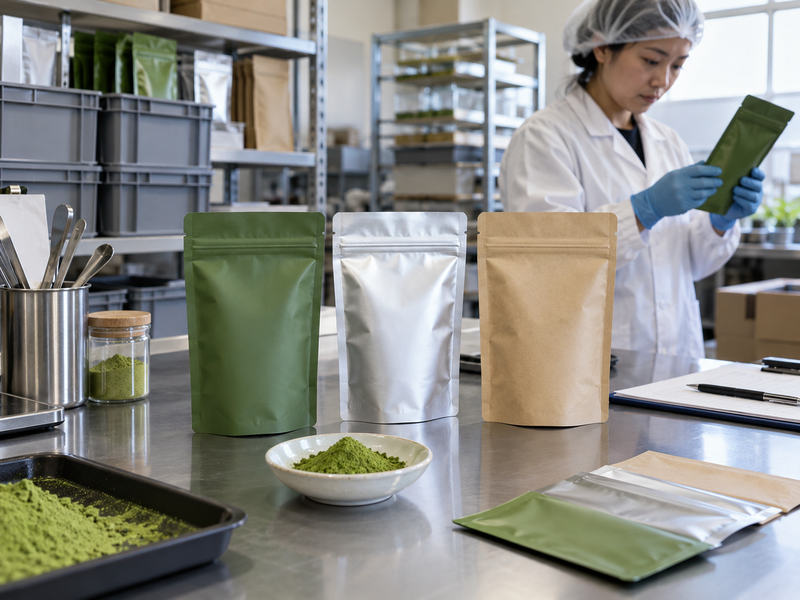
Control the comparison. Pack one homogeneous matcha lot into each candidate structure on the intended equipment. Match fill weight, headspace process, closure, carton, and storage exposure except for the variable being tested. Record film roll ID and production settings. Place enough packs at each test point for the planned methods and reserve unopened replicates. Include a current commercial pack as a control if available. Check seal integrity at filling and during storage, because a failure can make barrier rankings meaningless.
| Trial element | Example decision | Record |
|---|---|---|
| Product | One lot per comparison | COA and lot ID |
| Packs | Candidate A, B, C, control | Roll and pack IDs |
| Storage | Actual route plus challenge | Conditions log |
| Endpoints | Color, aroma, moisture, seal | Method and limits |
These are suggested design elements. Test intervals and pass limits should come from the product’s own quality specification and intended life. Evaluate both unopened packs and intended post-opening use separately. A film with the lowest OTR may lose its advantage if it forms poor seals on a high-speed line. The winner must work as a finished pack, not merely as a specimen in a barrier instrument.
9. What trade-offs affect cost and recyclability?
Calculate cost per usable pack
Compare quoted film price with conversion waste, filling rejects, packaging line speed, case dimensions, transport damage, and stock write-offs. A cheaper roll that creates frequent seal failures may cost more per acceptable pouch. Ask the converter for material yield and minimum order quantity, then put them beside the buyer’s forecast. Keep any environmental claim specific to the exact structure and collection system in each market. A mono-material description alone does not establish local recyclability or actual recovery.
| Cost element | Data source | Buyer calculation |
|---|---|---|
| Film purchase | Quotation | Cost per pouch |
| Line waste | Trial run | Cost per good pouch |
| Rejected seals | Quality record | Rework or scrap |
| Damage | Distribution test | Expected loss |
Use a realistic denominator. Calculate total packaging cost divided by accepted filled packs, then compare candidates at the same order volume. If a clear pack improves display value, measure that commercial benefit separately from barrier performance. Do not assign a longer shelf life as an assumed saving before a finished-pack study supports it.
10. What final decision record should buyers keep?
Approve a structure for a defined use
Approve a defined use. Summarize the application, product lot, candidate film codes, test conditions, barrier data, seal results, storage observations, food-contact review, and commercial cost. Record the chosen revision and any open limitation. A pouch approved for an opaque carton may need fresh review if marketing removes the carton or adds a clear window. Require notification before film structure, contact layer, converter, or print process changes. Store approved rolls and finished-pack references with the purchasing specification.
For Matcha Village or any matcha supplier, ask for the exact powder grade, pack size, destination, and intended distribution period before discussing material. The immediate next step is a side-by-side fill trial with comparable OTR and WVTR reports. Use the result to write a purchase specification that both film converter and packer can reproduce. A single attractive mockup cannot answer whether the powder, film, and sealing line will work together during real distribution.
After choosing a barrier film, apply the finished-pack checks in the packaging seal integrity guide.
FAQ
Q1: Is foil always the best matcha packaging barrier film? No; compare intact finished packs, sealing, cost, and the intended route.
Q2: Can OTR values from different data sheets be ranked directly? Only after checking units, method, temperature, humidity, and whether each value is typical or guaranteed.
Q3: Does nitrogen flushing replace barrier film? No. Headspace control and ongoing package permeation are separate checks.
Q4: Is a transparent pouch unsuitable for matcha? It needs a documented light-exposure assessment for the intended display and product life.
Q5: What should trigger reapproval? Any material, sealant, converter, closure, or distribution change that could alter performance.