
A pack can look premium and still leave a buyer unsure whether it has been opened. For matcha, the first-open feature must work with the moisture barrier, filling line, customer opening experience, and receiving inspection. Matcha tamper evident packaging gives a visible sign that a specified closure has been disturbed; it is not proof that no one could ever alter a product. This guide compares pouches, tins, and jars through observable tests rather than appearance alone. The matcha packaging overview raises useful format considerations; the buyer should confirm each claim with its own pack supplier and product requirements.
Contents
- What should tamper evidence show on a matcha pack?
- Which first-open features suit a pouch?
- What works on tins and composite cans?
- How should a jar closure be tested?
- Can tamper evidence coexist with a moisture barrier?
- What should the factory prove in a line trial?
- How should receiving staff inspect packs?
- What should artwork tell the customer?
- How do you compare cost and failure risk?
- What belongs in the approved pack specification?
1. What should tamper evidence show on a matcha pack?
Define the first-open signal
Write down what an unopened unit looks like and what changes on first opening. The feature might be a pouch top seal that must be cut, an induction liner under a jar cap, or a band that breaks when a lid turns. The sign should be easy for normal receiving or retail staff to see without special equipment. A decorative sticker that peels off cleanly and can be replaced may be a weak first-open signal. Ask the packaging supplier to show both intact and opened samples and explain how its closure behaves after transport and routine handling.
| Format | Possible first-open signal | Inspection question |
|---|---|---|
| Pouch | Intact top seal above zipper | Is the seal continuous? |
| Tin | Sealed membrane or breakable band | Is the lid area undisturbed? |
| Jar | Liner or breakaway ring | Does removal leave visible evidence? |
The FDA’s consumer advice on food tampering tells shoppers to examine packaging and seals for signs of disturbance. That advice supports making the feature inspectable; it does not mean a particular matcha pack is legally required to use one design. Check applicable destination-market rules separately.
2. Which first-open features suit a pouch?
Keep the security signal outside the reseal function
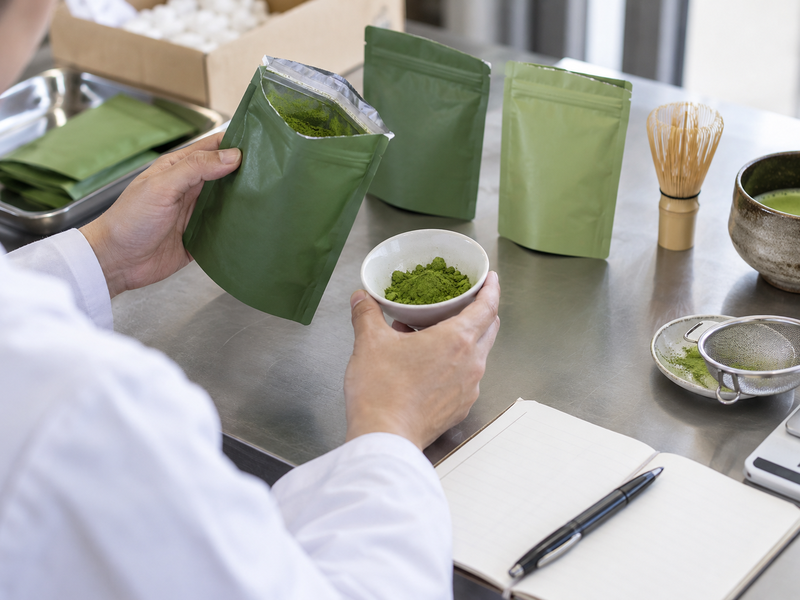
A common pouch design places a permanent top heat seal above a zipper. The customer cuts the top edge to reach the zipper, so the untouched top seal provides a first-open signal and the zipper supports later use. Check the distance between tear notch, seal, and zipper. If the notch starts below the seal, the first opening could bypass the intended feature; if it is too close to the zipper, opening can damage the reseal. Other designs use a perforated strip or a sealed spout, but they need the same visible first-open check.
| Pouch check | Trial observation | Failure to watch |
|---|---|---|
| Top seal continuity | Inspect both faces | Channel or powder in seal |
| Tear path | Open with ordinary scissors or hand | Zipper damage |
| First-open visibility | Compare intact/opened | Cut edge hard to notice |
| Zipper use | Open and reclose repeatedly | Misalignment |
Run the pouch with real matcha powder. Fine particles can reach the seal area during filling, so a flat empty-bag sample does not settle seal feasibility. The pack supplier and filler should agree on seal inspection criteria and line controls. The first-open feature should remain visible after case packing and shipping, not only on a pristine showroom sample.
3. What works on tins and composite cans?
Test the complete lid system
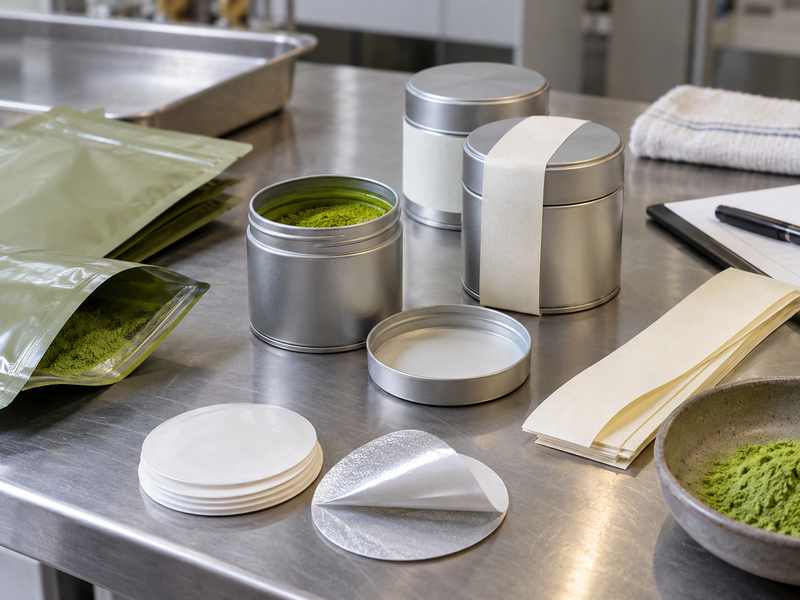
A tin may use an inner membrane, foil seal, shrink band, or another closure with visible first-open evidence. A friction-fit lid alone may be convenient but can often be removed and replaced without a clear sign. Assess the whole structure: body, rim, liner, lid, and any outer band. If an inner membrane is the first-open feature, the buyer must decide whether retail staff can inspect it without opening the outer lid. A band may offer visible external evidence, but it can crack in transit or hide a poor underlying seal.
Ask how the component is applied and checked on the production line. Record the force or method needed to open a sample, but do not confuse a hard-to-open lid with security. If the feature tears unpredictably, leaves sharp edges, or drops fragments into the powder area, request a redesign or another closure. Test after realistic case packing and distribution handling because dents can alter lid fit. The site’s bulk wholesale matcha information can support format discussions, while a signed sample of the full pack defines the chosen closure.
4. How should a jar closure be tested?
Look at liner, cap, neck, and opening
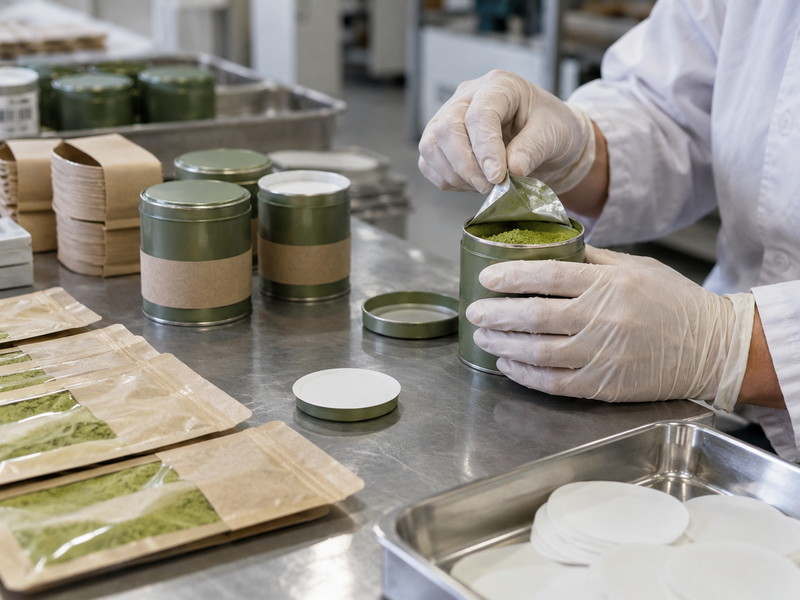
For a jar, an induction liner or breakaway ring can provide visible opening evidence when selected and applied correctly. The liner must be compatible with the jar finish and cap; the factory must set and verify its sealing process. A band that merely slides over the cap without breaking does little for first-open inspection. Ask for samples from the beginning, middle, and end of a production run, then inspect for missing liners, partial adhesion, wrinkles, and inconsistent break behavior.
| Jar component | Buyer check | Trial record |
|---|---|---|
| Jar finish | Clean, undamaged rim | Incoming inspection |
| Liner | Continuous bond or intended peel | Seal check |
| Cap | Correct fit and closure | Setup record |
| Breakaway ring | Visible break on opening | Opened-sample photos |
The chosen test method should suit the actual closure and material. Do not state that any liner is “airtight” or “tamper proof” without validated evidence. Also check customer accessibility: a liner that requires a tool or tears into small pieces may protect the pack in one sense while creating a poor user experience. Keep an approved intact sample and opened sample for receiving training.
5. Can tamper evidence coexist with a moisture barrier?
Evaluate both functions independently
The first-open feature and the primary barrier may be the same physical seal, but they answer different questions. A broken outer band can show disturbance while an intact inner foil still protects powder. An intact band cannot prove the inner foil was sealed correctly at filling. Review the material specification, seal design, pack integrity checks, and product-specific storage requirements. A laboratory or transport test should use production-equivalent packs. Avoid assigning a shelf life from material brochures alone.
| Function | Example evidence | What it does not prove |
|---|---|---|
| First-open signal | Break, cut, or removed liner | Barrier performance |
| Barrier integrity | Approved pack test | No later disturbance |
| Reseal after opening | Functional zipper or lid | Original unopened state |
The matcha packaging overview discusses airtight packaging, but buyers need measured performance for their exact laminate or container. If a change to the band, liner, or pouch top seal alters the closure process, repeat the relevant pack tests. Keep the quality specification and first-open description linked, while judging each against its own acceptance criteria.
6. What should the factory prove in a line trial?
Use production material and normal speed
Before bulk component purchase, run enough units to expose startup variation, steady running, stops, and restarts. Use the intended matcha powder, fill weight, pack material, coding method, and case configuration. Inspect seal continuity, missing liners or bands, powder on the closure, opening behavior, and whether the feature survives ordinary handling. Record good and rejected units with the reason for each reject. The trial should also show who checks the feature and how a failed pack is removed before case packing.
| Trial point | Record | Decision |
|---|---|---|
| Startup | First accepted units | Setup approval |
| Steady run | Sample count and defects | Process consistency |
| After stop | Restart samples | Repeatability |
| Packed case | Transit-handled samples | Survival and visibility |
Ask the factory to demonstrate its inspection method, including lighting and viewing position. A feature that is obvious in a marketing photograph may be difficult to inspect at production speed. If the trial finds intermittent failures, address the cause and rerun the affected check. Do not accept a verbal assurance that operators will simply watch more closely.
7. How should receiving staff inspect packs?
Make a standard comparison sample
Give receiving staff photos or physical samples of an intact pack, a normally opened pack, and known defects. At arrival, inspect shipping damage first, then examine a defined sample of units for missing or broken first-open features. Record lot, case, sample size, findings, and photographs. If a unit looks disturbed, segregate the affected stock and use the quality process to decide the scope of hold and next action. Do not put a suspect unit back into saleable stock merely because its powder looks normal.
| Finding | Immediate action | Follow-up question |
|---|---|---|
| Missing band or liner | Hold affected units | Is it isolated or systematic? |
| Broken pouch top seal | Hold and photograph | Transport damage or line defect? |
| Crushed but intact case | Inspect risk-based sample | Did packs deform? |
| Unclear condition | Compare approved sample | Is the standard adequate? |
The FDA’s tampering advice emphasizes checking for unusual or opened packaging. A warehouse procedure should turn that general caution into consistent observations and traceable records. Train staff to escalate uncertainty rather than making an unsupported safety judgment at the dock.
8. What should artwork tell the customer?
Use a simple, truthful opening cue
If the first-open feature is not obvious, a short instruction can point customers to it: for example, to check that the top seal or band is intact before opening. The wording must match the actual pack. Avoid calling a resealable zipper a tamper seal after the top has been cut. Do not claim the package is “tamper proof”; the feature provides evidence of a particular opening action under normal observation, not an absolute guarantee. Have a qualified reviewer check any market-specific label statement.
Place the cue where it can be read before opening, without covering the barcode, lot code, or required information. Use simple drawings only if they accurately show the feature. Test the wording with someone who has not seen the design: can they identify an unopened pack and follow the opening path? If the answer is no, the issue may be the feature itself rather than the label. The site’s quality overview may help buyers frame packaging questions, but the final artwork must reflect the selected pack and approved claims.
9. How do you compare cost and failure risk?
Include inspection and loss, not only unit price
Compare candidate packs on component cost, line speed, defect rate, inspection effort, damage in distribution, customer opening experience, and the cost of rework or held stock. A low-cost sticker can be expensive if it detaches in cases. A sophisticated liner may require equipment and routine verification that the filler cannot yet support. Use trial data and a realistic order volume rather than a sales brochure estimate. Keep the barrier requirement and the desired first-open evidence as separate scored criteria.
| Decision factor | Pouch | Tin | Jar |
|---|---|---|---|
| Visible external first-open cue | Top seal | Band option | Ring option |
| Inner closure option | Seal/zipper | Membrane | Liner |
| Main trial risk | Powder at seal | Lid or band fit | Liner application |
| Receiving check | Seal continuity | Band/membrane | Ring/liner |
These are comparison prompts, not claims that one material always performs better. Ask the supplier to price the exact pack specification and trial scope. If the cheapest option fails the user’s inspection test, it is not a functional equivalent. Document why the chosen design meets the buyer’s distribution and handling conditions.

10. What belongs in the approved pack specification?
Describe what must be made and verified
The specification should identify material and dimensions, closure components, seal or application method, approved first-open appearance, defect examples, sampling or inspection method, and records retained by the factory. Include approved artwork and the location of any opening cue. Define what changes require buyer approval: film structure, liner supplier, cap, band, zipper, seal position, or filling-line settings that affect closure. Attach the signed intact and opened samples and the successful line-trial report.
At purchase and receiving, compare the delivered component to that specification. At finished-goods release, confirm the production lot has the required inspection results. When a complaint arrives, the lot record should show which components and settings were used. This gives both sides a practical way to investigate a broken seal without assuming that every damaged pack has the same cause. Select the design only after its first-open signal, barrier function, and factory process have each been demonstrated on the actual matcha format.
FAQ
Q1. Is a zipper itself tamper evident? Usually it is a reseal feature. A separate intact top seal can provide a visible first-open signal.
Q2. Does a shrink band protect the powder barrier? It can show external disturbance, but the primary barrier needs its own specification and checks.
Q3. Can an intact pack still have a closure defect? Yes. The first-open cue and seal integrity require separate inspections.
Q4. Should receiving open a suspect unit? Segregate it and follow the approved quality procedure; routine dock staff should not improvise product testing.
Q5. What is the best pack format? Choose the format that passes the buyer’s first-open, barrier, line, distribution, and inspection trials at an acceptable cost.