
Matcha mousse cake has to slice cleanly without losing its light texture. A pastry team can get the flavor right in a bowl and still find that the mousse slumps, the sponge separates, or the glaze tears on cutting. Start with a defined slice and test the cake after its intended chill and display. Good Food Middle East’s layered version uses sponge, matcha mousse and white-chocolate glaze. Matcha Village’s sample service can support tea trials for those different layers.
Contents
- 1. What should the slice show?
- 2. Which cake base supports the mousse?
- 3. How should matcha be placed across the layers?
- 4. What determines mousse set and lightness?
- 5. How can assembly avoid gaps and slumping?
- 6. Which glaze or finish will cut cleanly?
- 7. How should chilling be controlled?
- 8. What cutting and packaging method works?
- 9. What is the saleable yield and allergen profile?
- 10. When is the cake ready for the pastry case?
1. What should the slice show?
Start with the cut face
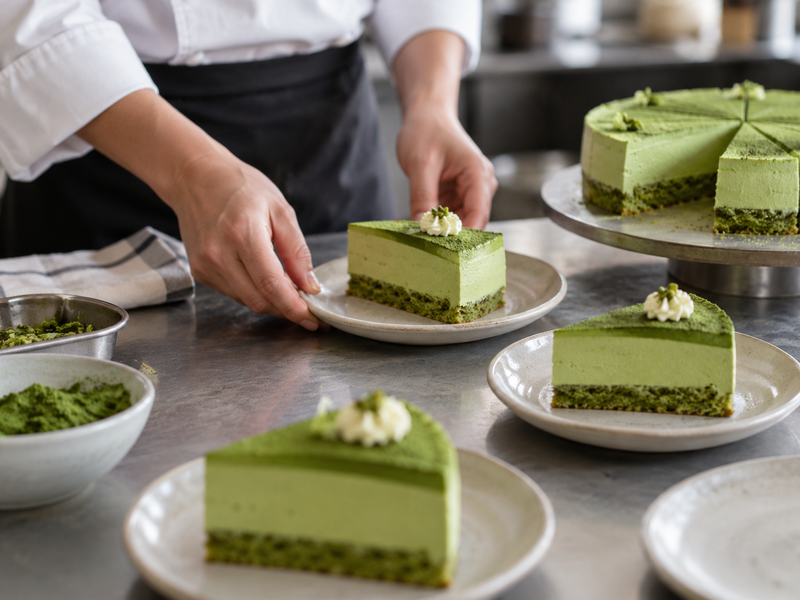
Decide the proportion of sponge, mousse and glaze that a customer should see and taste. A very thick mousse layer may look generous but slide when the slice is lifted. A thick sponge can dominate the tea and make the dessert feel like ordinary layer cake. Set a target slice weight, height, pan diameter and number of saleable portions. Photograph a cut slice after it has spent the planned time in the case, not only immediately after unmolding.
Taste from top to base in one forkful. The mousse should remain light enough to contrast with the sponge while holding its shape. Matcha should be clear despite cream and white chocolate. If the cake is sold whole for occasions, the finish must survive transport and a customer-cut slice. If sold by the slice, clean portioning and case life matter more. One formula may not suit both channels without different packaging or decoration.
2. Which cake base supports the mousse?
Check absorption and compression
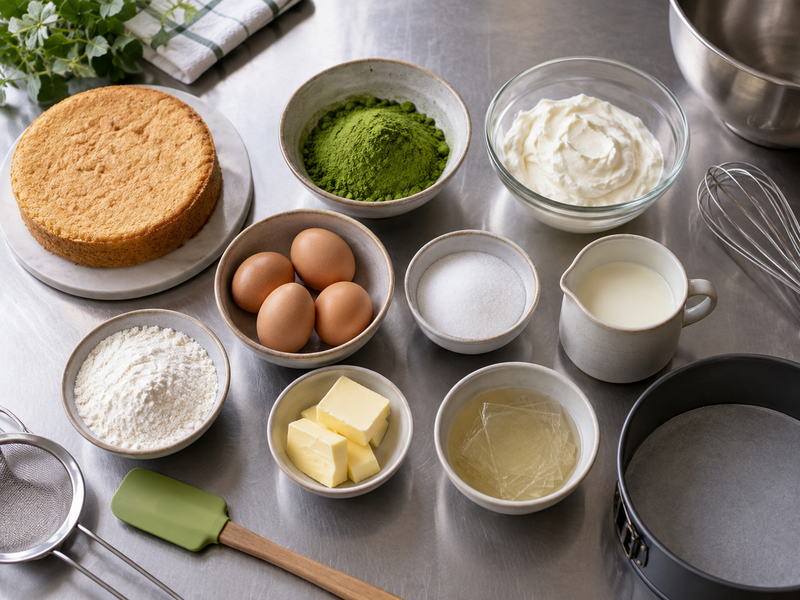
The Good Food reference uses sponge layers around the mousse. A bakery may use a similar light sponge or another dependable base, but it should run a plain control. Record batter weight, pan size, bake, cooled height and weight. A sponge that is too airy can compress under mousse; one that is too dry can feel separate from the filling. If a syrup is added, measure it rather than using it to hide a dry bake.
Cut samples from the center and edge before assembly. An uneven sponge creates an uneven mousse depth and makes slices tip. Leveling the cake creates trim that belongs in cost. Test whether the base holds together after the completed cake has chilled and been moved to the display case. A good sponge for a simple tea cake is not necessarily the best foundation for a tall mousse layer.
| Base check | Record | Why |
|---|---|---|
| Cooled height | Center and edge | Level layers |
| Crumb | Cut sample | Support and eating texture |
| Trim | Weight | True yield |
| After assembly | Compression or gaps | Structural fit |
3. How should matcha be placed across the layers?
Compare one clear note with several weak ones
Matcha can be in the mousse, sponge or glaze. The reference puts tea in the mousse and finish. Test the mousse on its own first; if it tastes weak, adding matcha everywhere may only increase cost and bitterness. A green sponge may give attractive contrast, but baking can dull color. A tea glaze gives an immediate flavor note yet may be too sweet if white chocolate dominates.
Weigh powder per layer and sift it before mixing. If a warm cream is used to disperse the matcha, check for dark clumps before it is folded into whipped cream. Taste finished slices after the planned chill, since cold temperature changes perception. Record the matcha lot and current specification; any claim about origin, grade or certification should be supported by the chosen product documentation. Compare two candidates in the complete cake rather than a bowl of water.
4. What determines mousse set and lightness?
Control the setting route
The reference recipe uses gelatin and whipped cream. The balance between setting agent, liquid and aeration determines whether the mousse holds a slice or turns rubbery. A pastry team can use that as a starting structure, but should formulate by weight for its own pan and ingredients. Bloom and dissolve the setting agent according to the chosen product’s instructions. If its solution is too warm or cold when combined, the mousse may lose volume or form strands.
Whip cream to a defined stage, then fold in the matcha base without large pale streaks. Record temperature and timing at the fold, as well as the height of mousse after it sets. Test a small sample cup beside the full cake; if both are grainy, the problem likely began before assembly. If a vegetarian setting route is desired, treat it as a separate formulation project rather than assuming a direct gelatin substitution.
Keep a measured sample of the mousse in a straight-sided cup during each full-cake trial. Mark its height immediately after filling and again after chilling. That simple comparison reveals lost volume even when the finished cake hides it between sponge layers. Cut the sample with a spoon to check whether it is uniformly set or firmer at the edge. If the mousse seems heavy, compare the cream’s whipping stage and the temperature of the matcha mixture before changing the setting agent. More gelatin can stabilize a slice while making the eating texture worse; the goal is a clean cut and a light spoonful together.
| Mousse fault | First check | Next trial |
|---|---|---|
| Slumps on cutting | Set and layer depth | Adjust formulation |
| Rubbery bite | Setting agent level | Compare lower level |
| Pale streaks | Fold method | Improve dispersion |
| Grainy texture | Temperature and incorporation | Review sequence |
5. How can assembly avoid gaps and slumping?
Use a stable ring and measured fill
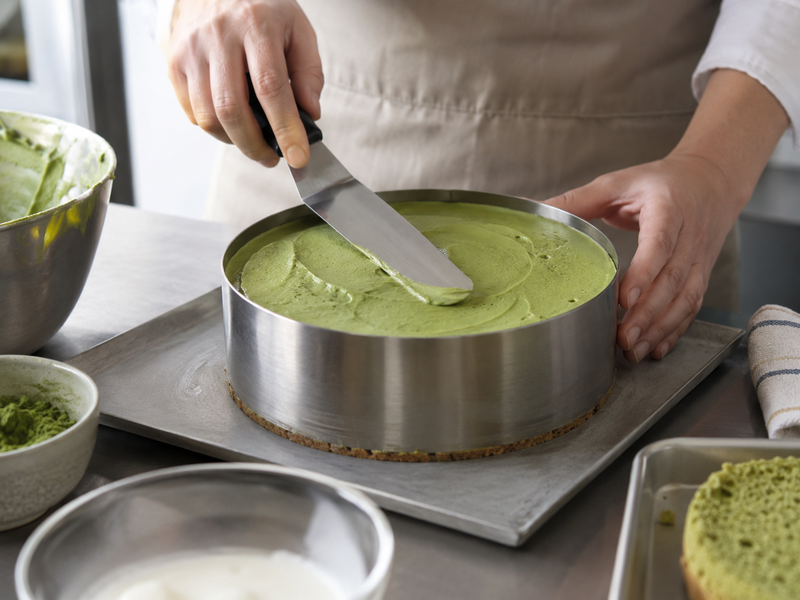
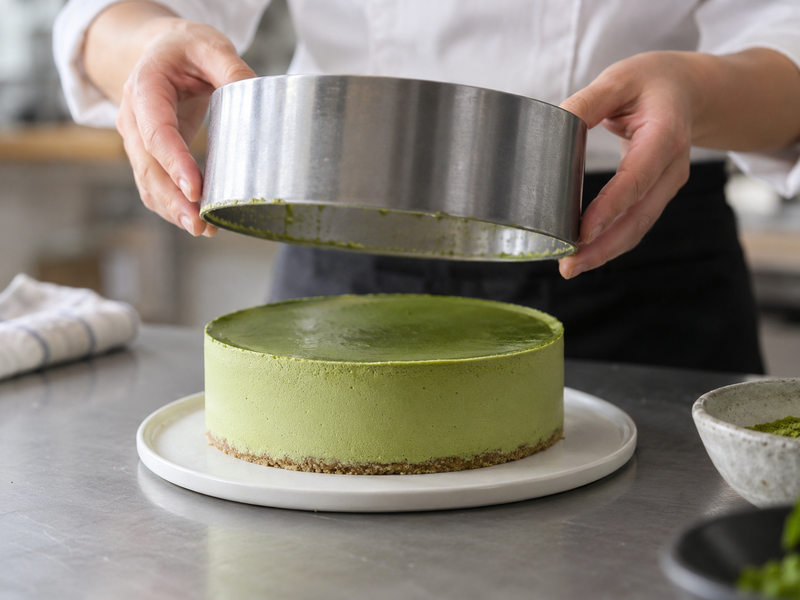
Choose a ring or pan that supports the cake’s height and can be removed cleanly. Weigh sponge layers, then deposit a measured amount of mousse and level it without compressing the base. Check the perimeter for air gaps; they become visible when the collar is removed. If the mousse begins to set before the second sponge is placed, staff may push too hard and squeeze it out. Record the workable assembly window.
Build a full cake during a normal production period, not only in a quiet test kitchen. Stage the ring, acetate or lining, sponge and mousse before folding the final cream. Record the finished height at three points. If it tilts, assess sponge level and deposit rather than covering the problem with extra glaze. A cake that looks acceptable in the ring must also survive transfer to a board and the first service cut.
6. Which glaze or finish will cut cleanly?
Test the top with the knife
A white-chocolate matcha glaze can add shine and sweetness, as in the reference, but it must set in a way that allows clean slices. Apply a measured weight at a controlled working condition and observe thickness at center and edge. A warm glaze may soften the mousse; a cool thick one may tear the surface. Compare a glazed version with a simpler dust or thin coating using the same mousse cake.
Cut both after the intended chill with the production knife. Watch whether the finish cracks, pulls mousse away or leaves marks on the blade. Decorations such as fruit or edible flowers add handling and may stain or release liquid in the case. Place them only after a display test. The top should signal matcha and help the cake sell, while allowing staff to deliver a tidy portion in ordinary service.
| Finish | Advantage | Cut or display concern |
|---|---|---|
| Thin matcha glaze | Smooth visible top | Temperature and thickness |
| Matcha dust | Quick tea note | Moisture spotting |
| White-chocolate detail | Contrast | Sweetness and cracking |
| Fresh garnish | Color | Liquid and handling |
7. How should chilling be controlled?
Build a cold route for the full cake
The cake contains cream and may include eggs, gelatin and other perishable components. Write the route from sponge cooling to mousse assembly, setting, unmolding, cutting and display under the bakery’s food-safety plan. The FDA Food Code is a U.S. model; local requirements and the exact formula govern handling. A recipe’s stated chill time is a texture step, not a general commercial shelf-life claim.
Test quality at several points in the intended sales window. Watch for condensation on glaze, loss of mousse height, dry sponge edges and matcha color change. A case that cycles warm air when opened may differ from a closed test refrigerator. Label batches so staff know which cake was assembled when. If whole cakes are transported, test the box and route before promising that the decoration will arrive intact.
8. What cutting and packaging method works?
Count good slices, not theoretical wedges
Mark a cut plan for the chosen diameter. Use a knife and cleaning routine that yields even, distinct layers. Lift a slice with the actual server and place it in the intended takeaway box. If the mousse leans or glaze touches the lid, the package or slice height needs adjustment. Compare the first cut with a later cut after the cake has been in the case; a pastry should not become impossible to portion during service.
Record full saleable slices, broken wedges and trim. For a whole cake, test how customers will cut it after transport and how the decoration responds. If the bakery sells both formats, use separate pack specifications. A slice that needs several minutes of careful repair at the counter is too fragile for a busy café, even if its flavor is good.
| Portion check | Passing result | If it fails |
|---|---|---|
| Cut face | Distinct, level layers | Review set or knife |
| Lift | No major slumping | Review support and portion |
| Box | Lid clears finish | Change pack or height |
| Whole cake | Stable after transport | Review board and box |
9. What is the saleable yield and allergen profile?
Cost the finished portion
Cost sponge, cream, setting agent, matcha, glaze, garnish, board or box and labor against actual saleable slices. Include cake leveling trim and wedges lost to uneven cutting. A thicker mousse may increase ingredient cost while reducing stable slice count. Compare price with the product’s position in the pastry case and the staff time needed to plate it.
Build the allergen sheet from every layer and current supplier documents. The reference includes eggs, wheat, almonds, milk and gelatin; other formulas will differ. The FDA major allergen guide provides a U.S. starting point, while destination rules determine the final declaration. Gelatin also matters to customers with dietary restrictions even where it is not a major allergen. Do not infer suitability from the cake’s green appearance.
10. When is the cake ready for the pastry case?
Repeat a full-size cake
The final sheet should list ingredient weights, matcha placement, sponge pan and bake, mousse setting method, assembly ring, fill height, chill route, finish, cut plan, pack and expected yield. Include photos of an approved whole cake and slice. Have a second pastry team make the cake with production equipment, then compare flavor, mousse texture and cut stability at the intended sale time. A small sample cup cannot prove a tall layer will hold.
During a limited sale, note specific faults: slices leaning, glaze smearing, mousse too firm, weak matcha or excessive sweetness. Each points to a different component. Change one variable in the next trial. The cake earns case space when ordinary staff can assemble, cut and sell it under an approved cold handling plan without discarding a large share of the batch.
| Decision | Evidence | Next step |
|---|---|---|
| Launch | Repeatable slice and yield | Train staff |
| Revise | One traceable layer fault | Component trial |
| Hold | Unresolved storage or label issue | Complete review |
FAQ
Q1. Why does matcha mousse cake slump? Review mousse set, layer depth and sponge level before adding more decoration.
Q2. Can matcha go in every layer? Yes, but test each placement; several weak tea additions may create bitterness without clarity.
Q3. Will a glaze make cutting harder? It can. Test the glaze thickness and cut with the production knife.
Q4. Is a small mousse cup enough to approve a cake? No. A full-size layer has different structural and cutting demands.
Q5. What is the most useful yield number? Saleable slices from a complete cake after normal trimming and service.
Make one full cake with the intended ring and cut it after its planned chill and case interval. The slices will reveal whether the mousse, sponge and finish work as one product.