
Matcha mochi cookies pair a baked tea-flavored cookie with a chewy rice-flour center. A bakery can make an appealing cut sample yet lose that contrast when insert weight, dough temperature, and bake time drift. This guide sets out a pilot formula, quality checks, and buying criteria for a repeatable commercial product. All example quantities are trial starting points that need validation on the intended line.
Search-intent reference: “Matcha Mochi Cookies”. The reference title confirms interest in the cookie-and-mochi format; the production guidance below is original.
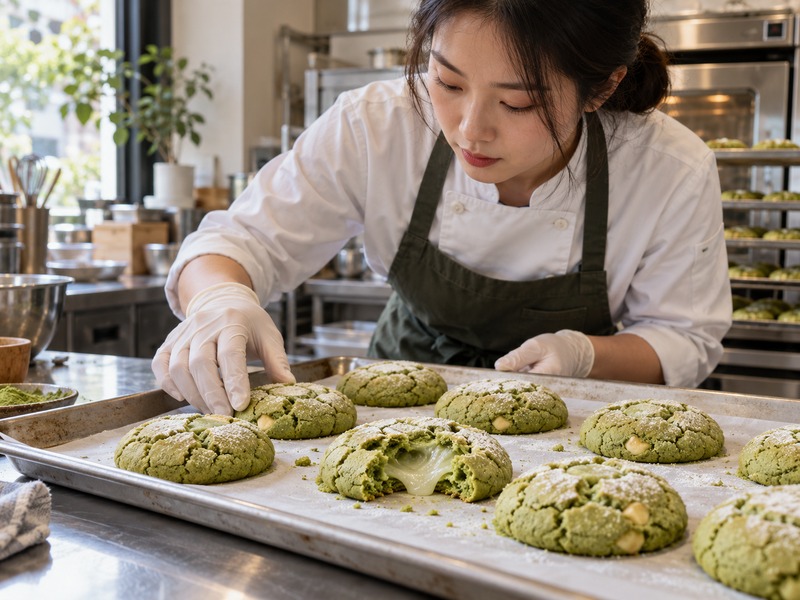
1. What should a matcha mochi cookie deliver?
Define the contrast in one finished piece
A buyer needs a product brief before choosing a formula. Name finished cookie weight, diameter, thickness, tea intensity, surface finish, and intended chew at the point of sale. A warm café cookie can tolerate a softer center than a wrapped retail unit that travels for days. Decide whether the green tea belongs in dough, mochi, or both. That decision changes how color and flavor appear when the cookie is cut. Inspect the center: a consumer expects mochi in a normal bite, not a small lump hidden near one edge.
Make a reference cross-section and describe what operators should accept. The insert should be centered, enclosed, and visibly distinct from surrounding crumb. If a bakery sells the cookie reheated, define that service method and test it after the intended storage period. A cookie that feels chewy straight from the oven may firm after cooling; another may become sticky in its pack. Separate those outcomes in the trial record. Set a target customer and price position as well, since a large mochi insert adds labor and ingredient mass without automatically improving the eating experience.
2. Which matcha grade works in a baked cookie?
Evaluate color after heat and storage
A culinary matcha with sufficient tea presence often suits sweet dough, but grade names are not a reliable substitute for baking trials. Butter, sugar, flour, and rice starch soften the tea note. Compare candidate powders at the same dose in the complete cookie. Photograph cooled cut samples under fixed light and taste them with the mochi center in place. Use the packed cookie: a bright dough ball tells little about the color and aroma that survive baking, cooling, and retail display.
Ask a supplier for identity, origin, lot code, ingredient statement, storage advice, and applicable quality documentation for the intended market. Check powder dispersion in dough and any visible dark spots. If a more aromatic grade is proposed, calculate the extra cost per accepted cookie rather than relying on price per kilogram. Store opened tea in a closed pack under the supplier’s stated conditions, away from moisture and strong odors. Matcha Village describes bulk matcha supply on its homepage; a bakery should request samples matched to its dough, bake profile, and monthly usage.
| Matcha trial item | How to assess it | Record for approval |
|---|---|---|
| Baked color | Cut cooled cookies under fixed light | Reference photograph |
| Tea flavor | Taste shell and full bite | Coded sensory notes |
| Dispersion | Look for powder pockets | Mixing and cut-piece notes |
| Lot fit | Review exact supplied item | Specification and test file |
3. How should the mochi center be specified?
Choose a chew that survives the route
Glutinous rice flour, water, and sugar can form a flexible insert after cooking. The insert’s water level, solids, and cooking method determine how it behaves during forming and baking. Too soft an insert may smear into dough or leak through seams. Too firm a piece can feel rubbery after the cookie cools. Record insert mass, diameter, temperature at wrapping, and texture before each bake. Cut several units: an insert that looks centered in one hand-formed sample may move under normal line handling.
Work with qualified food safety staff on the cooked insert’s cooling and holding plan. A moist, cooked component should not wait untracked on a warm bench while cookie dough is divided. If the insert comes from a supplier, request ingredient and allergen statements, storage conditions, lot identification, and handling guidance. Check whether starch dust used to portion mochi changes the cookie’s seam strength or label composition. Frozen inserts may simplify handling, but they require a separate bake and safety trial. Set an acceptable texture after the full sales route, not only at the moment the rice mass leaves its cooker.
4. What cookie dough can support a filled center?
Balance spread with enclosure
A dough that spreads widely may expose the mochi insert; a stiff dough can leave a heavy shell. Flour strength, sugar type, fat state, egg or alternative binder, leavening, and matcha all affect this balance. Start with a proven house cookie base and change its tea dose and handling one variable at a time. Measure spread on the planned tray and oven, then cut fully cooled pieces. Watch the edge: a thin rim may overbake before the center reaches an acceptable texture.
Set dough temperature at depositing and a rest time that staff can reproduce. Too much bench flour can block the seam, while warm fat may cause rapid spread. If the bakery wants an egg-free or dairy-free version, develop it as a separate formula with its own allergen and texture review. Replacing butter or egg by name alone does not preserve the same structure. Use a dough specification that includes handling feel and measured mass. A line operator should be able to identify a batch that has become too warm or crumbly before it produces a tray of rejects.
5. What pilot formula gives the team a clear baseline?
Keep dough and insert calculations separate
The table describes an illustrative dough using flour as 100% in baker’s percentages. It is not a validated cookie recipe. The bakery must set the actual dough and mochi masses per unit after determining finished size. One test might compare an identical shell around two insert weights while keeping bake conditions fixed. Record dough temperature, portion mass, insert mass, tray position, finished weight, and cross-section. Keep arithmetic visible: changing both insert water and shell sugar in one trial hides the source of a texture change.
Do not assume that the listed percentage of matcha will suit every powder. Its bitterness and color vary, and the sweet mochi center changes perception. Cook the insert using a separately documented formula and record its yield after cooling. The ratio between shell and center belongs on the piece specification, not only in a mixing sheet. Count trim and rejects during a normal shift. A pilot that yields ten attractive cookies from ten hand-selected dough balls may still fail on a depositor with a long queue and wider weight variation.
| Cookie dough component | Illustrative baker’s % | Trial role |
|---|---|---|
| Wheat flour | 100 | Reference base |
| Butter | 65 | Spread and bite |
| Sugar | 70 | Sweetness and edge |
| Egg | 20 | Binding |
| Matcha | 4 | Tea flavor and color |
| Leavening and salt | 2 | Structure and balance |
6. How can forming keep mochi in the center?
Use measured deposits and a seam check
Weigh dough and insert portions at the start, middle, and end of a run. Flatten dough to an even thickness, place the insert centrally, then close without trapping dry flour along the seam. A hand-forming method can establish geometry before automation, but the production line must prove it can repeat that geometry at normal speed. Look before baking: exposed white rice mass or a thin green patch predicts a split cookie. Photograph an acceptable raw piece and a rejected one for training.
Line equipment should be trialed with the real insert. A dummy paste may flow through a depositor while cooked mochi stretches, sticks, or cuts unevenly. If insert temperature changes across the shift, its deposit behavior may change as well. Keep a queue-time log and a reject count for off-center inserts, open seams, and underweight pieces. When defects cluster after a pause, investigate handling temperature and equipment restart before changing the formula. Trace the mochi and matcha lots in the batch record so product complaints can be linked to materials and process conditions.
7. How should the filled cookie be baked and cooled?
Validate the profile across an oven load
A filled cookie has two components that respond differently to heat. The outer dough must bake through without turning dull or dry, while the mochi center should remain pleasantly chewy under the intended serving condition. Test a full load, including tray edge and center positions. Compare cooled pieces rather than judging only hot cookies, because both crumb and rice insert change during cooling. Cut across the oven: one ideal tray position cannot define a production setting.
Record oven set point, actual load, time, tray type, bake loss, and cooling conditions. A dark or insulated tray may produce a different edge and base than the trial pan. Define whether cookies are packed at room temperature and how that condition is checked. Wrapping while warm can create condensation and alter the surface. A frozen dough program requires its own bake curve; an unadjusted fresh-dough time is not a safe shortcut. Food safety staff should set controls for cooked mochi handling and finished product cooling under the site’s process plan.
| Stage | Measurement | Failure sign |
|---|---|---|
| Raw forming | Shell and insert mass | Off-center or open seam |
| Oven | Load, time, tray position | Exposed insert or dark edge |
| Cooling | Product condition before pack | Condensation |
| Cut sample | Shell thickness and center | Dry rim or firm mochi |
8. Which checks belong on the batch release sheet?
Connect each defect with a likely cause
Record matcha and mochi lot codes, dough temperature, mixing endpoint, portion weights, forming rejects, oven profile, cooled weight, and package seal. Pick limits from actual pilot data and qualified food safety review. A vague instruction to “bake until done” leaves different shifts with different products. Use a cut-piece photo as a reference for centered filling and acceptable green crumb. Keep rejection categories separate: a broken shell, misplaced insert, and dry edge need different corrections.
Inspect representative pieces from the beginning, middle, and end of production. When color weakens, compare tea lot, dough mixing, bake exposure, and storage rather than replacing matcha immediately. When mochi feels hard, examine insert formula, holding conditions, baking, and the storage route. Review package weight and count because a filled cookie may look large while containing less insert than the approved sample. Store retained samples only where the site can label and maintain them appropriately. A useful release sheet lets procurement, bakery operations, and quality staff discuss the same evidence.
| Defect | Check next | Evidence |
|---|---|---|
| Exposed insert | Shell thickness and seam | Raw-piece photo |
| Hard center | Insert solids and hold | Timed sensory sample |
| Dull green | Tea lot and oven heat | Fixed-light cut photo |
| Wide spread | Dough temperature and sugar | Diameter and batch record |
9. How should cookies be packed and held?
Test texture in the actual sales package
A paper sleeve, sealed pouch, and bakery display case expose the cookie to different moisture conditions. The shell can soften in a tight pack while the mochi center firms during a long hold. Choose the intended route, then test the final recipe and pack together. Examine texture, color, aroma, surface stickiness, and microbiological status through a product-specific study. Open the package: a visually sound cookie can still stick to film or tear at the center when handled.
Do not assign a fixed shelf life from a home recipe. The moist insert, process, package barrier, and distribution temperature all matter. If the item will be frozen, evaluate thawing and any reheating directions with the final pack. Review allergens from cookie dough, mochi insert, flavors, and shared equipment. A buyer should approve ingredient and label proofs only after the production formulation is settled. Track consumer complaints by batch and package type. That record may show a storage issue even when factory cut samples looked acceptable.
10. How should a bakery cost and source the product?
Use accepted units and a defined tea specification
Cost the cookie dough, cooked mochi insert, dusting material, pack, labor, energy, and distribution by accepted finished unit. Include rejects from weak seams and off-center inserts. A larger mochi core may raise perceived value but also lower line speed and increase damage. Compare sizes after calculating saleable yield, not only ingredient cost. Count the packed piece: total batch cost divided by accepted units gives a realistic basis for pricing and a supplier quotation.
Send a matcha supplier the dough format, tea dose, target baked color, expected monthly volume, pack size, destination market, and required records. Request representative lots for a full bake trial. If the bakery uses a supplied mochi insert, agree its weight range, storage, temperature at use, and change-notice process. Matcha Village can discuss tea options through its contact page. The product is ready for scale only when the cookie shell, mochi center, batch record, and sales package perform together during a normal production run.
| Cost item | Unit basis | Common omission |
|---|---|---|
| Cookie shell | Actual dough mass | Bake loss |
| Mochi center | Cooked insert mass | Cooling and forming loss |
| Labor | Minutes per accepted batch | Hand closure |
| Pack and route | Accepted packed unit | Damaged returns |
FAQ
Q1: Can a standard matcha cookie hold mochi? It may need a revised dough temperature, portion mass, and seam design to keep the insert enclosed.
Q2: Can uncooked rice-flour paste be used as the center? The center needs a validated recipe and process. Use qualified food safety and texture checks before production.
Q3: Why does the mochi become firm? Examine its formula, cooking, cooling, baking, and storage route rather than changing tea dose.
Q4: Is culinary matcha suitable for this cookie? Select by baked color, flavor, documentation, and cost in the finished product.
Q5: Can fresh cookies be sold for a fixed number of days? Only a study of the final recipe, process, pack, and route can support a sales period.