
A matcha collagen latte combines powdered green tea with a specified collagen ingredient in milk or a plant-based liquid. For a café or beverage brand, the development work lies in flavor, dissolution, animal-source disclosure, and accurate labeling. A measured formula and supplier file can make the drink repeatable. The examples below are pilot inputs, not evidence of skin, joint, or other health effects.
Search-intent reference: “Matcha Collagen Latte”. Its title confirms interest in this drink combination; the commercial formulation and claim controls here are original.
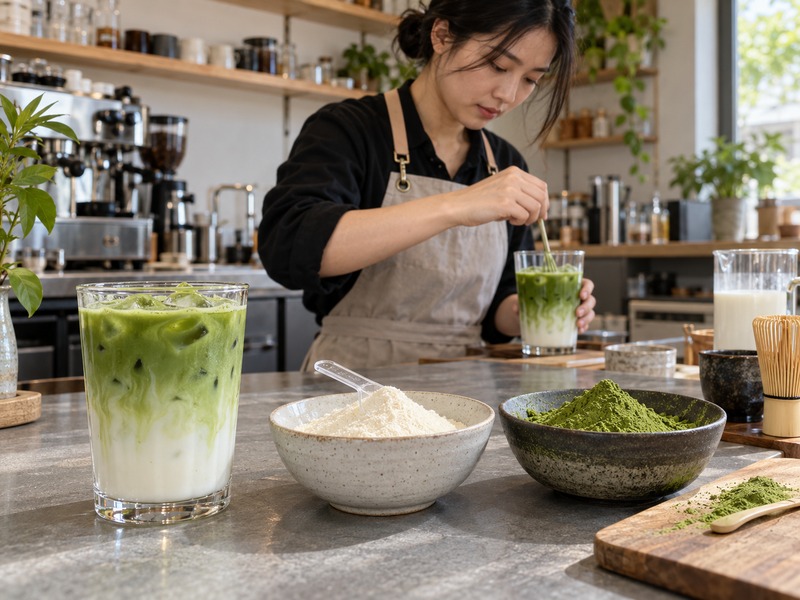
1. What should a matcha collagen latte deliver?
Define a beverage, not a promise of effects
A customer should receive a recognizable matcha latte with a clean texture and a transparent ingredient description. Decide serving size, hot or iced format, sweetness, tea intensity, milk choice, and acceptable foam before buying powders. Some brands want collagen to be sensory-neutral; others can tolerate a light background note. Test those preferences in the finished drink. Start with the cup: a powder specification matters only if staff can make the beverage consistently under the intended service conditions.
State the animal source of collagen in the product brief because it affects customer suitability, allergen review, and supply documents. A collagen latte is not vegan merely because it uses oat milk. Menu copy should describe ingredients and flavor without suggesting a measured health outcome. If a brand wants nutrition or body-function claims, qualified reviewers must evaluate the exact wording, evidence, serving composition, and target market. Run a normal-shift pilot to see whether the cup retains its color and smoothness while staff handle other orders.
2. Which collagen ingredient fits a beverage?
Compare source, handling, and supplier evidence
Collagen peptides may be sourced from bovine or marine materials, among others. Ask the supplier to identify the source precisely, provide an ingredient and allergen statement, and explain whether the product is suitable for the intended beverage process. Marine-derived material can introduce fish allergen obligations depending on the source and market. Check any required religious, origin, or certification documents for the exact ingredient rather than treating a sales sheet as proof. Request the technical file: brand language about “premium collagen” does not answer source or lot questions.
Compare candidate ingredients in identical matcha lattes at the intended dose. Note dissolution time, aroma, foam, sediment, and aftertaste in both hot and cold versions. A powder that disperses in warm water may clump when dropped into cold milk. Ask about recommended storage, moisture protection, lot coding, microbiological controls, and change notices. Keep an approved reference sample where the site can store it correctly. If procurement switches source species or supplier, recheck labeling and sensory performance. A change that looks minor on cost can alter the entire customer and compliance profile.
| Collagen selection item | Buyer question | Record |
|---|---|---|
| Source | Which animal and material? | Exact source declaration |
| Allergen | Does the source require declaration? | Market label review |
| Solubility | Does it disperse in the actual latte? | Hot and iced trial notes |
| Supply | Can lot quality be traced? | Specification and lot file |
3. How should matcha be selected beside collagen?
Judge tea in the complete drink
Collagen powder, milk, and sweetener can mute a delicate tea note. A beverage-oriented matcha with a clear green color and balanced bitterness may be more suitable than a costly sipping grade, but the choice needs tasting. Compare matcha samples at a fixed mass in the finished latte. Observe both immediate flavor and the cup after the intended handoff wait. Watch the green: a tea that looks bright dry may turn dull against a beige plant base or a strongly flavored collagen ingredient.
Ask for matcha identity, origin, lot code, specification, storage instructions, and relevant test records for the sales market. If organic status or another certification is part of the brief, verify it for the exact tea and supply route. The collagen supplier and matcha supplier should each know the complete drink matrix, because a good result in water does not prove performance in milk. Matcha Village describes bulk matcha and application supply on its homepage; buyers can request samples for hot and iced latte trials. Keep approved tea lots linked with the final beverage record.
4. What pilot formula gives a useful baseline?
Weigh every input and hold one reference
The following 400 g cup is an illustrative starting point, not a finished commercial recipe. It uses unsweetened milk or a specified plant drink, a separately chosen collagen ingredient, and a modest sweetener dose. Adjust matcha and collagen only after the base cup has been tasted in its intended temperature format. A product team should note whether ice contributes to the stated serving mass; the table below is a hot version before any iced adaptation. Keep one baseline: a trial where tea, collagen, milk, and sweetener all change cannot explain a better or worse cup.
Measure poured mass, preparation time, residual powder in the mixing vessel, and visible sediment after a realistic wait. Milk solids and sweetener can change perceived tea intensity, so compare candidate bases at equal final mass. The collagen dose must be recorded in grams per serving for costing and accurate label work. Do not convert this pilot into a protein or wellness claim without reviewing the finished formulation under destination-market rules. For a chain, choose tolerances based on real shift data and staff equipment, rather than presenting one test cup as a universal standard.
| Ingredient | Illustrative hot 400 g cup | Adjustment purpose |
|---|---|---|
| Specified milk or plant drink | 300 g | Body and background flavor |
| Water | 79 g | Powder premix and dilution |
| Collagen ingredient | 10 g | Declared ingredient dose |
| Matcha | 4 g | Tea note and color |
| Sweetener | 7 g | Flavor balance |
5. How can staff disperse two powders smoothly?
Specify the addition order
A reliable service method may premix matcha with a small portion of water, disperse collagen separately if its supplier recommends that route, then combine both with the chosen milk. The exact order should be set through trials on the intended whisk, frother, or blender. Dumping dry tea and collagen into a full cup can trap clumps along the wall. Inspect the vessel: green streaks and pale powder pockets indicate an incomplete mix even when the poured surface looks smooth.
Record water temperature, premix volume, mixing time, tool model, and cleaning steps. Excessive heat is not a shortcut; use temperatures compatible with the ingredient specifications and café process. In an iced latte, a small liquid premix can help before ice is added. If powder dust becomes a workplace issue during portioning, review handling and ventilation at the station. Portion packs can reduce scoop errors but add packaging cost. Clean protein residue promptly from seals and frother parts under the site’s sanitation procedure. Service instructions should fit the pace of a real queue.
6. Do hot and iced versions need separate standards?
Temperature changes foam, sweetness, and settling
Yes. A hot latte can show foam and tea aroma that an iced version does not. Cold milk slows dispersion and can make collagen texture more obvious. Ice also changes dilution as a cup waits for pickup. Write separate formula codes with final mass, ice mass, and mixing order. Taste each version at handoff and after the expected wait. Compare two cups: do not infer iced performance from a warm test in which every powder dissolved quickly.
Set a service window based on sensory observations and the café’s food safety plan. Check that the selected collagen remains acceptable in cold liquid and does not create a film or visible sediment. If a plant milk is offered beside dairy, test both independently and review allergen cross-contact at the bar. A milk substitution can alter sweetness, foam, color, and price. Train staff to follow the exact build for each format, including when to add ice. A vague “shake before serving” note cannot correct a formula that separates immediately.
| Format | Main control | Observation point |
|---|---|---|
| Hot latte | Premix and heating method | Foam and aroma at handoff |
| Iced latte | Powder dispersion before ice | Sediment after waiting |
| Dairy version | Milk specification | Body and allergen handling |
| Plant version | Exact base formulation | Color and texture |
7. Can a café formula become a packaged latte?
Retail processing needs a separate project
A fresh café cup is not a shelf-stable bottle formula. Packaged development must define refrigerated or ambient distribution, processing method, packaging, and product safety plan. Matcha particles can settle; collagen and milk systems can change under heat or storage. A co-packer or food technologist should test the full mix under the proposed process. Check after processing: a stable liquid in a bench pitcher says little about color, sediment, or flavor after commercial filling and transport.
Measure relevant product properties, including pH, viscosity, and distribution behavior as appropriate to the chosen route. Follow samples through actual storage and temperature variation, then set shelf life from product-specific evidence. A bottled latte needs a finished-product label that accounts for collagen source, milk allergens, ingredient order, nutrition, and any market-specific disclosures. Avoid borrowing nutrition values from a café calculation. If a brand wants a ready-to-drink protein claim, confirm finished composition and the relevant claim criteria. The plant process, not a kitchen recipe title, determines how the packaged drink may be described.
8. Which quality records should buyers and cafés keep?
Trace each powder and each cup defect
Procurement should hold current specifications and lot records for matcha, collagen, milk base, and any sweetener blend. At the store, record portion method, equipment setting, cup mass, and sanitation checks. A drink with visible green clumps may point to matcha addition order; a pale sediment may point to collagen handling; a changed background flavor may come from a new plant base. Separate the symptoms: one generic “poor texture” complaint gives suppliers little evidence.
Store dry powders under supplier conditions, protect opened packs from humidity, and train staff on lot rotation. If portion sachets are used, compare their contents and seal integrity with the approved reference. For a central blend, verify powder uniformity and reconstitution before replacing two individual additions with one mix. Retain complaint details such as store, time, ingredient lots, serving format, and photos where feasible. Review a new lot in the final latte before releasing it across a chain. A specification should describe finished-cup performance alongside dry-powder appearance.
| Observed issue | Immediate check | Record to retain |
|---|---|---|
| Green clumps | Tea premix and tool | Mixing method and tea lot |
| Pale sediment | Collagen dispersion | Ingredient lot and timed photo |
| Changed sweetness | Milk and syrup specification | Incoming labels and cup mass |
| Weak tea note | Tea dose and base flavor | Reference-cup comparison |
9. How should collagen and nutrition claims be reviewed?
Keep ingredient facts separate from outcome claims
“Contains collagen” is an ingredient statement when it accurately reflects the formula. Claims about skin, joints, recovery, or disease outcomes require a different evidence and legal review. This article does not support those outcomes. In the United States, the FDA explains food label claim categories and distinguishes disease-related health claims from other statements. In the European Union, the European Commission describes the health-claim framework. Apply current rules to the exact product and market with qualified advisers. Approve copy late: claims should follow a fixed formula and evidence file.
Collagen is animal-derived, so do not present this latte as vegan. If marine collagen comes from fish, review fish allergen labeling and cross-contact under local rules; the FDA identifies fish among major food allergens in the United States. A plant milk can introduce other allergens and does not erase the collagen source. Protein content claims also need a finished-product calculation or analysis and market-specific review. Avoid quoting a supplier’s collagen dose as proof of a labeled protein amount without checking the whole drink and applicable method.
10. How should buyers cost and source the latte?
Cost a finished cup with its service steps
Ingredient cost begins with measured grams multiplied by landed unit price. Add milk base, sweetener, cup, lid, labor, powder waste, and remakes. Collagen can be a major cost line, so a one-gram change matters to margin and to any declared ingredient amount. A lower-priced powder may add a flavor or dispersion defect that costs more during service. Cost the accepted cup: use real yield and remake data from a shift rather than a theoretical recipe alone.
Send suppliers the beverage format, hot and iced needs, source preferences, approximate dose, target market, projected volume, pack size, and required documents. Request commercial samples from representative lots and test them in the exact milk and tea combination. Ask how changes in collagen source, tea grade, or blend composition will be communicated. Matcha Village can discuss matcha supply through its contact page; collagen sourcing and claims review require their own qualified suppliers and advisers. A menu launch is sound when the cup tastes right, staff can reproduce it, and the label says only what the product file supports.
| Cost or approval line | Measure | Decision use |
|---|---|---|
| Matcha | Grams per accepted cup | Tea flavor and color |
| Collagen | Grams and source per cup | Price and label review |
| Service | Time, waste, remakes | True operating margin |
| Documents | Lot and claim file | Purchase approval |
FAQ
Q1: Is a matcha collagen latte vegan with oat milk? No. Collagen is animal-derived; the milk choice does not change that fact.
Q2: Can marine collagen create an allergen issue? Fish-derived material requires a market-specific fish allergen review and suitable cross-contact controls.
Q3: Does the drink improve skin or joints? This formula provides no evidence for such outcomes. Any proposed claim needs its own review and support.
Q4: Can the two powders be packed together? Possibly, after blend uniformity, moisture protection, reconstitution, labeling, and lot traceability are tested.
Q5: Can a café recipe go straight into bottles? No. A packaged latte needs process development, product-specific safety and shelf-life work, and final-label review.