
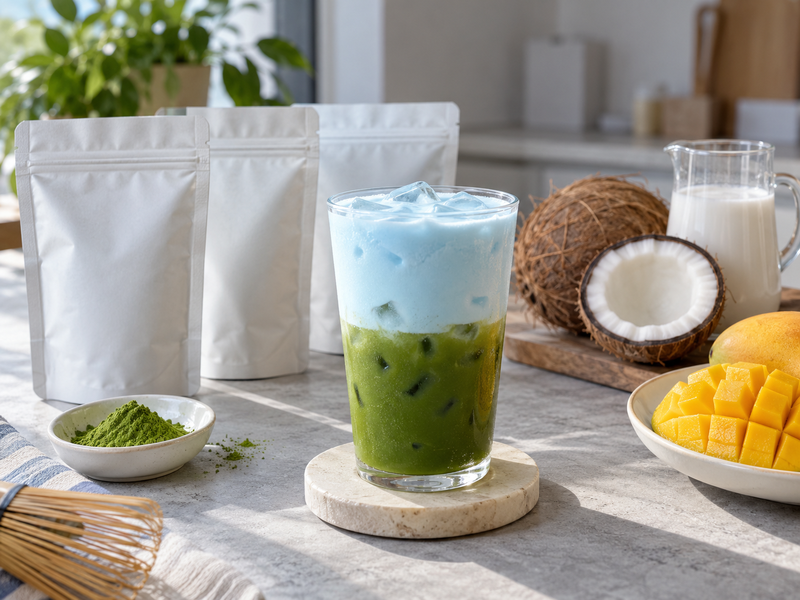
An iced blue coconut matcha can attract a customer before the first sip, yet a photo cannot tell a buyer whether the color, flavor, and foam will survive a busy service line. Starbucks introduced a drink under this name in 2026. Its published version combines matcha, mango flavor, toasted coconut cold foam, and blue spirulina. A café or beverage brand developing its own product should build and document its own formula rather than assume a copycat recipe matches the original.
Contents
- What is an iced blue coconut matcha?
- Which parts of the branded drink are publicly documented?
- How should a buyer build an independent flavor brief?
- Which matcha powder works under coconut and mango?
- How can a blue layer be specified responsibly?
- What makes the layered appearance repeatable?
- Which allergen and labeling checks are needed?
- How should cafés manage cold foam and holding?
- How can buyers cost and test a pilot?
- What should a supplier brief include?
1. What is an iced blue coconut matcha?
Describe the drink by its components
The phrase describes a cold matcha drink with coconut flavor and a blue visual element. It does not specify a universal recipe. Starbucks uses the name for a particular menu item; independent operators should describe their own ingredients accurately. The company’s 2026 announcement identifies mango flavors, toasted coconut cold foam, and a touch of blue spirulina in its version. Its published ingredient page gives a more detailed ingredient statement for the listed U.S. item.
A product-development team should separate three jobs: make a drink that tastes balanced, create an appearance that survives service, and meet the destination market’s ingredient and labeling rules. A bright blue foam may look striking over green matcha but could overwhelm the tea with sweetness or coconut aroma. A thin matcha base may look vivid only because the foam carries the visual story. Begin with a target consumer, cup size, desired sweetness, and intended price. Then test each layer on its own before combining them.
2. Which parts of the branded drink are publicly documented?
Use the source, not a guessed formula
Starbucks describes the drink as a tropical iced matcha with sweet mango flavors, finished with toasted coconut cold foam and blue spirulina. Its U.S. ingredient page lists milk, ice, blue toasted coconut cold foam, mango syrup, and matcha made from ground green tea. The source also lists components within the foam. These statements support a factual description of the current branded product, but they do not disclose commercial mixing ratios, process controls, or every regional variation. A copycat article is a recipe writer’s interpretation, not a manufacturing specification from Starbucks.
For B2B work, write “inspired by the flavor pairing” only if that accurately describes the new drink. Do not imply endorsement, affiliation, or formula equivalence. Keep the brand name out of the product’s own name and packaging unless legal counsel has approved its use. If the team plans to market a “blue coconut matcha,” its ingredient list must reflect the actual color and flavor components chosen. A menu photograph of another brand is no substitute for a tested proprietary recipe.
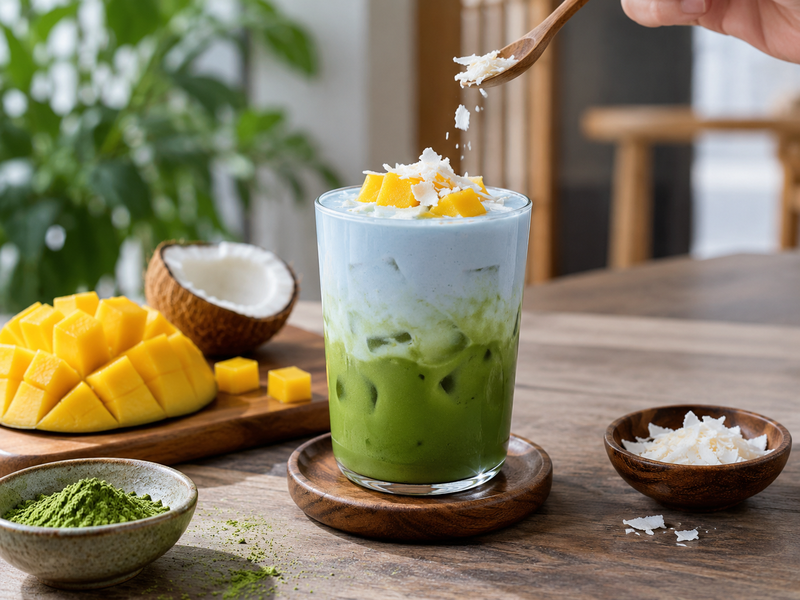
| Publicly described component | What it tells a developer | What remains to be developed |
|---|---|---|
| Matcha | Tea is in the drink | Powder source and dose |
| Mango flavor | Tropical sweetness is part of profile | Syrup or puree choice and amount |
| Toasted coconut cold foam | Coconut is a top-note and texture | Foam formula and stability |
| Blue spirulina | Blue appearance has a named source | Color dose and local compliance |
3. How should a buyer build an independent flavor brief?
Set a tasting target before choosing colors
Describe the first sip, middle, and finish. A useful brief might call for visible matcha flavor first, light mango acidity or sweetness in the middle, and toasted coconut aroma from the foam. That is an illustrative development target, not a claim about the branded product. Specify whether coconut should come from coconut milk, a syrup, a flavor, or a foam ingredient. Each option changes fat, sweetness, allergens, and cost. Decide whether the blue belongs in foam, a syrup layer, or the whole drink. The color plan should follow the flavor plan, because a spectacular blue layer has little value if it makes the tea taste weak.
Build a small matrix with tea dose on one axis and mango intensity on the other. Hold cup size and milk constant. Only after a preferred base is selected should developers vary the coconut topping. Taste immediately and after the expected customer carry time. Make a written rejection rule for combinations that look good but taste overly sweet or lose matcha flavor. This keeps visual novelty from crowding out repeat purchase potential. For private-label retail products, plan a separate shelf-life and packaging study; a café cup trial cannot establish packaged stability.
4. Which matcha powder works under coconut and mango?
Test tea strength in the full build
Coconut and mango are expressive flavors. The matcha needs enough presence to register without producing a harsh, dry finish. Compare two or three candidate powders in a fixed base recipe at equal weighed doses. Use coded cups and record dry aroma, dispersion, tea visibility under milk, and flavor after foam is added. A powder that tastes excellent when whisked alone may be too delicate in a sweet iced drink. A stronger powder may be more economical if it meets the target at a lower dose. Only a dose curve in the finished cup can resolve that tradeoff.
Ask whether the supplier sample is pure matcha or a blend. The Yamamasa Koyamaen production guide describes tencha processing for matcha, while commercial latte powders may add other ingredients. A premix can simplify service, but its sugar or milk content constrains the drink design. For Matcha Village candidates, request a lot-linked specification and full composition before comparing cost. If the finished beverage uses a color ingredient in addition to matcha, keep its regulatory review separate from the matcha review.
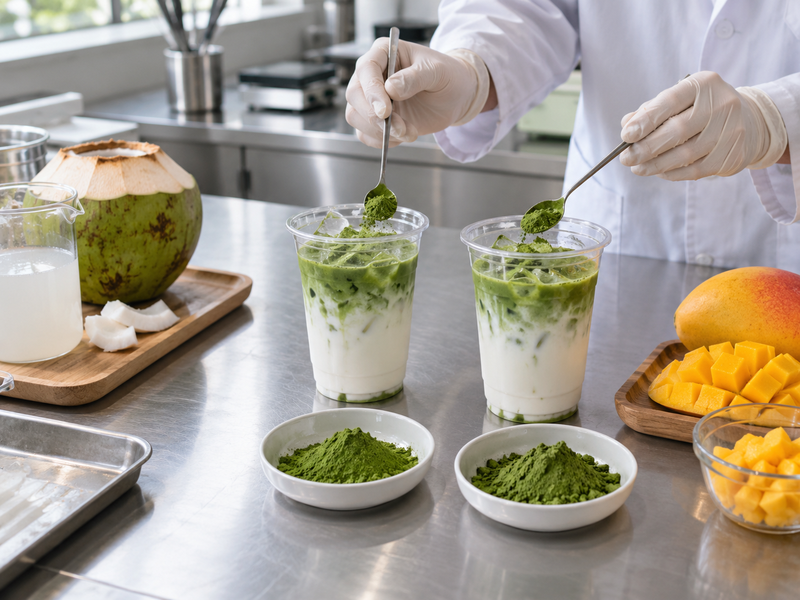
| Test | Why it matters | Pass condition to define |
|---|---|---|
| Plain tea | Finds off-notes hidden by syrup | Clean baseline flavor |
| Base plus milk | Shows tea presence | Recognizable matcha at planned dose |
| Full drink | Shows flavor competition | Tea remains clear beneath coconut |
| Wait test | Shows dilution and separation | Acceptable sip after carry time |
5. How can a blue layer be specified responsibly?
Name the actual color ingredient
“Natural blue” is not an adequate purchasing specification. The Starbucks announcement names blue spirulina for its product. Another developer might consider a different permitted color ingredient, but approval depends on the ingredient’s identity, food category, country, and intended use level. The FDA color-additive guidance explains that color additives have defined uses and labeling obligations. The FDA’s butterfly pea flower extract listing shows how an apparently familiar botanical color can have specific permitted food uses. It should not be substituted into a formula merely because it appears in a recipe online.
Ask a color supplier for the exact ingredient name, specification, permitted uses in each destination market, recommended use range, and stability information. Test color in the actual pH, milk, ice, and light conditions. Some blues shift or fade when mixed with acidic ingredients. A layer that photographs well immediately may look gray after five minutes. Take standardized photographs at service and after a normal wait. Regulatory sign-off should happen before printed menus or packaging are approved.
6. What makes the layered appearance repeatable?
Control sequence, density, and service time
Layering depends on how the components are poured, their viscosity, ice load, and how quickly they mix. Define the order of operations and use measured amounts. A cold foam needs a target texture that sits on the drink long enough for handoff, yet remains pleasant to sip. Train staff with the real cup, ice size, and milk. A small change in ice volume can shift fill level and create a different photo. A pump with inconsistent delivery can change both color and sweetness. Calibrate the equipment before blaming the ingredient.
Use a service trial at a busy site, not only in a development kitchen. Time each step and count remakes. Record whether the blue transfers into the matcha layer, whether foam collapses, and whether customers can drink through a lid. An intentionally mixed drink may be better than an unstable layered drink; that is a menu design choice. For delivery, test movement in a carrier. No still photograph can prove performance after a ten-minute trip.
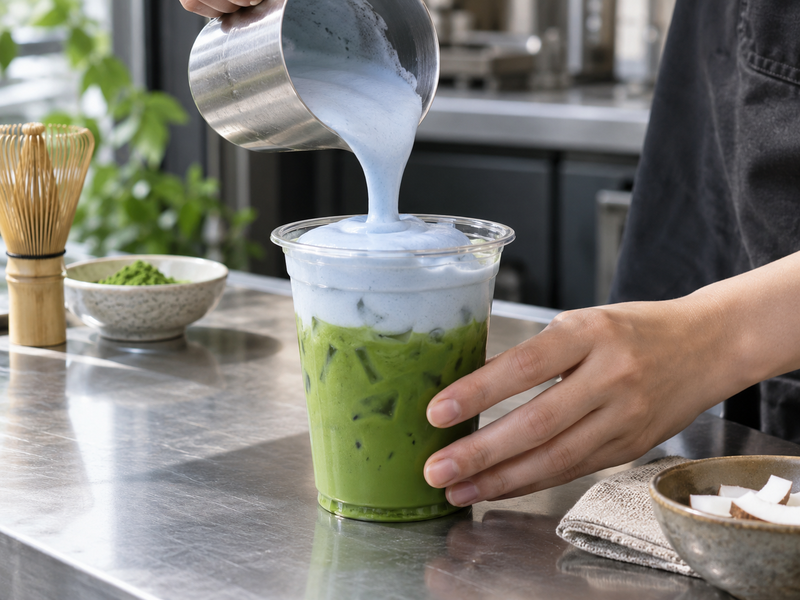
| Variable | Observation | Operational control |
|---|---|---|
| Ice load | Fill and dilution drift | Measured scoop or weight |
| Base temperature | Foam stability changes | Defined cold preparation |
| Foam viscosity | Layer sinks or clumps | Mixer setting and hold time |
| Pour sequence | Colors muddle | Written assembly steps |
| Travel time | Appearance changes | Timed takeaway trial |
7. Which allergen and labeling checks are needed?
Review the complete drink, not just tea powder
Matcha itself may be a single tea ingredient, but this drink can include milk, cream, coconut flavoring, syrup, and a color preparation with carriers. The FDA’s U.S. allergen page lists major food allergens including milk and soy. Starbucks’ current U.S. ingredient page lists milk in its version and warns that shared café equipment prevents an allergen-free guarantee. A separate operator must evaluate its own ingredients, cross-contact practices, and the local rules where it sells.
Do not assume coconut flavor means a dairy-free drink. A cold foam may contain cream even when its name highlights coconut. Likewise, a non-dairy foam can contain other ingredients requiring review. Collect full ingredient statements from the matcha, syrup, color, milk, and foam suppliers. If a packaged version is planned, the finished product needs its own compliant label and nutrition work. If a café menu uses descriptors such as “vegan” or “no added sugar,” verify them against every component and preparation step before launch.
8. How should cafés manage cold foam and holding?
Build food safety into the service design
Cold foam made with milk or cream may require temperature control. The FDA Food Code gives model retail foodservice guidance; local adopted rules determine requirements for a particular café. Define how the base and foam are prepared, held, labeled, and discarded. If foam is batched, record the validated holding time and temperature. A pretty topping cannot justify leaving dairy on the counter during a rush. Staff need a clear rule for a pitcher that has warmed, mixed with another ingredient, or passed its hold time.
Cleaning belongs in the plan too. A foam mixer with residue can change flavor and create contamination risk. Include disassembly, cleaning frequency, and verification in the SOP. Test the assembled drink in a takeaway cup, since lids and prolonged contact can flatten foam. For a ready-to-drink packaged product, consult a qualified process authority; café methods and timelines do not establish commercial shelf life or microbiological safety for a sealed beverage.
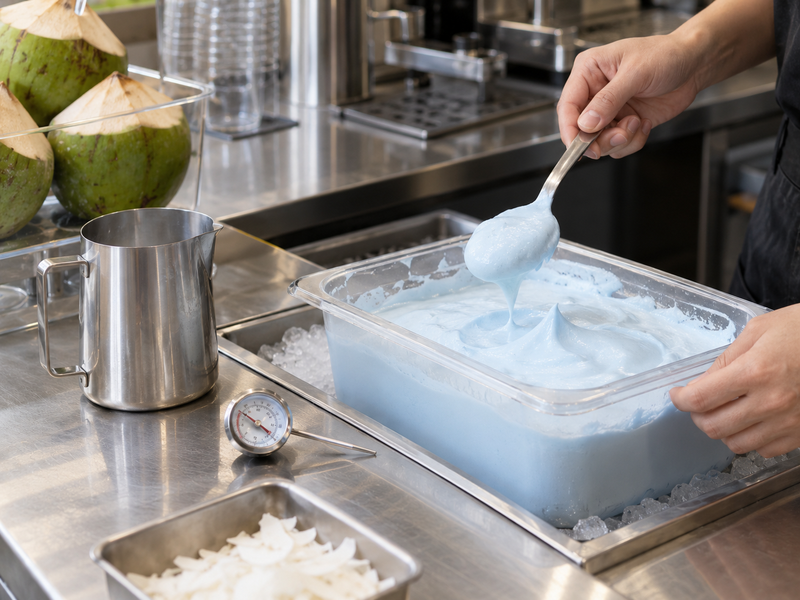
| SOP item | What to define | Who checks it |
|---|---|---|
| Foam preparation | Ingredient lot and batch size | Shift lead |
| Cold holding | Equipment and local-code limit | Food-safety lead |
| Cleaning | Mixer and pitcher procedure | Operator |
| Discard | Time and condition triggers | Shift lead |
| Handoff | Appearance and temperature | Operator |
9. How can buyers cost and test a pilot?
Count every layer and every remake
Calculate cost from the recipe that passed taste and service trials. Include matcha dose, milk, mango component, coconut foam, blue color, ice, cup, lid, labor time, normal waste, and delivered ingredient costs. A topping can become the most expensive element if it uses costly dairy or requires frequent disposal. Track the number of remakes during pilot shifts; a visually fragile drink may have a higher true cost than its ingredient sheet suggests. Record actual pump delivery and cup fill rather than relying on catalog claims.
Test several stores or service periods with the same written build. Compare customer-facing color, flavor, speed, and operator feedback. Use a second matcha lot before scaling if available. If the drink is sold in multiple countries, validate color permissions and labeling separately in each. Keep original artwork and product name distinct from any competing branded menu item. A viable launch means the team can reproduce the drink within its target cost and food-safety controls, even when a development chef is not standing behind the bar.
10. What should a supplier brief include?
Give each supplier the part it owns
Matcha Village can be asked for matcha or a matcha latte base suited to a cold, mango-and-coconut drink. Share cup size, milk base, sweetness, desired tea strength, target ingredient cost, projected volumes, pack size, and destination markets. Request sample lots, composition, specification, COA, storage guidance, and lead time. Separately brief the syrup, foam, and color suppliers on their own components. A matcha supplier should not be assumed to validate an unrelated blue additive or the final cold foam process unless that service is explicitly contracted and documented.
The final brief should identify who signs off flavor, visual performance, labeling, allergen controls, and store operations. Run the recipe as a complete system and keep records of the approved formula and lots. That is the path from a striking iced blue coconut matcha concept to a drink a chain can make repeatedly and describe accurately. Ask for the matcha sample set against the actual beverage brief before committing to a launch date.
| Supplier or team | Required input | Approval evidence |
|---|---|---|
| Matcha supplier | Powder or base, lot data | Taste and COA |
| Color supplier | Identity and market use | Regulatory sign-off |
| Foam supplier | Formula and handling | Stability and allergen review |
| Café operations | Build sequence and tools | Site trial |
| Purchasing | Delivered costs | Approved serving margin |
An iced blue coconut matcha deserves the same discipline as any other menu item: a documented recipe, compliant ingredients, and a service test. Matcha Village can supply tea candidates for that test; the buyer should approve the entire drink in its own market and operation.
FAQ
Q1: What makes the Starbucks drink blue? Starbucks names blue spirulina in its 2026 announcement and provides a detailed ingredient statement on its U.S. menu page.
Q2: Is iced blue coconut matcha necessarily dairy-free? No. The named Starbucks item lists milk, and independent recipes vary. Check every component.
Q3: Can butterfly pea replace blue spirulina? Only after checking its permitted use in the destination market and testing the specific formula. It is a different ingredient.
Q4: Which matcha works best with coconut? Compare candidate powders in the full recipe at measured doses. Tea should remain noticeable under coconut and mango.
Q5: What must a chain test before launch? Test taste, appearance after a wait, food-safety holding, allergen and color compliance, site repeatability, and approved cost per serving.