
Matcha liqueur puts a delicate tea powder into a difficult system: alcohol, sugar, light, and months of distribution. A vivid sample at the bench can leave sediment in a back bar bottle or disappear beneath a strong spirit. Buyers need a defined sensory target, a repeatable stability trial, and the right regulatory review before a label or cocktail menu goes live. The Yoshi Martini on Curiada shows one consumer use case; this guide examines what a producer and bar buyer must check behind that drink.
1. What is a matcha liqueur, and what should it taste like?
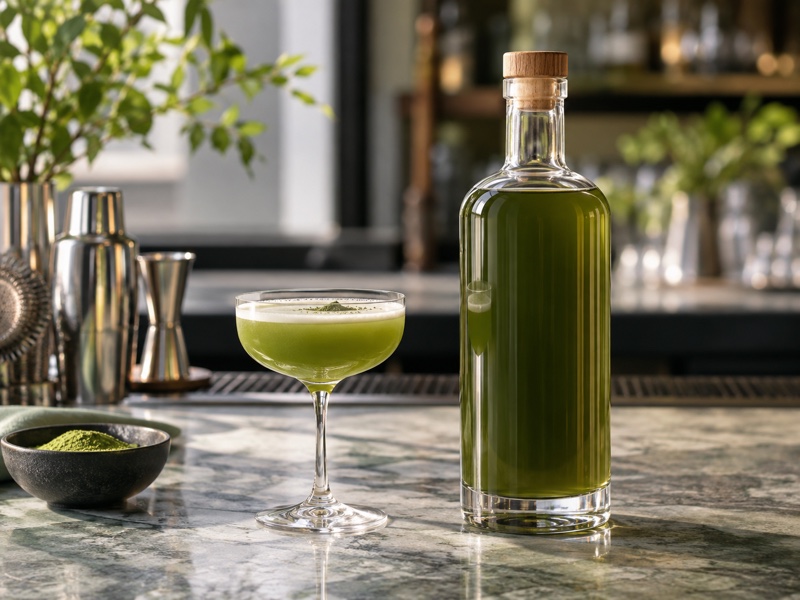
A matcha liqueur combines a sweetened alcoholic base with a matcha-derived flavor. Its exact composition depends on the recipe and the market’s classification rules. Some products use whole powdered tea, some use an extract, and some use both. That choice affects mouthfeel, settling, color, and what the label can truthfully say. Ask for the ingredient statement before judging a bright green bottle from its appearance alone.
Define the drink in a finished serve. Should a guest notice fresh tea first, then sweetness, or should tea act as a quiet bitter note behind gin? Taste the candidate neat at intended service temperature, then in the proposed cocktail. A sample that seems forceful neat may be right after dilution. Conversely, sweetness that feels balanced over ice can become heavy in a short stirred drink. Use the same glass, garnish, and dilution when comparing candidates.
Write a sensory brief the bar team can use
Record aroma, first sip, sweetness, tea finish, color, and texture. Make a reference sample and let a small panel score blind pours. Words such as “premium” and “authentic” do not tell a supplier what to adjust; “tea still identifiable after dilution with gin” does. Keep the accepted sample under controlled storage for later lot comparisons.
| Attribute | Buyer question | Evidence to keep |
|---|---|---|
| Tea character | Is matcha identifiable in the final drink? | Blind tasting sheet |
| Sweetness | Does sugar crowd out the spirit? | Standard cocktail trial |
| Texture | Is powder grit acceptable? | Neat and diluted tasting |
| Color | Does it match the intended menu image? | Fixed-light photograph |
2. Which tea ingredient works in an alcoholic base?
Powdered matcha and soluble tea extract behave differently. Matcha consists of milled leaf, so an attractive suspension may still settle. An extract may disperse more readily but can lose the full powdered-leaf character a buyer expects from the name. A blended approach might work, provided the resulting ingredient declaration and flavor are accurate. Request a sample of each candidate ingredient before paying for a finished liqueur trial.
Do a small compatibility screen with the actual alcohol base and sweetener. Pre-disperse the powder using a method the production line can repeat; note whether wet clumps form at the surface or cling to the vessel. Taste immediately and after the planned hold. Ask whether the powder lot has a specification covering origin, particle size or fineness, microbiological parameters, and any market-specific tests your quality team requires. Matcha Village offers pure matcha powder for application trials. Approval still has to be tied to the particular lot and finished formula.
Compare at equal finished strength
A supplier’s cost per kilogram is a poor shortcut if one powder needs a much higher addition for the same tea impression. Make side-by-side liqueur samples at the same intended alcohol and sugar levels. Change only the tea source. Compare aroma and aftertaste with opaque cups first, then inspect appearance. This separates a flavor decision from the visual appeal of a greener sample.
3. How does alcohol change extraction and flavor?
Alcohol can carry different tea notes than water. Extraction conditions, contact time, particle removal, and the base spirit all shape the result. A neutral base leaves more room for vegetal tea character; botanical or aged spirits can add competing aromas. Do not assume that a matcha that tastes smooth in hot water will taste equally smooth in alcohol. Make trials in the actual base, rather than in water with alcohol added at the end.
Keep a process log: ingredient weights, order of addition, mixing method, temperature, filtration, and the time between mixing and tasting. Revisit the same bottles later. An immediate tasting may flatter a cloudy product that later develops a hard deposit. A filtered product may look cleaner but taste thin. Decide whether the brand wants a stable clear-ish liquid or a deliberately cloudy liqueur that needs a “shake before use” service instruction. Such an instruction is only credible if shaking reliably restores a uniform pour.
| Trial condition | Hold constant | Observe |
|---|---|---|
| Powder source | Alcohol, sugar, process | Tea note and settling |
| Base spirit | Matcha dose, sugar | Aroma competition |
| Contact time | Ingredient lots | Bitterness and color |
| Filtration | Base batch | Flavor loss versus clarity |
4. Can the green color survive storage and service?
The green appearance is often the reason a bar buys the product, yet tea pigments change with processing and exposure. Test finished bottles under the light, temperature, and bottle material proposed for distribution. Photograph samples against a neutral card at receipt, after the intended warehouse hold, and after a period on an illuminated back bar. Use identical camera settings. Comparing a fresh bottle in daylight with an old one under warm bar lamps proves little.
Record both the color in the bottle and the color in a standard drink. A liquid can look attractive through green glass but turn muddy when mixed with citrus or a dark spirit. Do a small cocktail matrix with the actual menu ingredients and observe immediate appearance, separation, and color after a normal service delay. If the product depends on permitted color additives, have the regulatory team confirm their status and disclosure for each destination. Natural tea alone should not be promised to stay neon green throughout a long shelf life.
Separate color approval from taste approval
Blind taste the liquid in opaque vessels before a visual review. Otherwise, a saturated green sample can win despite a rough finish. A bar buyer needs both dimensions: a photogenic serve that guests also order again. The approved target can be a range rather than an exact shade, but document the range with standard-light images so replacement lots are judged consistently.
5. How much sediment is acceptable in a matcha liqueur?
A fine deposit is common when whole powder is used, but acceptability depends on the positioning and dispensing route. A bottle poured at a busy bar should not give the first customer a pale drink and the last customer a gritty one. Stand filled bottles upright, then on their sides if shipping may do that. Inspect the neck, shoulder, and base. Invert and pour the product as staff would during service. Note how many gentle turns restore a uniform liquid and whether material remains stuck to the glass.
For a packaged cocktail, sediment can be a visual defect even when the drink tastes fine. For a craft back bar product, a fine resuspendable haze may be part of the brief. Write that distinction into acceptance criteria. If filtration reduces deposit, retaste the filtered batch. If a stabilizer is considered, confirm the change with formulation and labeling specialists before scaling. A clear sample that loses the tea note is not automatically a better liqueur.
| Observation | Possible cause to test | Commercial consequence |
|---|---|---|
| Hard compact layer | Particle size or long hold | Inconsistent pours |
| Floating flecks | Poor wetting or aggregation | Visible defect in glass |
| Rapid separation | Weak suspension design | Extra bar handling |
| Persistent grit | Coarse material | Unpleasant finish |
6. Which cocktails reveal strengths and weaknesses?
Choose tests that stress different properties rather than making several versions of the same sweet drink. A stirred spirit-forward serve exposes bitterness and aroma. A shaken citrus serve challenges color and can create foam or specks. A milk or cream drink tests whether the tea remains detectable through fat. A long drink shows how the liqueur behaves at greater dilution. Curiada’s martini example is useful as evidence of search interest, but its formula is a consumer recipe, not a production specification.
Standardize each test drink. Weigh or measure ingredients, use a fixed ice amount and mixing time, and record finished yield. Have two bartenders prepare it independently. If their results diverge, the service sheet may be ambiguous or the liqueur may need a handling rule. Photograph the drink at pour and after a realistic wait on the pass. Buyers should also check whether the bottle can be poured cleanly from a speed rail and whether the cap, closure, or label tolerates repeated wiping.
7. What controls belong in a pilot batch?
A credible pilot uses the intended water, alcohol base, tea lot, mixing equipment, filter, bottle, and closure. Lab beakers make excellent screening tools, but they rarely reproduce a production pump, long transfer line, or bottling hold. Write down every process stage and collect samples at the start, middle, and end of the fill. Test whether the tea distribution changes as the tank empties. Keep an unopened bottle from each point for the stability study.
Measure the properties that the final specification will control, such as alcohol strength, soluble solids, fill weight, color, sensory profile, and visible sediment. Use validated methods chosen by the producer; a handheld reading without calibration is not a release criterion. Confirm that sanitation, filtration, and filling practices suit the actual formula. A sweet alcoholic drink is not automatically exempt from quality or spoilage concerns. The manufacturer should establish its own microbial and packaging controls.
| Pilot record | Why retain it | Recheck when |
|---|---|---|
| Tea and spirit lot IDs | Trace differences | New raw-material lot |
| Process sequence | Repeat dispersion | Scale change |
| Start/middle/end bottles | Find tank gradients | Before approval |
| Closure and bottle type | Check pack interactions | Packaging change |
8. What labeling and alcohol rules need review?
The applicable rules depend on the destination, the alcohol base, the recipe, and how the item is sold. In the United States, the Alcohol and Tobacco Tax and Trade Bureau explains that some alcohol products need formula review before label approval. Its distilled-spirits tool addresses liqueurs and related classes; a qualified compliance team should apply that tool to the actual formula. Avoid a label mock-up that assumes “matcha liqueur” is a complete legal class name in every jurisdiction.
Check alcohol declaration, ingredient and additive treatment, mandatory warnings, importer details, and any required translation with the market specialist. TTB says alcohol beverages at or above the relevant threshold need a health warning statement in the US. Do not market a cocktail as a health product because it contains tea. Advertising claims around energy, calm, or antioxidants require separate legal review, and the alcohol context makes casual wellness language particularly unsuitable.
Keep a claim file
Record the exact claim, evidence, market, label location, and approving reviewer. “Made with matcha” should be backed by a formula and supplier records. “Natural color,” “organic,” or origin wording needs support for the finished product, not merely for one ingredient. A distributor can then answer a retailer’s question without improvising from a sales deck.
9. How should a buyer compare suppliers and costs?
Ask for a sample tied to a production lot and enough documentation for your quality and import teams. For matcha powder, request specifications, origin and traceability information, packing format, lead time, and tests relevant to the destination. For finished liqueur, add formula ownership, bottling location, alcohol strength, case configuration, and stability evidence. A supplier may provide some documents under a confidentiality agreement. Agree on that route before a launch deadline is near.
Calculate cost per finished drink rather than price per bottle. The measure used in a cocktail, pour loss, broken bottles, and staff handling all matter. A cheap bottle that needs vigorous mixing before every pour may be expensive in a high-volume bar. Compare two products on the same menu recipe and at the same target flavor intensity. Include freight, duties, local taxes, and distributor margin according to your actual channel. Keep assumptions visible; a neat price comparison can hide costly service friction.
| Purchase factor | Request | Decision it supports |
|---|---|---|
| Lot-linked sample | Same material as offer | Sensory approval |
| Stability data | Actual pack and hold | Distribution fit |
| Case and lead time | Written terms | Replenishment plan |
| Regulatory packet | Market-specific documents | Launch feasibility |
10. When is matcha liqueur ready for launch?
Release only when a production-representative batch performs after the intended journey. Set a tasting date after shipping simulation or a real distribution leg. Open bottles from different positions in the case. Prepare the final menu drink with normal staff and equipment, then compare it with the approved reference. Note whether the product requires agitation and whether that step survives a busy service. If it does not, revise the format or the service design before printing a menu.
The launch file should contain the approved formula, sensory standard, stability plan, labels, and a complaint owner. Train bar staff on pour size and any bottle handling instruction. Train sales teams on what the product actually contains. When a customer reports a dull drink, the team can trace the bottle and recreate the serve instead of guessing whether the bartender, tea lot, or storage shelf caused it.
Start with one clearly defined cocktail and one approved supply route. Ask powder suppliers for lot-linked samples, run the liqueur in its proposed bottle, and let the service trial determine whether the concept earns menu space.
FAQs
Q1: Is matcha liqueur the same as a matcha cocktail? No. The liqueur is an alcoholic ingredient; a cocktail is the finished drink made with it and other components.
Q2: Does matcha powder dissolve in alcohol? Whole powdered leaf generally behaves as a suspension. Test settling and resuspension in the actual sweetened alcoholic base.
Q3: Can a bar use matcha syrup instead? It can build a different drink with syrup and a spirit. Sweetness, alcohol strength, color, and mouthfeel will need a new recipe.
Q4: How long does an opened bottle last? Follow validated manufacturer guidance. Check color, aroma, and sediment under the bar’s real storage conditions.
Q5: Can the label make wellness claims? Have a market-specific alcohol compliance specialist review every claim. Tea content does not make an alcoholic drink a health product.