
Matcha leaves start with the tea plant, but the path from fresh leaf to a powder worth serving has several decisions along it. 3 Leaf Tea’s introduction identifies the plant as Camellia sinensis and describes tencha as the material milled for matcha. A buyer who stops at “green tea leaves” misses the production choices that affect flavor, texture, traceability and price. This guide follows the leaf through shading, harvest, heat, drying, selection and milling, then shows what to ask when purchasing the finished powder for a café or food product.
Contents
- 1. Which plant does matcha come from?
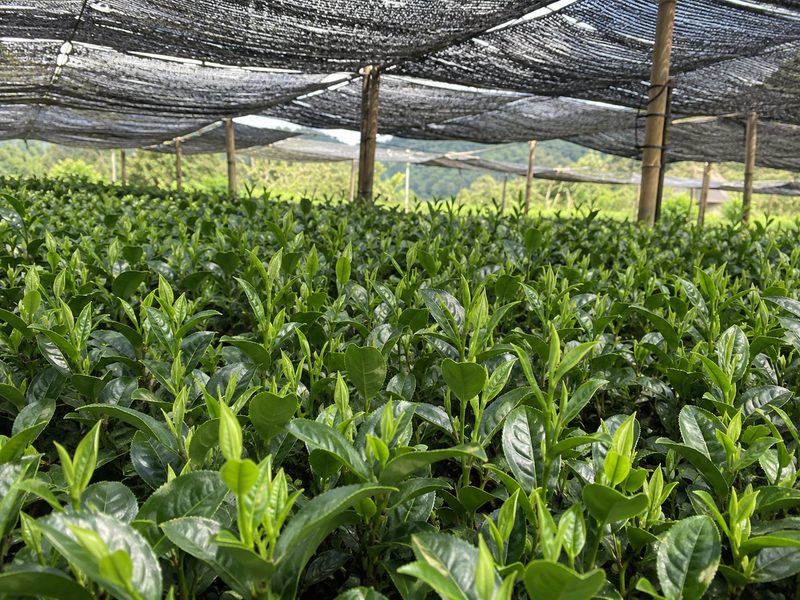
- 2. Why are the plants shaded?
- 3. What should a buyer ask about harvest?
- 4. How do fresh leaves become tencha?
- 5. Why does leaf selection matter?
- 6. How does milling affect the powder?
- 7. What can origin tell you about a lot?
- 8. How should you compare finished samples?
- 9. Which records should follow the leaves?
- 10. When is a leaf claim useful on a menu?
1. Which plant does matcha come from?
Start with identity, then ask about processing
Matcha is tea from Camellia sinensis, the same species used to make many other teas. Its identity depends on how the leaf is grown and processed, not on a separate “matcha plant.” Japan’s Ministry of Agriculture, Forestry and Fisheries describes matcha as powder made by grinding tencha. That matters when a product is described merely as “powdered green tea”: it may have been made from a different processed leaf. Ask the supplier to state the raw material and process in the specification, especially if the distinction matters to your label or product brief.
Do not try to judge plant identity by powder color. A vivid sample still needs an ingredient declaration and traceable lot. For a café buying finished powder, the practical question is whether the product supplied is the tea described on the invoice and whether that same product can be ordered again. If a supplier offers matcha leaves as whole dry tencha for later milling, ask who mills them, under what controls and how the finished powder will be identified. Our matcha grades guide can help frame the tasting brief. A leaf description is the beginning of a purchasing record, not proof that the resulting drink will taste right.
| Term in a supplier offer | What it should identify | Buyer follow-up |
|---|---|---|
| Tea plant | Camellia sinensis | Check ingredient declaration |
| Tencha | Processed leaf for matcha | Ask for process and lot |
| Matcha | Milled tencha powder | Test the finished lot |
| Powdered green tea | A broader description | Clarify source leaf and method |
2. Why are the plants shaded?
Ask for the production method without assuming a flavor
Tea destined for tencha is grown with reduced light before harvest. The Japan Matcha Association describes shaded tencha cultivation and its relationship to the tea’s taste and aroma. Shading is part of the traditional production method, yet a buyer cannot calculate taste from a photograph of a canopy or a claimed number of shade days. Conditions, leaf material and later processing also affect the finished cup. Ask how the offered lot was grown, then taste that lot using the same measured preparation as every competing sample.
If shade duration appears on a product sheet, ask whether it is a controlled specification for this lot or a general description of a farm’s practice. It is possible to make a sound buying decision without receiving every farm detail, particularly for a blended foodservice powder. What matters is honest wording and a repeatable result. A supplier who cannot share exact field practices may still provide traceability and a clear product specification; a supplier who gives an elaborate shade story should be able to explain which lot it applies to. Use the information to frame questions, not as a substitute for tasting.
3. What should a buyer ask about harvest?
Connect harvest details to supply continuity
Buyers often see “first harvest” or a seasonal date used as a quality shortcut. Ask what the phrase refers to in the offered product. Is the powder from one harvest, a blend of harvests, or a consistent profile blended across lots? Can the supplier maintain the same product as demand grows? A harvest story may help tell a menu’s origin, but a chain of cafés also needs a plan for the next shipment. Discuss available volume and the notice given when the source leaf changes.
Fresh leaves move into processing after picking; the precise schedule is a producer’s operating detail. Request the information your purchase decision actually uses: product code, production or milling date as supplied, lot code, and expected reorder window. If you buy tencha for your own milling, receiving quality and storage before milling deserve separate controls. If you buy powder, judge the final lot. Do not promise customers a particular harvest or cultivar unless your order and label controls can preserve that claim. A menu phrase that is true for the launch sample may become false when the recipe quietly switches to a new source.
| Harvest question | Why it matters | Document to retain |
|---|---|---|
| Single harvest or blend? | Reorder expectations | Product specification |
| Volume available? | Menu continuity | Supplier quotation |
| Will source change? | Claim accuracy | Change-notice agreement |
| Which lot was sampled? | Traceability | Sample label and order |
4. How do fresh leaves become tencha?
Follow the sequence, not a romantic picture of a mill
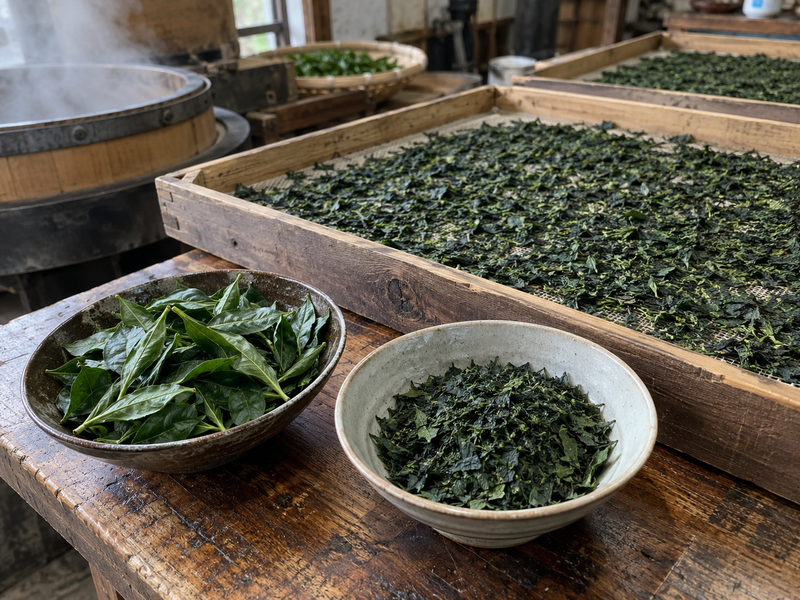
Japan’s agriculture ministry explains that tencha is made from shaded tea leaves that are steamed and dried without the rolling used for some other green teas; the tencha is then milled into matcha. Its tea overview is a useful starting point for the process. Steaming and drying help turn a perishable fresh leaf into a storable material. The precise equipment and control points vary, so ask the producer for its process description rather than assuming every line looks like a traditional workshop.
At the buying stage, the practical distinction is between a claim about leaf treatment and the finished powder you will use. Inspect sample packaging for intact seals and a lot code. Ask how the producer prevents mix-ups between incoming leaf lots and finished products. If a seller claims that a powder is tencha-based, request that description on a specification or other business document. A green color alone cannot show whether the source was tencha or a different powdered tea. For menu development, prepare the powder in the target recipe: the customer experiences the cup, not the process flowchart.
5. Why does leaf selection matter?
Ask what material reaches the mill
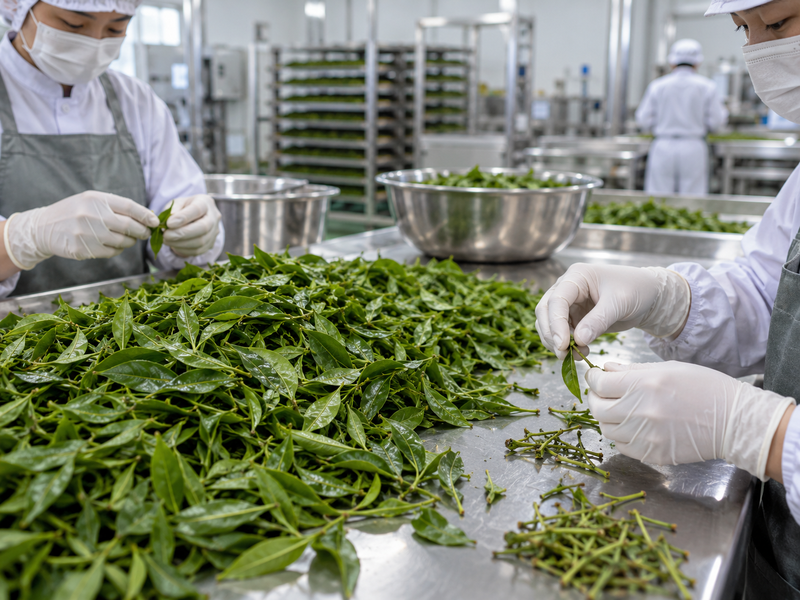
Producers sort and refine processed tea before milling. A buyer does not need to prescribe every sorting step, but can ask how the supplier controls stems, coarse pieces and foreign material in the finished powder. The specification should describe the product that arrives, not simply a beautiful picture of whole leaves. If a powder feels coarse or produces an unexpected texture, ask whether that result is normal for the lot, related to preparation, or a reason for a quality review.
Make a small control cup with a measured dose and consistent water. Look for visible clumps before whisking, observe dispersion after preparation and record mouthfeel. A sieve can resolve some handling clumps, but it should not be used to hide a recurring powder defect without discussing it with the supplier. For a large order, confirm acceptance criteria and how rejected packs will be handled. The point of asking about selection is to connect a manufacturing choice to a serving result: will the powder whisk smoothly, hold flavor in a latte and remain practical for staff to handle? A strict leaf story offers little value if the final product does not meet these tests.
| Finished powder check | Possible operational effect | Next action |
|---|---|---|
| Repeated clumps | Slower service | Check storage and dispersion |
| Coarse mouthfeel | Poor plain tea experience | Compare preparation and lots |
| Visible foreign piece | Quality hold | Keep sample and contact supplier |
| Shifting color | Menu inconsistency | Compare under fixed light |
6. How does milling affect the powder?
Check the material after it has been ground
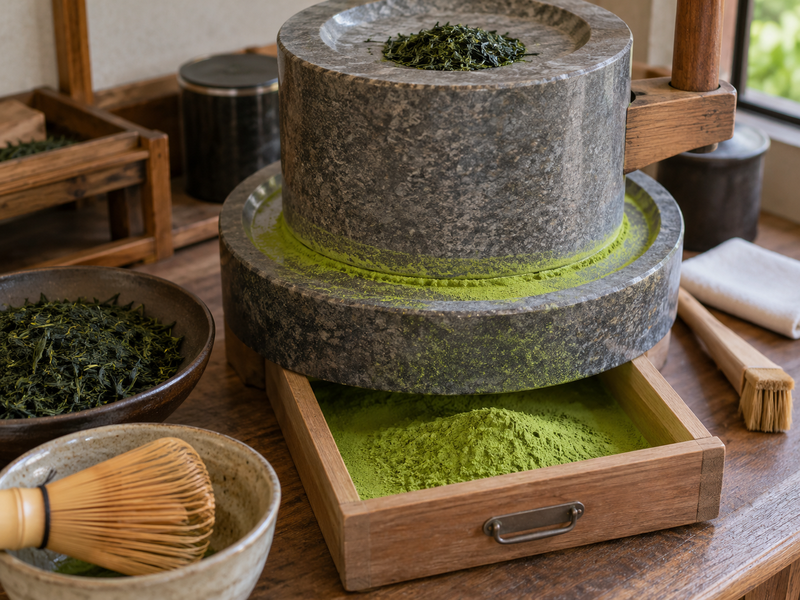
Milling turns tencha into the fine powder used in a bowl, drink or food. Suppliers may describe stone mills or other equipment, but the equipment name is not the whole buying case. Request a finished sample from the product you will receive. Evaluate its appearance, texture, aroma and behavior in the recipes that matter. Ask whether the sampled powder and commercial order will be milled and packed under the same product specification.
Powder exposes much more surface to air than intact leaves, so packaging and handling become part of the assessment. Ask for the supplier’s storage advice and shelf-life terms rather than inventing a universal rule. Open one pack during a pilot and see how it behaves through a normal service period while retaining another unopened for comparison. Staff should reseal working packs and preserve the lot identifier. If a seller offers to mill tencha only after an order, clarify lead time and how the resulting batch will be sampled or approved. A process promise is useful when it leads to a specific, testable delivered powder.
7. What can origin tell you about a lot?
Verify the claim against the item you buy
An origin can help a buyer trace supply and explain a product, but it does not replace sensory evaluation. The ministry’s Uji tea overview describes a long tea tradition in the Kyoto area; it does not imply that every matcha carrying a regional name is suitable for every recipe. Ask whether an origin statement applies to the leaf, processing, milling, packing or all of them. Those steps can occur in different places, and broad marketing language may conceal that distinction.
If you plan to print an origin on a retail pack, ask your compliance team to confirm the wording and documentary support for the destination market. Keep supplier declarations with the lot and packaging proof. A café menu can often be more useful and honest with a sensory description, such as “green tea with a gentle savory finish,” than with a place name customers cannot verify. For a mixed-origin blend, ask for the permitted range of source changes and how the supplier maintains the product profile. The best question is whether the claimed origin changes what you can taste, trace or accurately say to a customer.
| Origin claim | Verify with supplier | Use in the business |
|---|---|---|
| Leaf grown in a named area | Lot-linked declaration | Retail or menu wording |
| Milled in a named area | Processing record | Product description |
| Blended across areas | Ingredient and lot details | Supply planning |
| Packed in a named country | Packing statement | Import documentation |
8. How should you compare finished samples?
Test both tea and the planned product
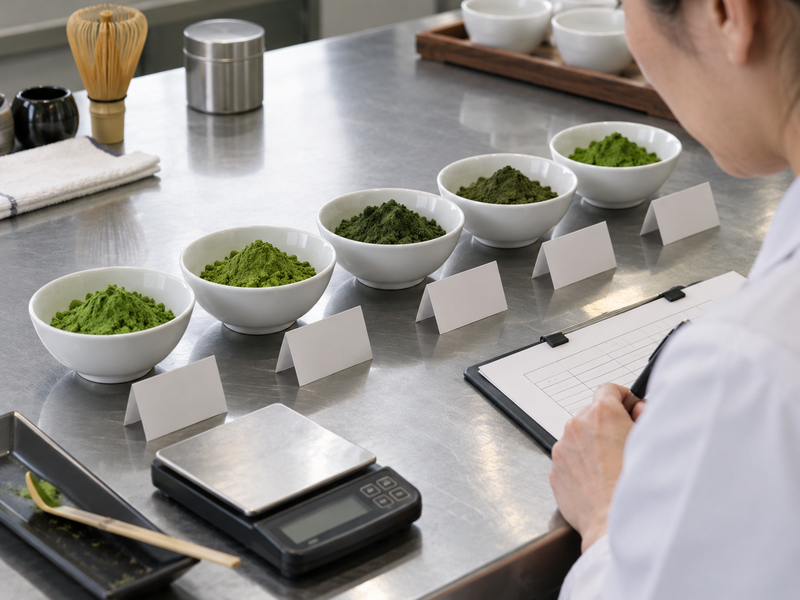
Code samples so a tasting group cannot see names or prices. Fix powder mass, water source, temperature, bowl, whisking method and serving time. Ask tasters to note aroma, first sip, mouthfeel and finish separately before discussing which they prefer. Repeat the strongest candidates in the product that will actually be sold. A powder that tastes delicate in water may be lost in milk; a stronger one may work in a sweet filling. Record the dose at which each candidate succeeds and its cost at that dose.
Use a short scorecard that another staff member can reproduce. Include one hidden repeat sample if possible; inconsistent notes on the same powder may signal preparation noise. Compare color under the same light, not across different phones or rooms. When a new lot arrives, retest against the approved reference. Avoid a purchasing meeting in which the story about matcha leaves overwhelms the cup. The most informative observation may be ordinary: one sample stays clear after ice melts, while another needs extra powder and turns bitter. That distinction changes the recipe and its margin.
9. Which records should follow the leaves?
Keep the chain readable at receiving
Record the product identity, supplier, lot code, quantity, relevant origin statement and the documents required in your market. These may include a specification, lot certificate and declarations needed for your customers. The exact list depends on the jurisdiction and intended use. A document is helpful only if it relates to the same lot as the bags delivered. Teach receiving staff what to compare on the label and paperwork, and what to do when the code or seal does not match the order.
Retain the sample approval, recipe card and any change notices together. If the supplier modifies a blend or milling arrangement, a dated record lets the buyer decide whether to taste again before release. If a customer reports a problem, the business can identify which packs and menu batches used the affected lot. Avoid turning a small sourcing team into a paperwork archive with no process: choose one storage location and name the person who can place a lot on hold. A clear record gives meaning to a supplier’s statement about where its matcha leaves came from.
| Record | Minimum link | Decision it supports |
|---|---|---|
| Approved sample | Product and lot | Reorder comparison |
| Specification | Product code | Acceptance criteria |
| Lot documents | Delivered code | Quality review |
| Recipe card | Approved powder | Service consistency |
| Change notice | Old and new item | Retest decision |
10. When is a leaf claim useful on a menu?
Say only what the operation can keep true
An explanation of matcha leaves helps a guest understand why a drink is prepared differently from steeped tea. A short line about shade-grown tencha or a verified origin may suit a product whose supplier can document the claim and whose recipe keeps that tea character visible. An elaborate field description may disappoint if the drink tastes mainly of syrup. Choose wording after the finished product is approved, then check it against the actual ingredient declaration and supplier records.
Keep a simple claim-review rule: the menu owner checks the wording when the powder, lot specification or recipe changes. If origin is central to the product name, an alternate powder from somewhere else is not a silent substitute. If the buying team wants supply flexibility, describe what the guest can reliably taste instead. The final purchasing decision should bring the field story, lot paperwork, cup quality and serving cost into the same record. That is how a leaf detail becomes useful rather than decorative.
Frequently asked questions
Q1. Are matcha leaves a different plant from green tea leaves?
No. Both come from Camellia sinensis. Matcha is distinguished by the leaf’s cultivation and processing into tencha before milling.
Q2. Is every powdered green tea matcha?
No. Ask whether the source material is tencha and check the supplier’s product specification.
Q3. Does a long shade period guarantee better flavor?
No. Taste the offered lot in a controlled cup and in the finished menu item.
Q4. Can a café buy whole tencha instead of powder?
It can if a suitable milling and quality-control process is available. Confirm how the resulting powder will be identified and approved.
Q5. What should a buyer retain for a reorder?
Keep the approved sample record, product and lot identifiers, specification, recipe card and relevant supplier change notices.