
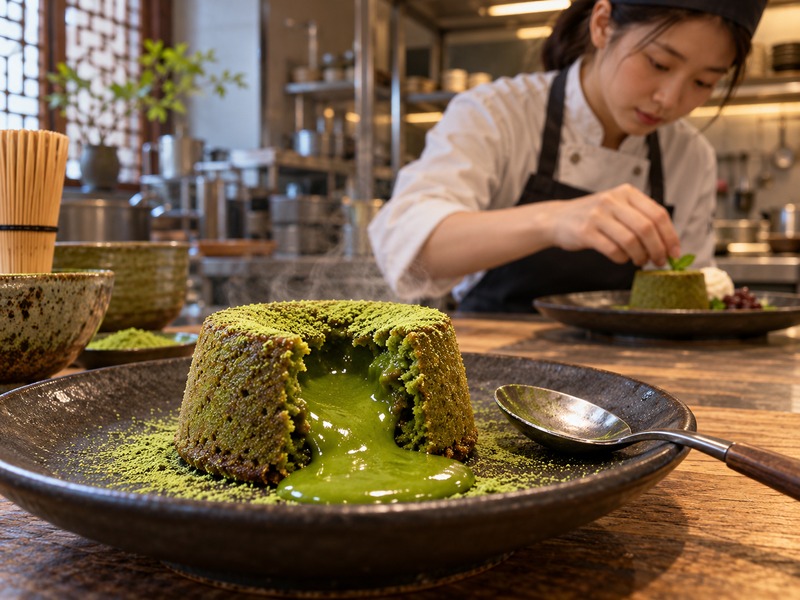
A matcha lava cake can have a flowing center at oven exit and a solid center by the time a server cuts it. Insert mass, mold position, bake load, and ticket delay set that window. Use a separately prepared center and cut samples at the real ticket delay.
Search-intent reference: Matcha Lava Cake.
1. What makes a matcha lava cake work on a menu?
A molten dessert is judged at the moment it is opened. The center has to flow after the normal ticket delay, and the outer cake has to stay upright on a plate. Define a target portion weight and service temperature before testing ingredients. A restaurant may need rapid oven pickup, while a frozen foodservice product must tolerate shipment and a standardized bake. The chosen route determines mold, insert, and staff instructions.
Service window and selling format
Cut-time flow: A lava cake earns its name when a warm shell opens to a flowing center at service. In a matcha version, a green tea note must survive warm white chocolate and any accompanying sauce. Decide whether the venue needs a plated restaurant dessert, a bakery takeaway with reheating directions, or a frozen portion baked on demand. These formats are different products operationally. A plated version can rely on an immediate cut, while a takeaway box may trap steam and stop the center from flowing. Specify the serving window and target center before calculating ingredients.
2. Which matcha and chocolate suit the cake center?
Sweet white chocolate and matcha can pull the dessert in opposite directions. Chocolate helps a green center look smooth, but excess sweetness can erase tea character. Compare powders in warm finished samples, not only in the cooled insert. Ask the chocolate supplier for a consistent specification because fat and sugar levels change flow. A powder with fine particles will disperse more easily and leave fewer dark specks in the center.
Tea flavor in shell and center
White-chocolate balance: Use matcha that remains clear in a high fat, sweet base. Compare candidate powders in both the warm center and baked shell, since the same powder may look different in each. White chocolate can carry green color but may overpower tea with sugar; inspect the ingredient list and cocoa butter content. If the center uses cream, check its fat level and consistency across suppliers. Request powder lot information and a sample from the production grade. Avoid choosing by dry color alone; taste a complete warm portion with the intended garnish.
| Channel | Service method | Main validation |
|---|---|---|
| Restaurant | Bake and plate | Flow after ticket delay |
| Takeaway | Pack and reheat | Steam and center |
| Frozen supply | Bake on demand | Starting state |
3. How should a matcha lava cake formula be designed?
Design shell and center as separate systems. The shell must set enough for unmolding, while the insert must remain fluid at the time of eating. A center made from ganache can reduce reliance on intentionally underbaked egg batter, but its cooling and storage still need controls. Record the ratio of shell batter to insert and the mold fill level. Test the bite with garnish because ice cream or sauce changes perceived sweetness.
Insert and shell weights
Insert-to-shell mass: A separate matcha ganache insert offers a controllable fluid center without depending on an underbaked egg batter. An illustrative insert trial uses white chocolate 100 parts, cream around 50–60 parts, and matcha around 2–3 parts. Set this as a starting point for texture and food safety trials. The shell can use the kitchen’s validated cake batter, with matcha measured against flour or total batter consistently. Record insert weight per mold, shell batter weight, and expected service temperature. A richer insert may flow while hot but set quickly on a cold plate.
4. What preparation sequence keeps the center fluid?
Production order matters when cold inserts meet warm batter. Prepare inserts to a uniform size, then place them centrally so every cake has the same wall thickness. Fill molds without air pockets. The kitchen should write separate routes for chilled and frozen portions because their heat transfer differs. During a trial, cut one cake at the planned service delay and another after a longer realistic wait to find the boundary.
Center placement workflow
Centered insert: Make the insert, cool it under the kitchen’s food safety procedure, and portion it uniformly. Prepare shell batter with sifted matcha so no bitter pockets remain. Deposit a measured base layer, center the insert, and cover it with batter without leaving a thin exposed top. Chill or freeze portions according to a validated plan. At service, bake from a defined starting state and cut a sample after the specified rest. A cake left in its mold too long may continue cooking and lose its flowing center.
| Insert ingredient | Bench parts | Control |
|---|---|---|
| White chocolate | 100 | Sweetness and fat |
| Cream | 50–60 | Food safety and flow |
| Matcha | 2–3 | Flavor and color |
5. How can kitchens make portions consistent at scale?
A line cook cannot rely on a showpiece baked alone in an empty oven. Load molds as they will be loaded during service and note hot spots. Keep molds of one material and diameter in the same batch. Check deposit weights at the start and end of production, then watch how often inserts move off center. Any plan for frozen stock needs a clear inventory rotation and a repeatable bake instruction.
Mold and oven loading
Oven-load spread: Choose molds with uniform diameter and material; a mixed tray of ceramic and metal will bake at different rates. Weigh both insert and shell rather than judging fill lines by eye. Test oven positions, load size, and the time from oven exit to plate. A service line may hold several orders simultaneously, so trial the longest realistic wait. Frozen portions need a separate bake curve and core check from chilled portions. Record any center leak during unmolding because that defect often begins with off center deposition, not oven heat.
6. Which tests define a saleable lava cake?
A quality check should show the cake in two states: intact on the plate and cut at service time. Measure flow, shell set, and whether the green center tastes balanced. Inspect cakes from multiple oven locations. If the center is set, check timing and insert composition; if a side leaks, check deposition and wall thickness. The kitchen should reject a collapsed cake even when its filling still flows.
Timed cut and core check
Shell and core pass: A passing portion has an intact shell, a visible green crumb, and a center that flows after the normal serving delay. Cut through the middle during validation; a camera view from the edge can overstate the amount of fluid filling. Check the center temperature under the kitchen’s safety plan and verify that no raw batter is served when the formula relies on a separate ganache. Taste shell and center together for sweetness, bitterness, and powder grit. Reject cakes that collapse before plating or arrive with a fully set center.
| Run check | Measure | Failure signal |
|---|---|---|
| Insert | Weight and center position | Leak |
| Oven | Load and mold type | Uneven set |
| Service | Exit to cut time | Set center |
7. How should a foodservice team cost each portion?
Portion costing must account for failed cakes and service work. Weigh the insert and shell, add matcha in both, then cost garnish and plate or carton. An overfilled mold raises ingredient cost and can increase leaks. A frozen batch may use more packaging and energy but reduce daily preparation time. Compare options at the same saleable portion weight and with realistic rejection rates from a busy shift.
Cost per served cake
Failed-unmold cost: Cost the insert and shell separately, then add mold preparation, garnish, plate or takeaway pack, energy, and service labor. Count failed unmolds and overbaked portions in a realistic yield, especially during busy service. Matcha price per portion depends on powder grams in both parts; a heavy center can use more powder than the shell. A frozen preportion model may reduce labor at service but add freezer space and packaging. Compare models with the same finished portion weight and the same accepted quality standard.
8. How should prepared cakes be held and served?
Holding rules differ before and after baking. Cream based inserts need controlled cooling and cold storage, while a finished cake loses its molten effect during a long warm hold. Write the starting state on the kitchen instruction and link it to the bake program. If takeaway is planned, test how steam changes shell texture and whether customers can reheat without overcooking the center. Do not borrow a plated dessert window for delivery.
Chilled or frozen bake route
Bake-from-frozen route: A prepared portion needs a clear start state, storage temperature, and use by rule from the kitchen’s validated process. Ganache with cream requires controlled cooling and cold storage. Frozen inventory needs a documented thaw or bake from frozen route, with no informal back and forth between states. A baked lava cake has a narrow serving window; it should be sold promptly rather than held warm until the center changes texture. Test takeaway packaging for steam, collapse, and reheating behavior before offering that channel.
| Cost line | Measure | Loss |
|---|---|---|
| Insert | Mass per mold | Overfill |
| Shell | Mass per mold | Collapse |
| Service | Labor and garnish | Overbake |
9. What safety and labeling controls apply?
A product file should describe every allergen in shell, insert, and garnish. The kitchen also needs records for insert cooling, portion storage, oven program, and service release. Lot codes link matcha and chocolate inputs with molded batches. If a supplier changes white chocolate, repeat flow and flavor checks before treating it as equivalent. Menu wording should describe the dessert customers routinely receive, not a single dramatic cut shot.
Insert lot and allergen file
Cream insert record: Review egg, wheat, milk, and soy allergens in the shell, chocolate, and garnishes. An insert based on cream and white chocolate still requires a food safety review, especially during cooling and service. Record lot codes for matcha and chocolate, insert batch, shell batch, molding date, storage, bake route, and release decision. Staff instructions should state which starting state each bake program expects. A menu can describe a molten matcha center when that center flows under routine service; do not promise a result that only appears in a staged photograph.
10. What should a service pilot prove before rollout?
A service pilot should include multiple tickets arriving close together. Ask cooks to follow the written instruction while a quality reviewer times oven exit, unmolding, and cut. Compare cakes from the earliest and latest mold positions. Measure how many portions meet the flow standard without extra attention from a pastry specialist. The buyer can order routine stock once recipe, service time, storage route, and margin survive that test.
Busy-service pilot
Rush-hour cut: Run a pilot during a normal service simulation, with multiple orders arriving at once. Include an oven loaded as it would be on a busy shift and a realistic wait between baking and plating. Test both early and late portions in a lot. Ask the service team whether unmolding and garnish fit the ticket time. Ask quality to inspect center flow, shell set, and handling records. Approve a powder and insert formula only when the cake performs across those conditions rather than in one carefully timed sample.
| Record | Control point | Decision |
|---|---|---|
| Insert batch | Cooling and storage | Release |
| Portion lot | Mold and start state | Bake route |
| Menu proof | Allergens and description | Sale |
Request matcha samples from Matcha Village with the white chocolate brand, insert ratio, and intended serving delay attached. Test each grade in both the center and shell, then cut cakes from multiple oven positions at the normal ticket time. The purchase decision should follow center flow, shell set, warm tea flavor, and failed-unmold cost on the service line.
FAQ
Q1: Does the center need raw batter? No. A separate matcha ganache insert can provide flow while the shell follows a validated bake.
Q2: Can portions be frozen? Yes, if the kitchen validates storage, bake route, center behavior, and lot controls.
Q3: Why does the center stop flowing? Bake time, delayed service, or a center formula that sets too quickly may be responsible.
Q4: Can a lava cake be delivered? Only after testing the pack and reheating route against the intended center flow and food safety plan.
Q5: How should matcha be selected? Compare the warm finished cake, including shell and center, rather than dry powder alone.