
Matcha angel food cake can rise well in the oven and sink during cooling, leaving a dense green band and torn retail slices. Egg white foam, powder dose, pan loading, and inverted cooling all affect the saleable loaf. Measure height and accepted slices after full cooling, when the cake is free of its pan.
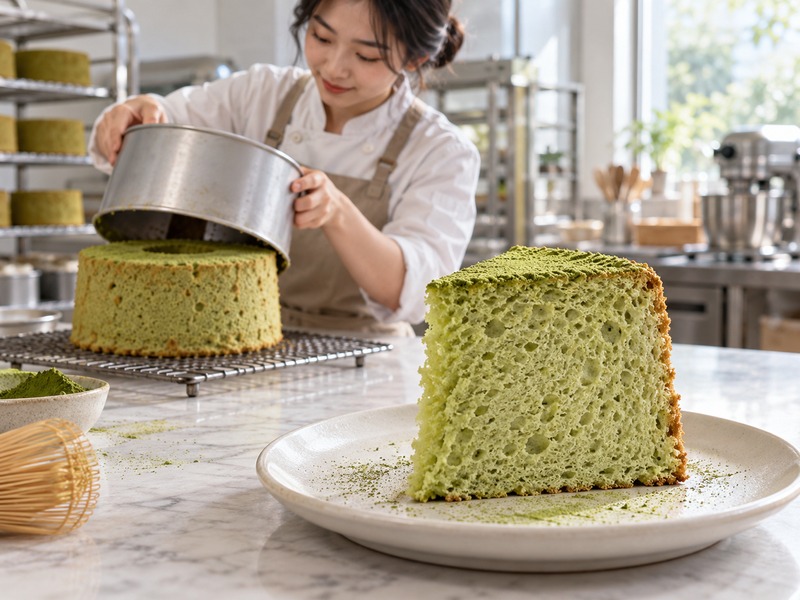
Search-intent reference: Fluffy Matcha Angel Food Cake.
1. What is matcha angel food cake for a bakery?
Angel food cake depends on a fragile foam, so matcha cannot be treated as a decorative color alone. Specify the target cake height, slice resilience, and tea flavor before trials. A whole cake sold in a box needs a protected top, while café slices need clean cut faces. Decide whether toppings are part of the unit. Cream and fruit can make an attractive plate but create a different storage and costing problem from plain cake.
Whole cake and slice target
Height after release: Angel food cake is a light foam cake built around whipped egg whites, sugar, flour, and no added yolk or butter in the classic base. Matcha introduces fine solids and flavor, but too much powder can weigh down the foam and leave an olive crumb. Decide whether the bakery sells a whole tube cake, slices for cafés, or a plated dessert with fruit and cream. Those formats need different crumb resilience. A whole cake must release cleanly; slices must survive cutting and packing. The target is a high, tender green crumb with enough tea flavor to be recognizable without a dense mouthfeel.
2. Which matcha works in a lean egg white foam?
Without butter or yolk in the classic base, the tea note is exposed. The chosen matcha should taste clean and sift into flour without clumps. Compare candidate powders in baked cake, where heat and air may alter color. Request actual shipping grade samples and lot documents from suppliers. A vivid sample that produces a low, bitter cake has not passed the application test, regardless of dry powder appearance.
Powder screen in lean crumb
Baked crumb color: Matcha for this cake must sift finely into dry ingredients and taste clean in a low fat base. There is little butter or chocolate to conceal bitterness, so a harsh culinary grade may stand out. Compare powders after baking because pale foam can show color change clearly. Ask the supplier for current lot documents and test the actual grade intended for purchase. A powder with clumps can form dark flecks that taste concentrated. Do not interpret a bright package photo as proof of bake performance; evaluate crumb from the center and outer wall after cooling.
| Format | Product requirement | Check |
|---|---|---|
| Whole cake | Clean release and height | Cooling and pan |
| Café slice | Resilient cut face | Slice trial |
| Plated dessert | Balance with toppings | Taste together |
3. How should the cake formula balance tea and structure?
Foam cake ratios do not accept casual substitution. Egg white, sugar, flour, and acid if used each affect volume and set. Treat matcha as a measured dry solid and change its rate in small steps. Keep the house formula stable during the powder screen so a volume loss can be attributed to the powder level. Record batter deposit, baked height, and usable slices alongside flavor; a pleasant bite cannot offset a collapsed batch.
Tea dose against flour
Matcha against flour: Use the bakery’s proven angel food base and express additions against flour or egg white weight consistently. A bench starting range for matcha is roughly 2–4% of flour, subject to color, flavor, and volume trials. Fold powder with the flour fraction rather than dropping it into a finished foam in one pile. Sugar supports foam stability, so a sharp reduction to offset sweet toppings may collapse volume. Adjust toppings separately before changing the structural base. Record egg white weight, sugar, flour, powder, acid if used, and final batter deposit per pan.
4. What mixing sequence protects the foam?
The mixing room should keep fat away from the egg white system. Clean tools, accurate white temperature, and a defined whipping endpoint make repeatable foam possible. Sift matcha with flour, then fold without crushing the air structure. Deposit promptly into the pan specified by the bakery method. If a worker waits for oven space, test that wait explicitly because the batter may lose volume before baking starts.
Foam-safe mixing order
Foam endpoint: Start with clean, grease free bowls and tools; residual fat makes egg white whipping unreliable. Sift matcha with flour until the blend looks even. Whip whites to the endpoint required by the house method, then fold dry ingredients in controlled portions with minimal deflation. Deposit batter promptly into an ungreased tube pan when that pan is part of the method. Baking should set the structure before removal. Cool the pan inverted according to the validated process so the cake does not sink under its own weight.
| Ingredient | Trial basis | Watch |
|---|---|---|
| Matcha | 2–4% of flour | Volume and bitterness |
| Egg white | House formula weight | Foam endpoint |
| Sugar | House formula weight | Structure |
5. How can a bakery scale angel food cake batches?
A larger mixer changes how quickly whites reach their endpoint. Train operators on foam appearance and a measurable control if available, then record batch temperature and mixing time as supporting evidence. Use matching tube pans and consistent batter weights. Check all oven positions for rise and surface set. After baking, invert pans as the validated method requires and give them space for airflow during cooling.
Full-mixer and pan trial
Inverted-pan clearance: A large mixer changes whipping time and foam temperature, so translate a small bowl recipe through measured endpoints rather than multiplying minutes. Check foam density or batter mass per fixed volume if the bakery uses that control. Fill pans to a consistent mass and keep pan type uniform. Test oven airflow and position: a crust that sets too fast may crack while the center stays weak. During cooling, give inverted pans enough clearance and time. Record shrinkage and release damage from every run, not only the best cake.
6. Which checks define an acceptable finished cake?
Quality should be assessed after full cooling. Measure height, mass, and the number of clean slices from each pan. Cut through the center to check for tunnels, a dense band, or gummy areas. Taste plain crumb before adding cream or berries. A green cake that tears badly during slicing may be poor for retail even if it looks tall when whole. Test packs for crushed corners after normal movement.
Cooled crumb acceptance
Slice resilience: An approved cake should rise evenly, release with limited tearing, and show a fine, resilient crumb rather than large wet tunnels. Compare height, finished mass, slice compression, and color from the center and edge. Taste without frosting so sugar does not hide a stale tea note. A gray ring may point to heat or powder behavior; a dense band may point to mixing, pan loading, or cooling. Photograph a clean cut with a ruler so packers can judge slice thickness. Check the packed slice after transport for crushed corners.
| Control | Record | Defect |
|---|---|---|
| Batter | Pan deposit weight | Uneven height |
| Oven | Position and bake endpoint | Weak center |
| Cooling | Inversion time | Shrinkage |
7. How should portion yield and cost be measured?
A foam cake can have a high apparent yield but a low saleable yield after trimming and breakage. Count good slices from each pan and price by accepted units. Include egg white separation waste or purchased white cost, matcha, sugar, pan preparation, cooling space, and protective packs. Toppings should be a separate cost line. Compare powders by total usable cake output and flavor, not only purchase price.
Cost per good slice
Accepted slices per pan: Egg white, sugar, and usable slice yield drive the cost sheet. Track raw egg separation loss or the price of pasteurized whites, then add matcha grams, flour, pan labor, cooling space, and packaging. A cake can look tall but yield fewer good slices if the top or base needs heavy trimming. Price whole cakes and café slices on separate yield calculations. If cream or fruit is sold with the portion, calculate that as a separate assembly component with its own waste and cold chain. Judge powder cost against cake volume, not only color.
8. How should matcha angel food cake be packed?
A cooled plain cake and a cream topped slice require different handling. Evaluate the selected pack for condensation, crushing, and color loss under display light. Let the finished cake reach the proper cooling endpoint before sealing. A rigid base may protect a slice better than a soft bag during delivery. If the bakery adds dairy or fruit, validate a chilled route and a new selling window for that finished unit.
Slice pack and display
Lid clearance: Cool completely before wrapping or slicing; residual heat can create moisture inside a bag and soften the crumb. Choose a pack that protects height without crushing the top. Slices need support under their cut face and enough clearance from the lid. Study color and texture under the actual display light, then validate a selling window for the finished cake. Cream topped versions need a separate refrigerated plan from plain cake. Avoid borrowing a shelf life from plain vanilla angel food cake because matcha color and added toppings change the finished product.
| Cost line | Measure | Risk |
|---|---|---|
| Egg white | Usable input mass | Separation loss |
| Cake | Good slices per pan | Trim |
| Pack | Support and clearance | Crushing |
9. Which safety and labeling records matter?
Ingredient and process records should let quality trace a slice to egg whites, matcha, pan batch, and packing time. Note whipping endpoint, deposit weight, bake, inversion, and release checks. Review egg and wheat allergens, plus milk if toppings use it. Any origin or organic statement needs documents that cover the claimed ingredient or finished product as required. A marketing panel cannot substitute for the approved ingredient specification.
Egg-white lot record
Egg-white lot: Egg and wheat are core allergen considerations, with milk present if cream or certain decorations are added. Check purchased egg white specifications, matcha lot records, sanitation, and storage conditions. Batch records should link mixing endpoint, pan loading, bake, inversion cooling, release, slicing, and packing. An “egg white cake” label still needs the complete ingredient declaration required in the destination market. Confirm any origin or organic claim against supplier paperwork and finished product requirements before cartons or menu boards are printed.
10. What must a bakery pilot confirm before rollout?
The pilot should reproduce a full production load with routine staff. Run a plain control alongside two powder levels, then compare height, crumb, tea flavor, and good slice yield. Pack and move representative slices; inspect them after the actual selling hold. If volume varies widely by oven position, solve the process before selecting a costly grade. The final purchase specification should reflect cake performance in a repeatable batch.
Full-load bakery pilot
Full-load oven trial: Run a trial using the planned mixer size, tube pans, oven rack layout, cooling method, and slicer. Compare a plain control with at least two matcha levels while keeping foam method fixed. Measure height and good slice yield after full cooling, then inspect packs after a representative delivery. If a brighter powder reduces volume or tastes harsh, it is not the right choice for this cake. Approve the grade only when the team can repeat height, crumb, flavor, and pack integrity at the intended volume.
| Record | Stage | Purpose |
|---|---|---|
| Ingredient lot | Egg white and matcha | Trace |
| Batch sheet | Whip, bake, cool | Repeatability |
| Label proof | Allergens and claims | Sale |
When requesting grades from Matcha Village, provide the egg-white method, matcha percentage against flour, and photographs of cooled center slices. Compare candidates in a full pan load with identical whipping and inversion conditions. Buy the grade that preserves cake height and tea flavor while producing the planned number of intact packed slices; a vivid dry powder alone is insufficient.
FAQ
Q1: Does angel food cake use butter? The classic base relies on egg white foam and contains no added butter or yolk.
Q2: Why did the cake sink? Check foam endpoint, fat contamination, bake set, pan type, and inverted cooling.
Q3: Can matcha be folded into finished foam? Sift it with flour and add in controlled portions to reduce clumps and foam loss.
Q4: Should the pan be greased? Follow the validated angel food pan method; an ungreased tube pan commonly supports climbing batter.
Q5: Can slices be sold with cream? Yes, with a separate refrigerated handling, allergen, and shelf life plan for the finished portion.