
Customers who ask for a “matcha latte sugar free” may mean three different things: no sweetener added at the bar, a drink without added sugar, or a drink with very little sugar in total. Those are different orders. Milk can contribute sugar even when the matcha and flavouring do not. A café needs an ingredient record and a recipe that staff can repeat before it puts a sugar claim on the menu. This guide starts with the language at the till, then builds an unsweetened drink the bar can make during a rush.
The top-ten search result Easy Iced Matcha Latte Recipe (No Sugar) uses maple syrup in its ingredient list. That is a useful reminder to read a recipe past its headline. A home recipe can show a pouring order, but a café has to check every ingredient, substitution and menu claim in its own finished cup.
1. What does “matcha latte sugar free” mean when a customer orders?
Ask one short question at the till
Train the register team to ask, “Would you like it without added sweetener?” when a guest uses the phrase “sugar free.” This identifies the common practical request without making a claim about the drink’s total sugar. If the guest needs a precise dietary limit, staff should consult the approved ingredient information rather than guess. A standard dairy latte may contain naturally occurring lactose. Some plant milks are sweetened, and even an “original” carton can differ from an “unsweetened” carton of the same brand. The order ticket should name the exact milk and state “no added sweetener” if that is what the guest chose.
Do not let a POS button called “sugar free” stand in for a recipe. It can hide a change of milk, a sweetened premix, or a sauce added at the bar. Keep the approved ingredient labels with the bar card. If a supplier changes the formula, review the drink again.
| Customer phrase | Clarifying question | What the ticket records |
|---|---|---|
| “No sugar” | “No added sweetener?” | Milk choice; no syrup or sweetened mix |
| “Sugar free” | “Do you need total sugar information?” | Refer to approved ingredient record |
| “Less sweet” | “Would you prefer half the usual syrup?” | Measured syrup amount |
2. Which matcha should a café buy for an unsweetened latte?
Taste the tea without syrup first
Choose plain matcha powder with an ingredient statement that names tea rather than a pre-sweetened latte mix. Ask the supplier for a current specification, lot identification and storage guidance. Make a small cup at the dose and milk ratio you intend to sell. Without syrup, rough bitterness, stale aroma and muddy colour are easier to notice. Paying for the most expensive ceremonial label does not guarantee a better latte; a powder that performs in water may lose its character in milk. Taste the finished drink after the normal handoff time, not only at the tasting table.
Test two candidate lots if the café buys in bulk. Record the whisking method, water temperature, milk and dose for a fair comparison. Score aroma, colour, finish, dispersal and cost per accepted serving. Keep an unopened reference sample under the supplier’s storage conditions. Compare each new shipment with the approved lot. The bulk matcha for coffee shop buying guide covers the broader purchase decision; the unsweetened cup is the final taste test.
3. Which milk fits an unsweetened matcha latte menu promise?
Read the exact carton and test its texture
Start with the milk the café actually stocks. The word “unsweetened” on a plant milk generally addresses added sweeteners, but the finished drink’s sugar content still depends on the product and serving size. Dairy milk contributes lactose. An oat, almond or soy product may have a different ingredient profile and a different effect on foam, colour and tea flavour. Do not assume that a different carton in the same brand family behaves the same way. Compare labels, then taste both hot and iced cups with the approved matcha dose.
A thick barista blend can make the drink seem sweet without syrup, while a thin unsweetened milk can leave a bitter edge. Check iced flavour after ten minutes and hot texture after the first few sips. Decide whether the menu lists one default milk or asks customers to choose. The bar card needs the product name and a substitution rule, not just “milk to fill.”
| Milk check | Record from the pack or test | Why it matters |
|---|---|---|
| Ingredient list | Exact product and sweeteners | Menu wording |
| Nutrition panel | Sugars per serving used | Customer information |
| Iced taste | After pouring and after ten minutes | Dilution and finish |
| Hot texture | At handoff temperature | Foam and mouthfeel |
4. How much matcha belongs in each cup?
Fix the dose before adjusting flavour
Weigh a starting dose rather than relying on a heaped spoon. For a 12-ounce service cup, a café might test 2, 2.5 and 3 grams of matcha in otherwise identical drinks; these are trial points, not a universal recipe. Matcha strength depends on the tea, milk volume, ice and the guest’s expectation. The approved dose is the smallest amount that gives a clear tea flavour without an unpleasant dry finish. A larger cup may require a new recipe, rather than stretching the same concentrate with more milk.
Mix the powder with a measured amount of water before it goes into milk. Sifting may reduce lumps, but a consistent whisk or mixer method matters more than a ceremonial-looking gesture behind the counter. Record water volume and temperature along with the powder. If a cup tastes harsh, first confirm the powder, dose and water method before adding sweetener to cover the fault. Once the recipe is approved, use a scale or calibrated portion tool and check the actual output of any automated dispenser. A mismatch of half a gram repeated across a busy day changes both taste and stock use.
5. How should baristas build an iced cup without added sugar?
Give staff a sequence they can repeat
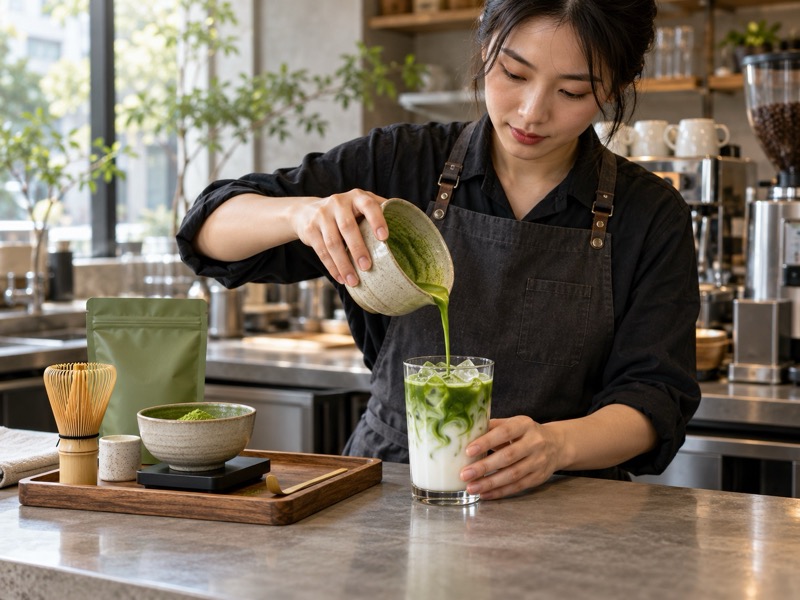
Prepare a smooth matcha concentrate from the weighed powder and water. Fill the approved cup with a measured ice portion, add the exact milk volume, then pour the concentrate. Stir or serve layered according to the menu photograph, but make the drinking instructions clear: a layered cup can taste milky on the first sip and strong at the bottom. The glass, lid and straw change how quickly the guest mixes it. Test the drink in its real takeaway pack, including the usual queue time.
Do not replace a missing unsweetened milk with a sweetened one without telling the guest. Put the permitted carton on the bar card and make the POS substitution visible to the barista. If the recipe needs a sweetener to taste acceptable, it is not yet a good no-added-sweetener recipe. Recheck the powder and milk combination before calling it complete. A small service trial will reveal whether staff can whisk and assemble the drink within the café’s normal ticket time.
| Step | Control point | Reject when |
|---|---|---|
| Portion | Approved matcha grams | Scoop varies between staff |
| Disperse | Measured water and smooth concentrate | Dry clumps remain |
| Assemble | Measured milk and ice | Cup is overfilled |
| Handoff | Correct milk on ticket | Unapproved substitution |
6. How should a hot version change?
Approve it as a separate drink build
Use the same approved matcha as a starting point, but do not copy the iced recipe gram for gram without tasting. Ice dilution disappears, the milk texture changes, and heat can make rough tea more obvious. Prepare the matcha concentrate separately, steam the selected milk using the café’s food-safety procedure, then combine. Avoid pouring dry matcha into a steam pitcher; clumps can hide in the foam and give the last sip a bitter burst. Watch what happens when the cup sits for five minutes under a lid.
Document cup size, concentrate volume, milk volume and service temperature in the hot bar card. If the approved unsweetened plant milk steams poorly, use a different tested product and revise the menu information. A hot order may be slower than an iced one because it occupies the steam wand; test both recipes at peak service rather than during a quiet training session. The target is a warm, balanced cup that still tastes of matcha after the first mouthful of foam.
7. What can staff offer when a guest wants more sweetness?
Keep customisation measured and honestly named
Offer the regular sweetened latte as a separate build, or provide a measured addition after the guest chooses it. Syrup, honey, agave and maple syrup all change the sugar picture. A “natural” sweetener is still an ingredient to record and cost. A non-sugar sweetener can also change aftertaste and may have its own ingredient and labelling implications. Train staff to state what they are adding, not to promise that a custom cup will still meet a “sugar-free” description. Do not improvise with a retail sachet that has not been tested in matcha.
Try small, documented changes in a tasting: different milk, a lower dose of a harsh powder, or a measured sweetener option. A guest who asks for less sweet may be satisfied with half the standard syrup, while a guest avoiding added sugar needs a different ticket. Record those choices separately in the POS. That data tells the café whether an unsweetened default deserves a permanent menu line or should remain a well-trained modification. It also stops an ambiguous “light sugar” instruction from becoming a different drink on every shift.
8. How should claims, allergens and substitutions be checked?
Review the finished drink, not one ingredient
Use a modest menu description such as “matcha latte with no sweetener added” only after checking the exact tea, milk and any topping. A more formal “sugar free” claim depends on the finished product and the rules in the market where it is sold. In the United States, 21 CFR 101.60 sets conditions for sugar-content claims on food labelling. A café should get qualified local advice before placing a regulated nutrition claim on packaging or marketing. Milk’s natural sugars make a blanket “zero sugar” promise particularly risky.
Keep current supplier statements for matcha, milk and optional add-ins. Note dairy, soy and nut ingredients where relevant, and follow the café’s normal cross-contact procedure. A request to switch milk changes the ingredient and nutrition record; it is not a cosmetic edit. If the normal bar product is out of stock, the manager should approve a substitute only after checking the new label and tasting the recipe. Put that decision where both the till and bar teams can see it. Staff should have a simple way to say, “Let me check the ingredient record,” rather than giving a confident answer from memory.
| Change | Who checks it | What is updated |
|---|---|---|
| New matcha lot | Purchasing and bar lead | Taste and lot record |
| New milk carton | Manager | Ingredients, taste and menu wording |
| New sweetener | Manager | Recipe, cost and customer information |
| New menu claim | Owner or qualified adviser | Approved public wording |
9. What does the accepted cup cost?
Include waste, remakes and a second milk SKU
Cost the finished drink from the exact grams and millilitres on its bar card. Matcha, milk, ice, cup, lid and any approved garnish belong in the calculation. Add the powder lost in sifting, whisking and remakes; a neat spreadsheet that ignores those losses will flatter the margin. If unsweetened milk is a separate carton used only for a handful of orders, count spoilage from opened packs. A lower-sugar choice may be valuable to customers, but the café still needs to know its real cost.
Compare the standard latte with the no-added-sweetener build at the same cup size. Removing syrup saves some ingredient cost, but a different milk or extra preparation step may offset it. Observe ticket times during a rush and check dose on several shifts. If the version sells steadily, ask for a milk pack size that matches turnover. If it sells rarely, offer it as a controlled modification.
| Cost line | Measure | Common miss |
|---|---|---|
| Matcha | Grams per accepted cup | Clumps and remakes |
| Milk | Millilitres and opened-pack yield | Slow-moving unsweetened stock |
| Packaging | Actual cup and lid | Different hot and iced formats |
| Labour | Observed ticket time | Extra whisking step |
10. How can a café test the drink before a full launch?
Run a short service trial with ordinary staff
Start with a small number of real service days. Give every shift the same recipe, product labels and till wording. Ask staff to record the requested milk, whether the guest wanted no added sweetener or simply less sweetness, and any remakes. Taste a random cup at opening and another during the busiest period. The second cup is often more revealing: a rushed whisk, wrong carton or inconsistent portion can make a carefully developed recipe fail in service. Check that the menu image matches the cup a customer actually receives.
Review customer comments against the recipe version and the lot in use. “Too bitter” may point to the powder or dose; “too watery” may point to ice and milk volume. Change one variable at a time and have the bar team sign off on the new build. If the trial works, publish the exact customer-facing wording, update the POS and set a date to review sales and waste. If it does not, keep the tested unsweetened modification available while the team fixes the cup. A clear ingredient answer and a repeatable drink are better than a menu claim the café cannot support.
Frequently asked questions
Q1: Is an unsweetened matcha latte automatically sugar free?
No. Milk may contain naturally occurring sugar, and the result depends on every ingredient and the serving size. “No sweetener added” describes the bar action more precisely.
Q2: Does pure matcha powder contain added sugar?
Plain matcha should be checked against its current ingredient statement. Sweetened latte mixes are different products, even when the front of the pack says matcha.
Q3: Can a café use maple syrup in a no-sugar recipe?
Maple syrup adds sugar. If it is used, name and measure it; do not describe that finished cup as having no added sugar.
Q4: Is unsweetened plant milk the best choice for every guest?
No. Taste and ingredients vary by product, and some guests need a specific allergen or nutrition answer. Check the exact carton and approved recipe.
Q5: Should the iced and hot versions share one bar card?
Keep separate builds. Ice, milk texture, cup size and service temperature change the finished drink and its cost.