
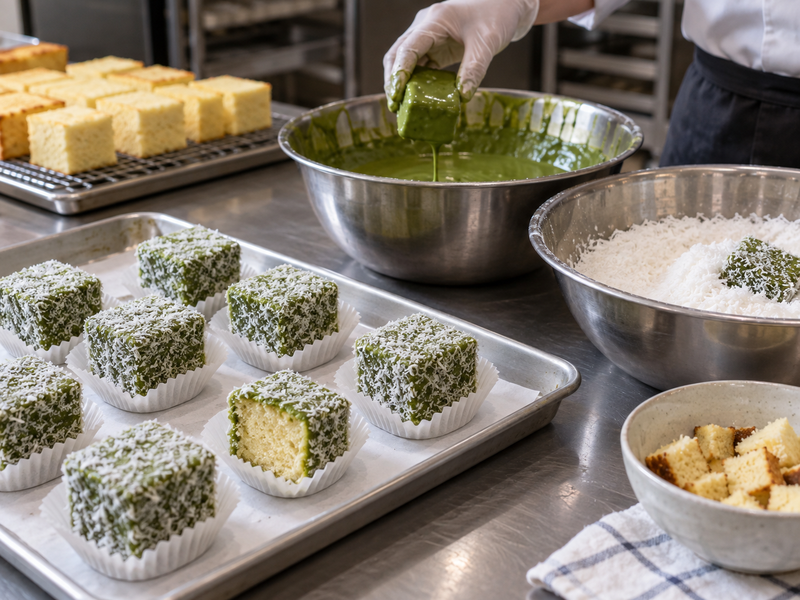
Matcha lamingtons bring together a cake cube, a tea-flavored coating and coconut on every side. The difficult part is keeping those layers in balance. A very soft cake can break during dipping, while a heavy glaze can hide the sponge and make the portion too sweet. A bakery trial should follow the product from the cut slab through coating and packing, measuring where weight is added and where saleable pieces are lost.
Contents: Format · Cake · Cutting · Glaze · Tea · Dipping · Coconut · Holding · Cost · Release
1. What should the finished matcha lamingtons look like?
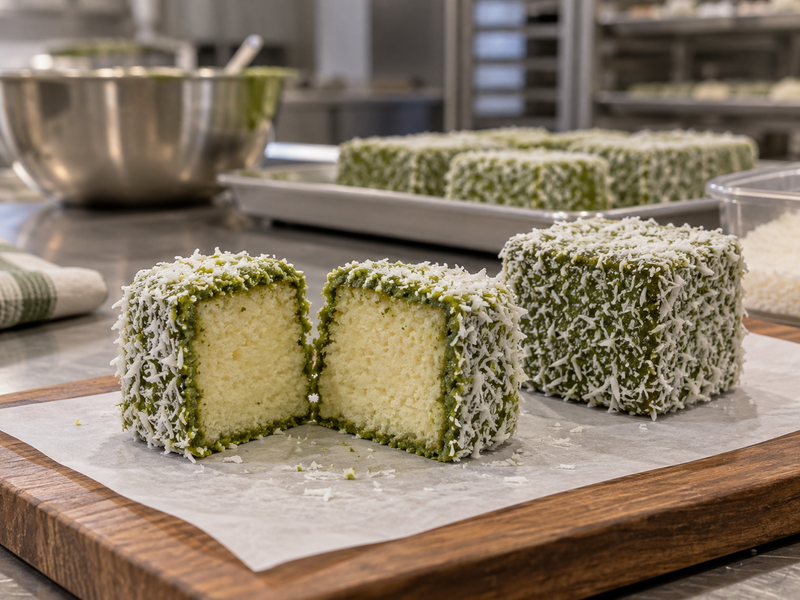
Define a cube with visible sponge inside and a continuous coating outside. The customer should be able to distinguish the tender cake from the coconut finish. A thick wet band around the crumb or bare patches at the corners suggest that the coating process needs adjustment, even if the top looks attractive.
Set the portion around the eating occasion
| Format | Useful feature | Development concern |
|---|---|---|
| Small cube | Fits a tasting selection | High coating relative to cake |
| Standard cafe portion | Clear sponge center | Comfortable bite and pack fit |
| Filled version | Additional flavor layer | More handling and moisture |
The Sift & Simmer reference uses vanilla cake cubes with a matcha white chocolate coating and coconut. It offers a useful example of tea concentrated around a pale center. A commercial version still needs its own geometry, coating weight and handling checks.
Start with an unfilled cube. Adding jam or cream before the basic coating process works makes it harder to identify the cause of breakage or softening. Keep one cut sample in the approval photographs so the intended cake-to-coating relationship is visible alongside the whole product.
2. Which cake base can survive the coating process?
Use a cake that is tender to eat but firm enough to lift, turn and coat. A bakery’s established plain sponge or butter cake can provide a starting point. The relevant test is not simply whether it tastes good on a plate; it must remain intact while its exposed faces contact the glaze.
Test the cake with the planned tools
Select one existing base formula and bake it at a controlled slab depth. Record the pan, batter weight and cooling process. A thin edge and a high center create uneven cube sizes before coating even begins. Compare pieces from different positions so the approval is not based only on the best central cut.
Sift & Simmer emphasizes a cake firm enough to hold its shape. Coles’ lamington recipe provides another primary recipe example using a sponge and a fork-assisted dipping method. These references show possible approaches without establishing one universal cake for every bakery.
Allow the cake to reach the condition specified in your trial before cutting. Warm cake can compress or tear more easily during handling. If chilling is part of the selected method, document it and evaluate the eating texture afterward rather than using cold firmness alone as evidence that the cake is suitable.
3. How do you cut even cubes without excess trim?
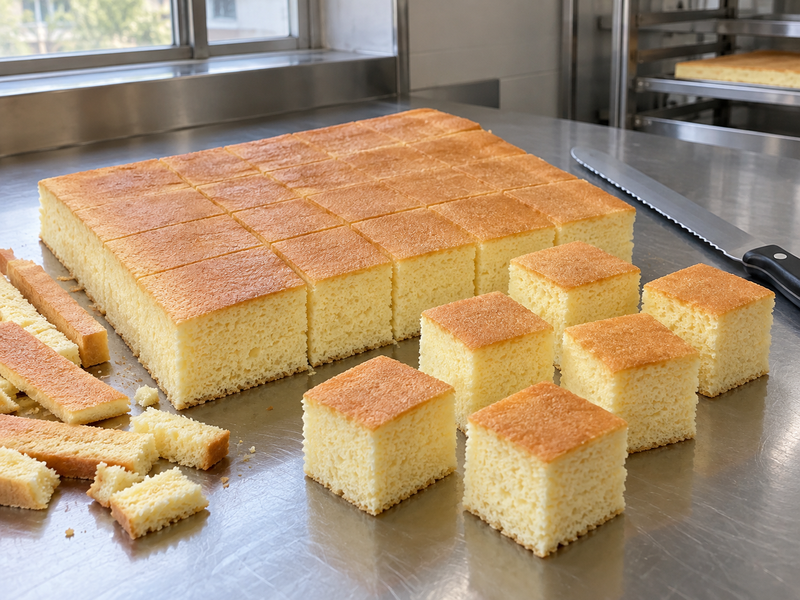
Measure the cooled slab and draw a cutting plan before production. Base the count on usable internal dimensions after any crust or edge trim required by the product. Theoretical cubes calculated from the pan’s outside measurements can overstate yield. A slightly different cut size may use the slab more efficiently, but it still needs to fit the intended portion.
Check the faces that will be coated
| Cutting check | Observe | Why it matters |
|---|---|---|
| Equal dimensions | Height, width and length | Consistent coating demand |
| Clean faces | Torn or compressed crumb | Glaze absorption and appearance |
| Sharp corners | Broken edges | Finished shape |
| Trim weight | Material removed | Actual cake cost |
Use a suitable sharp knife and a method that avoids pressing the sponge flat. Keep crumbs from accumulating on the cutting surface and adhering to the next cube. Record whether the top crust is retained or removed; changing that detail can alter both appearance and coating behavior.
Weigh a sample of cubes before dipping. If dimensions look equal but weights vary substantially, inspect the slab for density differences. That variation can affect how the pieces handle and how much coating they pick up, so it should be investigated before glaze adjustments begin.
4. What kind of matcha glaze should you develop?
A white chocolate-based glaze gives a creamy coating, while an icing-style glaze creates a different sweetness and setting behavior. Choose the system that fits the desired bite and handling. Do not substitute tea powder directly for cocoa in an existing chocolate icing without a trial; flavor intensity and the amount of powder required differ.
Keep the first coating formula simple
Begin with a plain coating base already suitable for cake dipping in your kitchen. Record its chocolate, liquid, sugar and fat ingredients. Add matcha as a controlled variable, keeping any dispersion liquid within the formula. If the chosen base needs reformulation to flow correctly, make that adjustment separately from the tea comparison.
The Sift & Simmer version illustrates a white chocolate route, while the Coles recipe uses a conventional cocoa icing. Their sequences and proportions belong to different coatings. Borrow the general understanding that the glaze must cover the cube and release excess, then validate your own tea version with the selected cake.
Inspect the glaze at the start and end of a short dipping run. It may change condition while staff work. Record the working method and any approved conditioning step so the last cubes do not receive a much heavier layer than the first without anyone noticing.
5. How can tea strength and glaze pickup be tested?
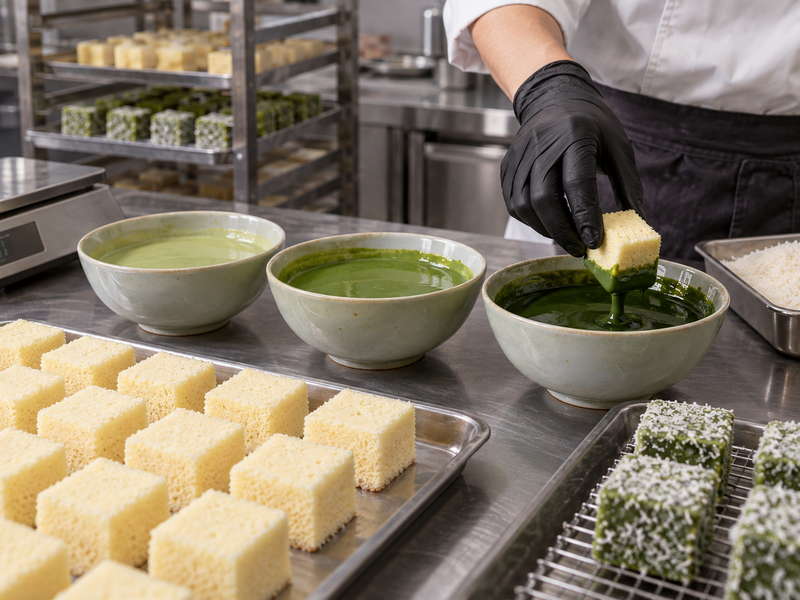
Compare tea strength before changing the cake or coconut. The proposed additions below are screening points for an existing plain white coating base, not a tested recipe. Use equal amounts of that base and keep the working condition similar. The best dose must be judged after the cube receives coconut, not from the glaze alone.
Measure what stays on the cake
| Trial | Plain coating base | Proposed matcha addition | Record after dipping |
|---|---|---|---|
| A | 200 g | 2 g | Coated cube weight |
| B | 200 g | 3.5 g | Coated cube weight |
| C | 200 g | 5 g | Coated cube weight |
Weigh the plain cube, the drained glazed cube and the finished coconut-coated cube. Those three weights distinguish cake size from glaze pickup and coconut pickup. Two equally green products can contain quite different amounts of coating, which affects both flavor and cost.
If the higher tea dose thickens the glaze enough to change pickup, record that effect. Do not immediately dilute it without measuring the addition. Choose the next trial deliberately: refine tea dose, adjust the coating base or compare a different powder, while preserving enough controls to understand the result.
6. How do you coat six sides without damaging the cake?
Arrange the cut cake, glaze, draining area and coconut in a sequence that avoids crossing tools over finished pieces. Work with a manageable amount of glaze so cake crumbs do not accumulate through an unnecessarily long run. Keep the main batch under the conditions required by the formula and your operation’s controls.
Support the cube during turning
Use the selected forks or dipping tools to turn the cake gently and expose each face. Let excess coating leave the cube through a consistent movement. Avoid squeezing with the tools, which can dent the sponge or create a weak corner that breaks during the next transfer.
Time a short run with the normal operator. A very delicate method may produce beautiful development samples but be difficult to repeat over several trays. Compare the first, middle and last pieces for coating thickness and crumb contamination. If the coating becomes rough, inspect both the cake’s strength and the condition of the glaze.
Record any rejected cubes immediately. A piece broken during dipping is different from one damaged during packing. Keeping those stages separate helps the bakery decide whether to improve the base cake, the tool or the workflow. Do not hide the cause by trimming every broken cube into a smaller unplanned portion.
7. Which coconut cut gives the right finish?
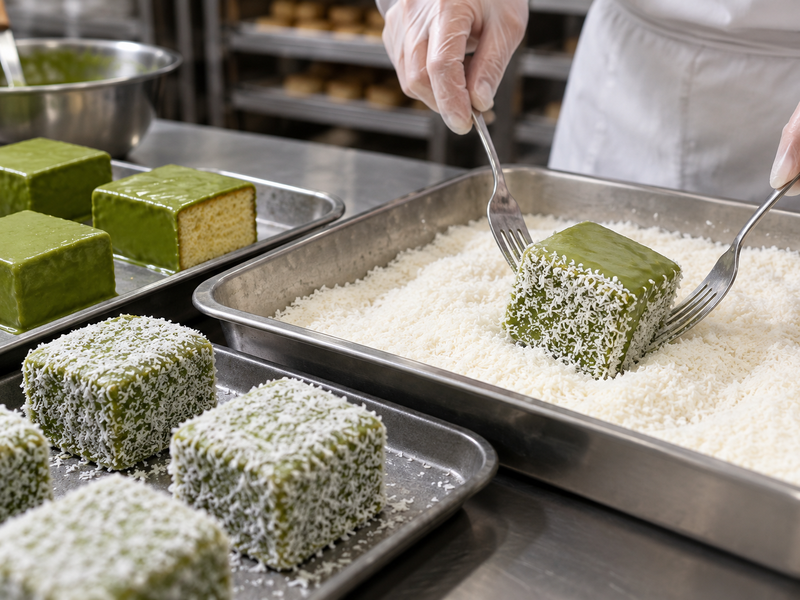
Coconut particle size changes coverage and the eating texture. Fine desiccated coconut can make a more continuous surface, while longer shreds create a rougher appearance and may fall away during packing. Specify the product actually used in the approved trial, including whether it is sweetened and how it has been processed.
Compare coverage after handling
| Coconut choice | Observe on the cube | Purchasing detail |
|---|---|---|
| Fine desiccated | Even coverage and fine bite | Particle description |
| Longer shredded | Loose strands and texture | Cut length |
| Sweetened product | Added sweetness and adhesion | Full ingredient list |
| Tea-tinted coconut | Surface flavor and color | Measured powder addition |
Start with plain coconut while selecting the glaze’s tea strength. If matcha is later added to the coconut, treat that as another finishing trial. Dry tea on the surface reaches the tongue differently from tea dispersed in the glaze and may make the first bite more intense.
Use shallow working portions and keep the coating station orderly. Wet clumps formed by stray glaze can adhere unevenly to later cubes. Follow the kitchen’s handling procedure for used coconut rather than automatically returning it to clean stock. Include the amount consumed or discarded in the production cost.
8. What should be checked after the coating sets?
Cut a finished cube and inspect the boundary between glaze and crumb. Some absorption is part of the product, but a thick saturated band may make it feel heavy or fragile. Compare samples after the normal setting interval and through the planned quality study. Keep the serving condition consistent when tasting.
Examine the bottom and corners
The bottom may collect excess glaze while the cube rests. Corners may lose coconut during transfer. Lift the product from the actual paper cup or tray and inspect those areas, not just the visible top. A finished piece should remain recognizable as the approved shape after ordinary handling.
If a glaze containing dairy ingredients requires chilled handling, keep that requirement attached to the product. Do not adopt room-temperature instructions from a different icing system. Shelf-life and storage decisions need the actual formula, process and packaging assessed together; a home recipe’s suggested duration is not a commercial approval.
For a cream- or jam-filled version, repeat the relevant tests after introducing the filling. Splitting the cube creates another fragile interface and another source of moisture. The unfilled version’s successful coating trial is useful background, but it does not establish how the filled product will behave in the same pack.
9. How do you measure the real yield and cost?
Build the cost from saleable coated pieces. The cake slab’s theoretical count misses trim, dipping breaks, coating losses and packing damage. Weighing the components at a few defined points makes those losses visible without turning every production run into a lengthy research exercise.
Keep a short mass-balance record
| Record | Measure | Purpose |
|---|---|---|
| Cake yield | Usable cubes and trim | Base cost per piece |
| Glaze pickup | Before and after dipping | Coating portion |
| Coconut pickup | Before and after rolling | Finish portion |
| Station losses | Unusable coating and crumbs | True material cost |
| Packed yield | Saleable pieces | Order planning |
Add labor for cutting, dipping, rolling and packing. A small cube may use less cake but require nearly the same handling as a larger one. Its coating proportion can also be higher, so reducing size does not necessarily reduce unit cost in direct proportion to weight.
Check the proposed sales pack with a normal number of pieces. Tight spacing may scrape coconut from the sides, while excess movement can damage corners. Include the paper cups, dividers and lid in the trial so packaging costs reflect the arrangement that actually protects the product.
10. What must be confirmed before a larger bakery run?
Confirm the base cake, cooled cube dimensions, glaze formula, tea dose and coconut product as one specification. Add the dipping tools, working condition and transfer method. Photographs should show the exterior, cut center and acceptable underside. A supplier or new operator needs those details to understand the product beyond its green color.
Give the tea supplier the coating application
Explain whether matcha is used in the glaze, coconut finish or both. Include the trial dose and the type of white coating base. The Matcha Village culinary matcha guide can help frame sampling for food applications, while approval should remain based on the complete coated cake.
For incoming ingredient changes, repeat the relevant comparison. A new coconut cut calls for coverage and handling checks; a new chocolate calls for glaze flow and set checks; a new tea calls for flavor, color and dispersion checks. Keep the records linked to the material actually purchased.
Run one full tray through the normal cutting and coating team before confirming a wholesale quantity. Count the packed saleable pieces, compare glaze pickup at the beginning and end, and use that observed yield to schedule the first production order.
Frequently asked questions
Q1: Can any soft sponge be used for lamingtons?
It must survive cutting and dipping as well as taste tender. Test the chosen cake with the actual glaze and tools before approving it for production.
Q2: Does matcha need to be added to the cake too?
No. A pale center with a tea-flavored coating is a distinct option. Add tea to the cake only through a separate trial if the intended product needs it.
Q3: Why does the glaze layer become too thick?
Check its working condition, formulation and draining method. Weigh pickup across the run. The last cubes may receive more coating if the glaze changes while staff work.
Q4: Can shredded coconut replace fine coconut directly?
Compare coverage, loose strands and eating texture first. Different cuts can alter pickup and packaging behavior, so update the specification if the substitute is approved.
Q5: How should a bakery estimate its first saleable yield?
Count complete pieces after packing and record losses at cutting, dipping and transfer. A pan’s calculated cube count is only the starting point for order planning.