
Matcha Keurig pods sound simple: put powdered tea in a capsule and press brew. The product problem is harder. Matcha is consumed as a suspension, while many capsule systems are designed to extract soluble material through a filter. A filtered capsule may deliver green tea flavor yet leave much of the powder behind. A food brand should decide what drink it is selling before buying tooling, ordering cartons, or promising compatibility.
For a café or distributor evaluating matcha Keurig pods, the useful first step is a small, measured brew trial on the exact machines customers own. This guide sets out the product, pack, and claim checks that make the result repeatable. It does not assume that Keurig makes or approves a proposed third-party product.
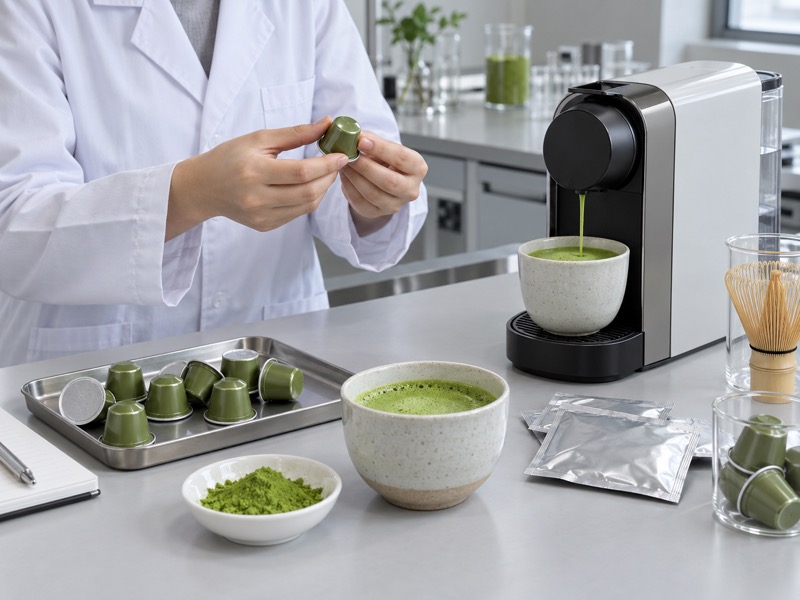
Contents
- What does the search for matcha Keurig pods mean for a product team?
- Which machine and capsule formats must the team define?
- How should matcha be formulated for a single-serve pod?
- What happens to powder during brewing and in the cup?
- Which pack and seal tests protect the green tea?
- How should a brewer compatibility claim be checked?
- What should a beverage sensory trial measure?
- How do labeling and trademark reviews affect the pack?
- Which costs and supply documents belong in the brief?
- When is a matcha pod ready for a limited launch?
1. What does the search for matcha Keurig pods mean for a product team?
The query mixes at least three customer expectations. One buyer wants the convenience of a capsule that produces a complete matcha drink. Another wants a green tea concentrate to mix with milk. A third may simply be looking for a way to prepare matcha beside an existing capsule brewer. Those outcomes need different powder doses, dilution instructions, and product names. Write the target cup first: finished volume, visible color, strength, mouthfeel, sweetness, and whether a separate stirring step is acceptable.
| Intended product | Customer action | Main development question |
|---|---|---|
| Unsweetened matcha beverage | Brew and drink | Is the powder dispersed in the cup? |
| Latte base | Brew, then add milk | Is the concentrate strong enough after dilution? |
| Sweetened latte mix | Brew and stir | Are sweetness and sediment consistent? |
2. Which machine and capsule formats must the team define?
“Works in a Keurig” is too broad for a product specification. Brewer models, pod holders, needle arrangements, brew volumes, and software features can differ. Identify the intended machine models, their production vintages, and the brew settings to be printed on pack. Then obtain the exact capsule component drawings from the packaging supplier. Record the physical fit, puncture points, lid position, and whether the capsule stays seated through a full cycle. Test actual production-equivalent capsules, not a hand-filled shell that may seal differently.
The trial matrix should cover common models in the intended channel, plus older and newer units where practical. Measure incomplete punctures, leaks, blocked flow, and cup volume. If one model fails, revise the capsule, narrow the compatibility statement, or choose a different platform. A compatibility claim belongs to a verified configuration, not to the tea ingredient alone.
| Machine variable | Record in trial | Failure to watch |
|---|---|---|
| Model and year | Exact name and identifier | Pod not recognized |
| Brew size | Selected setting, measured output | Weak or overflowing cup |
| Pod fit | Insertion and closure effort | Lid or rim damage |
| Puncture | Entry and exit location | Leak or blocked stream |
3. How should matcha be formulated for a single-serve pod?
The formulation brief begins with the cup, then works back to a capsule fill weight. Matcha particle size, bulk density, and moisture behavior affect filling and brewing. Pure matcha powder may cake, float, or remain inside a filter; a soluble matcha-flavored mix behaves differently and must be described as such. Ask for a bench sample of each route. Compare pure matcha, a deliberately formulated latte mix, and a control cup made by hand. Keep the tested recipe tied to a supplier lot so color or flow changes can be traced.
If sweetener, milk ingredients, or dispersing aids are considered, review allergen status, ingredient declaration, and the target market’s food rules before committing to a label. A bright prototype at the bench is not enough. Check whether the drink stays acceptable after the realistic hold time between brewing and consumption. Document the dose and any added mixing instruction. The better commercial formulation is the one that a first-time customer can prepare consistently, rather than the one that wins an isolated tasting with expert handling.
| Formulation route | Potential advantage | Check before approval |
|---|---|---|
| Pure matcha | Short ingredient list | Retained powder, sediment, weak extraction |
| Matcha latte blend | Easier cup profile | Added sugar, milk allergen, label accuracy |
| Concentrated tea base | Flexible milk addition | Strength after dilution, clear directions |
4. What happens to powder during brewing and in the cup?
Tea powder creates a useful mass-balance question: how much enters the finished drink? Weigh representative filled capsules and the used capsules after brewing, allowing for absorbed water. A simple dry-matter estimate is imperfect but can flag gross retention. Pair it with visual inspection of the pod filter, cup bottom, and first and last portions of the stream. Watch the whole brew, because a green first sip followed by pale liquid may still produce an inconsistent cup. Photograph cup color against the same background and lighting rather than trusting memory.
Run the trial at the smallest and largest brew volumes intended for the pack. Let each cup stand for a fixed period, then inspect sediment and stir it once. A suspension can settle; the question is whether the amount is acceptable and whether the label gives honest preparation directions. Do not equate a green color with a measured amount of consumed matcha. If the product instead extracts green tea flavor from a tea-containing blend, call that what it is. The customer benefit can still be convenience, but the product description must match the brewing mechanism.
5. Which pack and seal tests protect the green tea?
Matcha color and aroma depend on the condition of the powder when the customer opens or brews it. A capsule exposes a small fill to package material, headspace, humidity, light during packing, and heat during distribution. The team should request barrier specifications for the capsule, lid, and outer carton, then test the assembled pack. Start with seal integrity: an attractive material specification cannot rescue a weak heat seal. Inspect peel strength, dye or vacuum leak results as applicable, and the percentage of rejects after production-speed sealing.
Build a shelf-life plan around real distribution conditions and a defined sensory reference. Store finished capsules at intended and stressed conditions, then compare color, aroma, flow, and cup quality at scheduled intervals. A single warm-week exposure is not a validated expiry date. Maintain retained samples from each production lot. If the pack supplier changes a film or adhesive, repeat relevant checks, because a nominally equivalent structure may behave differently on the line. A buyer should receive evidence for the complete sealed system, not a generic “freshness” claim.
| Pack check | Practical evidence | Decision trigger |
|---|---|---|
| Seal quality | Production samples and leak results | Repeat failures or weak closure |
| Barrier | Component specification | Exposure beyond agreed target |
| Shelf life | Dated finished-pack comparisons | Color, aroma, or flow drift |
| Transport | Drop and vibration trial | Crushed rims or pinholes |
6. How should a brewer compatibility claim be checked?
A compatibility statement should name the tested capsule format and machine family precisely. Build a written protocol with machines, brew settings, sample count, acceptance criteria, and failure categories before testing. Include capsule insertion, cycle completion, leakage, cup volume, and cleaning impact. Keep a model-by-model result sheet. A pass on one domestic unit does not prove use in all commercial or newer brewers. A reseller also needs to know whether the proposed pod is made by the brewer brand, licensed, or simply designed for use in certain machines.
The Keurig recipe for a matcha green tea latte is a recipe reference, not evidence that any proposed matcha capsule is authorized or works across Keurig products. If the team wants to use a third-party compatibility phrase, have packaging and legal reviewers approve the exact words and visual treatment. Keep product testing, brand permissions, and distribution contracts as separate approval tracks.
7. What should a beverage sensory trial measure?
The panel should evaluate a repeatable drink, not a carefully selected hero cup. Serve coded samples at the same finished volume and temperature. Score tea aroma, vegetal and umami balance, bitterness, sweetness if present, color, texture, visible sediment, and aftertaste. Include time as a variable: taste immediately and after a realistic holding period, especially for office or hospitality channels. A hand-whisked control helps the panel locate the gap; a commercially relevant capsule competitor helps the buyer judge the category.
Separate liking from defects. Some consumers prefer a mild cup, while others expect an assertive matcha note. A low score can come from dilution rather than poor powder. If milk is part of the intended serving, test the exact milk type and quantity. Record the method so the result can be repeated with the next raw-material lot. A decision table can mark non-negotiables, such as no machine leak and acceptable color, apart from negotiable attributes, such as sweetness. This prevents a sweet sample from masking a weak tea base.
| Attribute | Same-day control | Recheck after hold |
|---|---|---|
| Tea identity | Aroma and flavor | Does tea remain recognizable? |
| Appearance | Color and foam | Sediment or ring formation |
| Texture | Powdery or smooth | Grit after cooling |
| Dose consistency | Cup-to-cup variation | Repeat on another brewer |
8. How do labeling and trademark reviews affect the pack?
The front panel should tell the customer what the pod contains: matcha powder, a blend, or a latte mix. The ingredient list, allergens, net quantity, serving directions, storage statement, and responsible business details must be reviewed for each destination market. Do not use a machine brand as decoration. The terms Keurig and K-Cup identify another company’s products; a third-party pack needs a carefully reviewed compatibility statement, not a visual imitation of an official pack. The USPTO record for K-Cup trademarks is one reason to route proposed wording through trademark counsel.
Claims such as “100% matcha,” “sugar free,” “recyclable,” or “compostable” each require their own evidence. A material that can technically be recycled is not necessarily accepted in every local collection stream. Printed preparation directions should specify the tested brew size and any stirring or milk addition needed to match the photographed cup. Avoid a staged image that promises a dense, frothy ceremonial drink if the pod produces a thin infusion. Honest labels reduce support tickets and make repeat purchase more likely.
9. Which costs and supply documents belong in the brief?
The unit cost needs more than matcha price per kilogram. Include powder loss during filling, capsule and lid, sealing scrap, outer pack, quality checks, freight, import handling, and expected returns. Calculate cost per acceptable brewed cup at the chosen dose and selling channel. Price the finished experience, because a cheap capsule that yields a weak cup may require more tea, a second capsule, or customer service. Sensitivity-test raw-material and pack price changes rather than treating the first quotation as permanent.
Ask suppliers for product specification, ingredient and allergen information, lot traceability, applicable food-safety documentation, pack structure and migration information where required, and test methods behind any caffeine or shelf-life statements. Request minimum order quantity, lead time, and change-control terms. If the brand sources matcha and capsules separately, identify who owns the finished-pack validation. Without that owner, a tea supplier may certify powder quality while a co-packer assumes someone else tested leakage or stability. A signed specification should state which party releases each batch.
| Cost or record | Owner | Why buyer needs it |
|---|---|---|
| Matcha specification | Tea supplier | Reproducible color, taste, identity |
| Capsule drawing and barrier | Pack supplier | Fit and protection |
| Finished-pack test | Co-packer or brand | Seal, cup result, shelf life |
| Landed unit cost | Brand or importer | Margin after freight and rejects |
10. When is a matcha pod ready for a limited launch?
A limited launch is justified when the team can describe the cup honestly and reproduce it across production lots and intended machines. Agree pass criteria before running the final pilot: mechanical compatibility, acceptable cup volume, sensory target, seal integrity, label approval, and traceable records. Release by evidence, not by enthusiasm. Run production-speed samples through the full chain, from filling to distribution simulation to consumer brew. Retain failed units and document corrective actions rather than replacing them quietly with hand-picked passes.
The first market test should be narrow enough to observe complaints and repeat purchase. Give distributors a machine list and brewing instructions. Ask customer support to log specific failure modes: unrecognized pod, leak, weak tea, sediment, or confusing label. Review those signals against the retained batch and trial data. If problems cluster by brewer model or supply lot, adjust the claim or specification before scaling. The next supplier conversation should request a production-equivalent capsule sample, a named compatibility matrix, and a sealed-pack stability protocol for the actual matcha formulation.
Sources: Keurig’s Matcha Green Tea Latte recipe; USPTO K-Cup trademark record. The recipe appeared as an article result for this query in the archived US SERP; it is not a capsule test.
FAQ
Are matcha Keurig pods the same as whisked matcha?
Do not assume so. A capsule brewer and a whisk distribute powder differently. Compare the finished cup with a hand-prepared control and describe the pod beverage by its actual ingredients and method.
Can a brand call its pod compatible with every Keurig brewer?
Only after a documented model-by-model test would a broad statement be worth considering. Most teams should name the tested machine family and have the exact pack wording reviewed.
Should a matcha pod contain pure powder or a latte blend?
That depends on the target cup. Pure powder offers a short ingredient list but can create retention and settling issues. A blend may disperse more easily while adding ingredient and label obligations.
What sample should a buyer request first?
Ask for production-equivalent sealed capsules filled with the proposed formulation, plus the capsule drawing, brew instructions, matcha specification, and test record for intended machines.
What is the first reason to stop a pilot?
Stop if the machine leaks or blocks, the pod cannot consistently produce the promised beverage, or the sealed pack fails integrity checks. Those are launch criteria, not details for later marketing fixes.