
A buyer may receive a bright green sample, an attractive origin story, and a low quote without proof that all three describe the same production lot. Matcha food fraud risk grows when records break between tea leaves, milling, packing, and resale. The Assure Food Safety article raises that concern for drinks. This guide gives importers, cafés, and brands a practical way to test claims before they approve a supplier. No single color test or certificate proves authenticity. Use several independent records and keep any suspect lot out of sale until your quality team has resolved the discrepancy.
Contents
- 1. What counts as matcha food fraud?
- 2. Which claims deserve the closest check?
- 3. How should a buyer map the supply chain?
- 4. Which documents should connect to the lot?
- 5. Can color and tasting expose a problem?
- 6. When should a laboratory be involved?
- 7. How can organic and origin claims be checked?
- 8. What should happen when a lot looks suspect?
- 9. How can purchasing terms reduce exposure?
- 10. What should an ongoing fraud review measure?
1. What counts as matcha food fraud?
Define the act before judging the supplier
The FDA defines economically motivated adulteration as intentionally substituting, adding, omitting, or removing something to increase apparent value or reduce cost. Applied to tea, possible concerns include a lower-value powder sold under a premium claim, a false growing origin, or an undisclosed ingredient in a product represented as pure matcha. Those are examples of risk, not accusations about any particular country or supplier. A naturally variable harvest or an honest labeling error can look similar at first inspection.
The buyer’s job is to separate a discrepancy from an allegation. Record what was promised, what arrived, and which evidence connects them. A label saying “ceremonial” offers less verifiable information than a lot code tied to raw material, milling, ingredients, and packing. Start with the exact claim: if the contract says pure matcha from one region, test that statement. Do not turn a darker color or a lower price into proof of fraud. They are triggers for questions and a controlled investigation.
2. Which claims deserve the closest check?
Prioritize claims that change price or compliance
Origin, organic status, pure tea content, harvest description, and named cultivar can all influence a quote. Matcha Village’s product portfolio includes different grades and blends, so a purchasing specification must distinguish pure matcha from a flavored or sweetened mixture. The ISO technical report on matcha describes cultivation, manufacture, and sensory characteristics and explicitly excludes flavored, blended, decaffeinated, and soluble extracts from its scope. That does not mean a blend is bad; it means a blend should be sold and labeled for what it is.
Build a claim register with exact wording, the document supporting it, and the lot to which it applies. Price is a prompt for review, not a verdict: a low quote may reflect grade, volume, contract terms, or surplus stock. Ask which factor explains it. If a supplier changes from one milling site to another, update the claim record. A buyer should not keep using an approved origin statement when the underlying supply route has changed.
| Claim on offer | Evidence to request | Common gap to resolve |
|---|---|---|
| Pure matcha | Ingredient specification and batch record | Unclear additives or mixed powder |
| Named origin | Grower, processor, and shipment trail | Brand address mistaken for growing place |
| Organic | Current certification and import records | Certificate not tied to operator or lot |
| Grade or cultivar | Written criteria and current sample | Marketing term without acceptance test |
3. How should a buyer map the supply chain?
Follow material, not the brand story
Draw the route from farm or raw-leaf supplier through tencha processing, milling, blending if any, packing, exporter, and the seller invoicing you. For each step, ask who owns the material, where it is handled, and how incoming and outgoing lot codes connect. A broker may know transport records but not leaf origin; a brand owner may know the label but not the mill. Those gaps need questions, not assumptions. The chain can be short or long and still be legitimate if records are consistent.
Request a one-page flow diagram for the SKU. A supplier may redact commercially sensitive names while still giving enough detail for traceability and claim verification. Keep a separate record of who can produce source documents when a customer or regulator asks. Test the map: choose one finished pack code and ask the supplier to trace it backward to its incoming tea batch, then forward to the shipped cases. If the answer changes between sales and quality teams, pause approval. This exercise also shows whether different harvests are blended while the marketing description implies a single source.
4. Which documents should connect to the lot?
Reconcile identifiers across the packet
A certificate of analysis is useful only when it identifies the material you are buying. Compare its lot number, product name, dates, and testing scope with the production label, packing list, invoice, and shipment record. A test report may cover contaminants but say nothing about growing origin; an organic certificate may cover an operator but not prove the contents of every case. Match the document to the claim it is supposed to support. A generic PDF with no lot link should not settle a specific dispute.
Keep the latest approved specification, sample record, change notices, and retained sample plan beside the documents. Ask whether the supplier tests every lot or uses a risk-based schedule; record the answer rather than assuming. Use a mismatch log: note missing fields, who owns the correction, and the date closed. Repeated corrections after goods ship are themselves a supplier performance signal. The goal is a chain that a second reviewer can follow without a verbal explanation from the salesperson.
| Document | Link to confirm | Limitation |
|---|---|---|
| Product specification | SKU and ingredients | May not prove each lot’s identity |
| COA | Finished or source lot | Covers only listed tests |
| Packing list | Cases and lot codes | Does not prove origin by itself |
| Certification | Operator, product scope, dates | Must match the claim and market |

5. Can color and tasting expose a problem?
Use sensory checks to trigger questions
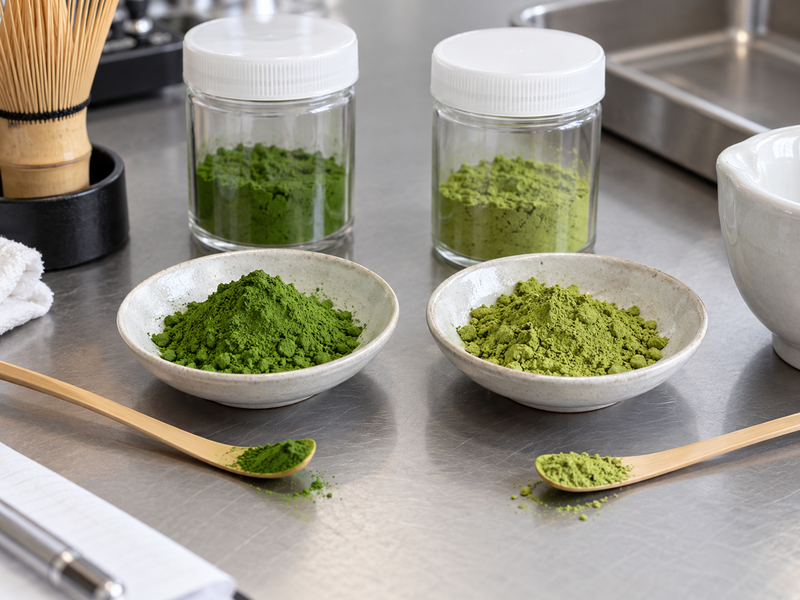
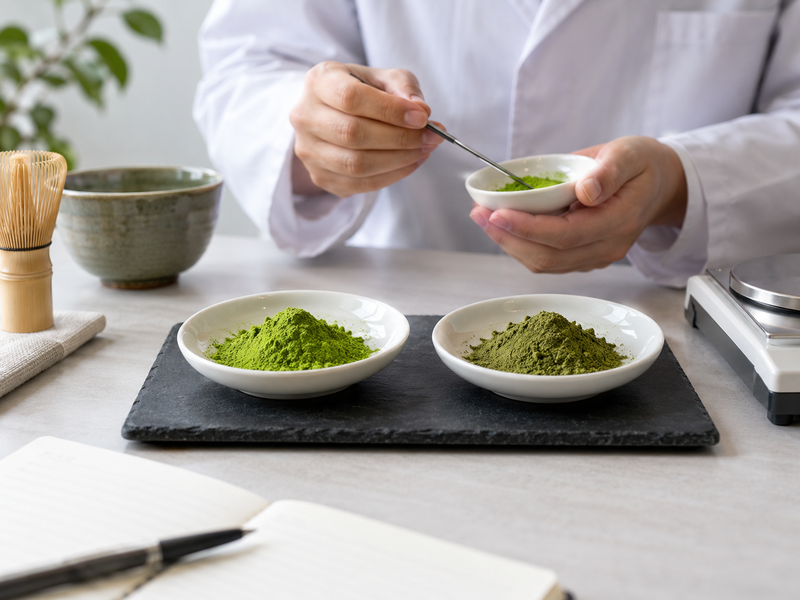
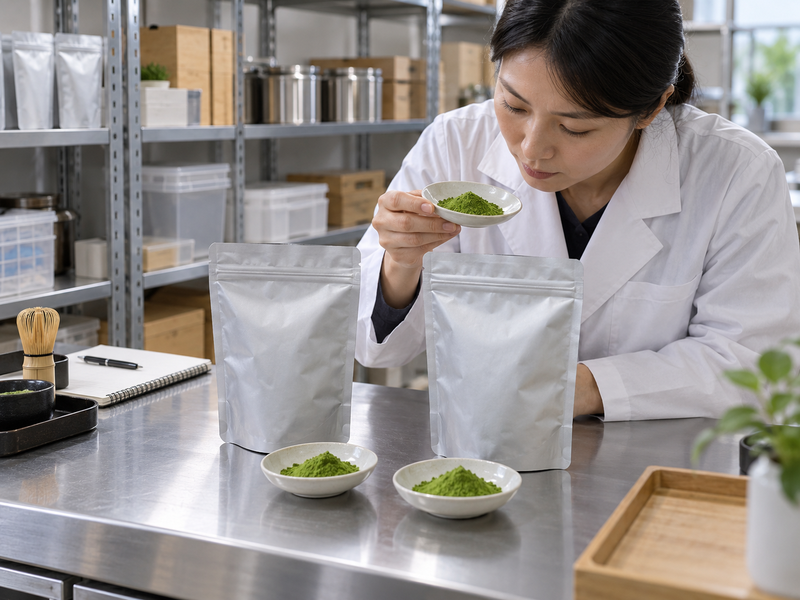
Color, aroma, taste, particle feel, and dispersion are valuable receiving checks because a known reference sample gives the team a baseline. They cannot establish origin or purity alone. Shade, cultivar, harvest, milling, storage, and age may all affect appearance. A vivid powder can still fail a document check, while a slightly changed green may reflect ordinary batch variation. Record the observation with a photograph taken under consistent light and a blind tasting against the approved sample.
Run the sensory check at a fixed powder dose and preparation method. Ask tasters to score tea aroma, bitterness, texture, and color before seeing price or supplier names. If a lot falls outside the agreed range, hold it and request an explanation supported by production records. Keep the result narrow: “more astringent than our approved lot” is defensible; “fake matcha” needs more evidence. Retained samples help compare the disputed shipment with the original approved lot. If storage conditions differ, investigate that possibility before attributing every sensory change to the supplier.
6. When should a laboratory be involved?
Match the method to the suspected claim
Laboratory work is appropriate when a material discrepancy, safety concern, or contractual test requirement cannot be resolved with records and sensory checks. Choose an accredited lab and ask what a proposed method can and cannot answer. A pesticide or heavy-metal panel checks named analytes against a specified test method; it does not identify a Japanese growing region. Ingredient substitution may require another analytical approach and representative comparison material. The FDA food-fraud page explains that detecting economic adulteration requires adapting to the kind of deception suspected.
Agree sampling rules before testing. Take a documented sample from the held lot, preserve chain of custody, and retain enough material for a confirmatory test if needed. Record which product specification and market limit will be used to interpret results. Ask one question of the lab: what decision will this result support? A broad test package that cannot answer the disputed claim may produce cost and delay without clarity. Do not publish a supplier accusation from an unexplained laboratory result.
| Suspected issue | Initial evidence | Specialist follow-up |
|---|---|---|
| Ingredient not declared | Specification and batch record | Method suited to suspected substance |
| Contaminant concern | Lot COA and risk history | Targeted validated panel |
| Origin mismatch | Source and movement records | Qualified origin assessment if available |
| Sensory drift | Blind reference comparison | Production and storage investigation |
7. How can organic and origin claims be checked?
Follow the rule that applies in the selling market
For US organic claims, use current USDA requirements, not a supplier’s translation of a certificate. The USDA organic labeling guidance explains how certification and label categories apply in the US market. USDA requires each imported organic shipment to be associated with an electronic NOP Import Certificate; one certificate may cover multiple shipments or a defined period. Verify that the certifier, operator, product scope, and shipment information align. Other markets have their own rules; a US checklist cannot simply be reused for the EU or UK.
Origin needs similar precision. Ask whether the statement refers to where leaves grew, where tencha was processed, where powder was milled, or where a brand packed it. Those may be different places. Put the exact claim in the contract and on approved artwork, then map it to records. Avoid shorthand: “Japanese brand” does not establish Japanese-grown tea. If a blend contains material from multiple sources, require wording that fits the actual recipe and market. A purchasing team should escalate uncertain claims before a label is printed.
8. What should happen when a lot looks suspect?
Hold the product and preserve the evidence
Quarantine the affected lot in inventory and block it from production or resale. Record the reason, quantity, location, case codes, and the person who placed the hold. Photograph unopened cartons and pack labels, secure retained samples, and preserve emails and document versions. Inform the supplier of the specific discrepancy, ask for a written response, and set a date for review. A supplier may resolve a mismatch with a corrected record, but a corrected record needs a source and approval trail.
Escalate safety concerns through your quality and regulatory procedures. If goods have already been sold, your incident team may need to assess withdrawal or recall duties in each market; do not assume every suspected fraud issue requires the same response. Keep one voice: sales, procurement, and quality should not send conflicting allegations to customers while facts are still being checked. Document the decision to release, reject, return, test further, or notify an authority and the evidence behind it. If the issue was an internal receiving or storage error, record that too. A fair investigation protects customers without turning suspicion into an unsupported accusation.
| Decision stage | Action | Record retained |
|---|---|---|
| Detect discrepancy | Hold affected lot | Quantity, code, reason |
| Investigate | Gather documents and samples | Versioned evidence file |
| Decide | Release, reject, or escalate | Approved rationale |
| Prevent recurrence | Correct the control gap | Owner and completion date |
9. How can purchasing terms reduce exposure?
Specify proof and remedies before shipment
An order should define the product, accepted ingredient list, origin wording, grade criteria, lot identification, required documents, testing rights, change notification, and the process for a disputed lot. State who pays for confirmatory tests and what happens to material held during review. The language must fit the buyer’s contracts and legal advice. Without a written acceptance standard, a team may disagree about whether a shipment is defective even when everyone can see it differs from the sample.
Do not demand impossible guarantees from an agricultural product. Define a range for measurable attributes and a process for changes in harvest or blend. Keep the approved sample available during the contract term. Ask who signs supplier declarations and whether the seller can obtain upstream records when challenged. Make change notice real: a new mill, packer, ingredient, certifier, or source region should trigger a review before the next shipment. A low quoted price is useful only when the supplier can meet the same evidence and remedy requirements as competing bids.
10. What should an ongoing fraud review measure?
Watch behavior across orders
A supplier that passes one onboarding review can still change sources, facilities, or staff. Review each shipment for lot-document matches, requested corrections, late COAs, sensory drift, and unexplained claim changes. Trend those observations by supplier and product, not by memory. A small buyer can use a spreadsheet with date, lot, claim, exception, closure evidence, and reviewer. Larger programs may tie the same fields to their quality system. The UK Food Standards Agency review of food-fraud prevention discusses vulnerability assessment and upstream supply-chain thinking.
Reassess risk when prices move sharply, a source region changes, a new trader appears, or the supplier stops providing previously routine records. A price change alone does not prove wrongdoing; it changes the questions worth asking. Close the loop: after an exception, update the claim register and purchasing specification so the same ambiguity does not repeat next month. Build enough evidence to defend your own product claims to a customer, auditor, or regulator without relying on a salesperson’s recollection.
| Review signal | Buyer response |
|---|---|
| Repeated lot-code mismatch | Request root-cause action and check next lot |
| New source or facility | Repeat claim and specification review |
| Unexplained sensory shift | Compare retained samples and handling records |
| Missing certification link | Suspend the claim until verified |

Use our matcha supplier audit guide when checking the supplier’s records.
FAQ
Q1: What is matcha food fraud? It is intentional misrepresentation or economic adulteration of a matcha product, such as a false ingredient or origin claim.
Q2: Can color prove that matcha is authentic? No. Color is a useful consistency check but cannot establish purity or origin on its own.
Q3: Is a COA enough to rule out fraud? No. A COA covers the listed tests for the stated lot. Claims outside that scope need other evidence.
Q4: Should a buyer reject an unusually cheap quote? Ask why it is cheaper and compare grade, specification, documents, and terms before deciding.
Q5: What should happen to a suspect lot? Hold it, preserve samples and records, investigate the exact discrepancy, and document the approved disposition.
Ask the next supplier for a lot-linked claim packet before you approve its sample. Check one finished pack backward through the production chain, write down any gap, and resolve it before making that claim on your own product.