
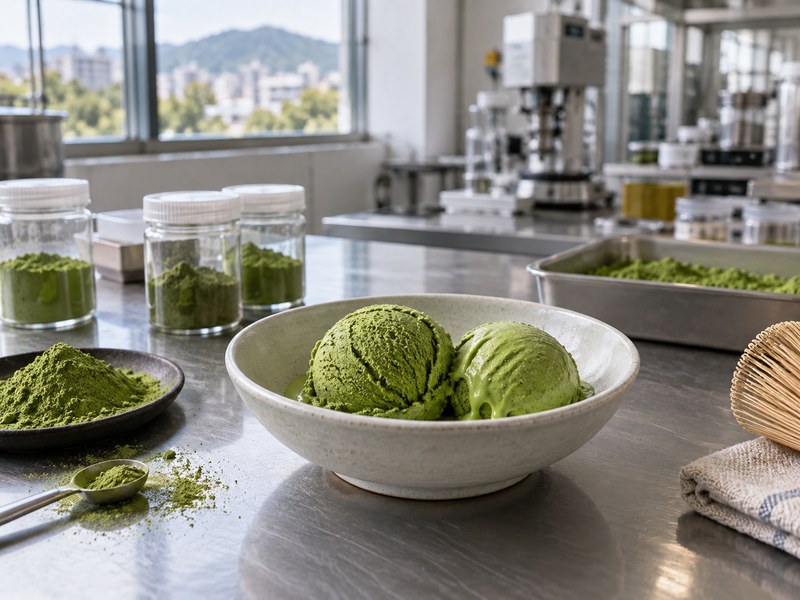
Matcha ice cream is a frozen dairy or plant-based dessert flavored with powdered green tea. A commercial version must taste of tea when cold, keep an acceptable green shade, scoop at the intended serving temperature, and survive its distribution route. A powder that tastes excellent in warm water may vanish in a sweet frozen mix. Begin with a controlled base formula and compare matcha lots at fixed doses. Then test freezing, hardening, storage, and serving as one system. This guide gives development controls, not a validated production recipe or shelf-life claim.
1. What distinguishes matcha ice cream from green tea flavor?
Matcha contributes actual powdered tea solids, aroma, color, bitterness, and a fine-particle texture. A generic green tea flavoring may contribute aroma without those solids; added color can make a product look green without tasting of tea. Buyers should read the ingredient declaration before comparing prices. The category also includes gelato, soft serve, dairy-free frozen dessert, and frozen novelties. Each has a different mix composition and temperature at consumption. A clear product name helps customers understand whether they are buying a dairy ice cream or a different frozen dessert, subject to local naming rules.
What should the product brief specify?
Define the eating moment. State format, serving size, temperature, sweetness, target color, and desired tea intensity. A scoop shop can accept a softer product than a wrapped bar shipped through retail freezers. Decide whether matcha should lead or sit behind cream and vanilla. Include expected distribution time and market on the brief. These choices guide powder selection and process tests more usefully than the word “premium.” If the product carries a claim about origin or organic status, tie that claim to the actual offered lot and applicable certification documents.
| Format | Main sensory target | Process concern |
|---|---|---|
| Scooped dairy ice cream | Tea flavor and smooth scoop | Holding cabinet variation |
| Gelato-style dessert | Dense tea flavor | Temperature at serving |
| Soft serve | Immediate aroma and flow | Mix handling and machine hygiene |
| Packaged bar | Flavor after storage | Coating and freeze-thaw exposure |
2. Which matcha powder survives a frozen mix?
Cold temperatures reduce aroma release and perceived sweetness, so tea must be assessed in the frozen product. A clean, assertive powder can work better than a delicate plain-drinking lot. Excessively rough tea may leave a bitter finish as the ice cream melts on the tongue. Compare candidate powders in the same mix at identical dosing and process conditions. Green color alone is a weak purchasing criterion: some vivid samples become muted in dairy, while others retain enough shade but offer poor flavor. Look for fine dispersion and no gritty residue.
What documents should accompany samples?
Request ingredient identity, origin, lot number, particle-size information where available, storage guidance, and testing relevant to the destination market. Ask whether the sample represents a repeatable supply specification. Keep sealed reference samples from the approved lot. A supplier’s “ceremonial” or “culinary” label may help organize options, but the finished frozen dessert decides suitability. Matcha Village’s bulk matcha portfolio can be screened through the same frozen application test. Include delivered cost and available pack sizes in the evaluation, since opened large bags may linger too long in a small pilot plant.
3. How much matcha should a developer add?
Screen several doses rather than relying on a recipe copied from a home ice-cream maker. An initial experiment might compare 0.5%, 1%, and 1.5% matcha by mix weight. Those are trial points, not prescribed levels. Powder intensity and base sweetness vary. Keep mix fat, sugar, stabilizer, and processing constant across the screen. Taste the product after hardening at its intended service temperature, then after a short melt in the mouth. A tea dose that seems restrained in liquid mix may be just right after freezing, or the opposite.
How do you select an economic dose?
Price the accepted scoop. Calculate grams of powder per liter of mix and per saleable portion after overrun. A cheap powder that needs twice the dose may cost more per serving and make the texture rougher. Record sensory scores alongside material cost, not on separate files. Repeat the winning dose using a second powder lot before confirming procurement. If the product is sold with a sweet topping, taste it both plain and with that topping; a sauce can bury tea or rescue a deliberately strong profile. Avoid increasing sugar during a tea-dose trial because it obscures the comparison.
| Trial level | Matcha per 1 kg mix | Evaluation |
|---|---|---|
| Low | 5 g | Is tea identifiable when frozen? |
| Mid | 10 g | Are aroma and sweetness balanced? |
| High | 15 g | Does bitterness or grit appear? |
4. How should matcha enter the mix?
Dry tea can form specks if scattered into a cold, viscous mix. Sift the weighed powder, then disperse it in a small measured portion of liquid from the formula using equipment suited to the batch. Add that smooth dispersion to the rest of the mix under controlled agitation. If the process includes heat treatment, the producer must decide where matcha enters based on its validated food safety system and flavor results. Adding tea after a kill step may preserve some aroma but creates a new hygiene and microbial-control question. A production team should not alter the process solely for color without validation.
What should operators inspect before freezing?
Look for dry clumps, uneven green streaks, foam from excessive mixing, and sediment after the normal aging period. Record the liquid mix’s appearance and taste, but do not approve powder there alone. Check that the ingredient does not block pumps or strainers and that a larger vessel disperses it as evenly as a beaker. Use a clean, calibrated scale for low doses. Log actual addition point, mixing time, and lot number. A repeatable dispersion procedure lets product developers distinguish a weak tea from poor mixing.
5. How do sugar, fat, and stabilizers affect tea flavor?
Fat provides body and can soften tea’s edge, while sugar affects sweetness and freezing behavior. Stabilizers help manage viscosity and ice-crystal growth during storage. The University of Guelph’s Ice Cream Technology e-Book explains the role of stabilizers in limiting coarse texture as ice crystals change over time. Matcha adds solids but does not replace a carefully balanced frozen-dessert base. Test a chosen powder across the actual base range you plan to sell. A plant-based base may reveal tea more strongly or introduce coconut, oat, or soy notes that change the finish.
How do you avoid changing too much at once?
Hold the base constant while screening matcha, then adjust sweetness or fat only after selecting a powder and dose. If the frozen product tastes flat, compare serving temperature before adding more sugar. If it feels icy, inspect water balance, freezing, storage, and stabilizer design rather than blaming matcha immediately. Work with the manufacturer’s existing validated base when possible. Record ingredient percentages, total mix weight, aging time, and draw conditions for each trial. This keeps a development meeting focused on causes that can be tested.
| Mix variable | Likely effect | Controlled question |
|---|---|---|
| Sugar | Sweetness and softness | Does tea remain clear? |
| Fat | Body and flavor release | Does cream mute tea? |
| Stabilizer | Ice-crystal control | Is texture stable in storage? |
| Matcha solids | Flavor, color, particles | Is finish smooth? |
6. Why do overrun and freezing change the result?
Overrun is the increase in volume caused by incorporated air. It changes how much product fills a carton, how dense a scoop feels, and how strong matcha tastes per spoonful. Freezing conditions influence ice crystals and texture. Compare candidate powders only in batches produced at a similar draw and overrun; otherwise a fluffy sample may seem milder for reasons unrelated to tea quality. A soft-serve machine creates a different product from a batch freezer. Scale trials should use equipment that approximates production, not only a tabletop appliance.
What should a line trial record?
Measure mix weight, output volume or overrun, draw temperature, hardening conditions, and scoop firmness at service. Check color before and after freezing under consistent lighting. If a new powder increases viscosity or settles in a feed tank, production behavior matters even if the tasting panel likes its flavor. Note any clumps at the nozzle or graininess after storage. A consistent process gives procurement a fair basis for choosing between powder lots. It also prevents a false conclusion that the tea changed when the freezer setting actually moved.
7. How can you keep matcha color acceptable?
The desired shade should be specified for the finished product, not the dry powder. Milk color, added flavors, oxygen, light, and storage can affect appearance. A clear lid may display the green nicely at launch while exposing the surface to light in a retail case. Evaluate packaged samples under the intended light and temperature conditions. Matcha color can be natural and variable; define an acceptable range with physical references rather than demand an identical digital color value from every lot. Any added coloring requires ingredient and label review.
What is a useful color trial?
Inspect at three points. Compare freshly hardened product, a sample after the expected warehouse period, and one after a realistic retail display interval. Photograph them under fixed lighting and evaluate the actual opened pack. A slightly muted green with strong tea flavor may be more acceptable than an artificial-looking shade with weak taste. Check the top, center, and edges of a large tub, as exposure and temperature can differ. Keep the powder package sealed and protected from moisture between batches so storage conditions do not introduce preventable variation.
| Observation | Possible source | Validation step |
|---|---|---|
| Gray surface | Exposure or light | Pack and display trial |
| Uneven streaks | Poor tea dispersion | Mixing procedure |
| Weak green throughout | Base and powder combination | Equal-dose powder comparison |
| Dark specks | Clumps | Sift and pre-disperse |
8. What storage and distribution tests matter?
Frozen distribution is rarely a perfectly flat temperature line. Warming and refreezing can enlarge ice crystals and damage texture. The University of Guelph resource on ice-cream shelf life explains why temperature fluctuation changes crystals. Run storage tests at the intended conditions and include controlled abuse scenarios that reflect actual transport risks. Assess flavor, color, texture, scoopability, package integrity, and food safety over the proposed life. Do not borrow a shelf-life number from a different formulation or plant.
What belongs in a distribution trial?
Use the real carton or tub, fill weight, sealing process, and pallet configuration. Monitor temperatures through shipping and at retail if feasible. Open samples at defined intervals and compare them with a retained reference. A coating on a matcha bar may crack or separate under cycling even when the ice cream core tastes fine. Document customer-facing defects such as frost inside a clear lid or shrinkage away from the container wall. Determine a date code from the finished product and validated route, with the manufacturer and regulatory team approving the decision.
9. How should a buyer compare suppliers?
Set acceptance criteria for lot documentation, tea flavor in the frozen base, color range, dispersion, testing, and repeat supply. Request samples from the same product you would purchase, not a special showcase lot. Ask how the supplier handles a lot outside specification and what notice is given for origin or process changes. Confirm packaging size fits production rate; a bag opened for weeks can complicate stock rotation. A competitive price means little if the factory needs more powder or loses tubs to gritty texture.
Which evidence closes the approval?
Keep signed specifications, lot-linked samples, sensory forms, process records, and a cost per saleable unit. Test at least one repeat lot before a large rollout when timing permits. If the powder is presented as organic, verify the current certificate and scope for the relevant market. For private-label ice cream, the tea supplier’s documents are only one part of the finished-product file; dairy, stabilizers, packaging, and the manufacturing site need their own checks. Maintain a clear change-control path so a new lot triggers the right trial rather than a silent substitution.
| Approval item | Evidence | Owner |
|---|---|---|
| Tea quality | Lot sample and frozen tasting | Product team |
| Ingredient safety | Relevant specification and tests | Quality team |
| Process fit | Line-trial record | Manufacturing |
| Unit economics | Cost per saleable pack | Purchasing |
10. What is a sound launch plan for matcha ice cream?
Start with a fixed base and three matcha dose trials. Narrow candidates through blind tasting, then run the winner on production equipment. Confirm dispersion, hardening, scoopability, and packaging at the intended serving temperature. Set a shelf life only after testing the actual formulation and distribution route. Train retail or foodservice teams on holding and portioning so the approved product reaches customers as intended. A menu claim should describe tea and origin accurately without turning a frozen dessert into an unsupported health promise.
What should happen after the first production run?
Retain a sample and the complete batch record. Compare customer feedback on tea strength, texture, and color with the approved reference. Review defects by location and handling condition before changing the recipe. If the tea needs adjustment, request a lot-linked sample and rerun a controlled line trial. Share a technical brief with Matcha Village or another supplier covering base type, dose range, destination market, annual volume, and required documents. That gives both sides a practical way to choose powder for matcha ice cream rather than shopping by label alone.
FAQs
Q1. Can café matcha powder be used in ice cream? It can be tested, but frozen sweetness and fat change how tea tastes. Approve it in the finished product.
Q2. Why does matcha ice cream taste weak when frozen? Cold temperature limits aroma release; the base and serving temperature also shape perceived intensity.
Q3. Does more matcha always improve color? No. A higher dose can increase bitterness or particles without solving storage-related color change.
Q4. Can a dairy-free version use the same tea dose? It needs its own trial because plant bases differ in flavor, fat, and freezing behavior.
Q5. How long can a packaged product be sold? Use a product-specific shelf-life study covering quality, safety, packaging, and the actual distribution route.