
Matcha furikake is easy to mix in a bowl and harder to sell consistently. Fine tea settles below coarse nori, a damp spoon makes the seasoning clump, and a shaker that works on dry rice may dump too much onto a moist bowl. A foodservice or retail team can solve those problems with weighed ingredients, a simple flow test and a package trial. The Silk Road Tea recipe offers a home-scale combination of sesame, nori, salt, sugar and matcha. The method here turns that idea into a repeatable commercial trial.
Contents
- 1. What should matcha furikake taste and look like?
- 2. Which ingredients belong in the first blend?
- 3. How should sesame and seaweed be prepared?
- 4. How much matcha should a trial use?
- 5. How do you keep the dry blend uniform?
- 6. What makes a shaker dispense evenly?
- 7. Where does the topping work on a menu?
- 8. How should a retail pack be tested?
- 9. Which labels and supplier checks matter?
- 10. What should the final product specification record?
1. What should matcha furikake taste and look like?
Start with the plated portion
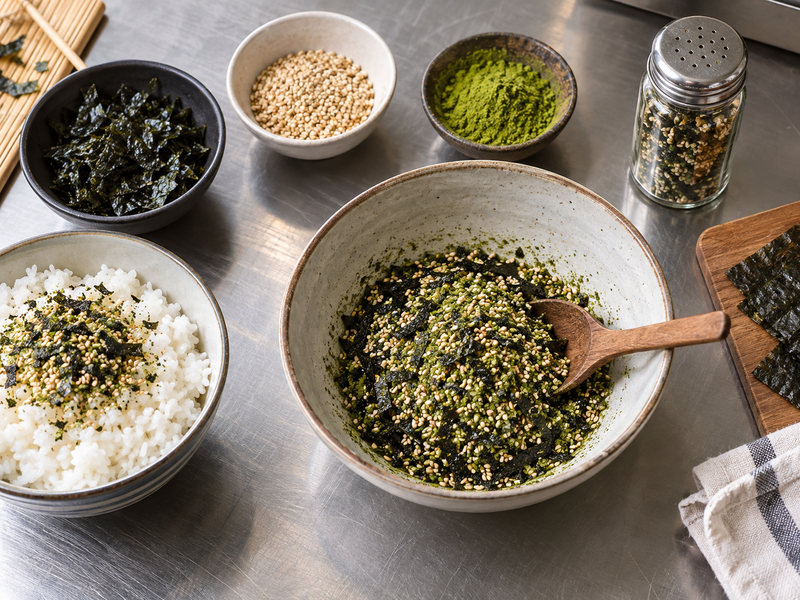
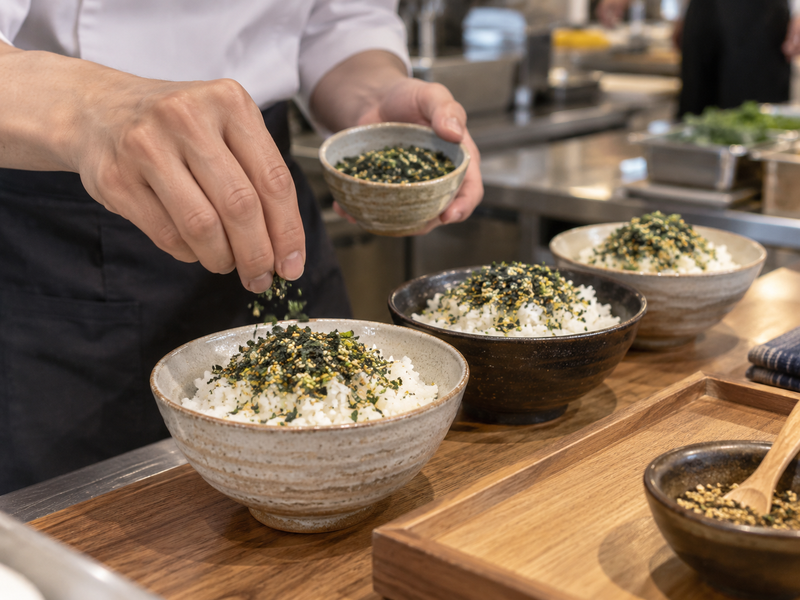
Furikake is a finishing seasoning, so judge it on the food it will finish. The Silk Road Tea version uses rice, vegetables and popcorn as serving ideas. For a café bowl, set a target sprinkle weight per portion and photograph it against white rice. The seasoning should show distinct sesame and nori pieces with a light green coating rather than an opaque powder blanket. Taste plain rice first, then a bowl with the topping, to check whether seaweed, salt and tea remain distinguishable.
Run a three-person tasting at two serving weights, perhaps 1 g and 2 g on a standard bowl. Those are trial inputs, not serving standards. Ask tasters to note saltiness, toasted aroma, tea character and the feel of particles between the teeth. Repeat on warm rice and on a cold rice salad; steam can change the way powder sticks. Look at the last bite. If most seasoning remains at the bottom of the bowl, the visual appeal at plating has hidden poor adhesion.
| Plated check | Record | Reason |
|---|---|---|
| Serving deposit | Grams per bowl | Controls salt and cost |
| Surface coverage | Top-view photograph | Shows distribution |
| Residue after eating | Grams or visual score | Shows adhesion |
| Tasting | Tea, nori, sesame, salt | Exposes imbalance |
2. Which ingredients belong in the first blend?
Keep the ingredient list short enough to diagnose
Begin with roasted sesame, roasted nori, matcha, salt and a small amount of sugar if the tea tastes sharp. The reference recipe uses those same five components, but its spoon measures are too imprecise for comparing batches. Write a 100 g pilot formula in grams and record the supplier and lot for every material. A useful first trial might reserve most mass for sesame and nori, then vary matcha and salt in separate versions. The exact ratios require tasting with the intended food and shaker; they are not published industry norms.
Decide whether the product is a loose foodservice blend or a retail shaker before adding chili, dried citrus or flavored flakes. Each addition changes particle size, moisture behavior, labeling and cost. A restaurant may favor more nori because a staff member can stir the tub before service. A retail customer expects the blend to remain reasonably mixed during transport and repeated pours. Start small. One clear base makes it possible to identify whether bitterness comes from tea dose, scorched sesame or a seaweed lot.
| Candidate component | Buying question | Trial observation |
|---|---|---|
| Sesame | Whole, split or coarse ground? | Crunch and separation |
| Nori | Sheet grade and cut size? | Visible flecks and flow |
| Matcha | Lot, grade and pack size? | Flavor after blending |
| Salt | Crystal size? | Even distribution |
3. How should sesame and seaweed be prepared?
Match particle sizes before mixing
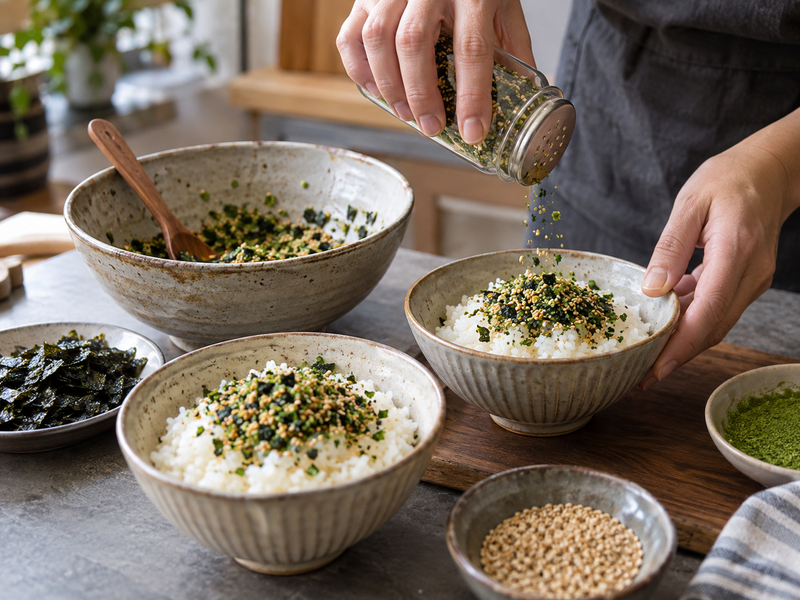
The home recipe toasts sesame, cools it, then pulses some seeds with salt and sugar. It also crumbles nori into small pieces. Those steps point to a practical production issue: whole sesame, fine salt and lightweight seaweed do not move alike. Compare two nori cuts and two sesame formats in separate 100 g blends. Sieve or photograph a small sample from each so staff know what “coarse” means for this product. If sesame is toasted in-house, weigh it before and after and record the pan or oven setting; otherwise buy a consistent roasted specification.
Cool toasted material fully before closing a container. Warm components can leave condensation on a lid, which undermines a dry seasoning. Avoid grinding all sesame to powder: it may improve adhesion while making the blend dense and prone to caking. A mixed population of whole and broken seeds can give both visible texture and a little surface area for matcha to cling to. Check the bottom of the bowl. A green layer there means the tea is separating, even if the top sample looks attractive.
4. How much matcha should a trial use?
Dose by finished blend weight
Matcha gives the seasoning its tea identity, but too much fine powder can coat the mouth and obscure sesame. Compare two weighed doses in the same base, for example 2 g and 4 g per 100 g of finished trial blend. These numbers are suggested test points, not a standard recipe. Taste each version dry only as a quick check; the deciding tasting belongs on rice or another intended dish. Record the actual grams deposited per serving, because a 4% blend used at 1 g delivers less tea than a 2% blend used at 3 g.
Request lot identification, ingredient specification and samples from the matcha supplier. Compare candidates in the seasoning rather than judging the powder only as a whisked drink. Sesame roasting and salt can hide subtle differences. Matcha Village describes a range of application grades and bulk supply options in its company information; a buyer should still test the actual proposed grade and lot in the finished blend. Taste after a week of ordinary handling. The purpose is a quality comparison in the chosen container, not a shelf-life claim.
| Pilot | Matcha per 100 g blend | Keep constant | Decide from |
|---|---|---|---|
| A | 2 g | Sesame, nori, salt | Tea clarity on rice |
| B | 4 g | Sesame, nori, salt | Bitterness and coating |
| C | Chosen dose, new lot | All other ingredients | Lot consistency |
5. How do you keep the dry blend uniform?
Test samples from the top, middle and bottom
Mixing time alone cannot prove uniformity. Fine matcha can cling to a blender wall while nori floats and sesame settles. For a small trial, combine salt with a portion of sesame first, fold in matcha, then add the remaining sesame and nori. Compare that sequence with a single-stage mix using the same vessel and batch size. Avoid adding wet binders just to make tea stick; they create a different product with new moisture questions. After mixing, draw samples from the top, middle and bottom without stirring again.
Spread equal sample weights on white cards and photograph them under the same light. Count visible nori pieces in a fixed area, or ask a tasting panel whether one sample is saltier or greener. A producer with analytical tools can set tighter composition limits later; a pilot should at least catch obvious segregation. Repeat after gently carrying and shaking a filled container, because transit can undo an apparently uniform mixer sample. Sample after movement. That is the blend a buyer or diner will actually pour.
6. What makes a shaker dispense evenly?
Measure pour weight instead of counting shakes
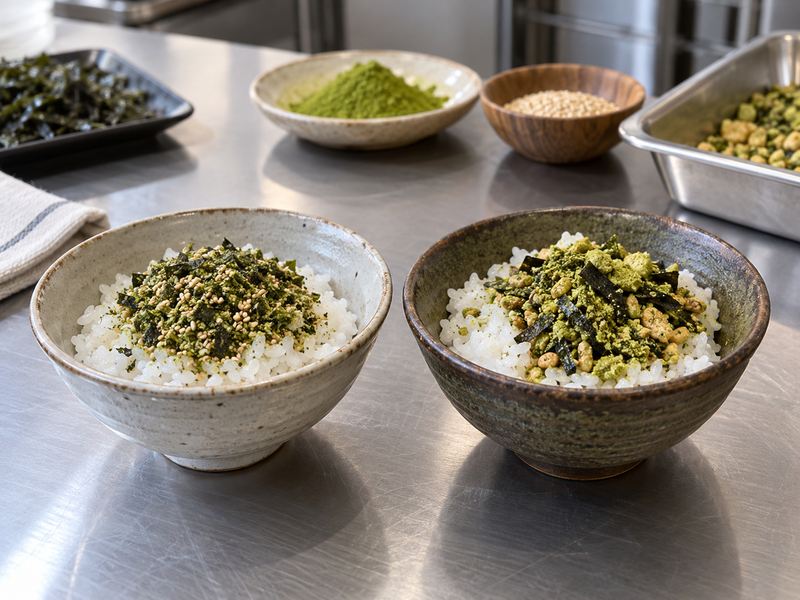
A shaker opening that releases sesame may trap nori; a wide opening may deliver a mound of salt-rich fines. Fill two candidate closures with the same well-mixed blend and weigh ten pours from each at a fixed tilt and duration. For a restaurant, test a spoon and a pinch as controls. Record average deposit and the largest outlier. Then inspect the opening for flakes caught across the holes. A dispenser that needs vigorous shaking may separate the blend further as it is used.
Test at full, half-full and nearly empty pack levels. A last-portion pour can differ from the first because larger particles and powder migrate. Photograph the rice after each pour, not only the empty shaker. If staff use a spoon, specify level or weighed deposits and keep the utensil dry. The FDA’s water-activity guide explains why available moisture affects food stability; it does not establish a safe shelf life for this recipe. Watch the final pour. Poor flow often appears only after repeated use.
| Dispensing test | Suggested record | Failure signal |
|---|---|---|
| Ten fixed pours | Individual grams | Wide spread |
| Full and low pack | Average grams | Dose drift |
| Opening inspection | Trapped flakes | Clogging |
| Rice coverage | Photo at fixed dose | Uneven patch |
7. Where does the topping work on a menu?
Trial it on contrasting surfaces
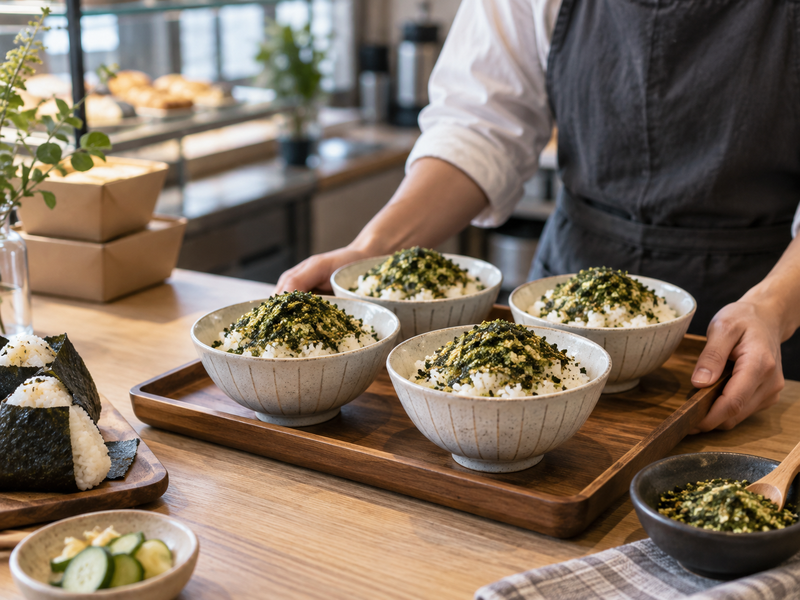
White rice is the clearest first test, but a foodservice buyer should check the actual menu. A moist onigiri surface may hold fine matcha while a dry popcorn surface sheds it. Roasted vegetables bring oil that can catch particles but may dull the green appearance. Test three foods under normal service conditions and use the same seasoning weight per 100 g of food for the first comparison. Then change deposit only where taste demands it. The reference recipe suggests rice, cucumber, popcorn and vegetables; treat those as serving ideas, not proof that one formula suits all four.
Record the time between plating and consumption. On a hot bowl, nori may soften; on cold cucumber, a wet surface may turn the seasoning into green patches. A sauce-heavy bowl can bury the topping entirely. For an assembled takeaway item, photograph it at packing and at the expected handoff time. Use the menu’s real container. A wide bowl, lidded tray and paper snack cup expose the blend to different humidity and movement.
8. How should a retail pack be tested?
Compare pack performance before choosing an expiry date
The package has to keep the blend dry enough to flow and protect sensory quality through its planned distribution route. Compare a small shaker jar with a resealable pouch at the intended fill weight. Store trial packs in the conditions the buyer expects, including a controlled higher-humidity challenge if the product team can run one safely. Record clumps, faded color, aroma, closure cleanliness and pour weight at scheduled checks. The FDA water-activity guidance states that water activity must be controlled and maintained during storage; it cannot replace product-specific validation.
Check whether a proposed liner, seal and cap fit the actual particles. Loose nori caught in a seal can compromise closure integrity. A transparent pack displays the product but may expose color changes faster under store lighting; run a side-by-side display trial rather than assuming either material wins. Establish any shelf life only through the company’s appropriate testing and regulatory review. Open a used pack. A first-opening photograph says little about a shaker handled repeatedly in a kitchen.
| Pack comparison | Jar | Pouch | Record |
|---|---|---|---|
| Closure after use | Cap and holes | Zip and seal | Residue or leakage |
| Pour performance | Fixed tilt | Spoon or pour | Deposit variation |
| Display appearance | Visible fill | Window or opaque | Color and clumps |
9. Which labels and supplier checks matter?
Treat sesame and seaweed as named inputs
Sesame is a major food allergen under US rules; the FDA’s sesame guidance explains the packaged-food declaration requirement. Buyers selling elsewhere must review their own market’s labeling rules. Ask for ingredient and allergen statements for sesame, nori, matcha, any added sugar and any seasoning component. Confirm whether a premixed seaweed product contains oil, fish or other ingredients rather than treating “nori” as a complete ingredient declaration.
Capture supplier lot codes on the batch record and define how substitutions are approved. One change in sesame cut or nori thickness can alter shaker flow even when the label remains unchanged. If the product is packed for retail, send the final ingredient list, net weight, claims and artwork through the buyer’s normal regulatory process. Do not promise “gluten free,” “vegan” or another claim from a kitchen recipe alone. Read the entire specification. The front-of-pack ingredient name cannot answer all formulation and cross-contact questions.
10. What should the final product specification record?
Turn a passing sample into a repeatable batch
Write the formula in grams and percentages, with approved suppliers, lot fields, sesame preparation, nori cut, mixing order, vessel fill and mixing time. Attach photographs of the accepted dry blend, a plated rice portion and the pack after several pours. Include an allowable serving-weight range based on the café’s own trial data. List the sample locations used for uniformity checks and the reason a batch would be rejected or reworked. These limits should come from repeatable trials, not from numbers copied from a household recipe.
Cost the seasoning per saleable serving or filled retail pack. Include material loss caught in equipment, rejects from poor sealing and labor to refill service dispensers. For a purchasing comparison, ask Matcha Village for an application-suitable matcha sample and documentation relevant to the market, then test it against the approved sensory target. Do not infer a certification or performance promise for a specific lot without its current documents. Run a second operator trial. If someone else can produce the same flow and plated appearance from the written sheet, the blend is ready for a controlled launch decision.
Use the culinary grade matcha guide to frame powder selection, then judge the complete seasoning blend after packing.
FAQ
Q1: What is matcha furikake? It is a dry Japanese-style finishing seasoning that combines matcha with particles such as sesame and seaweed. The final formulation should be checked on its intended food.
Q2: Can a café use one blend on rice and popcorn? Possibly, but test deposit, adhesion and flavor on both surfaces; a dry snack can shed powder that sticks to rice.
Q3: Why does matcha settle in a shaker? Fine tea powder and larger sesame or nori pieces can separate during movement. Test ingredient cuts, mixing sequence and repeated pours.
Q4: Does a dry blend automatically have a long shelf life? No. Packaging, water activity, sensory quality and the target market require product-specific validation.
Q5: Which allergen needs particular attention? Sesame is a major allergen in the United States. Check every ingredient and the rules where the product will be sold.