
A matcha face mask is a cosmetic concept that uses finely powdered tea as one component of a skin-applied formula. The word “matcha” may attract a product team already buying tea for food, but a food ingredient file cannot clear a cosmetic launch. The buyer needs a different brief: intended markets, format, ingredient identity, finished-product safety work, labeling ownership, and documented claims. This article turns a consumer recipe idea into questions a cosmetic formulator and regulatory reviewer can answer before anyone places an order.
For: private-label buyers, ingredient teams, and brand owners assessing a cosmetic concept. Decision: whether a qualified cosmetic partner has enough evidence to develop the concept. A food-focused matcha supplier should not be assumed to provide cosmetic manufacturing or compliance services.
Contents: 1 · 2 · 3 · 4 · 5 · 6 · 7 · 8 · 9 · 10
1. What is a matcha face mask in a commercial brief?
Specify the product, not the trend
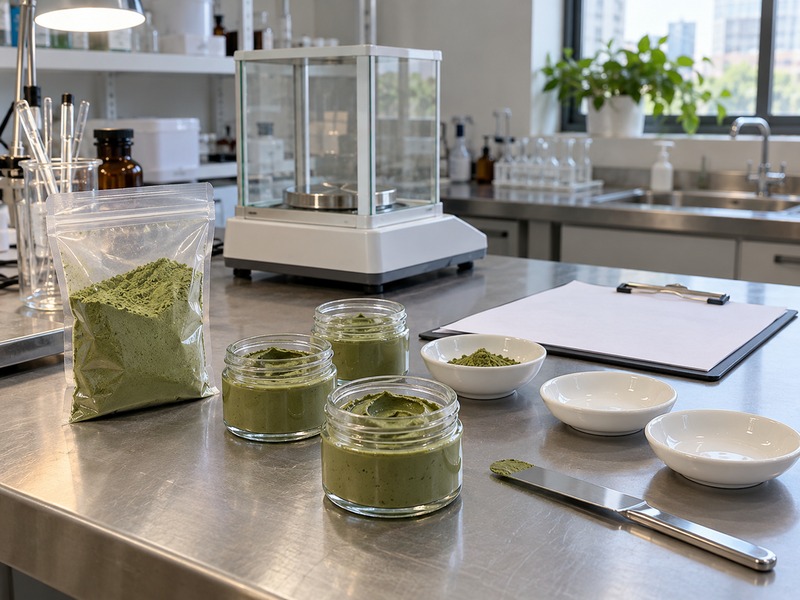
A mask can be a dry powder mixed by the consumer, a ready-to-use clay paste, a gel, or an emulsion. Each has different water exposure, packaging, stability, and use instructions. Write down where the product will be sold, who will apply it, how long it stays on skin, and how it is removed. A product brief should also identify who owns formulation, testing, labels, and post-market responsibilities. Start with intended use: it shapes the evidence needed from every ingredient and from the final formula.
The tea fraction may add color or a recognizable story, but its marketing role does not establish a skin benefit. A first bench sample can test spread, appearance, and rinse behavior. It cannot stand in for safety substantiation or market clearance. For a food manufacturer considering this adjacent category, the first deliverable is a ingredient inquiry for a specialist cosmetic formulator, not an implied offer to manufacture a finished mask.
| Brief field | Decision it controls | Evidence owner |
|---|---|---|
| Market and product classification | Applicable cosmetic rules | Brand regulatory lead |
| Format and expected use | Preservation and pack design | Cosmetic formulator |
| Tea ingredient role | Material specification | Ingredient buyer and formulator |
| Proposed claims | Claim substantiation | Brand legal or regulatory lead |
2. Which market rules apply before sampling?
Assign a regulatory owner early
The same jar may face different filing, labeling, and safety duties in different markets. A United States plan needs review against current FDA cosmetic requirements; an EU plan needs its own responsible-person and product-safety pathway. A distributor cannot resolve these by copying a food label. Record every target country before promising a launch date, and ask a qualified cosmetic regulatory specialist to map the duties. Put ownership on paper: one party should maintain the formula record, one should approve labels, and one should decide whether each market is ready for sale.
For the United States, FDA says marketers are responsible for cosmetic safety, while cosmetic ingredients generally are not preapproved except certain color additives. FDA also distinguishes registration and listing from product approval. Those points are explained in its cosmetic ingredient guidance and registration and listing page. A buyer should resist any pitch that turns a food certificate, an FDA registration number, or a recipe blog into proof that a cosmetic mask is compliant.
3. How should teams separate food-grade from cosmetic suitability?
Compare documents against use
Food-grade matcha is produced and assessed for ingestion under a food specification. Cosmetic use adds skin exposure, formula interactions, cosmetic labeling, and finished-product safety questions. Even a clean food certificate of analysis cannot answer whether a powder is suitable for repeated facial application in a clay paste. Conversely, a cosmetic team may need evidence absent from ordinary food procurement, such as a suitable ingredient naming decision and information for its safety assessment. Keep the boundary explicit: food-grade matcha does not equal a compliant cosmetic ingredient or finished mask.
A buyer can still use the food specification as a starting record for identity, lot traceability, and known contaminants. The cosmetic formulator then identifies missing tests and specifications for the intended use. Do not assume the food supplier has a cosmetic quality system, cosmetic ingredient dossier, or authorization to make skin claims. The pure matcha product page describes a food ingredient supply context; it should not be read as a cosmetic qualification. If no specialist can bridge the evidence gap, stop the concept before sample volume grows.
| Food file may document | Cosmetic team must still decide |
|---|---|
| Tea identity and lot code | Skin-use suitability in the final formula |
| Food contaminant results | Which limits and methods fit cosmetic exposure |
| Food storage guidance | Stability in the cosmetic base and pack |
| Food facility documents | Cosmetic-specific manufacturing obligations |
4. What ingredient documents should a cosmetic formulator request?
Request a lot-linked dossier
Start with ingredient identity, botanical source, production description, particle-size range if controlled, pack material, storage conditions, shelf-life basis, and a recent lot-linked certificate of analysis. Ask what contaminants are tested and which methods and reporting limits apply. The formulator may request additional information for microbiology, heavy metals, pesticide residues, impurities, or potential sensitizers, depending on the material and destination market. A list of test names without results, dates, units, or the lot represented is hard to use. Follow the sample: the data sheet, retained sample, trial material, and eventual commercial lot must remain traceable to each other.
Buyers should also ask about process changes, subcontracting, and advance notification of a changed tea source or grinding method. The goal is a dossier the responsible cosmetic team can evaluate, not a pile of certificates with impressive logos. If a supplier can only describe its food-grade business, record that honestly. The cosmetic developer may decide to source a different material or request further testing through an appropriate lab. Neither path should be presented as a certification already held by the tea seller.
5. Which mask format changes development work?
Water changes the risk profile
A dry mix shipped without water has different development questions from a water-containing jar. The consumer may introduce water at the moment of use, so directions, single-use portioning, and foreseeable storage after mixing matter. A ready-to-use cream or clay emulsion needs an evaluated preservation strategy, compatible packaging, and stability work over the proposed shelf life. The choice also affects texture: tea particles can settle in a fluid base, dry clay can dust during handling, and an emulsion can separate. Choose format before price: a low-cost powder is not a low-cost product if consumers struggle to mix it consistently.
Run early prototypes against actual use scenarios. For a dry sachet, observe opening, mixing with the stated amount of water, spread, and cleanup. For a jar, check fill consistency, dispensing, closure hygiene, and changes after repeated openings. Do not borrow a home recipe’s shelf-life estimate. FDA’s product-testing overview explains that the marketer carries responsibility for safety and that suitable testing depends on the product.
| Candidate format | Early development question | Commercial consequence |
|---|---|---|
| Dry single-use sachet | Does the user mix a smooth portion? | Portion and instruction design |
| Dry multi-use jar | Does handling add moisture? | Closure and use guidance |
| Water-containing paste | Does it remain stable and controlled? | Preservation and pack validation |
| Emulsion mask | Do phases remain uniform? | Process and stability work |
6. How can color and texture be evaluated without efficacy claims?
Describe what an observer can see
The buyer may want a green mask that spreads evenly and rinses without persistent grit. Those are observable attributes. A claim that matcha “detoxifies,” treats inflammation, repairs skin, or protects against disease is a different proposition and needs specialist review and evidence. Set a reference sample under controlled light, then describe color range, particle visibility, spread, drag, drying behavior, and rinse effort. Keep scoring concrete: “visible dark specks after spreading” gives a formulator a useful problem; “premium feel” does not tell the lab what to change.
Tea color can shift when powder contacts water, heat, air, minerals, or other formula ingredients. A bench team should observe the base in its intended pack rather than infer performance from dry powder color. Record a controlled mixing procedure and a fixed observation point. If an attractive prototype stains washcloths or leaves gritty residue, that belongs in the decision record even when a photograph looks good. Define a permissible visual range around the product’s intended appearance, and separate that tolerance from any claim about biological action on skin.
7. What stability and microbiology work belongs in validation?
Let a qualified team design the plan
A marketable mask needs an evidence program suited to its water content, intended use, pack, and distribution conditions. That may include stability observations, packaging compatibility, microbial limits, preservative efficacy work where appropriate, and a safety assessment of the final formula. A buyer should not set a universal test list or promise a shelf life from an ingredient specification. Validate the combination: tea, clay, water, fragrance, preservation system, and container can behave differently together than they do alone.
Request a written protocol identifying samples, conditions, endpoints, responsibility, and how failures will be handled. Changes in odor, color, separation, viscosity, or microbial result should trigger investigation rather than a silent reformulation. If the formula, pack, supplier, or proposed claims change, the specialist should decide which work must be repeated. FDA notes that cosmetics need to be safe under labeled or customary use and discusses available evidence on its cosmetic testing page. It does not certify a particular tea mask by virtue of a passing food test.
| Validation record | Question answered | When to revisit |
|---|---|---|
| Stability protocol | Does the formula remain acceptable? | Formula or storage change |
| Microbiology plan | Is microbial quality controlled? | Process or pack change |
| Pack compatibility | Does the container affect product? | New closure or material |
| Safety assessment | Is use supported by evidence? | New ingredient or claim |
8. How should packs and use directions be assessed?
Test the opening sequence
A mask’s pack should protect the formula and make the intended use plausible. A sachet can control portion size but raises waste and sealing questions. A tube may suit a fluid paste yet clog if the powder is too coarse. Observe users opening, dispensing, applying, closing, and cleaning the product under a controlled prototype test. Watch ordinary handling: a laboratory-perfect sample may fail after a customer leaves the cap loose or stores a mixed powder overnight.
Directions should tell the user how much to mix or apply, how long to leave the product on, where not to apply it, and whether a mixed portion should be discarded. The regulatory reviewer determines required warnings and labeling for each market. Do not borrow a consumer blog’s instructions without testing the finished product. If the brand sells both food matcha and a cosmetic mask, package design should make the two intended uses unmistakable. Green powder in an attractive pouch could otherwise invite the wrong use.
9. Which claims and labels need specialist review?
Separate appearance from effect
“Contains matcha” describes a formula component if true and documented. “Leaves skin brighter” or “soothes irritation” asserts a result; therapeutic language can change the regulatory character of a product. A brand needs evidence for any objective claim and a market-specific review of ingredient names, warnings, net contents, responsible-party details, and product description. The FDA cosmetics labeling summary explains core U.S. label elements. Route copy before artwork: printing a bold promise before the formula and evidence are settled creates avoidable rework.
A “before and after” image or a clinical-looking seal may suggest performance that no test supports. The FTC’s advertising guidance requires truthful, evidence-based advertising. Keep an approval record linking each approved line to its support and market. If the phrase is only a sensory description, make it precise enough that a customer will not read it as a medical benefit. For a food supplier, the safest commercial statement may be limited to documented tea identity and available food-grade specifications while a separate cosmetic expert reviews suitability.
| Proposed statement | Review question | Sensible owner |
|---|---|---|
| “Made with matcha” | Is ingredient identity documented? | Brand and ingredient buyer |
| “Gentle on skin” | What evidence supports it? | Cosmetic safety lead |
| “Treats acne” | Does this alter product classification? | Regulatory counsel |
| “FDA approved” | Is this inaccurate for the product? | Regulatory counsel |
10. What should a go/no-go supplier decision contain?
Close the evidence gaps
The decision file should name the target market, chosen format, intended tea ingredient, proposed supplier, pilot lot, formula owner, outstanding tests, label owner, and unresolved claims. Give each gap an owner and a date; do not convert an open question into a marketing promise. Make the stop rule visible: if safety ownership, suitable documentation, or a viable preservation path cannot be established, commercial procurement should wait.
Ask how the supplier notifies changes, replaces a rejected lot, and provides traceable documents at scale. Compare price only after the cosmetic team accepts the material specification. A cheap food-grade powder that needs extensive requalification or creates unstable color may be expensive in the actual mask. For the next meeting, bring a one-page gap register and a sample request tied to a single formulation question. The FDA cosmetic ingredient page gives a useful starting point for the specialist discussion; it is not a substitute for a product-specific assessment.
Reference: Matcha & Sea Clay Face Mask – Crafter’s Choice. Consumer recipe cited only for search-intent context; no formula or performance claim was adopted.
FAQ
Q1: Can food-grade matcha be used automatically in cosmetics?
No. A cosmetic formulator must assess the material and finished formula for intended skin use and target-market requirements.
Q2: Does a green tea mask need a preservative?
That depends on formula, water activity, pack, and use. A qualified cosmetic team should set and validate the preservation plan.
Q3: Can a supplier call a mask anti-inflammatory?
A brand should not make that claim without market-specific regulatory review and suitable evidence.
Q4: Which records should a buyer request first?
Ask for material identity, lot-linked specifications, production and storage details, and the proposed finished-product responsibility map.
Q5: When should a pilot be stopped?
Pause when safety ownership, core ingredient evidence, or a workable stability and preservation route remains unresolved.