
Matcha energy bars are easy to prototype and harder to sell consistently. A no-bake mixture may taste good by the spoonful but crumble in a wrapper, become sticky in a warm bag or vary from one cut to the next. Grateful Grazer’s no-bake matcha bars offer a useful recipe starting point. A retail brand can request matcha samples for formulation trials. The product also needs a weighed formula, allergen review, packaging test and a shelf-life decision based on evidence.
Contents
- 1. What job should the bar do for the buyer?
- 2. Which ingredients build the base?
- 3. How should matcha be added?
- 4. What controls binding and texture?
- 5. How should a pilot batch be mixed?
- 6. How can portions and yield be standardized?
- 7. Which allergen controls need written review?
- 8. What should packaging trials measure?
- 9. How should claims and costs be checked?
- 10. What evidence supports a retail launch?
1. What job should the bar do for the buyer?
Pick an occasion before building a formula
A café impulse snack, a gym-bag product and a gift-box bar face different conditions. One may be eaten immediately with a drink; another may spend hours in a warm bag. Decide intended portion size, texture, sweetness and eating occasion. “Energy” in the name can imply a benefit that the product has not been shown to deliver. Describe concrete ingredients and serving format rather than making vague performance promises.
Taste candidate bars with the drink customers are likely to buy. A sweet date-based bar may pair well with unsweetened matcha but feel too sweet beside a flavored latte. Photograph a cut bar and observe whether it can be held without shedding crumbs. Make the first brief practical: a target weight range, shape, flavor balance, wrapper type and likely selling location. Those choices determine the later formulation and packaging tests.
2. Which ingredients build the base?
Understand the role of each component
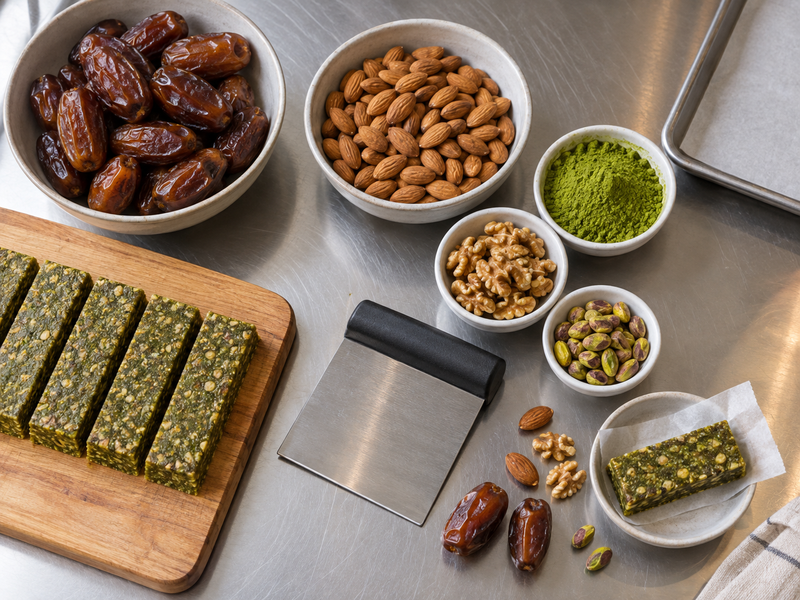
No-bake bars often use a sticky fruit paste, nuts or seeds and a dry ingredient such as oats. The fruit binds and sweetens; the particles provide chew and structure. A nut butter can add cohesion but may soften the bar. Grateful Grazer’s recipe is one illustration of the format. For a commercial trial, write every ingredient in grams and note whether it is chopped, ground or whole.
Ingredient form matters as much as name. Two date pastes with different moisture can produce very different bars at the same weight. A coarse oat may make cutting difficult, while a very fine one may make the bite dense. Buy enough of one specified lot for the first comparison so a supplier change does not become an invisible formula change. Keep a plain control without matcha to see what the tea actually changes in texture and flavor.
| Ingredient role | Example | What to check |
|---|---|---|
| Binder | Fruit paste or syrup | Stickiness and distribution |
| Structure | Oats, nuts or seeds | Particle size and chew |
| Fat source | Nut or seed butter | Softness and oil release |
| Flavor | Matcha, citrus or salt | Balance after packing |
3. How should matcha be added?
Make every bite taste alike
Weigh matcha as a percentage of total batch weight and sift it into a dry component or disperse it in a compatible binder. Adding it to a sticky mass in one pile can leave bitter green streaks. Mix a small test batch and take samples from several positions before pressing. If the color and flavor vary, adjust the mixing sequence before increasing the dose. A higher dose cannot fix uneven distribution.
Evaluate matcha after the bar has rested in its intended wrapper, not just during mixing. Strong fruit, chocolate or nut flavors can obscure tea. Matcha color may also change under the product’s light and storage conditions. Ask the supplier for current ingredient and lot documentation before making origin, grade or certification statements. Matcha Village’s background supports general sourcing discussion, but a specific bar ingredient needs its own current record.
4. What controls binding and texture?
Test a cut bar, not a spoonful of mixture
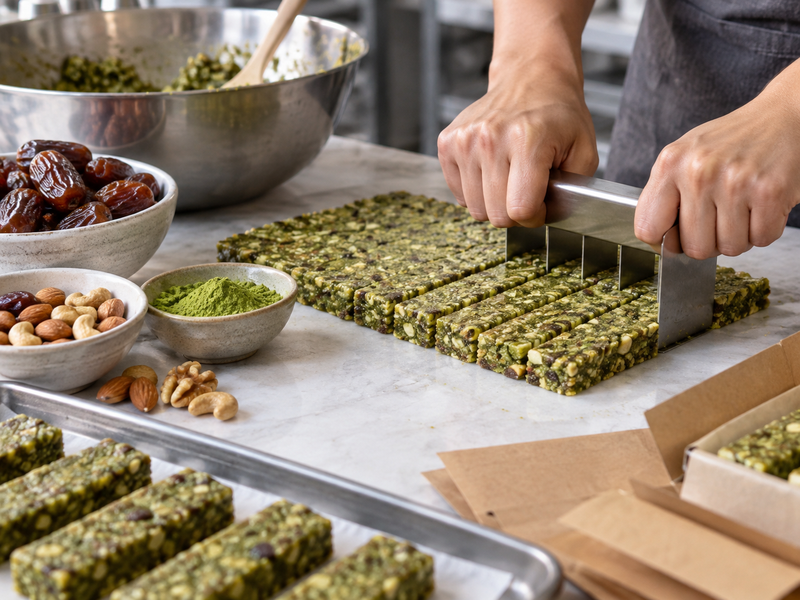
Press the mixture to a measured depth in a defined pan or frame. Record pressure, rest time and cut temperature. A bar can seem cohesive in a bowl yet fracture when cut thin. Compare two binder levels while keeping everything else fixed. Observe clean cutting, hand feel, chew and whether oil or moisture appears on the wrapper. A bar that only holds together while cold may not suit an ambient retail display.
Water activity and microbial stability cannot be judged by touch or taste. If the business wants an ambient shelf-life claim, obtain an appropriate validation plan with qualified testing and packaging review. The first formulation trial can still establish a practical quality target: the bar should survive ordinary handling, not smear, and taste like the approved sample. Record the environment and time used in each trial so a later change can be explained.
| Texture fault | Possible contributor | Next controlled test |
|---|---|---|
| Crumbles on cutting | Low binder or coarse particles | Change one binder level |
| Sticks to wrapper | Excess binder or soft fat | Adjust formula or film |
| Oily surface | Fat separation | Review ingredient and mixing |
| Hard after chilling | Formula or temperature | Test at sale conditions |
5. How should a pilot batch be mixed?
Scale by process, not only arithmetic
A small food-processor batch may mix evenly while a larger mixer leaves dry corners. Document equipment, load size, ingredient order and mixing time. Scrape the vessel in a consistent way and inspect several samples for matcha distribution. If nuts are chopped in-house, record the size range; finely ground and roughly chopped pieces change both texture and yield. Use a batch sheet that captures actual weights, not just target weights.
Keep the work area and tools appropriate for the food being made. A no-bake process does not eliminate food-safety obligations. The FDA Food Code is a U.S. retail model, while local rules and the operator’s plan control production. If ingredients are heated or cooled during the process, document that as part of the approved method. A pilot should also measure mix left on the machine and pan, because that loss affects saleable yield.
6. How can portions and yield be standardized?
Measure the pan, the cut and the waste
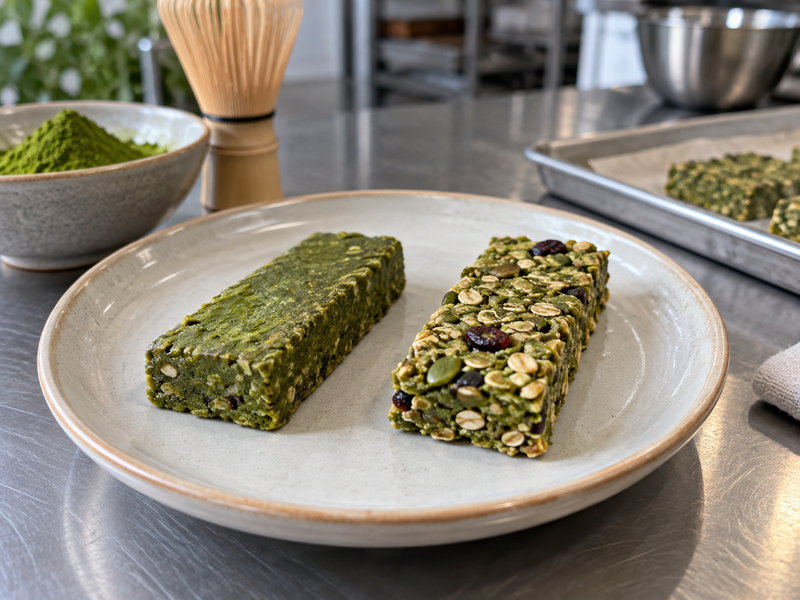
Weigh the finished mix before pressing. Spread it in a frame with known dimensions and use a guide to set thickness. Cut a fixed grid and weigh bars from the center and corners. If weights vary, adjust pressing and cutting before changing the declared portion. A thick edge or uneven surface will give some customers a smaller bar and make nutrition calculations less reliable.
Record saleable bars, broken pieces and trim. Trim may be usable in a separately approved product, but do not count it as saleable bars in the primary yield. Check how the bar handles after wrapping and a short transport test. For cafés, a smaller bar may be easier to sell with a drink; for retail shelves, a larger piece may justify packaging cost. Test both rather than assuming one size works everywhere.
| Yield item | Record per batch | Use |
|---|---|---|
| Finished mix | Total weight | Reconcile ingredients |
| Planned grid | Rows and columns | Target count |
| Actual bars | Count and weight range | Portion control |
| Trim and rejects | Weight and reason | True cost |
7. Which allergen controls need written review?
Follow ingredients through the entire process
Nuts, peanuts, sesame, milk or soy can enter through obvious ingredients, chocolate, protein additions or shared equipment. Build the allergen matrix from current supplier labels and the actual production route. The FDA’s major food allergen guidance is a primary U.S. reference. Required declarations vary by sales market, so the final label needs review for that destination.
Do not describe a bar as free from a named allergen solely because the formula omits it. Shared tools, storage and supplier cross-contact statements may matter. Train staff to know where allergen information is documented and how to handle questions. If making several bar variants, plan the production sequence and cleaning controls before launching all flavors. A formula revision must trigger a label and matrix review, not just a new batch sheet.
8. What should packaging trials measure?
Test the wrapper with the real product
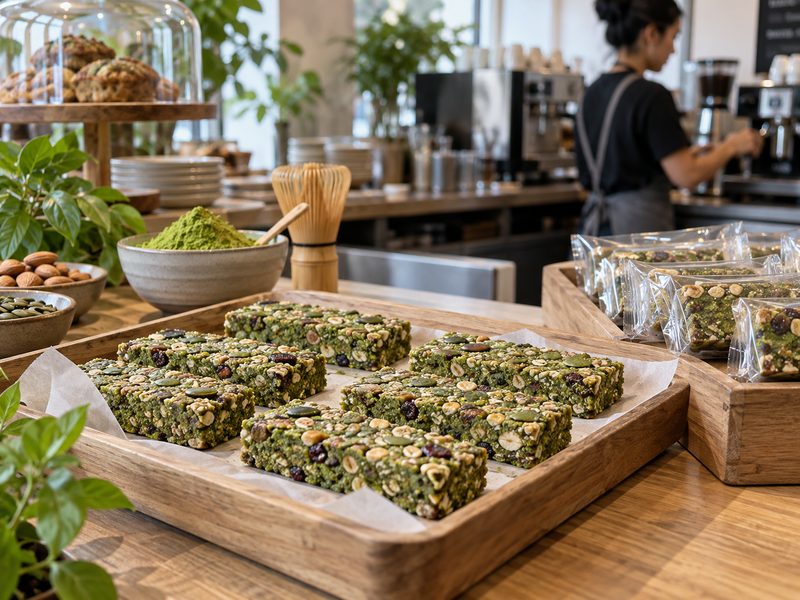
The wrapper must protect the bar, open cleanly and carry required information. Put bars in candidate packs, then assess appearance, odor, texture and wrapper adhesion under the intended storage and transport conditions. A bar that sweats or stains film may need a formula change as well as different packaging. Check seal quality and whether crumbs interfere with it. Printed colors should not be used as a substitute for a documented food-contact packaging specification.
Work with qualified packaging and food-safety advisers on shelf-life validation. A short taste test cannot justify a long date code or ambient claim. The first pack trial can still compare practical issues: crush resistance in a bag, ease of opening with one hand, barcode position and how many units fit in the display. Record the pack material and supplier so the approved version can be reordered consistently.
| Pack trial | Observe | Why it matters |
|---|---|---|
| Short transport | Breakage and crumbs | Customer handling |
| Display exposure | Color and wrapper appearance | Shelf appeal |
| Open test | Clean release from film | Eating experience |
| Seal inspection | Contamination or weak seal | Pack integrity |
9. How should claims and costs be checked?
Use evidence for every number and phrase
Cost the bar from actual saleable yield, including matcha, base ingredients, wrapper, label, labor, test loss and rejects. If a “protein” or “energy” statement is planned, obtain a compliant nutrient calculation and review the claim under the rules of each market. Do not infer benefits from matcha alone. A café menu can say “matcha, oat and date bar” without promising a physiological effect.
Check package weight, ingredient order and any required nutrition information against the final formulation, not an early trial. A change in the binder can alter weight, allergens and labeling. Compare retail price with the bar’s role in the assortment: it may be an impulse companion to a drink, or a standalone packed product with higher distribution cost. Keep the approved sensory target visible when considering cheaper ingredient substitutions.
10. What evidence supports a retail launch?
Confirm the process on a second batch
The product sheet should list ingredients by weight, supplier items, allergen matrix, equipment, mixing order, pressing depth, cut grid, expected saleable count, packaging and storage plan. Make a second full-size batch on a different day and compare texture, weight range, matcha distribution and pack behavior. A recipe that works only in a tiny test bowl is still a prototype.
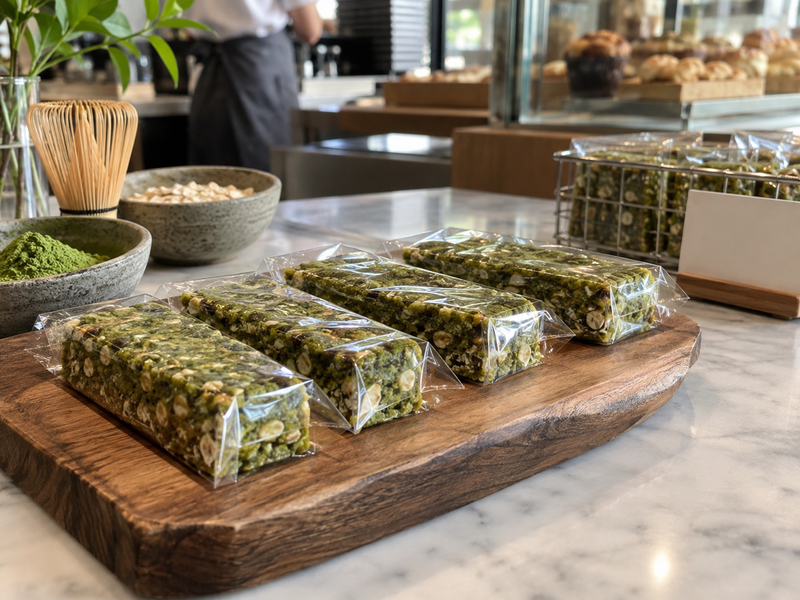
Hold a limited sale after the food-safety, label and shelf-life questions have been resolved for the intended market. Collect specific feedback: too sweet, too dry, hard to open, powdery, or indistinct matcha. Each points to a different next experiment. Record returns and waste by cause. The launch decision should be based on repeatable production and an approved pack, not on an attractive cross-section photograph.
| Decision | Evidence | Action |
|---|---|---|
| Launch | Repeatable batch, valid label and pack | Schedule production |
| Revise | One traceable texture or flavor fault | Run a controlled trial |
| Hold | Unvalidated storage or claim | Finish the review |
FAQ
Q1. Can matcha energy bars be made without baking? Yes, but no-bake production still needs safe ingredients, controlled handling and a validated storage plan.
Q2. Why does a bar crumble after cutting? Binder level, particle size, pressing or cut temperature may be involved. Change one variable in the next test.
Q3. Can nuts be replaced with seeds? Possibly, but that is a new formula with different flavor, texture, cost and allergen review.
Q4. How long will the bars last? A responsible date requires evidence for the final recipe, pack and storage conditions.
Q5. Is a nutrition claim needed to sell them? No. A clear ingredient description and good eating quality can carry the product.
The next useful pilot is a full pan cut to the intended retail grid, with every piece weighed and wrapped. That test exposes the problems a spoonful of mixture cannot show.
Record cutting loss, wrapper failures and any oily residue inside each pack during that run. Those observations show whether the formula survives as a real sales unit, rather than only as a plated sample from the development kitchen.