
A matcha electric whisk can speed up preparation, but a café buys a complete working system: head, motor, power source, cup, cleaning routine, and replacement parts. A high-speed frother can make impressive foam in one demo and splash across a shallow vessel during a rush. Test the device on your actual recipe and station before adding it to every counter. These ten checks help a buyer compare repeatability, hygiene, handling, and total operating cost without accepting a “professional” label on trust.
Contents
- 1. What task should the device perform?
- 2. Which head design fits the recipe?
- 3. Does the motor stay controlled under load?
- 4. What vessel prevents splashing?
- 5. Is the drink result consistent?
- 6. How will staff clean the food-contact parts?
- 7. What power and charging plan works?
- 8. What electrical and use documents are needed?
- 9. Can parts be replaced without buying a new unit?
- 10. How should a café approve the device?
1. What task should the device perform?
Specify dispersion before admiring foam
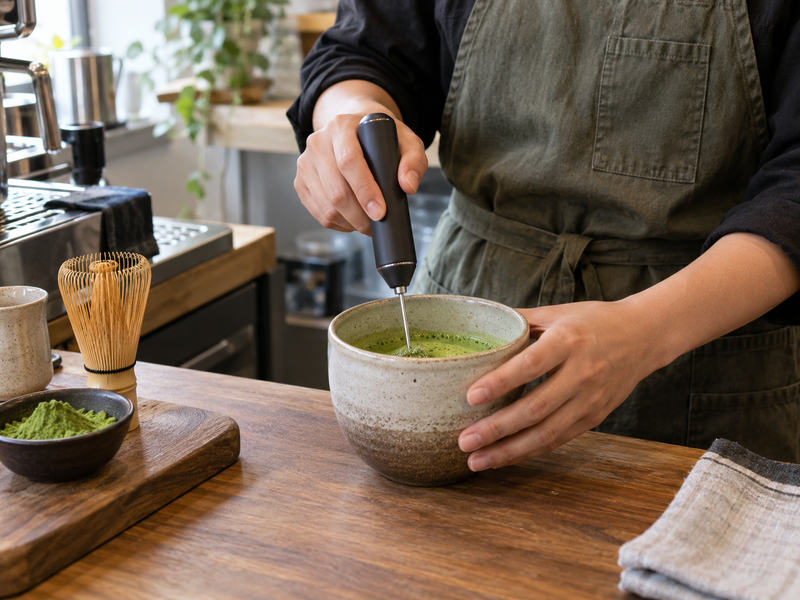
Decide whether the whisk will disperse matcha into a short water concentrate, aerate a bowl of tea, or froth milk. Those tasks use different liquid volumes and depths. A café might want a smooth base that pours into iced milk, with little need for a tall foam cap. A retail customer may value a visible foam head. Write one pass description for each drink: no dry powder at the bottom, acceptable surface texture, and a preparation time that fits service.
The Crafti electric whisk guide shows a consumer preparation approach. Treat it as a starting reference, not proof that any model suits high-volume commercial use. Observe the current method and identify the bottleneck. If inconsistency comes from unweighed powder or varying water volume, an electric whisk may simply reproduce that inconsistency faster. Keep the recipe fixed while testing tools.
2. Which head design fits the recipe?
Compare contact, depth, and cleanability
Small ring frothers, multi-loop heads, and other attachments move liquid differently. Put each in the normal cup at the intended depth before switching on. Check whether the head can sit below the surface without touching the bottom or sides, and whether the shaft reaches the smallest approved batch. A head too large for a narrow cup will clatter; a tiny head may require more repositioning in a larger volume. Measure the head and cup rather than assuming a product photo shows compatibility.
Ask whether the head detaches for cleaning and whether a replacement head is sold. Inspect joints and wire bends where powder might collect. Test a mixed drink, rinse as the manual requires, and look for remaining green film. Do not assert that one head “protects nutrients” or “creates ceremonial foam”; judge only the observable service result and the cleaning method the manufacturer permits.
| Head feature | Trial question | Procurement note |
|---|---|---|
| Diameter | Clears cup wall? | Record minimum vessel width |
| Shaft length | Reaches recipe depth? | Test smallest batch |
| Attachment joint | Traps residue? | Inspect after cleaning |
| Replaceability | Spare available? | Price and supply term |
3. Does the motor stay controlled under load?
Compare repeated drinks, not a single spin
Prepare a sequence matching a realistic busy interval. Watch for changes in speed, unusual vibration, heat in the handle, or a switch that is hard to operate with damp hands. Record each run’s duration and pause according to the manufacturer’s instructions. A motor that runs freely in water may behave differently in a thicker matcha base. Do not exceed its stated duty cycle to prove toughness; the test should reflect intended use.
Check how easily staff can start and stop the device without spraying liquid. A momentary button may give control but tire the thumb; a lock-on switch may need a clear stop action. Ask two operators to make the same drink and note whether they can keep the head at a consistent depth. The motor specification on a listing is less useful than repeatable drink preparation under the actual load.
4. What vessel prevents splashing?
Test the tool and cup as one pair
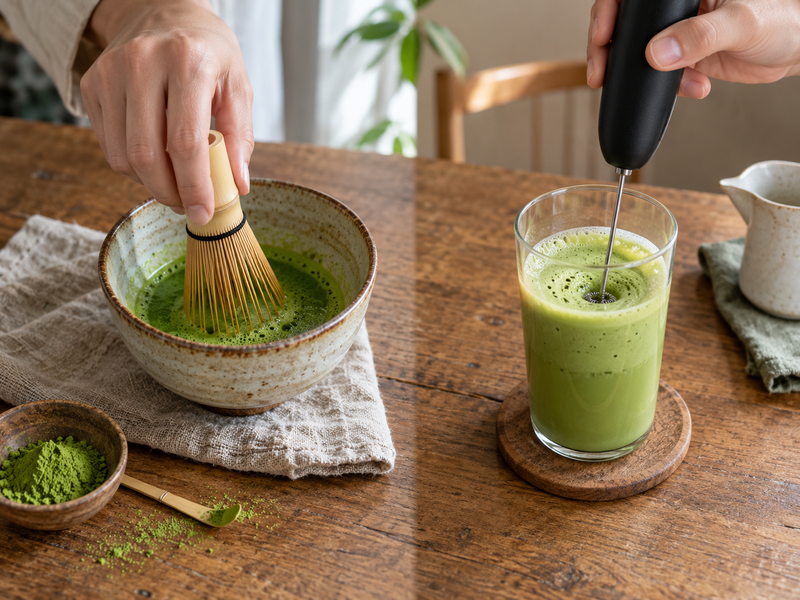
An electric whisk can pull a vortex and throw droplets when the head rises near the surface. Use the proposed preparation cup, normal liquid volume, and normal speed. Mark where the liquid starts and how high it climbs. Start the whisk below the surface if the manufacturer instructs that, then observe whether the operator can stop it without lifting a spinning head through the liquid. A tall, narrow cup may contain splash but make cleaning or pouring harder; a wide bowl may be easy to access but expose more surface.
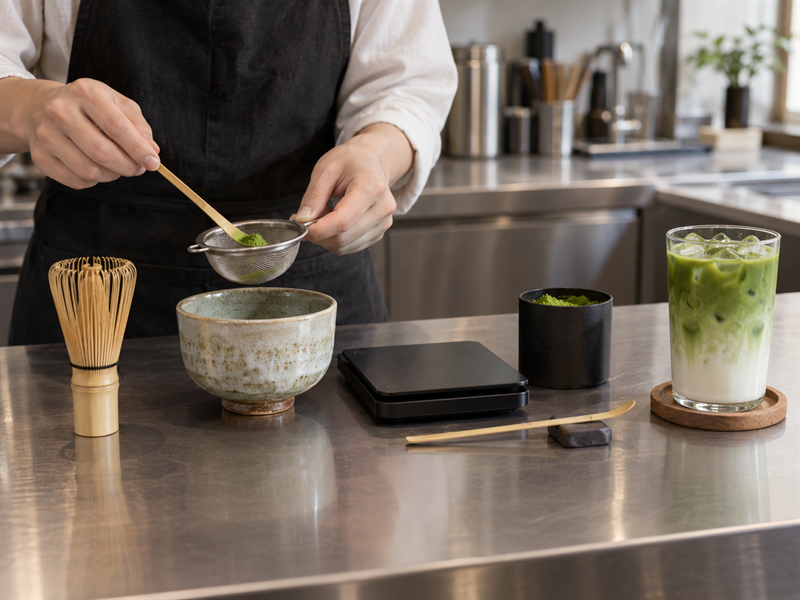
Check the cup’s material and food-contact suitability separately from the motor. Measure poured yield after whisking to see whether the vessel retains a costly amount of concentrate. Place the cup in the station layout with the scale, powder tin, and serving glass. A tool that needs a special cup may still be worthwhile, but that cup belongs in the cost and cleaning calculation.
| Pairing check | How to test | Accept when |
|---|---|---|
| Head clearance | Run at normal depth | No repeated wall contact |
| Splash | Prepare three servings | Counter remains within local standard |
| Pour | Transfer to service glass | No awkward drips or retention |
| Storage | Place in station layout | Tools fit safely |
5. Is the drink result consistent?
Blind the comparison when possible
Use the same matcha lot, weighed dose, measured water, and serving format for an electric whisk and the current method. Prepare several drinks in alternating order, then have a taster compare them without knowing which tool made each. Record visible clumps, foam, mouthfeel, and appearance at the time the customer receives the drink. For lattes, evaluate after milk and ice are added; concentrate appearance alone may not predict the finished product.
Do not claim the electric method is better because its first drink has more foam. If the drink is prepared for takeaway, also observe it after the normal wait before collection. A useful device produces a result staff can repeat without excessive training. Time the entire process, including retrieving, cleaning, and putting away the tool. A two-second blending advantage can disappear if the head takes much longer to clean.
6. How will staff clean the food-contact parts?
Follow the manual and inspect the joint
Obtain the manufacturer’s cleaning instructions before the trial. Confirm whether the head is removable, which parts may be immersed, and which detergents or sanitizing methods are permitted. Never assume the motor housing is waterproof because the whisk head can be rinsed. After a realistic service delay, clean the head as instructed and inspect wires, joints, and the shaft under good light. If dried matcha remains in an inaccessible area, the model is a poor fit for commercial use.
The FDA Food Code describes cleaning and sanitizing principles for food-contact equipment in US food service. Check local requirements and confirm the device can meet the operation’s approved method. Make a one-page station procedure that separates the powered body from washable parts. Staff need to know what to do after every drink and at the end of a shift, not just how to turn it on.
| Part | Confirm in manual | Trial observation |
|---|---|---|
| Whisk head | Removable or fixed; wash method | Residue after cleaning |
| Shaft joint | Exposure limits | Trapped powder |
| Motor housing | Wipe-only or rated otherwise | Splash and grip condition |
| Storage stand | Cleaning method | Drips near power source |
7. What power and charging plan works?
Count availability across the shift
Battery-powered, rechargeable, and corded models create different station needs. Record how many drinks the sample makes in a normal shift under the permitted duty cycle, and how its performance changes before it needs charging or fresh batteries. Do not rely on a manufacturer’s maximum runtime as the number of matcha drinks; actual load and pauses differ. If the device is rechargeable, place the charging point away from the wet preparation area according to the manual and local electrical practice.
Keep a second unit or a defined alternative method if the drink depends on an electric whisk. A dead battery should not stop service. For a multi-site buyer, standardize the charger and spare process where possible, then record who is responsible for charging at close. Consider battery replacement, power adapters, and safe storage in the whole-life cost. The lowest purchase price may become expensive if devices disappear from service while waiting for proprietary parts.
8. What electrical and use documents are needed?
Ask for model-specific information
Request the user manual, electrical ratings, charger details, warranty terms, and any conformity documents relevant to the destination market. Check that the documents identify the exact model and supplied power adapter. A vendor’s general claim that a device is “certified” is not enough to establish what has been evaluated. An importer should review applicable market requirements with its own compliance team. Do not publish a blanket safety guarantee based on packaging symbols.
Confirm intended usage in the manual: household only or suitable for the planned commercial duty. A café should not assume that a consumer frother carries a commercial warranty. Ask about maximum run time, required pauses, immersion limits, and storage conditions. Train staff to follow those instructions. If a model cannot be used within its stated limits at the required pace, eliminate it before a large purchase, however attractive the first drink looks.
| Document | Verify | Why |
|---|---|---|
| Manual | Exact model and duty limits | Defines permitted use |
| Power rating | Device and adapter match | Installation planning |
| Conformity record | Market and model identified | Import review |
| Warranty | Commercial use terms | Replacement cost |
9. Can parts be replaced without buying a new unit?
Price the working system
Ask whether whisk heads, shafts, batteries, chargers, and stands can be ordered separately. Record prices and expected availability in writing. A detachable head can simplify cleaning, but a proprietary attachment may turn a minor break into replacement of the entire device. Test how firmly the head attaches and whether staff can remove it without tools or excessive force. Keep spare parts clearly labeled so they are not mixed across similar models.
For retail, state what the package includes and whether replacement heads are available to consumers. For cafés, track failures by part during a limited rollout. If heads bend from striking a narrow cup, redesign the cup pairing or technique before blaming the motor. Whole-life cost includes unit price, power supplies, cleaning time, replacement parts, and downtime. Use observed local data rather than a vendor’s hypothetical lifetime claim.
10. How should a café approve the device?
Run a limited station trial
Choose one recipe and one station, train several operators, and run the device under ordinary demand for a defined trial period. Record drink quality, preparation time including cleanup, splashes, complaints, device faults, and power interruptions. Keep the current preparation method available as a control. Ask staff whether the tool improves a real bottleneck and whether the cleaning steps are feasible when the queue builds.
At the end, review the drink result, manual limits, documentation, parts supply, and total cost together. Reject a model that fails a non-negotiable cleaning or intended-use requirement, even if it is fast. If it passes, write the cup pairing and recipe into a station card, retain the approved sample, and inspect delivered units against the same model specification. A controlled rollout avoids turning one persuasive demo into a chain-wide equipment problem.
| Approval area | Evidence required | Decision |
|---|---|---|
| Drink | Repeated finished-drink comparison | Meets menu standard |
| Workflow | Full-cycle timing and splash log | Fits station |
| Cleaning | Manual and inspection | Fits approved process |
| Use limits | Model-specific documents | Suits duty and market |
| Cost | Parts and downtime estimate | Justified against current method |
FAQ
Q1. Can an electric whisk replace a bamboo chasen? It can prepare some recipes efficiently, but compare the finished drink and service experience before replacing a chasen across the menu.
Q2. Does more foam mean better matcha? Not necessarily. For a latte, smooth dispersion and the finished drink may matter more than a tall foam cap in concentrate.
Q3. Can the whole whisk be rinsed under a tap? Follow the exact model’s manual. The food-contact head and powered housing often have different cleaning limits.
Q4. Is a home frother suitable for a café? Check the maker’s intended-use statement, duty limits, warranty, cleanability, and local compliance needs before commercial use.
Q5. What should be tested first? Prepare the normal recipe in the normal cup, then clean the tool exactly as staff would during service.
Approve the station, not the demonstration
Choose a matcha electric whisk only when the tool, cup, power plan, and cleaning method all pass together. A repeatable drink and a workable shift routine are stronger evidence than a dramatic foam photo.