
Matcha demand forecasting starts with the products the business expects to sell and the matcha each one consumes. A useful forecast explains its assumptions, keeps different ingredient codes separate and can be compared with actual use after the period ends.
For a cafe chain or food manufacturer, the forecast supports purchasing discussions without becoming an automatic order. This guide develops a practical demand estimate from operating records, identifies uncertainty and gives the supplier a clearer view of likely requirements.
Contents: 1. What decision should matcha demand forecasting support? | 2. Which operating records should be collected? | 3. How do finished-product quantities become matcha demand? | 4. How should waste and non-sale use be handled? | 5. What baseline should be used before adding business changes? | 6. How should launches and promotions change the forecast? | 7. How can uncertainty be shown without false precision? | 8. How should the forecast be evaluated after the period ends? | 9. What should the supplier receive from the forecast? | 10. How does the forecast become a maintained buying input?
1. What decision should matcha demand forecasting support?

Choose the planning period and product level
State who will use the forecast and which period it covers. A branch replenishment estimate, a factory production plan and a supplier’s longer-range discussion may need different levels of detail. Choose the smallest time interval that helps the decision without creating detail the business cannot maintain.
TNK’s forecasting article bases demand planning on a business’s own recipes and sales history. The method below extends that purchasing task with data checks, ownership and a review of assumptions.
| Planning choice | Definition to record |
|---|---|
| Ingredient code | Exact matcha or blend being forecast |
| Location | Branch, factory or distribution point |
| Time period | Interval used for demand and review |
| Decision | Supplier outlook or purchasing input |
Keep a forecast for each noninterchangeable ingredient. Combining pure matcha and a sweetened blend into one weight can hide which product the business actually needs. Record any approved substitution separately rather than silently merging the two series.
2. Which operating records should be collected?
Build a small, consistent data set
Collect sales or production quantities, recipe versions, opening days, stock movements and recorded losses for the chosen period. Use the same calendar and product codes across the files. If one report counts cups and another counts ingredient weight, keep that difference visible until the conversion is made.
Check the meaning of each field with the staff who create it. A point-of-sale total may include refunds or cancelled items, while a production report may count planned output instead of completed saleable units. Those differences can distort a forecast even when every spreadsheet total is arithmetically correct.
Preserve missing data as missing. A blank branch report should not be converted to zero sales, and a closed day should be identified as a closure. If an estimate is used to fill a gap, record the method and owner so it can be replaced when better evidence arrives.
Start with a manageable history and improve it as the process runs. A smaller set of understood records is more useful than a large export containing inconsistent product names and unexplained stock adjustments.
3. How do finished-product quantities become matcha demand?
Use the recipe version that will be produced
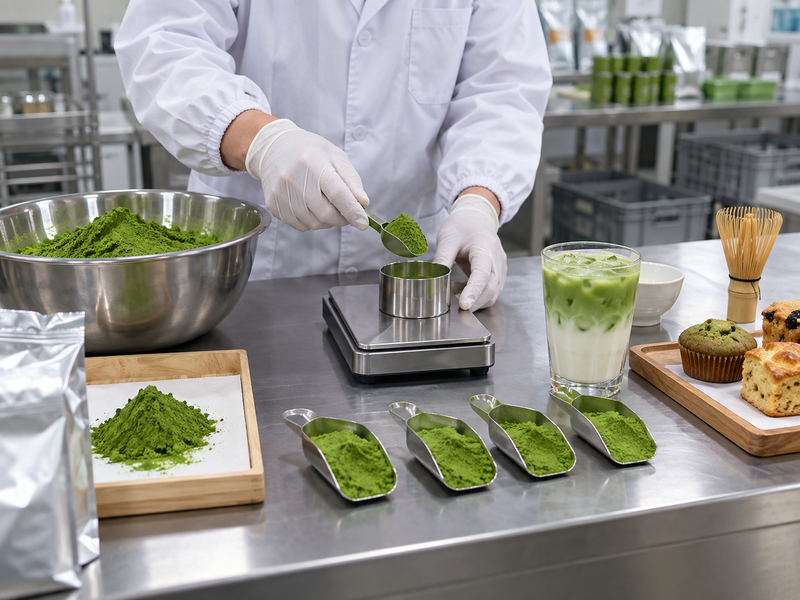
For each finished product, multiply the expected number of units by the approved matcha quantity per unit. Add the results for products using the same ingredient code. Keep the units consistent and convert grams to kilograms only after the calculation is clear.
An illustrative calculation might assume forty drinks per day, two grams per drink and five operating days. Those assumptions imply four hundred grams of recipe demand before separately recorded losses. They are an arithmetic example, not a serving recommendation or sales forecast.
| Input | Record behind the value |
|---|---|
| Finished units | Sales or production forecast |
| Matcha per unit | Approved recipe revision |
| Operating days | Location calendar |
| Ingredient identity | Purchasing and recipe code |
When a recipe changes, apply the correct version from its effective date. A higher-dose launch should not be forecast using last month’s recipe. Keep the matcha measurement records aligned with the operating instructions that staff will actually follow.
4. How should waste and non-sale use be handled?
Explain the gap between recipe and stock use
Compare theoretical recipe demand with recorded ingredient consumption. Investigate remakes, training, product development, spillage, sampling and other non-sale uses. Record them separately where practical so the purchasing team can see whether a difference is a recurring requirement or a correctable operating issue.
Avoid adding an arbitrary loss percentage because another business uses one. Base the estimate on your own observations and state any uncertainty. If the records are incomplete, create a temporary assumption with a review date rather than presenting it as a measured rate.
Keep inventory adjustments under review. An unexplained count correction is not automatically waste and should not permanently increase the forecast. Ask whether goods were transferred, recorded against another code or counted at the wrong time before changing the demand model.
For a factory, separate planned trial material from routine production consumption. For a cafe chain, distinguish launch training from normal service. Those uses may be real purchase requirements, but placing them in a permanent daily baseline can overstate demand after the project ends.
5. What baseline should be used before adding business changes?
Choose a method that can be tested
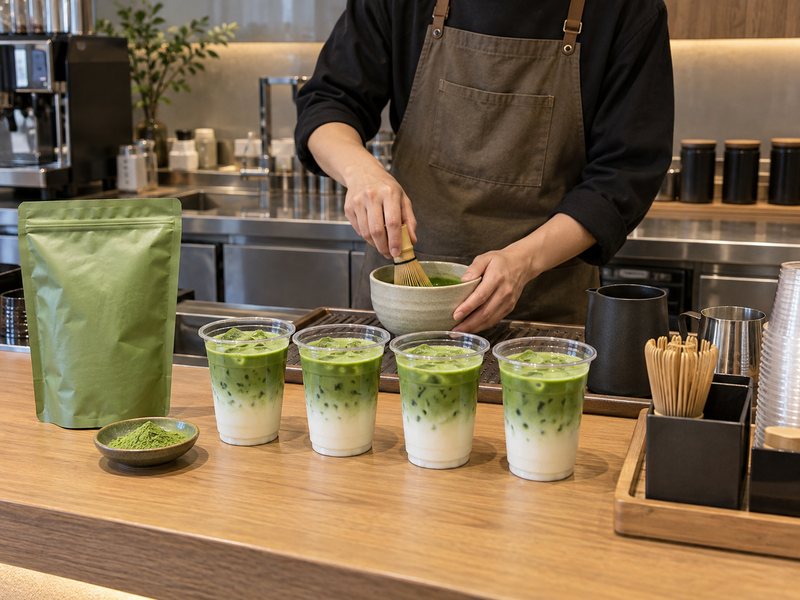
Build a baseline from a method the team can explain. Depending on the data, that could use recent comparable days or another simple historical pattern. Keep the method fixed long enough to evaluate it, and document what makes the comparison periods relevant.
Forecasting: Principles and Practice describes simple benchmark methods. A simple baseline gives the buyer something concrete to compare with a more elaborate forecast, rather than assuming complexity produces a better result.
| Baseline question | Check before use |
|---|---|
| Are days comparable? | Similar operating pattern |
| Were products available? | Stockouts and menu gaps identified |
| Was there a promotion? | Temporary activity separated |
| Did the recipe change? | Ingredient conversion updated |
Do not treat a stockout as proof that demand disappeared. Record the period when the product could not be sold and explain how it affects interpretation. Any estimate of unserved demand should remain an assumption with a stated method, not a hidden correction.
6. How should launches and promotions change the forecast?
Add explicit adjustments with owners
Ask marketing and operations for planned changes that affect matcha use. These may include new branches, menu launches, promotional offers, events or a change in production mix. Record the start and end dates, the products affected and the person responsible for the assumption.
Separate the baseline from each adjustment. If a promotion is cancelled, the team should be able to remove its effect without rebuilding the entire forecast. This also makes it possible to compare the expected effect with the actual result after the event.
Check for displacement between products. A new matcha drink may replace some sales of an existing matcha drink rather than add the full projected quantity to total demand. Ask the commercial team to explain its assumption, particularly when the two products use different doses or ingredient codes.
Keep one-time preparation needs visible. Training, photography and launch samples can consume matcha before customer sales begin. Put those quantities in the relevant period with their own owner instead of burying them in an ongoing percentage uplift.
7. How can uncertainty be shown without false precision?

Build scenarios from named assumptions
Create a central estimate and plausible alternatives based on specific uncertainties. A branch opening date, promotion response or customer production schedule may change the result. Vary those assumptions deliberately rather than adding the same arbitrary percentage above and below every forecast.
Keep each scenario internally consistent. If a launch moves later, its training use and sales demand may also move. The supplier needs to understand the timing as well as the total quantity. A larger annual total does not necessarily mean a larger order this month.
| Uncertainty | Scenario change to test |
|---|---|
| Opening date | Shift affected periods |
| Product mix | Change units by recipe |
| Promotion response | Adjust the named campaign input |
| Customer schedule | Move the relevant production demand |
Explain which assumptions have evidence and which remain judgment. Do not attach a confidence percentage unless a method supports it. A scenario is useful when it shows what the business would need to do if the underlying condition changes.
8. How should the forecast be evaluated after the period ends?
Compare a saved forecast with later actuals
Save the forecast before the period begins and compare it with the actual result when records are complete. Do not overwrite the old version and then claim the revised number was the original prediction. Keep the forecast date, horizon and assumptions with the result.
Hyndman and Athanasopoulos explain that forecast accuracy should be evaluated on new data. For this purchasing process, compare forecasts with later observed demand at the same product, location and time level.
Record both the direction and size of the difference. Repeated underestimation and a mixture of positive and negative errors can have different planning implications even if a summary measure looks similar. Examine the ingredient weights alongside the finished-unit numbers to see whether recipes or sales caused the gap.
Investigate the largest useful differences rather than every tiny fluctuation. Identify whether the cause was missing data, a changed plan or normal uncertainty. Record a corrective action only when the evidence supports changing the process.
9. What should the supplier receive from the forecast?

Share the planning information with its status
Send the supplier the product codes, expected quantities by period and the status of the information. Clearly distinguish an indicative forecast from accepted purchase orders. Ask how the supplier uses forecasts and what further action, if any, is needed to reserve material or production under the actual agreement.
Include relevant uncertainty and update dates. The supplier can respond more usefully when it knows that a quantity depends on a planned launch rather than a confirmed customer order. Avoid presenting the highest scenario as a commitment unless the business has authorized that decision.
| Shared field | Purpose |
|---|---|
| Product and period | Identifies the planning requirement |
| Central estimate | Provides a working demand view |
| Named uncertainty | Explains potential changes |
| Status and update date | Separates outlook from commitment |
Ask for feedback on feasibility and timing, then record the response separately from demand. Supplier availability can constrain the purchasing plan, but it should not silently rewrite the business’s estimate of what customers are likely to require.
10. How does the forecast become a maintained buying input?
Assign an owner and a repeatable review
Name one owner for assembling the current forecast and identify who approves material changes. Operations should provide recipe and production updates; commercial teams should explain promotions and launches; purchasing should supply lead-time and order information. Keep responsibilities specific enough that missing inputs can be followed up.
Use a regular review that fits the buying cycle. Check data completeness, changed assumptions, actual-versus-forecast differences and the next supplier update. The meeting should produce decisions and owners, not only a new spreadsheet saved beside the old one.
Pass the approved forecast into the inventory and replenishment process. It describes expected consumption; the eventual order also needs usable stock, open orders, packaging units and other purchasing constraints. Keeping those steps distinct makes the reason for an order easier to review.
Before sending the next supplier outlook, confirm the recipe revisions, operating calendar and named adjustments. Save the approved version with its date, then schedule the comparison with actual usage after that planning period closes.
Frequently asked questions
Q1: Is a demand forecast the same as an order quantity?
No. It estimates consumption. The buying decision also considers usable inventory, confirmed receipts and purchasing constraints.
Q2: Should every cafe use the same matcha consumption benchmark?
Use the business’s own sales, recipes and operating calendar. An industry example cannot replace those inputs.
Q3: How should missing sales records be treated?
Mark the gap and document any temporary estimate. Do not silently convert missing information into zero demand.
Q4: Can a promotion uplift be added permanently?
Keep temporary activity separate with start and end dates. Review the actual effect before changing the routine baseline.
Q5: How can a new business forecast without history?
Use explicit assumptions and several plausible scenarios, then replace them with observed sales and consumption as records accumulate.