
A matcha date smoothie combines powdered green tea, dates, liquid, and a creamy base. For cafés, one appealing cup can become an inconsistent menu item when date size, tea strength, and blending time change. A weighed formula and a short service standard solve that problem. The guidance below treats each figure as a pilot starting point that needs tasting and local food safety review.
Search-intent reference: “Matcha Vanilla Date Smoothie”. Its title signals consumer interest in vanilla and date sweetness; this production guide is original and written for professional buyers.
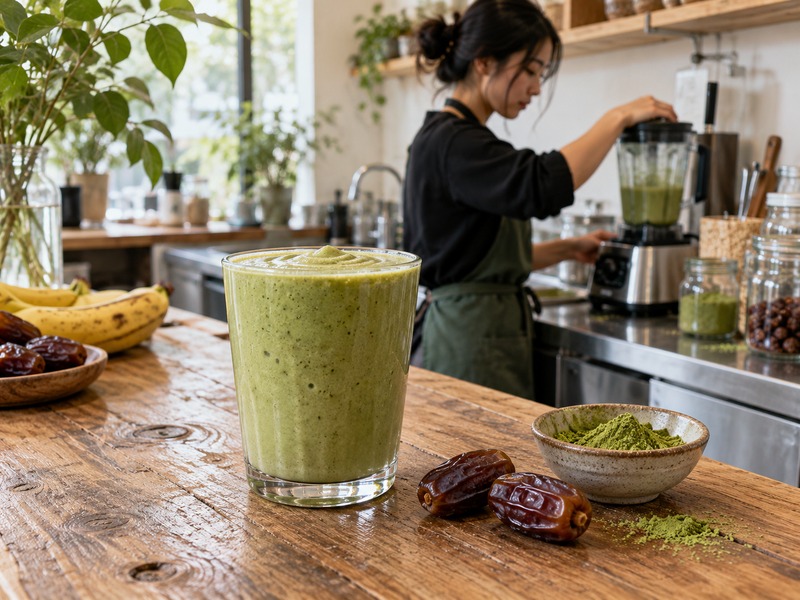
1. What should a matcha date smoothie deliver on a menu?
A drink specification starts with the customer experience
Define the cup before ordering ingredients. A café version might need a clean tea note, restrained date sweetness, a spoonable but drinkable texture, and an even green color. A retail bottle has a different job: it must survive filling, transport, storage, and opening without an unpleasant sediment layer. Record serving size, ice fraction, target temperature, cup style, and whether the drink is prepared on demand. Those details determine whether a kitchen recipe can become a repeatable operating procedure. Here is the practical question: can another operator reproduce the cup during a busy service period?
Use a tasting card with separate ratings for tea aroma, date flavor, sweetness, thickness, color, and grit. Ask staff to describe a defect rather than mark a sample “good” or “bad.” One date variety can taste more caramel-like while another brings sharper fruit notes. Plant milks change body and sweetness even when their cartons carry similar names. Keep every change on a versioned formula sheet. If menu copy promises a smooth drink, screen date pieces and matcha particles at the bench before relying on a high-power blender to hide them.
2. Which matcha grade fits a date smoothie?
Select against the finished matrix
Date paste and milk can cover delicate tea aromas. A very costly sipping grade may add little value once blended with frozen ingredients. A culinary grade with a clear green appearance and controlled bitterness often gives a better purchasing balance, though the actual choice depends on tasting. Request samples from more than one lot and make each into the finished drink at the intended dosage. Compare them after blending and again after the expected service hold. Powder viewed dry under bright light cannot answer whether tea flavor survives dates and vanilla. Check the cup: it is the relevant test environment.
For each candidate, obtain a specification, ingredient statement, origin details, lot code, relevant microbiological results, and contaminant documentation appropriate to the destination market. Record color under the same light and use the same liquid base for comparisons. If procurement requires organic status or a particular certification, verify documents for the exact item and market rather than assuming every grade carries the same claim. Matcha Village describes its bulk tea and application supply on its manufacturer homepage; buyers should request a sample aligned with their own formula brief.
| Selection factor | Bench question | Purchase record |
|---|---|---|
| Color | Does green remain appealing in the full drink? | Approved sample photo under fixed light |
| Flavor | Does tea remain distinct beside dates? | Blind tasting notes |
| Particle feel | Does powder disperse without grit? | Blend method and observation |
| Documentation | Does the lot meet market requirements? | Current specification and test records |
3. How should dates and the liquid base be chosen?
Sweetness, solids, and texture move together
Whole pitted dates, date paste, and date syrup behave differently. Whole fruit offers a familiar ingredient declaration but introduces variation in size, moisture, and fragment risk. Paste often doses more consistently when supplied with a defined texture and solids range. Syrup blends quickly yet contributes less body, so it may require another texture adjustment. Ask suppliers how fruit is pitted, screened, packed, and stored. Check for pit fragments during incoming inspection; a blender does not turn a hard fragment into an acceptable defect. For service teams: portion dates by mass, never by count.
Oat milk can support a fuller body, almond milk can create a lighter cup, and dairy changes protein behavior and allergen declaration. Treat those as formulation tendencies, then confirm with the exact commercial product. Unsweetened bases make date contribution easier to control. Check whether the chosen milk already contains oil, gums, sugar, or added flavor because these affect separation and cost. Keep allergen controls explicit across utensils and blenders. If a café offers dairy and plant-based versions, use separate formula codes and verify that menu wording matches ingredient and cross-contact practice.
4. What pilot formula makes a workable starting cup?
Use percentages that operators can scale
A pilot formula should show masses, not a list of household spoons. The example below is a design brief for a 400 g blended serving, not a validated commercial recipe. It assumes an unsweetened milk base and pitted dates. Start with a small sensory run, then adjust one ingredient at a time. Matcha level should reflect the chosen grade, expected serving size, flavor target, and caffeine labeling rules where applicable. Vanilla can round the date note, but too much makes the tea disappear. Keep one baseline: otherwise each trial becomes hard to interpret.
Weigh ingredients before adding ice. Ice percentage changes both apparent sweetness and beverage yield, especially if service staff pack a cup with different-sized cubes. Blend a fixed number of seconds at a specified machine setting, then weigh the poured cup. Log the result and any residue left in the jar. If a lighter drink is needed, alter liquid and ice together rather than adding water late without recording it. Scaling a 400 g prototype into a prep batch also calls for checks on hold time, mixing order, and food-safe chilling, since a larger vessel cools and separates differently.
| Ingredient | Illustrative 400 g pilot mass | Adjustment lever |
|---|---|---|
| Unsweetened milk | 240 g | Body and dilution |
| Pitted dates or equivalent paste | 32 g | Sweetness and solids |
| Matcha | 4 g | Tea intensity and color |
| Ice | 122 g | Temperature and texture |
| Vanilla | 2 g | Aroma balance |
5. How can a café blend the drink without clumps?
Set an order and confirm it on the actual machine
Put liquid into the jar before dry matcha. A small premix of matcha and cool liquid can reduce dry pockets, especially when a low-powered blender is used. Add softened or pre-portioned dates, then ice, and blend until no visible pieces remain. Avoid boiling water as a shortcut for dissolving tea: unnecessary heat changes aroma and slows a cold service workflow. A fine sieve can remove obvious matcha agglomerates before mixing, though it will not fix an unsuitable powder. Watch the jar wall: green streaks reveal unmixed material that would create cup-to-cup variation.
Define a maximum time between blending and handoff because ice melts and solids settle. A finished cup should be observed at the counter after the period a customer might wait for pickup. If separation appears, decide whether the menu can tolerate a stir cue or whether the formula needs more body and better dispersion. Clean blender seals and date residue promptly; sugary fruit left in crevices creates a sanitation problem. Give staff a simple rejection rule for visible pit fragments, dry clumps, wrong fill weight, or an unusually dull color.
6. How should a chain keep servings consistent?
Control portions before adjusting machines
Pre-portioned date paste can remove one source of variation across stores. Matcha sachets sized for one drink can reduce scoop errors and protect opened powder from repeated air exposure, although packaging cost rises. A chain should compare both options against its labor model. Record approved cup mass with a practical tolerance derived from trials, not an invented universal number. The same formula will yield a different texture on machines with different blade geometry and power, so machine model belongs on the operating sheet. A useful audit: weigh three consecutive cups made by different staff.
Calibrate scales, label opened ingredients, and train staff to keep date paste covered between portions. If a replacement plant milk changes its solids or sweetness, run a short reapproval rather than swapping cartons silently. Use batch codes for matcha and paste in central kitchens; traceability matters when a quality complaint arrives days later. A store manager can check visual color and pour weight daily, while procurement reviews supplier lot documents and complaint trends over longer periods. These checks cost less than repeatedly reformulating a drink whose input materials drift without notice.
| Control point | Store record | Reason |
|---|---|---|
| Matcha portion | Measured mass or sachet code | Flavor and color consistency |
| Date portion | Paste mass and lot | Sweetness and fragment trace |
| Blend cycle | Machine and setting | Particle breakdown |
| Finished cup | Weight and visual check | Yield and presentation |
7. Can this concept become a packaged beverage?
Retail processing needs its own development plan
A fresh café blend should not be treated as a shelf-stable bottle formula. Dates add solids, matcha settles, and milk systems may separate under heat or storage. Packaged development needs a defined process, suitable packaging, hygienic design, and validation by qualified food technologists. Decide whether the product will be refrigerated, frozen, or processed for ambient sale before selecting stabilizers or making shelf-life claims. Particle size, viscosity, pH, and microbial controls need measurement on representative production batches. One route does not fit all: a frozen smoothie pack and a ready-to-drink bottle face different failure modes.
Run small process trials with the chosen co-packer or plant. Examine matcha color after the actual heat or pressure treatment if used, then follow samples through intended distribution conditions. Date paste may darken a green beverage and can carry its own microbial and specification issues. A label review should cover allergens, ingredient order, nutrition, caffeine disclosures where required, and any market-specific claim rules. Avoid lifting a café nutrition panel into a packaged product without testing the manufactured article. Shelf life belongs on the product only after a documented study for its process and market.
8. Which quality checks belong in a purchase specification?
Connect incoming checks with finished drink checks
A matcha purchase specification should state identity, grade or sensory profile, particle behavior, color criteria, packaging, storage, lot coding, and required tests. The supplier can provide certificates and samples; the buyer still must check that every delivered lot matches the approved item. Date materials need their own control for pitting, moisture or solids, foreign matter, and lot traceability. Store ingredients away from heat, moisture, and strong odors, following supplier instructions. Do not judge green powder alone: use a reference drink made under fixed conditions for lot approval.
Build a retained-sample routine only if facilities can store and label samples correctly. Record complaints by symptom: sediment, low tea flavor, bitter aftertaste, date fragments, or color loss. Each symptom points toward different inputs or process steps. For example, coarse fruit pieces may trace to date preparation, while dry green clumps suggest mixing order or powder agglomeration. Confirm root cause with records before blaming a supplier. A clear complaint taxonomy helps procurement, operations, and product development speak about the same failure instead of trading vague judgments.
| Observed defect | Likely checks | Useful evidence |
|---|---|---|
| Green clumps | Powder handling and mixing order | Jar-wall photo, lot, operator record |
| Date fragments | Pitting and blend cycle | Retained ingredient and sieve check |
| Rapid separation | Solids, dilution, dispersion | Timed cup photos |
| Dull color | Lot color, storage, base color | Reference drink comparison |
9. How should a buyer calculate cost per serving?
Include loss and service labor
Ingredient cost begins with grams used multiplied by landed price per gram. Date paste price may look higher than whole fruit, yet reduced trimming and faster portioning can alter the real comparison. Add cup, lid, straw, labels, waste, staff handling, and any central-prep labor. Model a drink at its approved fill mass rather than its advertised cup volume. Ice changes volume without carrying the same ingredient cost. Work from a real shift: note jar residue, remakes, and overfilled cups, then revise assumptions with those observations.
Make a sensitivity sheet for matcha dosage and landed price. A small change in tea grams can affect margin and taste, so never cut dosage solely to hit a percentage. Test whether a lower-cost grade still delivers the defined sensory target. Compare ingredient options across an equivalent prepared cup, not per kilogram alone. Freight, minimum order quantity, opened-pack waste, and shelf stability of raw ingredients also affect purchasing. When a supplier quotes a new grade, request both a commercial sample and current specification, then cost the approved formula after tasting it.
10. What should a supplier brief contain before scale-up?
Make the request measurable
Send suppliers the product application, serving mass, matcha dose under trial, target tea profile, preferred origin or certification, expected monthly demand, pack size, and destination market. State whether a buyer wants bulk matcha, portion packs, or a blended component. Ask for current specification, ingredient and allergen statements, lot traceability, available test records, lead time, and samples from representative stock. A vague request for “smoothie grade” invites mismatched quotations. Specify the matrix: the supplier needs to know that dates and milk shape the cup.
Before approval, compare at least two lots under one preparation method and document what the finished drink should taste and look like. Agree how changes in source, milling, or packaging will be communicated. A chain can start with a store pilot and expand only after operators can reproduce the target. Matcha Village can discuss bulk powder and application matching through its contact page. Bring the formula brief, required documents, and planned launch volume to that conversation. A workable smoothie begins with measured portions and ends with a cup staff can make reliably.
| Brief item | Buyer supplies | Supplier returns |
|---|---|---|
| Application | Drink matrix and dose | Candidate grades |
| Quality | Sensory and document needs | Specification and lot records |
| Commercial | Volume, market, pack preference | Quote, pack sizes, lead time |
| Change control | Approval method | Change notice procedure |
FAQ
Q1: Can whole dates replace date paste in a café? Yes, provided staff weigh them, check for pits, and confirm that the selected blender removes visible pieces.
Q2: Should matcha be whisked before blending? A small cool-liquid premix can help on weaker machines. Compare it with direct blending under the actual service cycle.
Q3: Does a date-sweetened drink need sugar-free wording? Date sugars remain sugars. Label and menu claims need review against local rules and the full formula.
Q4: How long can a blended cup wait? Set a service window from observed ice melt, separation, sensory change, and applicable food safety controls.
Q5: Can a café formula be bottled unchanged? No. A packaged version needs its own process design, validation, label review, and shelf-life study.