
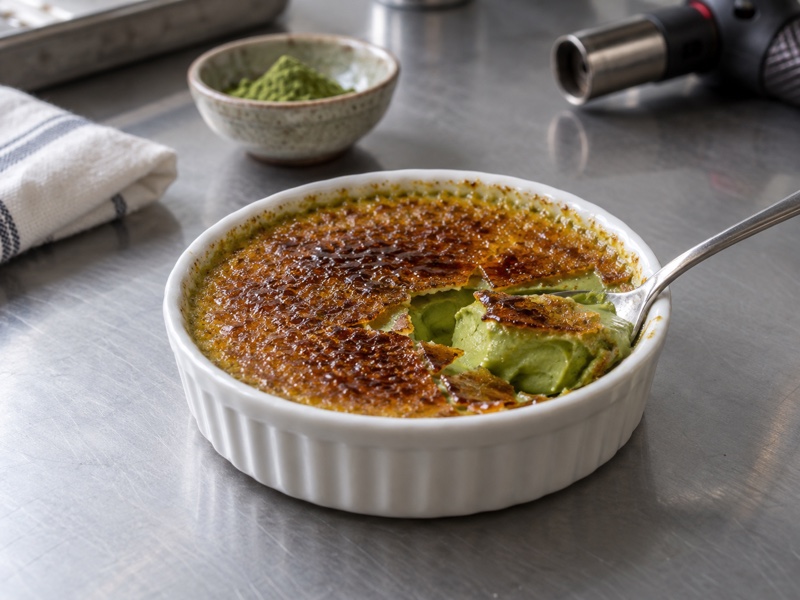
Matcha creme brulee is a baked egg custard flavored with powdered green tea and finished with a brittle caramelized sugar shell. A pastry kitchen can make a beautiful green filling that weeps overnight or a perfect set that tastes only of cream. The useful answer is a controlled trial: hold the dairy and egg base steady while changing matcha dose, cooking endpoint, and service timing one at a time. The Biscoff-layer recipe in current search results shows a dessert variation; the checks here address a bakery, hotel, or restaurant that needs repeatable portions. Record findings in the final ramekin, not in a tasting spoon of uncooked base.
1. What should a finished matcha creme brulee taste and feel like?
Define the target before ordering a case of powder. The spoon should crack a thin sugar shell, pass through a smooth custard, and carry a clear tea note after the caramel fades. Decide whether the menu promises a delicate dairy dessert with a green finish or a pronounced matcha dessert. Both can sell, but they call for different powders and doses. A tasting panel should use identical ramekins and taste each sample after the same chilling period. Warm custard exaggerates aroma and gives a misleading picture of the guest experience.
Texture needs its own vocabulary. “Set” means the center holds on a tilted spoon without curd-like grains or free liquid. A custard can look stable from above while a watery layer has formed beneath it. Cut one sacrificial sample through the middle and inspect the edge, center, and base. Photograph the cut under fixed light, then repeat after the intended holding interval. Those images help a second kitchen recognize the approved endpoint when staff or ovens change.
| Attribute | Approval question | Simple check |
|---|---|---|
| Tea flavor | Does matcha remain clear after caramel? | Blind tasting after chilling |
| Custard | Is the spoonful smooth throughout? | Cut one center sample |
| Surface | Does sugar crack without a thick slab? | Standard spoon test |
| Color | Is the green acceptable in service light? | Photograph in the ramekin |
2. Which matcha should the pastry team buy?
Ask for pure matcha rather than a presweetened latte mix if you need control over the custard formula. A mix may bring sugar, milk powder, or flavorings that change sweetness and allergen declarations. For a baked dairy application, begin with a culinary or dessert-oriented grade and test it in the finished custard. A powder that tastes excellent in water may be too soft once cream and caramel surround it. Conversely, a bold powder may give useful tea flavor in custard yet taste too astringent when whisked plain.
Request a specification, ingredient statement, lot identification, and appropriate test documents for the intended market. Keep samples sealed and compare lots side by side using one master base. Record both dry powder appearance and finished custard taste; the latter decides the purchase. Matcha Village describes pure matcha options for baking and desserts, but any grade recommendation still needs a kitchen trial with your own eggs, cream, and baking process. Cost per kilogram alone obscures a powder that requires a higher dose to be tasted.
3. How much matcha belongs in the first custard trial?
Run a small dose ladder against an unflavored control. As an experimental design, make three matcha additions around a selected starting dose while keeping total liquid, egg, sugar, ramekin fill, and bake constant. These are test points, not a universal recipe. Weigh powder rather than using spoon measures. Tiny differences become visible when a chain kitchen scales from six ramekins to hundreds. Label each tray with a code so tasters are less influenced by color or expectations.
Disperse matcha in a small portion of warm dairy and whisk it smooth before adding that portion back to the main batch. A fine sieve can remove dry pockets, although straining after egg addition may also remove undispersed matcha and change the effective dose. If you strain, weigh or inspect residue and keep the method consistent. Taste the chilled custard without sugar, then with its shell. The winning dose is the one guests can identify after caramel, without a drying tea finish or an unusually dense set.
| Trial variable | Hold constant | Record at tasting |
|---|---|---|
| Matcha dose | Egg, dairy, sugar, fill mass | Flavor strength and astringency |
| Powder grade | Recipe and oven load | Color, flavor, required dose |
| Dispersion method | Powder lot and dose | Specks, residue, smoothness |
4. How should eggs, dairy, and sugar be balanced?
Egg yolk supplies thickening and richness, while cream softens the set. More yolk may seem like a quick cure for a loose custard, but it also changes flavor, cost, and the risk of graininess during cooking. A change from heavy cream to a lower-fat dairy alters water and fat balance, so do not treat it as a procurement swap. Establish a plain control recipe your kitchen already handles well and introduce matcha without changing every other component. That gives the team a meaningful comparison.
Sugar has two separate jobs: sweetness within the custard and the brittle topping. Keep those amounts separate in the batch sheet. A sweet filling can mute matcha, while too little internal sweetness may make an assertive powder taste harsh. If you add a biscuit or nut layer, as some consumer variations do, test moisture migration into that layer and declare its ingredients correctly. For packaged sales, review milk, egg, wheat, soy, and any nut sources against the FDA allergen labeling guidance for US products; other markets have their own rules.
5. Which cooking endpoint protects a smooth set?
Write down oven setting, water-bath depth, ramekin material, fill mass, tray position, and how the center moves at removal. A time printed in a home recipe cannot account for a loaded commercial oven or a wider ramekin. The outer edge should not boil while the center remains loose. If a trial looks grainy, review heat transfer before adding starch or more cream: a shallow water bath, hot spot, or crowded tray may be driving the problem. Carryover heat continues after the tray leaves the oven, so record the cooling step too.
Food safety must be validated for the actual process, especially when shell eggs enter a batch that will be held cold. Use your food safety plan and local authority requirements for cooking and cooling targets. The FDA Food Code is a model code for US retail food establishments, not a blanket specification for every recipe or country. A probe measurement can support repeatability, but only a validated endpoint and documented controls can support a commercial safety decision.
| Process record | Why capture it | Failure signal |
|---|---|---|
| Fill mass and ramekin diameter | Controls depth | Uneven center set |
| Water-bath level | Moderates edge heating | Grainy perimeter |
| Oven load and rack | Reveals hot spots | Tray-to-tray variation |
| Removal and cooling observations | Captures carryover | Weeping after chill |
6. Why does the green color dull or spot?
Matcha’s color is sensitive to processing and exposure. A vivid slurry can look muted after heat, against amber caramel, or under warm display lamps. Judge color in the finished dessert with its actual sugar top, not beside a dry powder sample. If a new lot seems browner, make a side-by-side control before blaming the supplier; a longer bake or larger ramekin may explain the change. Avoid promising a bright neon custard from tea alone. High powder additions can also make the texture rougher and the flavor bitter.
Specks usually point to poor dispersion. Premix powder with a small quantity of dairy, scrape the bowl walls, and use a repeatable mixing time. If the production team mixes a larger batch, check the first and last filled ramekins for equal color. Fine particles can settle while a filled kettle waits. Gentle agitation between pours may help, but vigorous whisking after eggs enter can create foam that scars the baked surface. Pick a method that distributes tea without loading air into the custard.
7. How long should custards chill before service?
Chill a trial long enough for the center to reach the service texture; a warm spoonful cannot predict the cold set. Document transfer from oven to cooling area, container spacing, refrigeration, and time until tasting. A deep stack of hot ramekins cools differently from a single open tray. Do not invent a shelf-life number from appearance. Validate holding against the actual ingredient system, preparation environment, and local food rules. The FDA Food Code identifies 41°F/5°C or below for cold holding foods that require temperature control in US retail settings; verify the applicable requirements where you operate.
Test the same custard at opening, mid-service, and the proposed last sale time. Check for whey-like liquid at the edges, skin formation, odor changes, and a firmer bite. Covering protects aroma and hygiene but can also leave condensation on a surface. Compare cover types in the real refrigerator. Keep the caramel step outside the base custard holding study because a burnt sugar top absorbs moisture and loses its crack after assembly.
| Holding stage | Sample observation | Decision |
|---|---|---|
| After full chill | Center set and tea flavor | Formula approval |
| During refrigerated hold | Weeping, skin, aroma | Practical prep window |
| After topping | Crack and moisture | Service window |
8. When should the sugar top be torched?
Torch close to service for the crispest shell. Measure sugar by weight or use a defined spoon and spreading pattern; a thick pile makes a hard glass plate instead of a delicate crack. Dry surface moisture gently before applying sugar. Move the flame evenly and stop when the sugar forms a continuous amber layer. Burned spots can overwhelm the tea, while pale unmelted patches feel gritty. Train on the exact ramekin, since its lip and glaze affect access and heat reflection.
For banquet service, run a timed line test with the number of covers expected. Plate a few units at different points in the workflow and note when the shell softens. Ask staff to taste one dessert at the end of the real waiting period, not just immediately after torching. A centralized pastry kitchen may transport un-torched custards and finish them on site; a retail case without a finishing station needs a different product concept or a validated pre-topped service window.
9. What belongs on a commercial production sheet?
Write a sheet another shift can execute without a conversation. Name the exact matcha lot and grade, supplier, dairy and egg specifications, ingredient masses, mixing order, sieve size if used, ramekin size, fill mass, oven load, cooling method, and topping weight. Attach a photo of approved custard color and a note describing the center motion at removal. The sheet should say what to do when a lot deviates: hold, compare with retained control, then release or reformulate through an authorized person.
Cost the finished portion, not only ingredients tipped into a bowl. Include breakage, a sacrificial quality sample, torch sugar, labor during finishing, and any unsold refrigerated portions. A premium powder may lower required dose or deliver better color through service; evaluate that in cost per approved dessert. If a supplier offers multiple grades, ask for application samples and test them in one day with identical ingredients. Procurement can then make an informed choice rather than ranking bags by price alone.
| Sheet field | Example of an objective entry | Why it helps |
|---|---|---|
| Powder | Supplier, grade, lot | Traces flavor shifts |
| Fill | Mass per named ramekin | Controls bake depth |
| Bake | Oven load and observed endpoint | Makes shift repeatable |
| Release | Chilled texture and color standard | Prevents weak portions |
10. How should a buyer approve the pilot for a menu launch?
Use a tasting and operations gate. Blind-taste at least the approved control and candidate after identical chilling. Check the top during actual service timing. Then cost the portion and ask whether a busy shift can reproduce the method without rework. A candidate that tastes remarkable in a quiet development kitchen may fail if torching backs up service or the custard weeps after normal prep. Record which criterion caused rejection; changing one variable at a time keeps the next trial useful.
Matcha Village can supply different pure matcha grades for a side-by-side dessert trial, with specifications and samples requested for the relevant market. The buyer still owns the final recipe, food safety validation, label review, and shelf-life study. Start with one defined ramekin and a plain control, then scale only after the trial survives the same chilling and finishing sequence the guest will see. A clean crack over a smooth, unmistakably tea-flavored spoonful is the release test that matters.
FAQ
Q1: Can a latte mix replace pure matcha? It can change sugar, dairy content, and allergen declarations. Treat that swap as a new formula and read its ingredient statement.
Q2: Why does custard look set but release liquid later? Overcooking, uneven cooling, or a weak formulation can all contribute. Compare a cut sample after identical refrigerated holds.
Q3: Should the sugar shell be made the day before? Test it under your actual humidity and holding conditions. For a crisp crack, finishing near service is usually the stronger starting point.
Q4: Is a brighter powder always better? No. Judge color and tea flavor after baking and caramelizing, using the proposed serving light.
Q5: Can one shelf-life number apply to every café? No. Ingredients, handling, packaging, refrigeration, and local requirements determine the validated window.