
Matcha contract packing works best when the brand and packer agree who supplies material, approves the line setup, accounts for losses and releases finished stock. Choosing a pouch or tin leaves those decisions unresolved. Write a packing brief around the actual powder and commercial format, then use a controlled line trial to turn the proposed service into a reviewable order.
Contents
- 1. What work should matcha contract packing include?
- 2. Who should own ingredients and packaging materials?
- 3. How do you check whether the line fits the product?
- 4. What should the packing trial establish?
- 5. How should material losses and output be reconciled?
- 6. What should the brand know about changeovers?
- 7. How do you control labels, codes and artwork?
- 8. Who may release the finished packing order?
- 9. How should leftover material and complaints be handled?
- 10. What belongs in a request for a packing quotation?
1. What work should matcha contract packing include?
Define the boundaries of the service
Describe the operations you want the packer to perform. Receiving bulk powder, portion filling, sealing, coding and case packing form one possible scope. Blending, milling or sourcing the ingredient add different responsibilities. Ask the packer to identify any operation it will subcontract so the brand understands the actual route from incoming material to finished cartons.
Keep the service scope attached to the quotation. A proposal described as full service may still exclude artwork review, material procurement, laboratory work or finished-stock storage. Identify the exclusions that affect your launch schedule and assign an owner before comparing prices. The buyer needs comparable scopes as well as commercial rates.
| Operation | Question for the packer | Brand decision |
|---|---|---|
| Ingredient handling | Who receives and approves powder? | Supply and release arrangement |
| Filling and closing | Which format will the line trial use? | Commercial pack specification |
| Coding and cases | Who approves identifiers and artwork? | Controlled packing instructions |
| Finished-stock handling | Who releases, stores and dispatches? | Delivery responsibility |

2. Who should own ingredients and packaging materials?
Track ownership separately from custody
Agree whether the brand supplies powder, the packer purchases it or the parties use another documented arrangement. Identify who approves the ingredient supplier and who receives the supporting evidence. Do the same for pouches, tins, liners, labels and cartons. A packer holding material on its premises does not tell the buyer who may authorize its use or disposal.
FDA’s co-manufacturer guidance discusses supplier approval and verification within certain U.S. co-manufacturing arrangements. Its applicability depends on the activities and hazards involved. The parties should review their actual responsibilities rather than assuming a commercial ownership clause resolves them. The guidance was checked September 27, 2026.
Record how material is identified in the packer’s stock system and how the brand can reconcile the quantity held. Include restrictions on substitutions, transfers to another customer and use of leftover printed packaging. If an order stops after materials have been delivered, the agreement should explain who decides their return, continued storage or other disposition. Ask advisers to review the final commercial terms where needed.
3. How do you check whether the line fits the product?
Review the powder and pack together
Give the packer representative material and the proposed commercial packaging for its technical assessment. Ask what line preparation, tooling and handling the format requires. A line capable of filling another powder or a similar pouch has not necessarily demonstrated your complete pack. Keep the exact film, closure, fill target and case arrangement identified in the trial brief.
Ask how the packer will manage powder transfer, product contact parts and the sealing area during normal operation. Request its proposed inspection methods and the basis for the checks. The brand should understand how the line trial will evaluate the pack without prescribing unverified settings from a generic equipment brochure.
| Technical input | What to provide | What to request |
|---|---|---|
| Matcha powder | Identified representative lot | Handling assessment |
| Primary pack | Commercial material and dimensions | Compatibility review |
| Closure and code | Approved design requirements | Inspection proposal |
| Shipping case | Intended arrangement | Packing and handling trial |
The matcha packaging guide supports format selection. This contract review should connect the chosen format to the packer’s actual operation and approval evidence.

4. What should the packing trial establish?
Agree observations before starting the line
Write a trial protocol that identifies the material, packaging revision, intended fill and checks the team will perform. Ask the packer to propose the operating conditions and record them during the run. Have the brand’s technical owner agree the observations needed to decide whether commercial packing may proceed. A successful-looking sample presented after the event gives less information than a planned trial record.
Record the sequence of setup, running, planned interruptions and any adjustments actually made. Select trial samples according to the agreed plan and identify where they came from in the run. Keep unsuccessful samples or photographs where appropriate so the team can understand the changes needed, rather than reviewing only the most attractive finished units.
Separate trial findings from commercial promises. A short trial can identify questions about the pack and line, but it does not automatically establish a guaranteed production rate or a finished-product shelf life. Ask the technical team what further validation the product needs. Close the trial with an approved operating brief, unresolved actions and a clear decision about the next production stage.
5. How should material losses and output be reconciled?
Account for the whole packing order
Agree how the packer records incoming powder, finished product, retained samples, work in progress, rejected units and unused material. Define the basis and units for each record. Keep packaging counts alongside powder quantities because a discrepancy in printed pouches may need a different investigation from a powder-weight difference.
Request the reconciliation format before the order starts. The brand should be able to understand what the packer classifies as setup use, process loss, testing material or recoverable stock. Do not negotiate a universal loss percentage without evidence from the actual product and process. Any allowance should be reviewed commercially and technically for the agreed scope.
| Quantity category | Record expected | Closure question |
|---|---|---|
| Material received | Identified quantity and lot | Does receipt match dispatch? |
| Finished output | Approved units and product identity | What quantity can be released? |
| Samples and rejects | Purpose and disposition | Where did material go? |
| Remaining stock | Quantity, condition and location | Who authorizes its next use? |
Investigate unexplained differences before closing the order. A yield summary without categories makes it difficult to distinguish legitimate recorded use from missing stock or a reporting error.
6. What should the brand know about changeovers?
Review the controls around your packing run
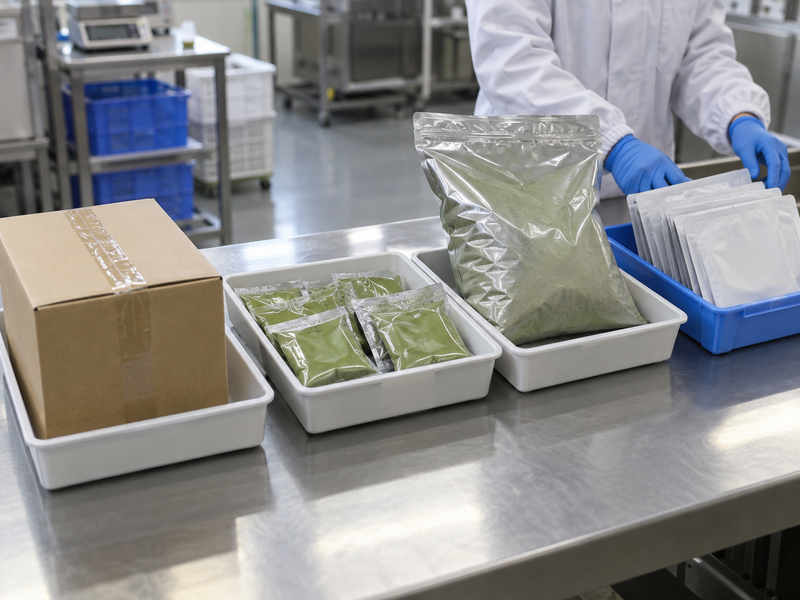
Ask which products use the equipment before and after your matcha and what information the packer can provide about relevant cross-contact risks. Review the site’s changeover procedure, verification and response to an incomplete or failed check. Include product-contact utensils, transfer containers and rework practices where they affect your order.
For facilities within its scope, 21 CFR 117.80 addresses sanitary manufacturing and packing controls, including protection from contamination and allergen cross-contact. It was checked September 27, 2026. The responsible specialists should determine the controls applicable to the proposed operation.
Keep changeover evidence linked to the run rather than relying only on a general facility presentation. Ask who verifies line readiness and who may start production. If the packer proposes returning collected powder to the product, obtain a specific technical review of that practice before including it in the agreement. Avoid treating all recovered material as reusable because the original ingredient belongs to the brand. Record the approved disposition of such material in the reconciliation process.
7. How do you control labels, codes and artwork?
Use one approved instruction set
Identify the artwork revision, pack components, lot-code format and other variable information in the packing instruction. Assign responsibility for legal label review separately from checking that the line prints the approved information correctly. A packer can reproduce supplied artwork accurately while the brand still needs to verify that the wording suits the destination and product.
Agree a start-of-run approval and a procedure for checks after relevant adjustments or interruptions. Keep the actual checked sample or an appropriate record attached to the run. Prevent superseded labels and printed packs from remaining available for accidental use. Ask how the packer segregates and reconciles unused material bearing your brand.
| Controlled item | Approval owner | Run evidence |
|---|---|---|
| Artwork content | Brand’s qualified reviewer | Approved revision |
| Printed or applied code | Assigned operational approver | Checked production sample |
| Pack components | Technical specification owner | Material identity record |
| Obsolete printed stock | Brand and stock custodian | Documented disposition |
Record any approved deviation before packing continues. Verbal agreement during a busy shift is difficult to reconstruct when finished units have already left the facility.

8. Who may release the finished packing order?
Define the evidence and authority
Agree which records the packer submits and which party authorizes commercial release. The package may include the run record, relevant inspection results, component identities, reconciliation and disposition of deviations. Define the records for your product instead of collecting a standard folder that nobody has assessed for completeness.
Keep ingredient acceptance, packing approval and finished-order release separately identifiable. A brand-approved powder does not establish that the right artwork, fill and closure were used throughout the order. Conversely, neat finished packs do not close an unresolved ingredient hold. The release reviewer needs the evidence from the appropriate stages before changing the order’s stock status.
Specify what happens when the brand reviewer is unavailable or an inspection is still pending. The packer should know whether material may remain in controlled storage and who can authorize any movement. Shipment scheduling must not silently become release permission. Record approved restrictions and make them visible to dispatch staff, including whether only a defined portion of the order has been released while another portion remains under investigation.
9. How should leftover material and complaints be handled?
Keep the order traceable after dispatch
Define what happens to unused powder, blank packaging and printed components after the run. Record quantities, condition and location, and identify who may authorize reuse. When material carries a product claim or artwork revision, review its suitability before applying it to a later order. The next run may use a different formula, market or label version.
Agree what records and samples the packer keeps for investigating complaints, based on the applicable requirements and the parties’ quality agreement. Ask how the brand can obtain relevant evidence and how the packer traces finished packs to ingredient and packaging lots. Keep the complaint contact route available after the commercial invoice has been settled.
| Post-run item | Decision required | Supporting record |
|---|---|---|
| Unused ingredient | Return, hold or approved reuse | Lot, condition and quantity |
| Printed components | Continue use or controlled disposition | Artwork revision and count |
| Complaint evidence | Investigation access and responsibilities | Run, sample and traceability records |
When an issue appears, preserve affected stock and records under the agreed procedure. Commercial responsibility should be assessed using the evidence rather than inferred from who physically held the material last.

10. What belongs in a request for a packing quotation?
Make the offer comparable and executable
Send the powder specification, proposed commercial format, destination, expected order pattern and ownership arrangement. Include the operations requested and the approvals needed before a run can start. Ask the packer to state its assumptions, exclusions, trial requirements and handling of remaining material. Leave quantities and dates as project inputs instead of inventing a standard minimum or lead time.
Request separate descriptions of setup work, routine packing, material procurement, inspections, storage and any outside services. The commercial team can then compare offers covering the same work. Ask what changes would trigger a revised quotation, such as a new pouch, artwork version or additional product step.
For the next proposed order, complete the responsibility table with the packer and identify the exact material for a line trial. Have technical staff agree the trial checks, stock reconciliation and release file. Resolve ownership and leftover-material decisions before sending commercial stock, then issue one controlled packing instruction approved by both parties’ designated owners.
FAQ
Q1: Is contract packing the same as private-label manufacturing?
The scope depends on the agreement. Some projects involve filling buyer-supplied powder; others include ingredient sourcing or blending. List the actual operations instead of relying on the service name.
Q2: Can a packer replace an unavailable pouch with a similar one?
Require the agreed change review before substitution. Similar appearance does not establish that the replacement meets the approved material, line, artwork and product requirements.
Q3: Should the brand approve every machine setting?
The packer should propose and control its operating method. The brand’s technical team needs enough evidence to approve the product and agreed process scope, with changes handled through the quality agreement.
Q4: Does a successful filling trial establish shelf life?
It provides evidence within the trial’s scope. Finished-product stability and shelf-life decisions require their own appropriate work covering the actual material, process, pack and intended distribution conditions.
Q5: What happens when printed packaging remains after a label change?
Identify and control the remaining stock. The authorized owner should decide its permitted use or disposition, document the quantity and prevent obsolete components from entering a later run.