
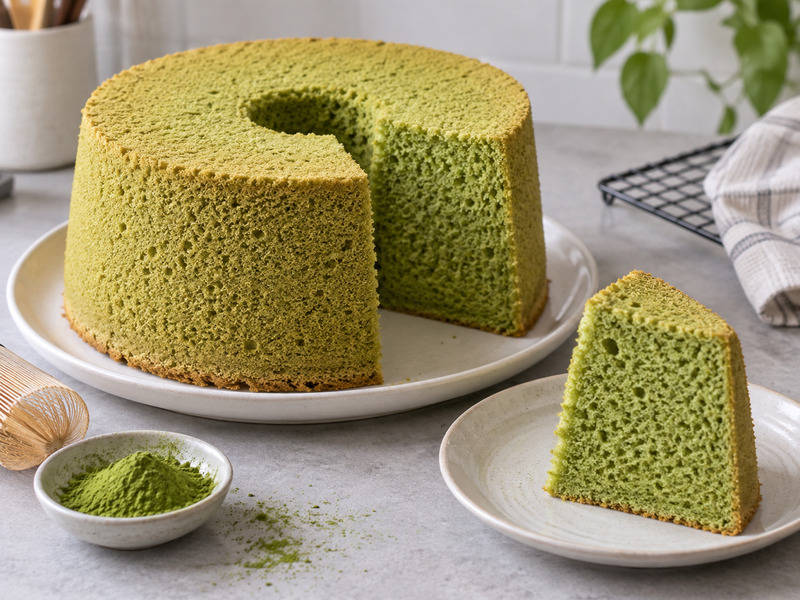
Matcha chiffon cake asks a bakery to preserve a light egg-foam structure while making tea flavor noticeable after baking. A small home cake can look excellent even when its method is too sensitive for a full production line. Different pan sizes, mixing times, and cooling methods expose that weakness. A bakery or private-label brand needs a process window, a finished-cake standard, and evidence from the actual equipment. The decisions below cover ingredient selection, foam handling, color, slicing, packaging, and cost without assuming one recipe will suit every plant.
1. What should a sellable matcha chiffon cake deliver?
Chiffon is valued for a light, springy crumb rather than a dense butter-cake bite. Matcha should be recognizable without making the finish harsh. The desired green may be a soft natural shade rather than the color of dry powder. Set those expectations before evaluating a supplier sample. A product intended for a café slice has different requirements from a wrapped supermarket cake: the café can cut and serve close to bake day, while a wrapped cake must tolerate handling and storage.
Translate the concept into acceptance criteria
Write a brief for height, weight, crumb openness, softness, tea aroma, sweetness, and appearance after the selling interval. Include a reference photograph of a cut slice, not only a full cake. Decide whether frosting, cream, or filling will be part of the sold item; those additions can cover a weak sponge. Have a small panel taste plain cake and the finished presentation. An airy cake that collapses in its pack is not commercially ready, while a perfectly tall cake with little tea identity will disappoint customers who chose matcha. Use these criteria to reject a trial before negotiating ingredient price.
2. Which matcha should a bakery trial?
A chiffon batter is exposed to mixing, oven heat, and air during cooling. Evaluate powder through that process. Fine texture helps distribute tea without visible pockets; a clear but balanced flavor matters after baking. Dry-powder brightness cannot predict the crumb color in every formula. Pure matcha candidates should be compared at equal weight in the same batter. The supplier’s grade word can help organize samples but should not decide which cake enters production.
Judge the cooled slice, not a powder display
Run coded bake trials with a control lot and at least one candidate. Keep flour, egg, sugar, oil, pan fill, oven profile, and cooling method constant. Taste center and edge slices after full cooling, then repeat after the intended selling period. Score tea presence, bitterness, aroma, and any sandy sensation. If a greener candidate tastes rough in the finished cake, color alone is a poor reason to choose it. Record the lot number and the actual powder mass per accepted cake. This links supplier approval to cost and lets quality staff detect a change on repeat orders.
| Matcha criterion | Finished-cake test | Purchasing record |
|---|---|---|
| Flavor | Blind cooled-slice tasting | Approved lot and dose |
| Dispersion | Cut-surface inspection | Mixing method |
| Color | Standard-light photograph | Acceptable crumb range |
3. How should matcha enter the batter?
Tea powder can form lumps when added late to a wet mixture. Sifting with dry ingredients may help, while a slurry can suit some formulas; each method changes mixing and possibly batter aeration. A plant should trial the method compatible with its equipment. Do not add an unmeasured extra mixing step simply to chase a smoother color. The goal is even distribution with the egg foam still able to support cake volume.
Compare mixing methods with one batter target
For a dry blend, check sieve residue and inspect batter for green streaks before deposit. For a slurry, record liquid taken from the formula, its temperature, and when the slurry enters. Weigh any powder left in a bowl or screen so the nominal dose does not hide process loss. Bake both methods with the same pan fill. Compare height, crumb, and tea flavor across several cakes. If a high-shear bench mixer hides clumps that appear in production, the bench method is not representative. Write the chosen sequence into a batch sheet with a maximum mixing time and a clear visual endpoint.
4. How can egg foam remain stable at scale?
Chiffon depends on a controlled egg-white foam and careful incorporation into the base batter. Underwhipped foam may lack support; a very stiff or dry foam can be difficult to fold evenly. Both can produce uneven volume. Production adds variation from egg temperature, bowl size, mixer speed, batch dwell time, and the interval before deposit. A formula that relies on one pastry chef’s intuition needs a more precise process before multiple shifts can repeat it.
Record a usable foam window
Specify ingredient weights, mixer attachment, speed stages, approximate time, and observable foam condition. Then record batter density or another practical in-house indicator at defined points. Run a trial at the beginning and end of the allowable deposit window. If later pans bake lower, shorten the window or change batch size. Train operators with photographs of underdeveloped, accepted, and overdeveloped foam. A cake that passes only when the first pan enters the oven immediately may still be possible for a small bakery, but it will struggle on a line with a queue of filled pans.
| Process point | Variable to record | Sign of drift |
|---|---|---|
| Egg foam | Speed, time, visual stage | Poor folding or low volume |
| Folded batter | Density and uniformity | Streaks or deflation |
| Deposit | Fill weight and wait time | Uneven cake height |
5. Which pan and oven variables matter most?
Pan geometry changes heat flow and cake support. A tall tube pan, a shallow sheet, and a small individual mold do not produce the same chiffon under one bake schedule. The bakery must validate the exact pan finish and preparation method used on site. Some chiffon processes rely on batter adhering to the pan walls during rise; changing the pan or treating its surface differently can alter height. Avoid carrying a home recipe’s oven temperature into a production deck or tunnel without testing.
Map the bake across the full load
Weigh filled pans and record their position in the oven. Check center and edge cakes for height, internal set, crumb moisture, color, and release behavior. A single central sample can hide a hot edge that dries or browns tea flavor. Record the time from deposit to oven entry, especially when several trays are queued. If a new oven requires a different profile, validate taste and texture as well as appearance. The optimal process is the one that produces acceptable cakes throughout a normal load, not the one that makes one photograph-ready cake in an empty oven.
6. How should cakes cool and release from pans?
Cooling is part of the structure-building process. A hot chiffon can contract or collapse if handled incorrectly, while a cake left too long in an unsuitable position may trap moisture. The appropriate method depends on pan design and recipe. A bakery should document whether pans are inverted, supported, or moved to racks and when release occurs. Package trials should not start until the cake has reached a suitable condition for wrapping; trapped warmth can create condensation.
Measure the cooling route
Record cooling position, room conditions, time, and cake height before and after release. Inspect torn sides and compressed bottoms because those defects affect saleable yield. If staff use a knife or tool to release a cake, train the angle and check for crumb loss. An individual cake may cool more quickly than a large tube cake but can dry faster in open air. Trial both the shortest and longest practical cooling intervals. This identifies a window operations can manage rather than an ideal time that only works on a quiet shift.
| Cooling check | Method | Reject condition |
|---|---|---|
| Height retention | Measure before and after | Collapse beyond standard |
| Surface | Inspect top and sides | Tears or wet patches |
| Packaging readiness | Check cake and pack | Condensation after sealing |
7. What should shelf-life testing include?
A chiffon may lose moisture, compress, or lose tea aroma during storage. Its color can also look different under wrap than it did on the cooling rack. Test the final product in the actual pack and route, not a naked cake held under a cover in the test kitchen. If cream or fruit is added, it brings separate spoilage and texture questions. Qualified food safety staff should determine the appropriate shelf-life protocol and storage conditions for the full product.
Inspect the eating experience over time
At planned intervals, open a pack and check aroma, crumb spring, moisture, off-notes, and appearance. Photograph a fresh cut face under consistent light. Include transport vibration and stacking if the cake will be distributed. A cake that technically remains intact but tastes stale before its label date needs a shorter quality window or a better package. Keep sensory and safety decisions distinct; a pleasant aroma is not a microbiological test. Date claims should follow validated evidence, and any change to packaging or filling should trigger a targeted repeat study.
8. How should slices and whole cakes be packed?
A café may display a whole cake and cut slices to order. A grocery channel may require individually wrapped portions with fixed weight. Whole cakes can suffer side damage in transport; slices can dry at exposed edges. The package should protect shape without pressing on the top. A transparent pack can show color, yet condensation or scuffing can make it appear dull. Select the sale format early because portion geometry feeds back into pan and bake choices.
Test packing with normal staff and speed
Cut cakes at the approved cooling point, weigh slices, and count saleable units. Run a packing trial with employees who will do the work in production. Check whether they can handle the cake without squeezing it and whether labels cover the cut face. For wholesale shipments, stack the actual cartons and inspect corner damage after transport. A too-large box raises freight cost and allows movement; a tight one crushes the cake. Include wrapper removal in the consumer test. A beautiful cake that tears when unwrapped makes a poor first impression.
| Format | Benefit | Main risk to test |
|---|---|---|
| Whole cake | Strong display presence | Transport and release damage |
| Café slice | Flexible service | Variable portion weight |
| Wrapped slice | Standard retail unit | Dry edge and compressed crumb |
9. How should a bakery calculate yield and cost?
Matcha is one input among eggs, sugar, flour, oil, energy, packaging, and labor. The bakery should cost accepted cakes or slices after cooling, release, and packing. A high theoretical batter yield can hide torn cakes and underweight slices. Record powder grams per batch and per saleable portion so supplier price changes can be translated into menu impact. Then compare candidate matcha only after each has passed the finished-cake standard.
Look at the full production run
Capture mixer time, pan count, oven occupancy, cooling space, release losses, and packing labor. A formula that saves a small amount of matcha but needs a slow manual fold may be costly at scale. Conversely, a more expensive powder may need a lower dose to produce the same tea note. Use measured trials rather than assuming either outcome. For a café chain, model a busy store and a quiet store: the latter may lose more unsold slices. A smaller cake or frozen component strategy might fit demand, but it needs its own validation.
10. What should a supplier and production approval contain?
The approval package should join a lot-specific matcha specification with the measured recipe, mixing and foam stages, pan and oven profile, cooling method, slice standard, and final pack. Request ingredient identity, origin support for any origin claim, and relevant quality records. Bulk wholesale matcha can be assessed against the bakery’s trial. The supplier should say how it will notify the buyer about raw-material or process changes that may affect the cake.
Keep one reference cake and one reference powder
On a new tea lot, bake a small batch beside the approved control using the same equipment. Compare height, crumb, flavor, and color after full cooling and at the normal sale time. If the cake changes, investigate powder and process records before altering the formula. Train operators with accepted and rejected examples, not only a photograph of a whole cake. The last approval question is operational: can a normal shift reproduce this product at the intended volume? If it cannot, revise the process before accepting a national purchase order.
| Approval record | Why it belongs | Recheck trigger |
|---|---|---|
| Powder and lot sample | Ingredient consistency | New lot or source |
| Foam and bake card | Repeatable structure | Equipment change |
| Packed slice standard | Saleable experience | Pack or portion change |
FAQ
Q1: Can a premium drinking matcha be used in chiffon cake?
Yes, but price and dry-powder quality do not prove it works after baking. Compare it with other candidates in finished cake.
Q2: Why did the cake collapse after baking?
Investigate foam development, folding, deposit delay, bake endpoint, pan behavior, and cooling before changing the matcha dose.
Q3: Should matcha be mixed with flour or liquid?
Either route can work. Choose by dispersion and cake volume in the actual formula and mixer.
Q4: How should a chain define portion consistency?
Set an accepted slice weight, size, crumb condition, and packed appearance, then count rejects during a full production trial.
Q5: When should a new powder lot be retested?
Run a targeted controlled bake when the lot or source changes, especially if flavor, color, or particle behavior differs from the reference.