
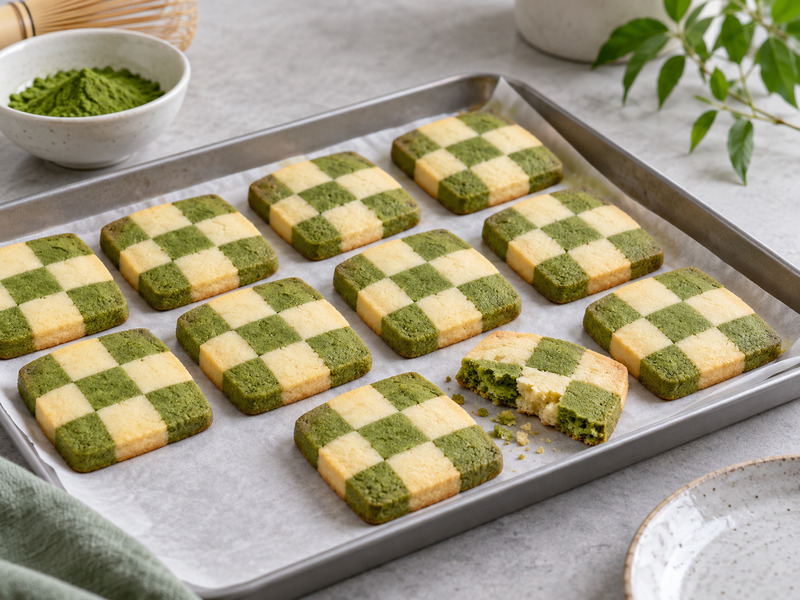
Matcha checkerboard cookies sell through their cut face before anyone tastes one. That puts geometry, color contrast, and breakage beside flavor on the approval sheet. A pastry chef can assemble a few precise logs by hand; a commercial bakery must make the pattern repeatedly within its labor budget. The useful development question is whether dough, chilling, cutting, baking, and packing can produce enough saleable cookies from an ordinary shift. This guide turns the visual concept into a production specification and a supplier brief.
1. What should the finished checkerboard cookie promise?
A checkerboard cookie uses contrasting doughs arranged so each slice shows an alternating pattern. Matcha supplies green color and tea flavor to one dough; the other may be plain, vanilla, or another compatible flavor. The pattern should remain legible after baking. A cookie that looks exact in raw dough but spreads into a blur fails its central selling point. Yet a precise grid with weak tea flavor can feel like a colored butter cookie rather than a matcha product.
Define appearance and eating quality together
Choose target diameter, thickness, number of visible squares, acceptable edge variation, tea intensity, sweetness, and bite. Photograph accepted and rejected examples in normal retail lighting. Decide whether the cookies are sold loose at a bakery counter, in a clear pouch, or inside a gift tin. Each route places different pressure on breakage and color. Test blind flavor before showing the pattern: the visual cue may convince tasters that the tea is stronger than it is. The written standard should help a production employee separate a harmless handmade variation from a unit that cannot be sold under the promised image.
2. How should two doughs be designed to behave alike?
The pale and green doughs need comparable firmness, moisture, and bake spread. Adding matcha only to one side changes its dry-solids balance. If the green dough cracks while the pale dough stays pliable, assembly becomes slow and the pattern breaks. If one spreads faster, the squares distort in the oven. Treat the two doughs as a paired system, not two independent flavors. Butter temperature, flour, sugar, and mixing time influence both halves.
Run a paired dough test
Make each dough at the intended batch size and record temperature after mixing. Roll equal-thickness strips, assemble a short test log, chill it for a defined interval, and slice. Note tearing, smearing, and differences in firmness. Bake several slices from both ends and the middle. A small composition adjustment may improve matching, but change one factor per trial. The operator should be able to lift and align strips without extended hand repair. If assembly demands constant patching, the formula or shaping method is not ready for scale. Keep the accepted dough temperature range on the batch card.
| Dough relationship | What to observe | Production consequence |
|---|---|---|
| Similar firmness | Strip handling | Clean alignment |
| Similar spread | Baked grid | Legible pattern |
| Similar moisture | Cracks and seams | Lower breakage |
3. Which matcha works in a buttery cookie?
Butter and sugar soften tea intensity, while baking can darken the green. Select powder by its performance in the finished cookie. Fine particle size helps avoid specks and gritty bites. A very costly drinking powder may bring little advantage after butter, heat, and storage; a cheap powder may require a higher dose and still taste rough. Pure matcha powder can be sampled against a fixed cookie formula with clear acceptance criteria.
Compare controlled bake samples
Use the same dough composition, matcha weight, strip size, chill, and bake profile for coded candidates. Taste a cooled cookie and another after the planned selling interval. Score tea aroma, bitterness, sweetness balance, and whether the green dough tastes different enough from the pale dough. Inspect the cut face under the lighting of the intended sales channel. If one candidate appears greener raw but bakes brown, record the change rather than selecting from the bag. Price per accepted cookie matters more than price per kilogram. Keep a retained powder sample so a future lot can be compared before a large run.
4. How can the grid be assembled consistently?
Strips must share dimensions for the squares to align. A slight change in width compounds across the log. Hand assembly can work for a premium small batch, but a high-volume bakery should test guides, cutters, or extrusion methods suited to its equipment. The aim is not mathematical perfection; it is a repeatable visual standard at a viable labor rate. Too much pressure while joining strips can flatten corners, while too little can leave gaps that open during baking.
Specify a build method and tolerance
Measure strip width and height at several points. Define the arrangement, whether an outer dough wrap is used, and how logs are joined. Record the time per log during a normal shift. Slice a chilled trial log and inspect the first, middle, and last cookies. If the ends are consistently distorted, decide whether they can be reworked, sold in another format, or counted as waste. Store a photograph of the accepted raw cross-section beside a baked reference. Operators can then correct alignment before a whole log is committed to the oven.
| Geometry control | Measurement | Decision |
|---|---|---|
| Strip size | Width and height | Fit within accepted grid |
| Log section | First, middle, last slice | Identify end loss |
| Seam | Visual and handling check | No opening during bake |
5. Why do chilling and slicing matter?
A warm log deforms under the knife; an excessively hard log can crack or shatter at the seams. The workable window depends on the fat, sugar, and equipment in the formula. Chilling also affects how long the bakery can stage prepared logs before baking. A production plan should say whether logs are chilled, held frozen, or cut soon after assembly. Each choice needs a trial for shape and eating quality after baking.
Set a slicing window with real operators
Record log temperature or a practical firmness cue, slice thickness, blade type, and rate of cutting. Measure variation across several employees rather than approving one expert’s best tray. A slicer that presses the grid sideways may need a different blade or log orientation. Weigh the lightest and heaviest slices; thickness affects bake color and pack count. If logs are frozen, test thawing and condensation effects before assuming they can enter the same bake schedule. The result should be a clear procedure for starting, pausing, and resuming a production run without losing the pattern.
6. How can baking preserve shape and green color?
Oven temperature, tray load, dough temperature, and bake time all change spread and browning. A lighter bake may preserve color but leave the center underdone; a longer bake may give the desired snap while muting green. The bakery must set a sensory and process endpoint together. A photograph taken at oven exit can mislead because cookies firm as they cool. Check the cooled product that will enter the pack.
Map the full tray rather than one cookie
Bake a normal load and compare center and edge positions for diameter, grid clarity, underside color, and bite. Rotate only if the production method will include rotation. Measure whether the pale dough browns faster than the matcha dough. A small size change may make squares clearer without changing the powder. If the first tray differs from later trays, inspect log temperature and oven recovery. Record accepted bake conditions and reject examples. A product that needs every cookie placed precisely in one hot spot is unsuitable for a commercial line.
| Bake observation | Possible cause | Check |
|---|---|---|
| Rounded grid | Warm dough or excess spread | Log and oven records |
| Dull green | Heat exposure or powder behavior | Cooled color comparison |
| Uneven snap | Thickness or tray position | Weight and position map |
7. What shelf-life issues affect the pattern and bite?
Cookies can absorb moisture, lose crispness, develop stale fat notes, or break during distribution. The green dough may change appearance faster than the pale side under light or heat. Test the final package along the planned route and selling period. An open bakery jar, a sealed pouch, and a gift tin create different conditions. Do not extend a date because the pattern remains visible; flavor and texture can decline first.
Open packs throughout the proposed period
At each test point, check aroma, bite, breakage, and color under the same light. Count crumbs and cracked units after a simulated shipping route. If a clear window is part of the design, compare product near the window with product deeper in the pack. A barrier material may protect eating quality but add cost or obscure the visual benefit. Food safety staff should set the study and labeling basis for the actual formula. Recheck after a change in fat, wrapper, or pack size. The sellable life should reflect the customer’s cookie, not an unopened sample kept under ideal laboratory conditions.
8. How should allergen and pack design be approved?
Wheat, milk, and egg may appear in common dough formulas, while nuts or other ingredients can enter through flavorings or shared equipment. The exact recipe determines the declaration. The FDA’s allergen guidance can inform U.S. label review, and each destination market needs its own check. Do not put a “gluten-free” or “dairy-free” statement on a visually green cookie without verifying the whole formula and controls.
Choose a pack that shows and protects
Arrange cookies so buyers can see the grid without exposing fragile edges to repeated impacts. Test tray inserts, stacking height, and seal pressure. A small break in the corner can turn a square into a visually poor unit even if it still tastes good. The artwork should show the actual baked pattern range, not only the best development cookie. For a gift tin, check whether cookies rotate and chip during parcel shipping. Include packaging assembly time and rejected broken units in the cost model. A pack that solves damage by adding excessive material may erase the margin of a low-priced item.
| Pack choice | Visual gain | Risk to test |
|---|---|---|
| Clear pouch | Pattern visible | Light exposure and breakage |
| Tray insert | Better orientation | Material and packing labor |
| Gift tin | Premium presentation | Movement during shipping |
9. How should a bakery calculate true cookie yield?
Theoretical dough weight divided by target cookie weight ignores strip trimming, distorted log ends, cracked slices, bake rejects, and broken packed units. Count these losses separately. A labor-intensive pattern can still make sense as a premium item, but its price must reflect the work. Compare the product with a simpler matcha cookie using the same sales channel; the checkerboard needs a reason for its extra handling. A visually distinctive gift pack might justify a different price than a loose counter cookie.
Use a full-shift trial for costing
Record mixer time, strip preparation, assembly minutes per log, chilling space, slicing rate, tray output, and packing rate. Calculate accepted cookies at final pack inspection. If a method change saves labor but slightly softens the grid, ask the commercial team whether customers still recognize the product. The best process may not produce the sharpest individual cookie. Cost matcha by actual powder used per accepted pack, including trimmed material that cannot be reused. A pilot with ordinary employees will give finance a better number than an expert’s demonstration batch.
10. What should purchasing and quality sign off?
Approval should join a powder sample tied to a lot, paired dough formulas, assembly diagram, chilling and slicing window, bake profile, packed reference, shelf-life evidence, allergen review, and yield record. Purchasing can ask about bulk matcha supply once the bakery knows which powder behavior it needs. A supplier should notify the buyer about changes likely to affect color, flavor, or particle behavior. A grade name alone cannot guarantee the same baked grid.
Keep reapproval triggers visible
When matcha lot, flour, fat, cutter, oven, or pack changes, run a focused comparison against the retained reference. Inspect both pattern and bite. Give line staff a one-page set of accepted and rejected cross-sections and a way to flag drift early. The product is ready to scale when normal batches produce the promised geometry at an acceptable rate and customers can recognize the tea after storage. Put that outcome in the purchase brief so procurement is buying a result rather than a green powder description.
| Approval file | Evidence | Trigger for repeat test |
|---|---|---|
| Matcha input | Lot-specific sample and spec | Powder change |
| Grid method | Strip and slice measurements | Tool or dough change |
| Saleable pack | Damage and shelf-life result | Pack or route change |
FAQ
Q1: Why do matcha checkerboard cookies lose their grid?
The doughs may spread at different rates, strips may be uneven, or slicing may deform a warm log. Test each stage separately.
Q2: Does darker matcha make a better cookie?
No. Approve powder by baked color, tea flavor, texture, repeatability, and cost per accepted cookie.
Q3: Can assembled logs be frozen?
Potentially. Validate slicing, bake behavior, condensation, and finished eating quality after the intended frozen hold.
Q4: Which pack best shows the pattern?
A clear pack helps display it, but the chosen format must also control light exposure and breakage on the actual route.
Q5: What should a commercial pilot measure?
Count assembly time, trimmed ends, distorted slices, bake rejects, broken packed units, and accepted cookies per shift.