
Search for matcha calories and you may find a tiny figure for powder, a much larger figure for a latte, and a third figure for a bottled drink. All three can be correct for their own serving. The mistake is treating them as interchangeable. Plain matcha powder contributes a small amount of energy at normal drink doses; milk, sugar, fruit, cream, and toppings can contribute far more. A current matcha calorie explainer gives a rough example of about 5 kcal for 2 g of powder, but that figure should not be copied onto a product label without checking the actual ingredient and serving. Here is a practical way for cafés and brands to read the numbers.
1. What does a calorie number describe?
A calorie value describes energy in a defined amount of food or drink. The definition of the amount matters as much as the number. A powder label may show energy per 100 g, while a café recipe uses 2 g. A packaged drink may show energy per bottle, and a menu board may show it per standard cup. Compare the units before comparing the claims. The US FDA’s calorie guidance explains that calories on a Nutrition Facts label refer to the energy in a serving.
If a supplier quotes a matcha calorie figure, ask for the basis: which product, which batch or representative analysis, and what serving weight? A precise-looking number without a serving is not useful. A consumer asking whether matcha is “low calorie” may mean unsweetened tea; a café manager may mean a drink with whole milk and vanilla syrup. Answer the actual question. Do not imply that a green color makes a sweetened drink light.
| Number seen | Likely basis | Check before using |
|---|---|---|
| Per 100 g | Powder nutrition panel | Convert to the true dose |
| Per teaspoon | Estimated scoop | Weigh the scoop |
| Per cup | Standard recipe | Confirm size and add-ins |
| Per bottle | Entire packaged unit | Check serving count |
2. How many calories come from plain matcha powder?
At the small doses used in a cup, the powder usually supplies only a modest fraction of the drink’s total energy. The exact amount depends on the product’s nutrient composition and the mass added. Matcha is ground leaf rather than an infused tea bag, so the drink contains the powder’s solids. Do not assume its calories are literally zero. The example above uses roughly 5 kcal for a 2 g serving; another supplier’s panel or a different dose may differ. Use the actual product’s label or validated nutrient data for business decisions.
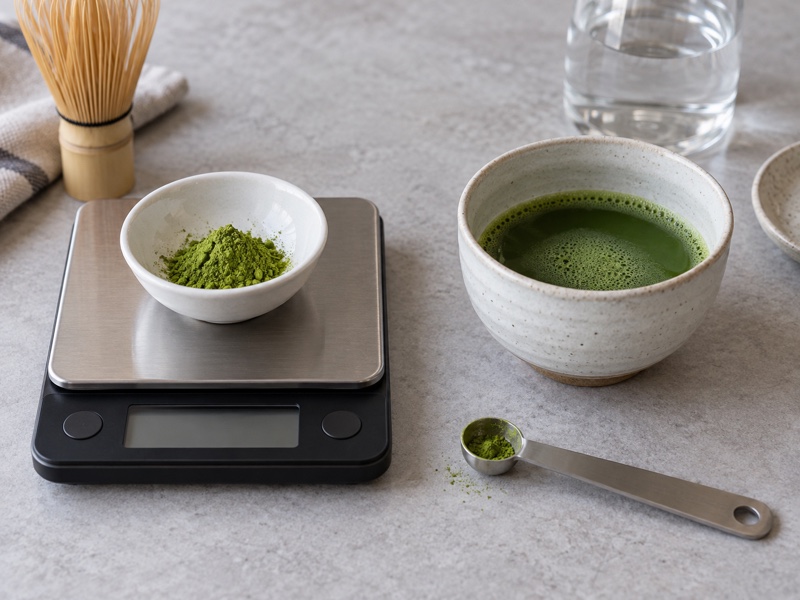
Convert a per-100-g value with a simple equation: calories per serving = calories per 100 g × grams used ÷ 100. If a powder panel states 250 kcal per 100 g and the recipe uses 2 g, the arithmetic yields 5 kcal. That is an illustration, not a universal matcha value. Weigh the serving with an appropriate scale. A heaped spoon can be meaningfully heavier than a level one, and “one scoop” is not an auditable unit unless the scoop and fill method have been checked.
3. Does water change matcha calories?
Plain water adds no calories to the calculation. It changes volume, texture, and concentration, but not the total energy contributed by the powder. A 2 g serving whisked into a small bowl and the same 2 g diluted into a tall glass contain the same powder-derived calories, provided nothing else is added. Ice also changes the volume and drinking experience without adding energy. A café should still distinguish between a standard serving and a free refill or double powder order.
Preparation can confuse people because a lighter-tasting cup looks as though it must contain fewer calories. Taste is a poor measuring tool. If the same amount of powder is in the larger cup, dilution has not removed its energy. Conversely, a very small concentrated shot could have the same powder amount as a full cup. The recipe card should state grams of powder and every added ingredient. Then the nutrition calculation follows the actual serving, not the appearance of the drink.
4. Why do matcha drinks vary so much?
Milk, syrup, honey, sweetened fruit bases, cream, and toppings each add energy. Their amounts vary between cafés and even between cup sizes at one café. The FDA nutrition label guide emphasizes serving size because it changes how numbers should be interpreted. For a finished drink, multiply each ingredient’s calories per unit by the amount actually used, then add the results. Do not add the powder number to an unmeasured “splash” of milk and call the result accurate.
Consider two cups that both say “matcha” on the menu. One is water and powder; the other is milk, sweetened syrup, and whipped topping. The tea may be the least important calorie source in the second cup. This does not make the second drink bad. It means the label or menu information should describe the complete product. A consumer choosing based on calories needs the full serving, not a claim about pure tea powder.
| Added ingredient | Why its number varies | What to record |
|---|---|---|
| Milk | Type, fat and sugar content | Brand and grams per cup |
| Syrup | Concentration and pump size | Product and measured volume |
| Fruit base | Fruit and added sweetener | Brand and grams |
| Cream or foam | Fat and sugar | Finished portion weight |
5. How should a café calculate a serving?
Begin with an approved recipe card, not a staff member’s memory. Weigh the powder, milk, syrup, and toppings for the standard size. Read energy data from each ingredient’s package or another appropriate validated source. If one label gives calories per 100 ml and the recipe uses grams, use a reliable conversion for that specific ingredient or measure the serving in the label’s unit. Do not assume every liquid has exactly the density of water. Keep the calculation sheet with the ingredient names and label dates so updates can be traced.
Suppose an illustrative cup contains 2 g matcha contributing 5 kcal, milk contributing 90 kcal at the amount used, and syrup contributing 40 kcal. The sum is 135 kcal before any topping. These are example inputs, not values for a specific café or brand. Change the milk or pump size and the total changes. For formal menu or packaged-food declarations, have a qualified professional confirm the method, applicable rounding, recipe tolerance, and local legal requirements.
| Illustrative line | Calories in measured amount |
|---|---|
| 2 g example matcha | 5 |
| Measured milk serving | 90 |
| Measured syrup serving | 40 |
| Example total before toppings | 135 |
6. What is the difference between total and added sugar?
Calories and sugar are related but different numbers. Total calories come from the energy-yielding components in the whole serving. Sugar can arrive naturally in milk or fruit or be added as syrup or sweetener. The distinction matters for nutrition labeling, yet it does not mean a fruit-heavy drink has no calories. A buyer should read the actual Nutrition Facts panel and ingredient list rather than infer “low sugar” from the absence of a sugar pump. The FDA’s label materials distinguish total sugars and added sugars on packaged foods.
For recipe development, record both the sugar source and its mass. If a premade mango purée already contains added sugar, counting only the syrup misses part of the formula. If milk is sweetened, a standard “milk” line is too vague. This is particularly relevant when a café offers dairy and plant-based alternatives. The two versions may differ in energy and sugar even at the same cup size. A clear menu can disclose that values vary by customization when allowed under local rules.
7. Can a teaspoon be used instead of grams?
A teaspoon is convenient at home, but its weight changes with powder density, spoon shape, leveling, and how tightly it is packed. A café recipe that needs consistent taste, cost, and nutrition should use grams during development and verification. Staff may eventually use a validated scoop, but periodically weigh several scoops from different people and powder lots. If the results spread widely, keep the scale in the workflow or change the tool.
This is a practical quality issue as well as a nutrition issue. A larger scoop makes a greener, stronger cup and raises ingredient cost. A smaller scoop may disappoint customers who know the usual flavor. If the powder is a bulk ingredient for bottled drinks, production should record batch mass and finished yield. An estimate from teaspoons will not serve a useful audit trail for a manufacturing run.
8. Are “zero calorie” and “low calorie” safe claims?
Claim wording is regulated and depends on the product, serving, and market. Do not place such language on a menu, package, or advertisement simply because the plain powder contribution looks small. A sweetened latte cannot borrow an implication from unsweetened matcha. Label rules also include rounding conventions and definitions that vary by jurisdiction. Have the relevant regulatory or nutrition professional review any explicit claim before it goes live.
For editorial content, plain language is often better: “Unsweetened matcha in water has far fewer calories than this sweetened latte” is a comparison only if you have calculated the actual products involved. Without that work, explain the mechanism instead: the drink’s calorie total depends on the measured powder, milk, sweetener, and toppings. Avoid promises that matcha causes weight loss or offsets calories elsewhere in the recipe. A tea ingredient cannot do that accounting for you.
9. How can a buyer compare two matcha products fairly?
Match the serving basis. Convert both powders to the same gram amount, or both ready-to-drink products to the same bottle or volume. Check whether either product contains milk powder, sugar, creamer, or other ingredients. A pure matcha powder and an instant latte blend are different categories. A pack that looks smaller may contain more servings if its recommended dose is lower; a front-of-pack calorie badge may use an unusually small serving. Read the back panel and the preparation directions together.
For a café supply decision, taste and cost still matter. A powder with a slightly different calorie value at a 2 g dose may not materially change the finished latte, while a different syrup or milk certainly can. Keep nutrition numbers accurate, but do not pretend that tiny differences in powder energy justify ignoring a drink’s overall formula. When comparing finished products, note the cup size, customization, and whether toppings are included in the published value.
| Comparison | Fair basis | Frequent mistake |
|---|---|---|
| Powder vs powder | Same gram dose | Different scoop sizes |
| Latte vs latte | Same actual serving | Ignoring toppings |
| Pure powder vs instant mix | Full ingredient and serving review | Treating both as pure tea |
| Bottled drink vs café drink | Stated package and cup sizes | Comparing only label front |
10. What should a brand keep on file?
Keep the supplier nutrition information, recipe weights, ingredient labels, calculation workbook, sign-off date, and revision history together. Retain evidence for the actual powder lot or representative product data used. If a syrup supplier changes formulation, update the calculation. If a café switches from 180 g to 220 g milk but retains an old menu number, the number is no longer tied to the cup. Schedule checks when recipes, suppliers, serving tools, or cup sizes change.
The useful takeaway is a unit habit: every calorie figure needs a product and a serving. For a new menu item, weigh one real cup before writing the number. For packaged products or regulated menu labeling, use that measured recipe as the starting record and obtain qualified review. That keeps the content honest and makes later changes easier to defend.
FAQs
Is plain matcha tea calorie-free? Do not assume zero. A small powder dose typically contributes a small amount of energy; use the product data and serving weight.
Does adding ice lower the calories? Ice adds no energy but does not remove the calories already in the powder and other ingredients.
Why is a matcha latte higher in calories? Milk, sweetener, and toppings can contribute substantially more energy than the tea powder.
Can I use an online estimate on a menu? Use measured ingredients and appropriate product data, then have required declarations reviewed under the rules for your market.
Does unsweetened plant milk always lower calories? No. Compare the exact products and quantities; plant-based milks vary widely.