
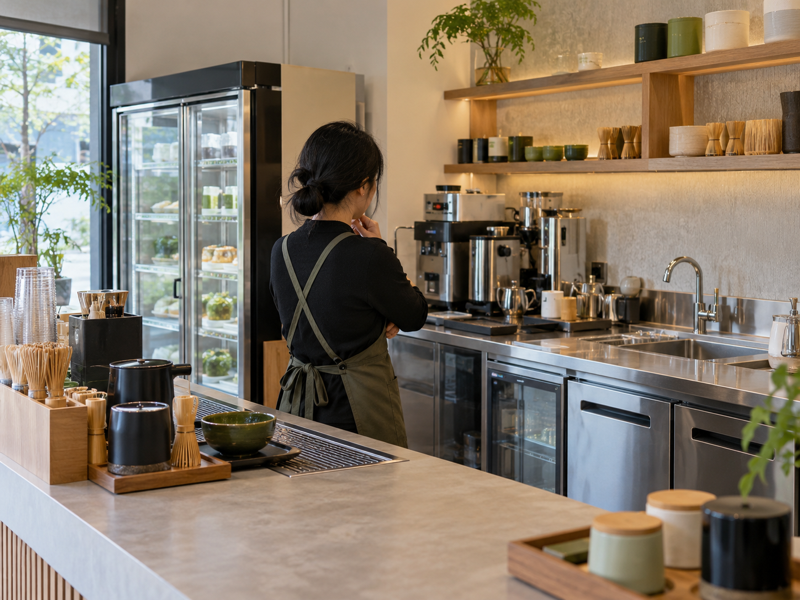
How to open a matcha cafe starts with a paid demand test, a workable bar plan, and a small menu. Opening a matcha cafe is a sequence of operating decisions, not a mood board. A lease can be signed before anyone checks whether the bar can make ten iced lattes in a rush.
A powder can be approved in a tasting, then fail when the milk or water changes. The practical route is to define the customer and drink, test a small menu, calculate the economics, and prove the service flow before committing to a full buildout. This checklist is written for an owner who needs evidence before spending on equipment, stock, and signage.
Contents
- 1. Who will the matcha cafe serve?
- 2. What concept should be tested before signing a lease?
- 3. How should the opening menu be built?
- 4. Which permits and site constraints need attention?
- 5. What equipment is needed for a reliable station?
- 6. How should the matcha supplier be selected?
- 7. What should the business plan calculate?
- 8. How should staff be hired and trained?
- 9. What should the pre-opening test cover?
- 10. What should the first month measure?
1. Who will the matcha cafe serve?
Describe the customer in the context of the location. A commuter buying a fast iced latte, an office worker staying for a meeting, and a tea enthusiast ordering unsweetened matcha have different expectations. Map likely visits by daypart and what each customer would buy. Then compare the concept with foot traffic, nearby food businesses, and the actual price range people accept in that area.
Talk to potential customers before finalizing a menu. Show real sample cups and prices, not only photographs. Ask which drink they would purchase and how often. Listen for objections such as “too sweet,” “too expensive,” or “I don't know what matcha tastes like.” A small interview cannot prove demand, but it can reveal a mismatch between the founders' preferred concept and local buying behavior.
| Customer situation | Likely requirement | Pilot check |
|---|---|---|
| Morning commute | Fast takeaway | Ticket time |
| Lunch break | Predictable quality | Repeat purchase |
| Tea enthusiast | Clear ingredient story | Straight tea tasting |
| Weekend visit | Seating and dessert | Dwell time and basket |
2. What concept should be tested before signing a lease?
Write a one-page concept brief: target customer, core drinks, price position, service model, seating plan, and why the location fits. Include the number of cups the counter must serve during a peak hour. This brief becomes a filter for equipment and layout decisions. Without it, a beautiful location can pull the business toward an expensive format that the menu cannot support.
Run a paid pop-up or a limited menu inside an existing venue if possible. Use the intended powder, cups, milk, and staff process. Record paid orders, wait time, remake rate, ingredient waste, and customer comments. Give the pilot a pass threshold before it begins. A queue can look encouraging while the drinks take too long or the ingredient cost absorbs most of the price. The pilot is a learning tool, not a launch party.
3. How should the opening menu be built?
Begin with a small set of drinks that differ in a way customers understand: straight matcha, hot latte, iced latte, and one signature variation. If the café sells pastries, pick a few that fit the production space and holding conditions. Every modifier adds a stock item and a training decision. Add flavors only after the base recipes work and staff can make them under a queue.
Write recipe cards using grams and milliliters. Include milk SKU, water, ice, syrup, vessel, mixing method, and a finished-cup reference. Have staff who did not design the drinks prepare them without coaching. If they struggle, change the card or station. A short menu that produces reliable cups can earn more trust than a long menu with inconsistent preparation.
| Opening item | Job on menu | Operational test |
|---|---|---|
| Straight matcha | Show ingredient character | Tea-only sensory check |
| Hot latte | Year-round familiar option | Foam and temperature |
| Iced latte | High-volume takeaway | Ice dilution and speed |
| Signature drink | Give a reason to return | Ingredient overlap |
| Small pastry range | Raise basket value | Storage and waste |
4. Which permits and site constraints need attention?
Food business rules depend on the jurisdiction. Ask the local authority, landlord, and qualified advisers what permissions apply to food handling, building works, signage, fire safety, accessibility, employment, and any packaged retail products. Put these items into the schedule before paying for a fixed opening date. A site that looks ready for a café may still lack the plumbing or power the chosen equipment needs.
Check physical constraints with the actual workflow. Where will deliveries arrive? Is there enough cold storage for the milk and desserts the menu requires? Can staff wash and sanitize tools without crossing the order line? How are waste and cleaning materials stored? The answers affect buildout cost and service quality. Use measured drawings and equipment dimensions rather than a rendering alone.
5. What equipment is needed for a reliable station?
Build the equipment list from the menu and expected volume. A small test counter needs a scale, mixing tools, water source, refrigeration, sink access, and suitable storage. A higher-volume shop may need more preparation capacity, duplicate tools, a clearer ice system, and spare parts. Buy for the peak hour you have evidence for, with room for reasonable growth. Avoid buying a showpiece tool that slows every cup.
Trial the equipment before ordering multiples. Measure how long it takes to dose, mix, pour, and clean. Watch where tools sit between drinks. If the team prepares iced drinks in clear cups, inspect settling and appearance after a wait. If it uses a batch base, validate holding time and food safety with the local rules. Equipment and recipe design should be decided together.
| Station need | Minimum decision | Scale-up question |
|---|---|---|
| Weighing | Accurate, cleanable scale | How many stations need one? |
| Mixing | Repeatable tool | Does it survive peak volume? |
| Cold storage | Milk and ingredient capacity | Is retrieval fast? |
| Water | Consistent supply | Does temperature stay controlled? |
| Cleaning | Sink and sanitizer plan | Can staff keep up during rush? |
6. How should the matcha supplier be selected?
Send suppliers a use brief: intended drinks, cup size, milk types, target sweetness, estimated volume, market, and required documentation. Compare candidates in standardized recipes, including hot and iced formats. Record flavor, color, dispersion, dose, and cost per usable cup. A bag price does not tell you whether the powder will work with milk or whether it needs a larger dose.
Request ingredient information, lot traceability, storage guidance, pack size, minimum order, lead time, and a process for handling quality concerns. Keep a reference sample from the approved lot. If the café plans to sell retail pouches, treat their packaging and labeling as a separate project. Matcha Village offers B2B powder products, but any buyer should approve a specific sample and documentation for its own menu and market.
7. What should the business plan calculate?
Estimate sales by item and daypart rather than multiplying a single optimistic cup count by thirty days. Calculate cost from measured recipes, then add cups, lids, payment fees, labor, rent, utilities, cleaning, waste, and maintenance. Use low, expected, and high demand scenarios. Include the opening period, when training and awareness may raise costs before repeat sales form.
Cash needs a schedule, not only a projected profit figure. List deposits, buildout milestones, equipment payments, first inventory, permits, marketing, and a reserve for delays. Ask what happens if opening is pushed back or a supplier lead time doubles. Revise assumptions with pilot data. A business plan is useful when it tells you which claim needs testing next, not when every cell shows steady growth.
| Planning input | Evidence to collect | Risk if guessed |
|---|---|---|
| Average price | Local menu and paid pilot | Revenue overstatement |
| Cups per hour | Timed station trial | Capacity overstatement |
| Ingredient cost | Weighed recipe and invoice | Margin overstatement |
| Staff hours | Real shift plan | Labor understatement |
| Startup cash | Quotes and payment dates | Funding shortfall |
8. How should staff be hired and trained?
Hire for foodservice discipline and customer communication, then teach the specific matcha method. A barista should know why powder is weighed, how a clump looks, and what to do when a customer asks for unsweetened tea. Train against recipe cards and a reference cup. Have new staff make multiple drinks without coaching while a trainer records weight, taste, appearance, and time.
Schedule mock shifts before opening. A quiet tasting tells little about how the team handles four modifiers, two milks, and an incorrect order at once. Practice handoff language, allergy questions, cleaning, and remakes. Give a shift lead authority to pause a faulty lot or revise a station setup. Training is successful when the regular team can serve the approved cup without the founder standing beside them.
9. What should the pre-opening test cover?
Run the counter as if it were open. Use the real menu, point-of-sale system, stock locations, cups, and cleaning routine. Invite a controlled number of paying customers over several dayparts. Track ticket time, line length, remakes, waste, sold items, and feedback. Do not change several recipe variables midway through the test; otherwise you cannot tell what fixed a problem.
Review the test with staff immediately. Identify one or two bottlenecks, change them, and run another shift. A refrigerator door in the wrong place may cost more time than a different whisk. A menu description may cause repeated questions. A cup size may leave drinks too weak. Make the launch decision from observed service and realistic cash needs, not a calendar date alone.
| Check | Evidence | Release condition |
|---|---|---|
| Taste | Blind reference comparison | Consistent across staff |
| Speed | Peak ticket times | Within service target |
| Cost | Actual ingredient use | Fits price plan |
| Safety | Local compliance check | Required approvals complete |
| Supply | On-hand stock and reorder | Next delivery covered |
10. What should the first month measure?
Measure sales by SKU, repeat purchases where the system allows it, ticket time, remakes, powder yield, waste, and customer complaints. Review by daypart. A weekday lunch rush may need a different staffing plan from a quiet morning even when daily sales look acceptable. Keep a short issue log with owner, action, and follow-up date.
Change one meaningful variable at a time. If the iced latte is weak after ten minutes, inspect ice and milk volume before changing powder. If a dessert is wasted every evening, reduce the batch or remove it. If customers cannot find the shop, fix listings and signs before paying for more promotions. The opening month should turn assumptions into measurements that improve the next ordinary shift.
Before a full opening, write a one-page release note with the few conditions that still matter. Put the approved menu and product codes on it, together with observed peak ticket time, the most recent recipe cost, required local approvals, opening stock, and the next supplier delivery. Name who can stop a launch if a condition fails. This is useful because final-week pressure can make a team treat unresolved issues as normal.
A missing second sink, untested plant milk, or uncertain permit is easier to address before a public rush. Run the opening day at a volume the trained staff can handle and keep a short log of customer questions and remakes. Review the log after service, adjust only documented problems, and repeat the reference-cup check the next day. A quiet, accurate first week gives better information than a single overloaded launch day.
FAQ
Q1: How much money does it take to open a matcha cafe?
Costs depend on location, buildout, equipment, labor, and menu. Obtain local quotes and model cash timing before committing.
Q2: Can a coffee shop test matcha without opening a separate café?
Yes. A limited menu can test demand, recipe, and service flow using existing staff and space.
Q3: How many drinks should be on the opening menu?
Start with a small, distinct range that the team can prepare consistently. Add items after sales and service data justify them.
Q4: Is expensive matcha necessary?
Choose powder through a finished-drink test and cost-per-cup calculation, not price or grade label alone.
Q5: What is the strongest pre-opening signal?
Paid demand paired with acceptable taste, service time, remake rate, and ingredient cost is more useful than free-sample praise.
Related reading: matcha powder for cafes and How to Start Your Own Matcha Brand.