
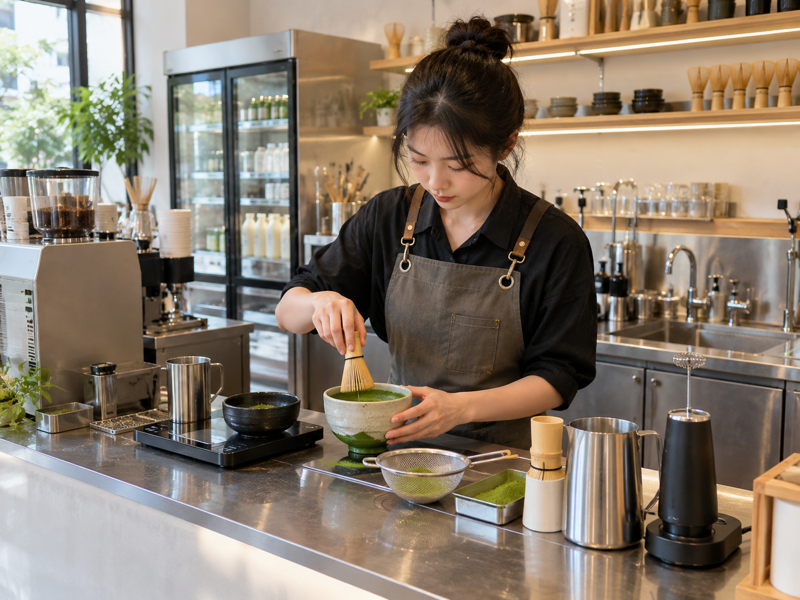
A matcha cafe equipment list should start with recipes and peak service, not a catalog. A traditional whisk may be right for a tea-led counter. A high-volume latte bar may need a different mixing method, duplicate tools, and more ice capacity. Both need reliable measuring, safe water and milk handling, cleaning, and a way to keep the bar moving when a tool fails. This guide builds an opening list from the work each station performs and gives buyers questions to ask before ordering.
Contents
- 1. What equipment is required for the core menu?
- 2. How should a scale be chosen?
- 3. Which mixing tool fits the service model?
- 4. What water equipment does matcha need?
- 5. How should refrigeration and ice capacity be sized?
- 6. What cups and vessels should be standardized?
- 7. Which cleaning and sanitation tools are needed?
- 8. How much redundancy is worth buying?
- 9. What should buyers ask equipment vendors?
- 10. How should the opening list be approved?
1. What equipment is required for the core menu?
List each opening drink and its steps: weigh powder, add water, mix, steam or pour milk, add ice, finish, and hand off. Add cleaning after every cycle. This task map produces a minimum equipment list: scale, suitable mixing vessels and tools, controlled water source, refrigeration for milk, ice storage for cold drinks, and sinks or sanitation facilities that meet local rules. Cups and storage containers also belong in the practical list.
Avoid buying for drinks that are not approved yet. A blender, specialty topping machine, or extra dispenser may be useful later, but each takes space, power, cleaning time, and maintenance. Validate the base drinks first. If the café also serves coffee or desserts, plan their equipment separately and check whether workers can share the counter safely at the busiest hour.
| Recipe step | Equipment question | Trial evidence |
|---|---|---|
| Dose | Can staff weigh grams quickly? | Repeated dose check |
| Mix | Does the tool remove clumps? | Finished-cup inspection |
| Heat | Is water and milk controlled? | Temperature trial |
| Chill | Is milk and ice accessible? | Rush simulation |
| Clean | Can tools be washed between orders? | Full-cycle timing |
2. How should a scale be chosen?
A scale needs the range and resolution appropriate for a small powder dose and a cup or mixing vessel. Check that it is stable on the chosen counter, readable under station lighting, and cleanable after spills. Test several operators weighing the same target amount. A scale that drifts or shuts off mid-order creates uncertainty that staff may solve with a spoon.
Plan where the scale lives. Steam, water, and powder spills can shorten its life. Keep a backup and a calibration or check-weight routine appropriate to the equipment. If the shop uses a fixed scoop in service, use the scale to verify how much powder the scoop actually holds across staff and lots. A scoop can be convenient, but its volume is not the same as a controlled mass.
3. Which mixing tool fits the service model?
Compare a bamboo whisk, metal whisk, electric frother, shaker, and any approved machine with the same powder and recipe. Measure smoothness, foam, preparation time, cleaning, and how the tool behaves after repeated cups. A beautiful tool can still be wrong for a crowded bar if it needs long drying or careful storage. A fast device can be wrong if it splashes and leaves sediment.
Choose a standard method, then write its exact steps into the recipe. If a tool requires a particular vessel shape or liquid depth, buy them together. Test a new operator after a short training session. The winner is the method that makes the approved cup with acceptable time and cleaning effort, not necessarily the most familiar instrument.
| Tool | Strength | Watch point |
|---|---|---|
| Bamboo whisk | Direct control and ritual | Drying and replacement |
| Electric frother | Fast single-cup mixing | Splashing and power |
| Shaker | Useful for cold assembly | Sealing and sediment |
| Batch mixer | Potential high volume | Hold and sanitation |
| Fine sieve | Helps some clumpy powders | Added service step |
4. What water equipment does matcha need?
The water source should support measured volume and a repeatable temperature range. Excessively hot water can change flavor and make powder harder to judge fairly; the chosen range should come from recipe trials and supplier guidance. Test the equipment while several drinks are made in sequence. A unit that holds temperature for one cup may recover too slowly during a rush.
Plan filtration and maintenance based on local water quality and equipment requirements. Keep records for filter changes and cleaning. The design should allow staff to fill a vessel safely without carrying hot water across the customer path. If a café uses cold water for iced drinks, test dispersion separately; a tool that works in warm water may clump in cold milk. Water is a recipe variable as well as a utility.
5. How should refrigeration and ice capacity be sized?
List the milk SKUs, fruit preparations, desserts, and other chilled ingredients the menu will actually hold. Estimate peak use and delivery frequency. Choose refrigeration that maintains required temperatures under normal door opening and fits the bar layout. Do not assume a small undercounter unit can handle a menu designed for a larger kitchen. Check local food safety rules for storage, monitoring, and cleaning.
Ice planning needs the same care. An iced matcha menu can use more ice than a hot-drink-led forecast suggests. Weigh ice per recipe, estimate peak orders, and allow for ordinary melt and handling. Test whether staff can replenish the bin without blocking service. A visually elegant ice well is not useful if it runs empty after the lunch queue.
| Cold item | Planning input | Failure signal |
|---|---|---|
| Dairy milk | Sales mix and delivery | Repeated emergency runs |
| Plant milk | SKU count and open life | Excess waste |
| Fruit puree | Prep and shelf life | Separation or spoilage |
| Ice | Weight per cup and peak cups | Service interruptions |
| Desserts | Display and holding | End-of-day waste |
6. What cups and vessels should be standardized?
The mixing vessel affects how well powder disperses. A cup's shape affects foam, layering, and perceived fill. Test the intended hot and iced cups with the actual recipe. Make sure lids fit securely and that a clear cup does not reveal unwanted sediment after a normal wait. A larger cup should have a separate formula; extra milk alone can weaken the matcha.
Reduce unnecessary vessel varieties. Each additional size needs storage, purchasing, and staff recognition. If the café offers a retail matcha kit, keep its bowls and tools separate from service equipment so display stock does not become a substitute during a rush. Standardization should help workers find and use the correct item without reading a tiny label.
7. Which cleaning and sanitation tools are needed?
Include tool washing and drying in the timed recipe cycle. Whisks, frothers, shakers, pitchers, and strainers can hold residue. Decide which tools can be cleaned between cups and how many duplicates the station needs. Follow local food safety rules and manufacturer instructions for sanitation, water, and chemical handling. A tool that is hard to clean may create more labor than it saves in mixing.
Provide space for clean and used tools, not just a sink. During a peak hour, a barista needs to know where a wet whisk goes without touching fresh powder or finished cups. Keep spare brushes, cloths, and approved cleaning supplies in known locations. Train staff on an end-of-shift routine and check whether it fits the closing schedule.
| Tool | Cleaning question | Spare plan |
|---|---|---|
| Whisk | How is residue removed and dried? | Backup whisk |
| Frother | Which parts contact drink? | Spare head or unit |
| Shaker | Does seal trap liquid? | Extra clean shaker |
| Pitcher | Can milk residue be removed? | Multiple pitchers |
| Scale | Can spills be wiped safely? | Backup scale |
8. How much redundancy is worth buying?
Identify equipment whose failure would stop the menu: scale, water unit, refrigerator, ice supply, and mixing tools. Some items deserve a low-cost spare on site. Others require a service agreement, nearby repair provider, or temporary menu change. Write the response before the failure occurs. The cost of redundancy should be compared with lost sales and remakes during downtime.
Test the backup method. If the electric frother fails, can staff use a manual whisk at the required volume? If the ice machine stops, can the café obtain safe replacement ice quickly? If a refrigerator fails, what stock must be discarded and who decides? The right plan depends on location and volume, but an untested backup is only a sentence in a manual.
9. What should buyers ask equipment vendors?
Request dimensions, power and water requirements, throughput, cleaning instructions, warranty, spare parts, service coverage, and realistic delivery time. Ask for a demonstration using your intended recipe where possible. A vendor's capacity claim may be based on a different drink and workflow. Measure your own cups per hour with setup, operation, and cleaning included.
Check total installed cost. A low-priced machine can need plumbing, electrical work, filters, or a service contract. Confirm whether the kitchen or café already meets local installation rules. Put vendor quotes beside the floor plan so a late dimensional surprise does not trigger expensive changes. Keep model numbers and manuals in a shared store record for future replacements.
| Vendor question | Why it matters | Evidence |
|---|---|---|
| Installed footprint | Fits actual counter | Measured drawing |
| Utilities | Safe connection | Contractor review |
| Throughput | Meets peak demand | Live trial |
| Cleaning | Fits shift routine | Demonstration |
| Support | Limits downtime | Written terms |
10. How should the opening list be approved?
Build a simple bill of equipment tied to each approved menu item and expected peak volume. Mark what is essential for opening, what has a backup, and what can wait. Run a mock service with the proposed station and actual tools before placing a large order. Let regular staff make the drinks while the buyer records missing items and awkward steps.
After opening, review remakes, service time, cleaning labor, and downtime. A tool may need replacement because it fails the operation, not because a new model appears. Keep manuals, maintenance dates, and supplier contacts accessible. The equipment plan is finished only when the café can make its approved menu reliably on an ordinary busy day.
A useful equipment acceptance test happens before the vendor leaves. Run the approved drink recipe with the installed machine and the store's water, cups, and staff. Record temperature recovery, mixing quality, noise, cleaning time, and whether the power and drainage work under repeated use. Check that manuals, spare parts, service contacts, and warranty details are handed over in a place managers can find.
Train staff on shutdown and fault reporting, not only the ideal operating sequence. Mark any issue on an acceptance sheet and resolve it before relying on the equipment for launch. Repeat the same check after a repair or major service. A counter full of new hardware is not a functioning station until the team can produce the reference cup and clean the equipment on the schedule the business requires.
FAQ
Q1: Does a café need a bamboo whisk?
Only if it fits the recipe and service model. Test it against other methods for cup quality and cleaning time.
Q2: Is a scale necessary?
Measured dosing makes recipe testing and cost control much easier, even if a calibrated scoop is later used in service.
Q3: Can a café make matcha ahead of time?
Possibly, but it must validate flavor, settling, safe holding, and discard rules for its process.
Q4: What spare is most useful?
A backup for any low-cost tool that can stop service, such as a scale or mixing device, is worth considering.
Q5: Should equipment be bought before the menu is final?
Buy only shared essentials early. Final capacity and specialty equipment should follow recipe and service trials.
Related reading: matcha powder for cafes and A Guide To Traditional and Non-Traditional Matcha Tools.