
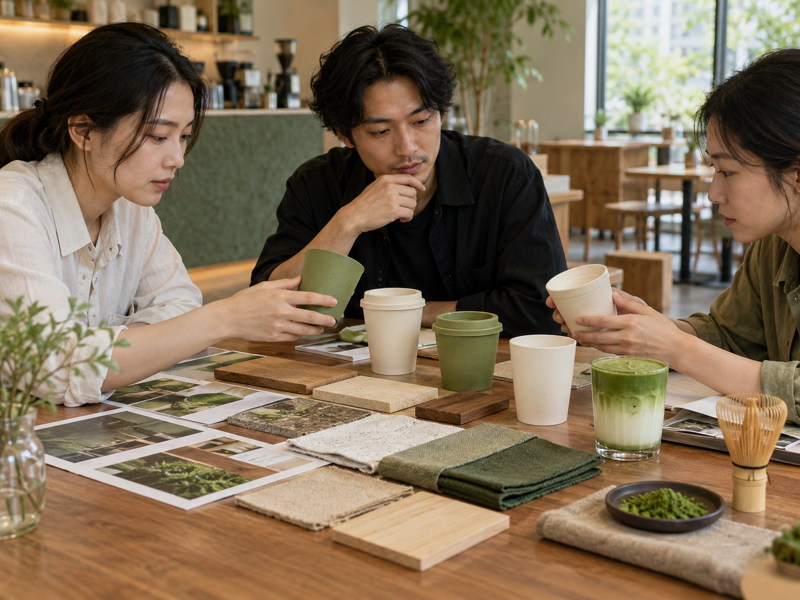
Matcha cafe branding begins with the drink and service a customer receives. A matcha cafe brand is the set of expectations a customer carries into the shop. The logo and cup color make those expectations visible; the drink and service decide whether they are met. A café that claims careful tea sourcing while serving an inconsistent sweet premix creates a gap customers can taste. Build branding from a specific promise that operations can repeat. This guide connects positioning, menu language, materials, pricing, and staff behavior so the brand is useful beyond a launch photograph.
Contents
- 1. What should a matcha cafe brand promise?
- 2. Which customer is the brand for?
- 3. How can the menu express the brand?
- 4. What role should visual identity play?
- 5. How should sourcing claims be handled?
- 6. How should staff speak for the brand?
- 7. What should the physical space communicate?
- 8. How can price support the positioning?
- 9. Which measures show whether the brand holds up?
- 10. How should the brand change as the cafe grows?
1. What should a matcha cafe brand promise?
Choose a promise customers can test. It might be unsweetened tea prepared with care, a quick reliable iced latte, or a playful dessert menu with clear matcha flavor. Each leads to different ingredients, service times, and price expectations. Avoid a stack of broad adjectives such as “premium,” “authentic,” and “healthy” unless the business can explain what each means in the cup.
Write a short promise and a list of proofs. If the promise is “tea-forward,” the plain latte should taste of tea without syrup. If it is “fast,” peak ticket times matter. If it is “origin-led,” product records should support the story. Test the promise with someone who has never seen the concept deck. Ask what they expect to taste and pay; then serve the proposed cup.
| Promise | Customer proof | Operator control |
|---|---|---|
| Tea-forward | Recognizable matcha | Powder and dose |
| Convenient | Predictable queue | Layout and staffing |
| Playful | Distinct flavors | Menu testing |
| Traceable | Clear source information | Supplier records |
| Calm | Comfortable visit | Space and service |
2. Which customer is the brand for?
A matcha specialist and a first-time latte buyer may both enter the shop, but the lead audience should be clear. Define the occasion: morning takeaway, afternoon break, dessert visit, or corporate order. The audience shapes price, service speed, menu breadth, and the words on the board. A brand aimed at every possible customer often says little to anyone.
Use paid tastings and short interviews to learn what people understand. Show the menu without the founder's explanation. Ask what they would order, why, and what would make them return. Record mismatches. If customers think the shop is a quiet tea room but the operation is a high-volume takeaway bar, visual language may be setting the wrong expectation. Change the message or the experience before scaling either.
3. How can the menu express the brand?
Names and descriptions should sound like the same business and tell the truth about ingredients. A tea-led café can state cultivar or origin when documented and relevant; a casual bar can still describe sweetness and milk clearly. Avoid a wall of poetic names that require staff to translate every item. The customer should know what arrives in the cup and whether a drink contains coffee or added sugar.
The menu hierarchy also carries the promise. If the brand says matcha is central, a plain drink should not be hidden beneath ten flavored options. If the concept is dessert-led, a narrow unsweetened menu may disappoint its audience. Use photographs of the real service cup. A beautiful glass in a campaign image can mislead when the normal takeaway order arrives in an opaque container.
| Menu element | Brand signal | Accuracy check |
|---|---|---|
| Category order | What the shop values | Matches sales intent |
| Item name | Tone and memory | Can staff explain it? |
| Description | Taste and ingredients | Matches recipe |
| Photo | Expected appearance | Uses normal cup |
| Price | Position | Supported by quality |
4. What role should visual identity play?
Color, type, cup material, and interior finish help customers recognize the shop. They should also function at small scale, under real lighting, and across physical and digital surfaces. Test a mark on a cup lid, receipt, map listing, and retail pouch. A complex graphic may look strong on a presentation slide and vanish in a mobile search result.
Match visual cues with the product. A subdued natural palette can support a calm tea room, while brighter colors may suit fruit-forward drinks. Neither choice is inherently more honest. The problem is inconsistency: a refined visual system paired with a sugary, poorly mixed cup makes the brand feel hollow. Choose materials the store can clean and replenish, not only ones that photograph well on opening day.
5. How should sourcing claims be handled?
Any claim about origin, grade, ingredients, or processing needs a record behind it. Ask suppliers for current specifications and lot information. If a drink uses a blend, do not describe it as pure single-origin matcha. If the supply changes, review menu copy, packaging, and staff talking points. Words such as “ceremonial” are used differently by suppliers and should not stand in for a transparent description of the actual product.
A useful sourcing story explains what the café chose and why. “We tested this powder in our house oat latte because it keeps a clear tea flavor” is specific and testable. It does not need a grand claim. Matcha Village's B2B role can be described through the products and documents actually supplied, while each café remains responsible for its own final menu and market claims.
| Claim | Evidence to hold | Update trigger |
|---|---|---|
| Ingredient composition | Current specification | Formula change |
| Origin | Supplier traceability | Source change |
| Dietary statement | Full recipe review | Milk or topping change |
| Flavor promise | Sensory standard | New lot or recipe |
| Sustainability | Verifiable program | Supplier change |
6. How should staff speak for the brand?
Give staff short, factual answers to common questions: what matcha tastes like, whether a drink is sweet, which milk is standard, and why a straight tea differs from a latte. Train with the real recipe and tasting notes. A script should support conversation, not make every interaction sound identical. Allow staff to say they will check a supplier sheet rather than guessing about origin or allergens.
Service recovery is part of the brand. A clumped drink should be remade without debate. A customer who expected unsweetened tea should receive a clear explanation and suitable alternative. Set rules that staff can act on during a rush. A brand promise becomes credible when the ordinary team handles a problem well, not only when a founder tells its story at an event.
7. What should the physical space communicate?
The space should make the service model legible. A quick bar needs visible ordering and pickup. A tea tasting room needs seating and time for questions. Materials, lighting, and sound can support the intended visit, but they should not hide practical needs such as cleaning, refrigeration, and queue movement. A customer who feels lost at the entrance will not notice the carefully chosen wall color.
Put the product in the right place. If the café sells packaged powder, show how it relates to the drinks and provide accurate ingredient information. If the barista's preparation is part of the experience, let customers see it without crowding the station. The space should help the team deliver the promised cup repeatedly.
| Space cue | Customer inference | Operational test |
|---|---|---|
| Visible bar | Preparation matters | Safe sightline |
| Quick pickup shelf | Fast takeaway | Queue flow |
| Tasting seats | Conversation is welcome | Staff time |
| Retail display | Product can be taken home | Label accuracy |
| Warm lighting | Calm visit | Cup inspection remains possible |
8. How can price support the positioning?
Price communicates an expectation. A higher-priced matcha latte should have a clear reason: ingredient quality, a larger dose, careful service, or a distinctive format that customers value. It still needs a viable margin based on real costs. A low price can fit a quick-service model if the recipe and workflow support the volume. Avoid using price alone to claim quality.
Test the menu at the intended price during a paid pilot. Ask customers whether they would reorder and why. Compare the cup with nearby alternatives without assuming every competitor serves the same product. Review modifiers and dessert bundles for clarity. A brand loses trust when the advertised price looks reasonable but the final ticket depends on hidden milk or size charges.
9. Which measures show whether the brand holds up?
Track repeat purchases, complaints, remakes, and the reasons customers choose the shop. Search reviews for patterns: weak tea, sweetness, slow service, packaging leaks, or clear praise for a particular drink. Connect each pattern to an operational measure. A brand perception problem may start with dose drift or a changed milk SKU, not a campaign.
Check across channels. The drink shown online should resemble the cup in store and the one delivered. Menu descriptions should match current recipes. Staff should answer core questions consistently. Run periodic blind tastings with different operators and lots. If the product promise is measurable, the brand team can work with operations rather than issuing more adjectives.
| Signal | Underlying check | Possible action |
|---|---|---|
| Weak tea complaint | Dose and milk volume | Recipe retraining |
| Long wait | Ticket time and layout | Station change |
| Misleading photo | Real cup comparison | Replace image |
| Origin question | Supplier record | Update copy |
| Low repeat | Taste and price feedback | Rework offer |
10. How should the brand change as the cafe grows?
Keep the core promise stable while letting menu and channels evolve. A café may add hojicha, genmaicha, retail pouches, or catering. Test whether the name and visual system can hold those products without confusing customers. New items should use the same standard of honest descriptions, supplier records, and repeatable preparation.
Before opening another location, document what makes the first one work: approved recipes, buying specifications, staff training, service targets, and customer language. A brand cannot be copied by sending a logo file to a new shop. It travels through operational decisions. The next location should be judged by the same cup and service promise, with local adjustments tested rather than improvised.
Before a second shop or wholesale channel opens, conduct a simple promise audit. Order anonymously from the first café, read the menu as a newcomer, and compare the served cup with the online photo and written description. Ask a staff member what the drink contains and where the shop's ingredient claim comes from. Review the same points in delivery packaging and on any retail pouch.
Write down gaps that customers can notice, such as a sweeter cup than the menu suggests or a different milk shown in imagery. Fix the recipe or the claim, then retest. This audit is more useful than a broad survey asking whether customers “like the brand,” because it links perception to a specific operational decision. A repeatable promise can travel to another location; a beautiful graphic file cannot carry an inconsistent recipe.
FAQ
Q1: Does a matcha cafe need a Japanese visual style?
No. Choose a style that fits the actual product, audience, and place without implying an unsupported origin.
Q2: Can a café call every matcha drink healthy?
Avoid broad claims. Review the full recipe and applicable rules before making nutrition or health statements.
Q3: What matters more, logo or recipe?
Customers experience both, but a repeatable drink is the proof behind the visual promise.
Q4: Should staff memorize a brand story?
They should know concise, factual answers. Natural conversation is better than a rigid speech.
Q5: When should branding be revisited?
Review it when customer expectations repeatedly differ from the real menu, service, or product range.
Related reading: matcha powder for cafes and Matcha Branding: 5 Approaches, With 17 Real Examples.