
Matcha bubble tea brings whisked matcha together with milk or another drink base and cooked tapioca pearls. The appealing photo is easy; an even cup at busy service is harder. Pearls change texture as they wait, powder can clump, and a generous syrup pour can bury the tea.
Contents: Components · Recipe · Pearls · Powder · Milk · Sweetness · Texture · Scaling · Sourcing · Menu
1. What Belongs in a Matcha Bubble Tea?
Separate the drink from the topping
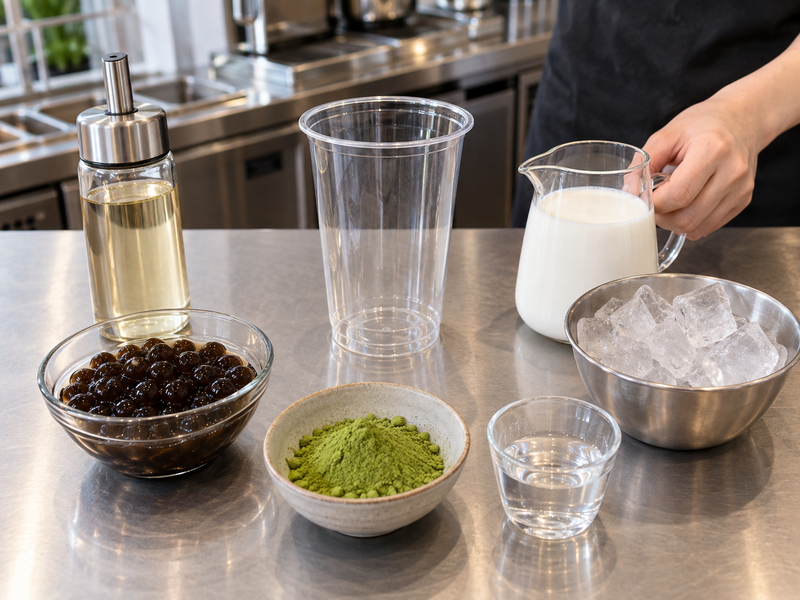
The core build includes matcha, water for dispersion, milk or another base, sweetener if needed, cooked pearls, and ice for a cold version. Some shops add brewed tea, cream, fruit, or flavored syrup. Those extras should earn their place through tasting. Pearl syrup already contributes sugar, so a recipe that balances the liquid alone may become too sweet once the topping enters the cup. Start by defining the finished cup: its size, liquid fill, pearl serving, ice amount, and expected handoff time. Then calculate ingredient quantities around that target.
For a 16 oz trial cup, a team might begin with 2–3 g pure matcha, 35–50 mL water, a measured pearl portion, ice, and milk to a marked fill line. This is a trial range, not a universal formula. Matcha strength and pearl syrup differ. Build the cup you intend to sell: tasting tea in an empty glass skips both pearl sweetness and ice dilution. Keep toppings, cup, and straw consistent across trials.
2. How Do You Make a Matcha Bubble Tea?
Use one clear mixing sequence
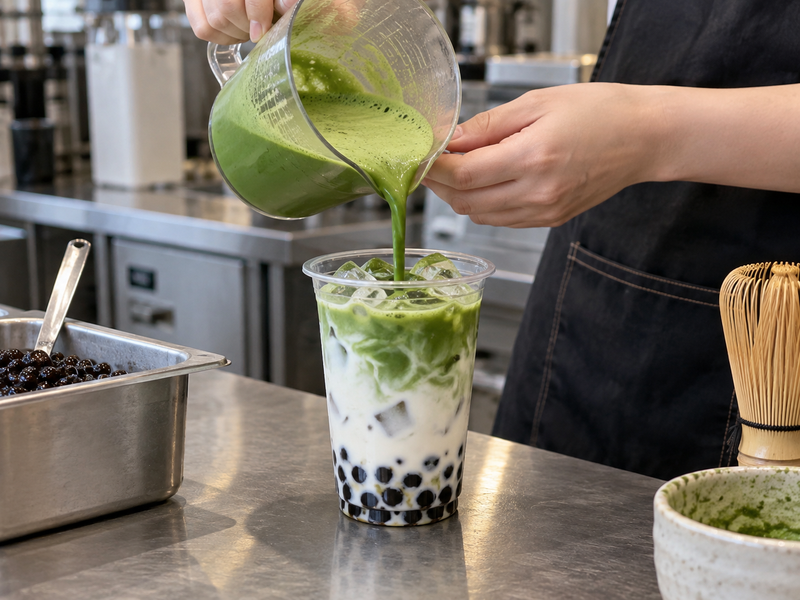
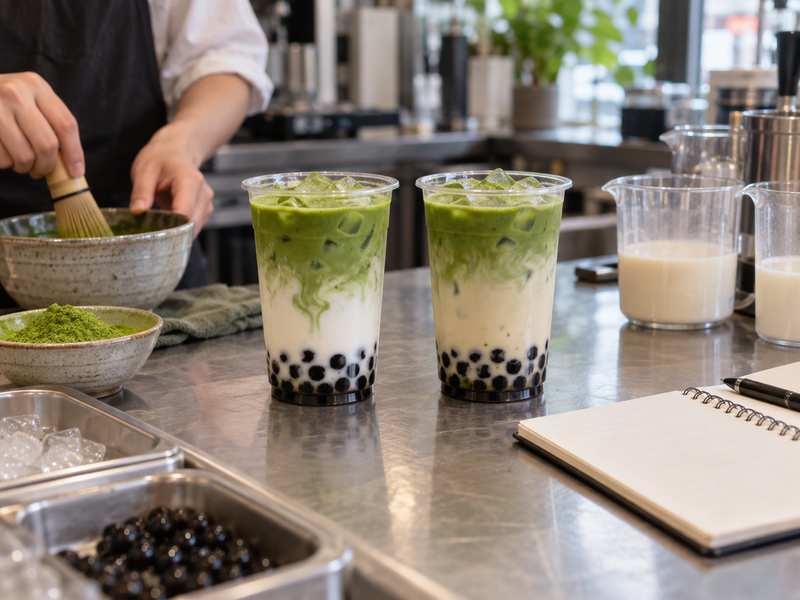
Prepare pearls according to the manufacturer’s cooking directions and your kitchen’s food safety procedure. Sift measured matcha if needed, then whisk it with a small amount of warm water until no dry specks remain. Combine the matcha base with chilled milk and any measured syrup. Put a defined serving of pearls in the cup, add ice, and pour in the matcha mixture. Stir before serving if the layers stay separate. A layered cup can look appealing, but the customer needs an even drink after stirring. Serve with a straw suited to the pearl size.
Test the last five minutes: taste immediately after assembly and again after a short wait. Check whether pearls remain pleasant and whether ice has weakened the tea. If the drink fades, adjust liquid and ice before raising matcha dose. If it tastes sugary, account for syrup clinging to pearls before cutting tea. Write quantities in grams or milliliters. A scoop marked “one portion” should also have a measured weight, since wet pearls drain differently depending on the tool and operator.
| Assembly step | Why it matters | What staff should see |
|---|---|---|
| Cook and portion pearls | Controls texture and sweetness | Pearls meet shop’s hold standard |
| Disperse matcha in water | Limits dry clumps | Smooth, uniform tea base |
| Add milk and syrup | Sets body and flavor | Even green liquid |
| Fill with ice and pearls | Controls final volume | Cup reaches marked fill line |
| Stir or give guidance | Makes layers drinkable | Tea and topping taste balanced |
3. How Should You Cook and Hold Tapioca Pearls?
Follow the pearl supplier’s process
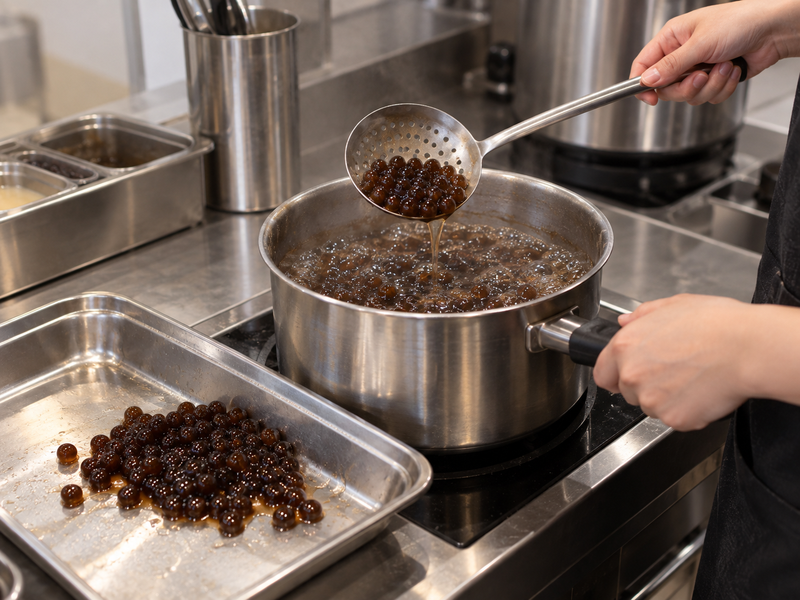
Tapioca pearls differ in size, starch composition, cooking time, and recommended hold. Use the instructions for the exact product you buy, then verify texture in your own equipment. A pearl can be soft outside and still firm at its center. Taste several from a batch rather than relying on the timer alone. Drain and hold them as your supplier and food safety plan direct. If you use syrup, measure both the pearl portion and its syrup contribution. Uneven draining turns one cup pleasantly sweet and the next syrup-heavy.
A pearl is a timed ingredient: label batches with preparation time and discard time based on a validated operating procedure. Do not extend a hold simply because pearls still look glossy. Texture and safe handling both matter. During a rush, assign a person to check batch age and portion size; the matcha maker cannot reliably track every topping container while building drinks. Record waste during the pilot. A method that demands a large cooked batch at opening may be costly if matcha boba sells slowly. Smaller batches can protect quality, provided staffing and equipment support them.
4. Which Matcha Works Well With Boba?
Taste powder in a complete drink
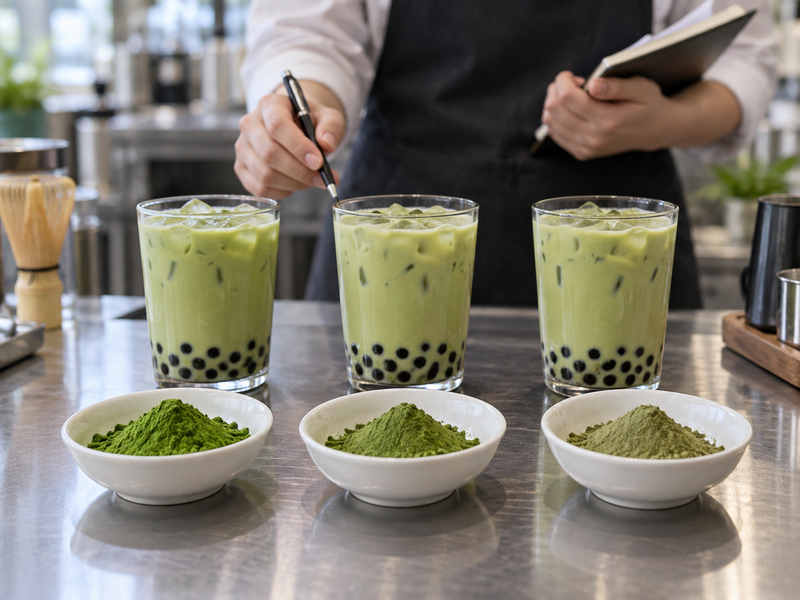
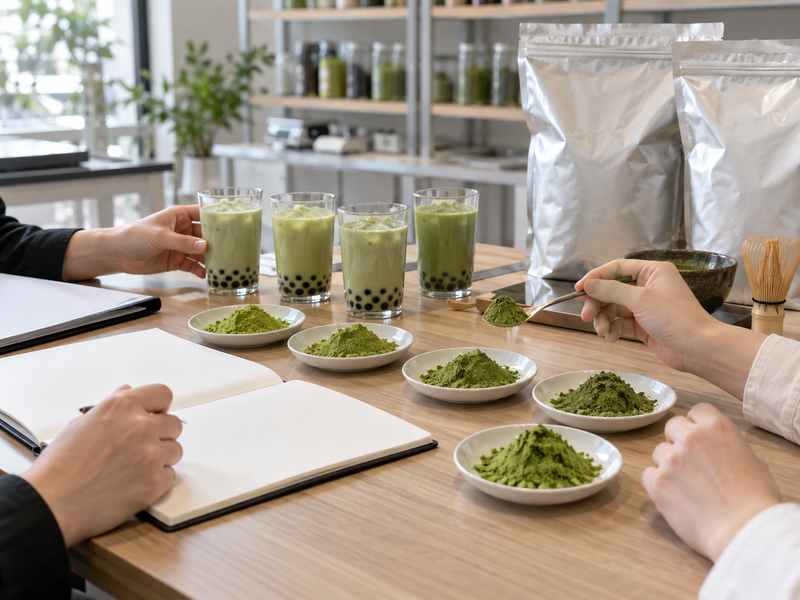
Sweet pearls and milk soften tea flavor. Choose a matcha that stays recognizable after both are added. A very delicate powder can disappear; a harsh powder may need too much sugar. Ask for samples intended for beverage use and compare them at the same dose in the same cup. Look at color, aroma, dispersion, finish, and how much tea character survives after pearls and ice. Test the cup under service lighting, because bright studio photos can hide a dull drink. Recheck after the normal customer walk from counter to table.
Matcha Village describes several pure matcha grades and a separate latte powder range. Grade names help organize samples but do not predict performance in your formula. Let the finished cup decide: log sample codes, lot details, and ingredient costs. A higher-priced powder may justify itself if its taste remains clear at a lower dose; that is a trial outcome, not something to assume. For a bubble tea chain, ask for enough sample to test several drinks across shifts. A single beautiful cup cannot reveal prep variability or whether the flavor survives normal ice melt.
| Matcha question | Simple test | Buying implication |
|---|---|---|
| Does tea remain noticeable? | Taste with pearls and full sweetener | Sets workable dose |
| Does it disperse? | Inspect bottom of finished cup | Affects prep time and remakes |
| Does color hold? | Compare fresh and delayed cups | Affects visual consistency |
| Does it fit cost? | Calculate powder cost per cup | Supports menu pricing |
5. Which Milk or Tea Base Should You Use?
Let your menu promise guide the base
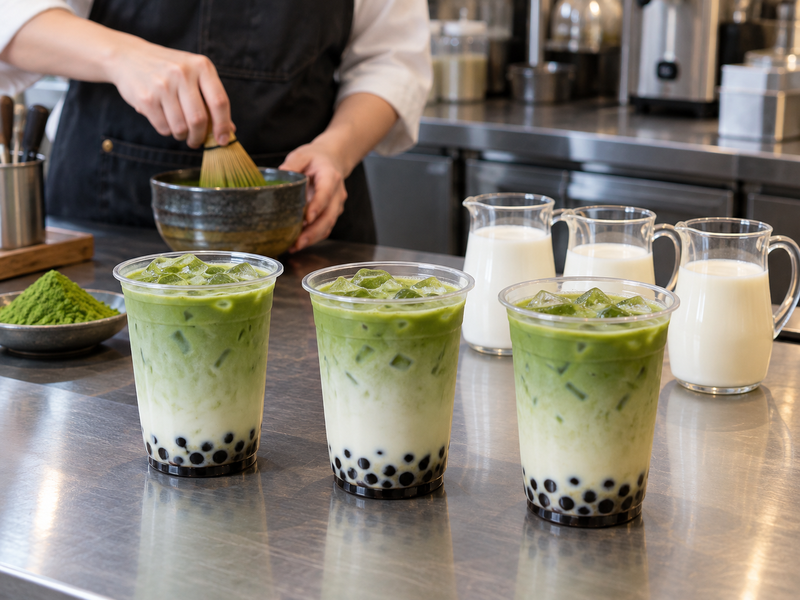
Whole milk gives a familiar creamy cup. Oat and soy milk can also provide body, while almond milk brings a distinct flavor that may compete with matcha. Product brands vary, so test specific milks rather than assuming an entire category behaves one way. If your menu calls the drink “matcha milk tea,” decide whether that means matcha plus milk or matcha combined with brewed tea and milk. Explain the build clearly when customers may expect one or the other. A brewed tea base can add depth, but it also adds preparation, holding, and flavor variables.
For a chain, select a standard milk available across locations. Examine whether it foams or separates when shaken with the tea base, and check flavor after ice has melted slightly. Name the alternative precisely: a plant-based drink may still contain ingredients from a premix or topping that affect vegan or allergen claims. Review all supplier specifications before making such claims. If a customer can choose among four milks, test each with the standard syrup and matcha dose. A quick substitution at the till can otherwise produce an unexpectedly thin or sweet cup.
6. How Do You Balance Sweetness Across the Whole Cup?
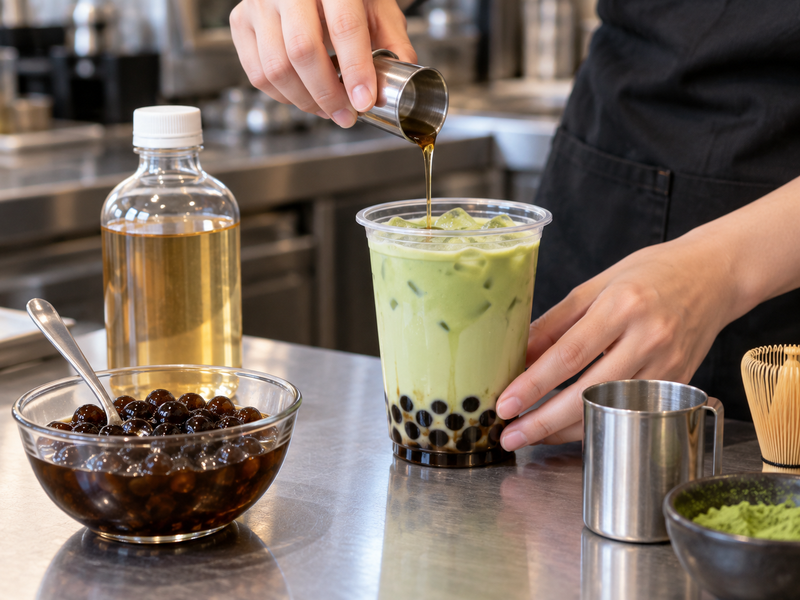
Count syrup in every component
Sweetness may enter through pearl holding syrup, flavored syrup, sweetened milk, or a matcha premix. Make a small ingredient map before setting “regular sugar.” Taste a complete cup with pearls, ice, and the drink base. Then offer defined sweetness levels only if staff can reproduce them. Liquid syrup blends quickly into a chilled matcha base. Granulated sugar often settles in a cold cup unless dissolved earlier. If the pearls are held in syrup, reducing drink syrup may have a larger effect than switching matcha powders.
Check the bottom of the cup: syrup can collect around pearls and create a sweet final mouthful. Stirring method and assembly order influence that effect. Set a target for total syrup, including what enters with the pearls, and test with a typical customer drinking pace. Buyers evaluating matcha latte powder should check its ingredient list and sweetness before adding extra syrup. A premix can shorten preparation, but the recipe must start from its actual composition. Pure matcha gives the operator more freedom over sugar while requiring a separate sweetening step.
| Sugar source | Where it enters | Control to write down |
|---|---|---|
| Pearl syrup | Topping container | Drain method and portion |
| Drink syrup | Matcha or milk base | Measured volume and concentration |
| Sweetened milk | Liquid base | Exact product SKU |
| Matcha premix | Powder dose | Ingredient list and powder weight |
7. How Can You Prevent Clumps and Separation?
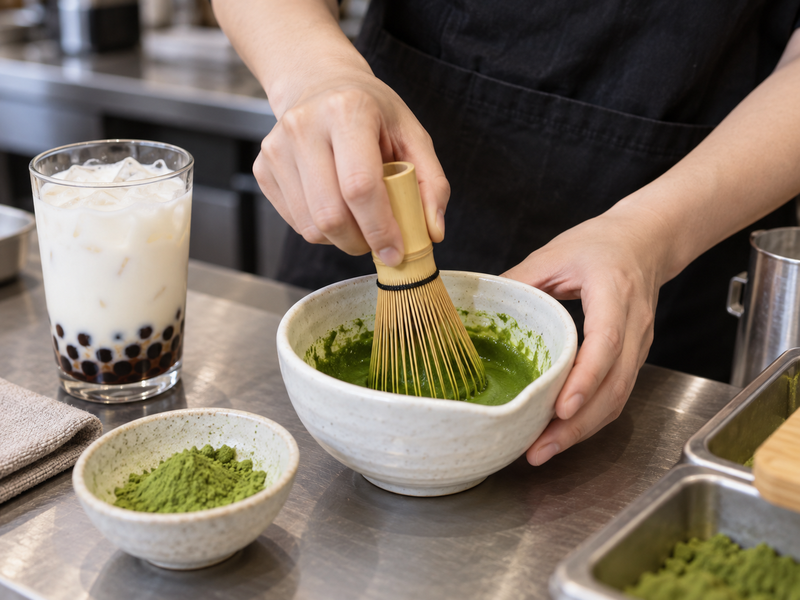
Solve the problem at the mixing stage
Matcha powder does not dissolve like sugar. Its particles disperse through liquid and can settle over time. Whisking matcha with a small amount of water before adding cold milk makes dry pockets easier to remove. A shaker or suitable blender can work, but equipment must be cleaned between drinks and should not introduce excessive foam. If the drink separates during a realistic wait, decide whether staff will stir it at handoff or whether the formulation needs work. A layered presentation should come with a clear stir cue rather than an assumption that customers know what to do.
Look at the cup from below: undispersed powder often collects where pearls make it difficult to spot. Lift a trial cup and inspect its base after drinking. Check whether the straw pulls mostly pearl syrup before tea. A consistent mixing order, measured water volume, and immediate pour address many problems. For packaged or longer-held drinks, separation becomes a formulation issue requiring proper product development and stability testing. Do not treat a café shaker test as proof that a bottled version will remain stable through distribution.
8. What Changes at a Busy Bubble Tea Counter?
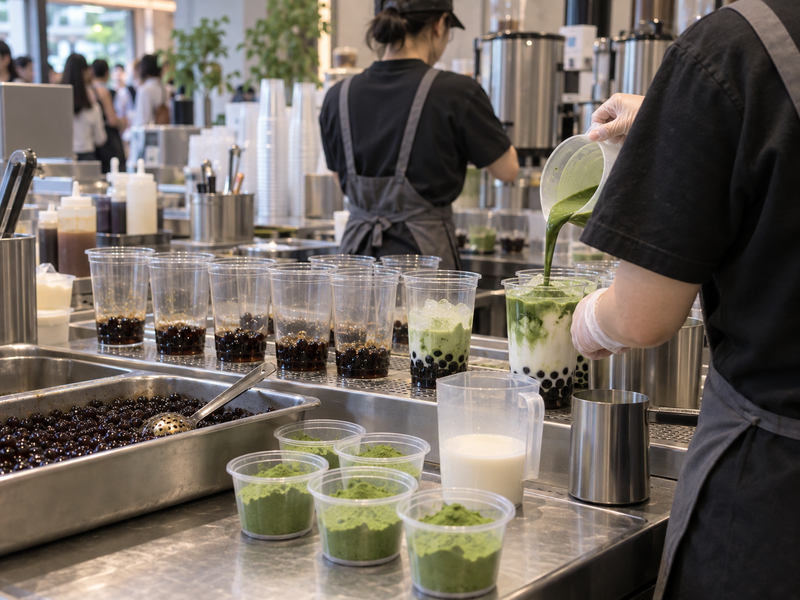
Design prep around the queue
Peak service exposes every vague recipe instruction. Staff need a measured matcha dose, standard water measure, defined pearl scoop, syrup measure, ice fill, and final liquid line. Time each step with the actual counter layout. A beautiful process that takes twice as long as neighboring drinks may become a bottleneck. Pre-portioned dry matcha can reduce measuring time. A prepared tea base may also help, but its storage, labeling, and hold time need validation under the shop’s food safety plan. Pearl batches require their own schedule and disposal control.
Count remakes, not only sales: a drink with high demand and frequent clumps can burden the team. Watch new staff build the cup from the written recipe without verbal help. Rewrite ambiguous steps based on where they hesitate. Multi-site operators should send the same powder, syrup, cup, ice specification, and recipe card to every branch. Check representative cups after a supplier lot change. A store that substitutes a different milk or pearl brand may need a revised recipe rather than a quick handwritten note.
| Counter task | Standard to define | Evidence from trial |
|---|---|---|
| Matcha portion | Weight per cup | Dose variation across staff |
| Pearl portion | Drained weight and syrup rule | Sweetness and food cost |
| Mix time | Observable smoothness cue | Clump and remake rate |
| Batch hold | Labeled start and discard time | Texture at service |
| Handoff | Stirring and straw instruction | Customer feedback |
9. What Should a Chain Ask a Matcha Supplier?
Share the application before requesting a price
Tell a supplier your cup size, matcha dose target, milk or tea base, sweetness, pearl type, and estimated demand. Ask for beverage samples, specifications, ingredient and allergen information, pack sizes, lead times, and lot identification. If an import market requires specific tests or documentation, request current evidence for the proposed SKU and shipment. Do not treat a list of company capabilities as proof that every lot carries every certificate. Confirm the offered product and terms in writing before approving it for multiple branches.
Matcha Village describes bulk wholesale matcha, blends, and private-label formats. That range can matter if a chain begins with store-level mixing and later considers a proprietary powder. Bring your recipe to the sample call: suppliers can compare candidates against a real flavor and color target. Ask how a change in powder lot is communicated and what packaging best suits your branch usage. Price comparisons should use finished-cup cost, allowing for dosage and waste, rather than cost per kilogram alone. Keep a retained sample and written approval criteria when selecting a product.
10. How Can You Test a Matcha Boba Menu Item?
Run a short, controlled menu pilot
Choose one standard cup and one clearly defined variation, perhaps an oat milk option. Train staff with a single recipe card and taste a reference cup at opening. During the pilot, record prep time, remakes, pearl waste, customer comments, and sales by daypart. Ask customers about tea strength, sweetness, and pearl texture separately. “Too sweet” may point to pearl syrup rather than the tea base. If a drink loses color after a short wait, test a different powder or mixing method under the same conditions.
Change one variable at a time: adjust matcha dose, syrup, ice, or pearl portion in separate trials. That discipline prevents a better cup from becoming impossible to reproduce. When the base works, consider flavors such as brown sugar or fruit only if they leave matcha recognizable and fit the menu’s service speed. Buyers planning several branches can discuss sample selection and supply with Matcha Village. Bring pilot results and expected order cadence; they are more useful than a request for a generic “best matcha.”
| Pilot measure | What it tells you | Possible response |
|---|---|---|
| Cup prep time | Queue impact | Simplify portioning or mix step |
| Remake reason | Where consistency fails | Fix recipe or training cue |
| Pearl waste | Batch size fit | Adjust cooking schedule |
| Repeat orders | Product acceptance | Keep or refine the item |
Frequently Asked Questions
Q1: Is matcha bubble tea usually served cold? Many menus serve it iced, but a hot version can work if the pearl supplier’s handling guidance and the finished texture support it.
Q2: Can I use instant matcha latte powder? Yes, after checking ingredients and sweetness. Treat it as a different recipe from pure matcha.
Q3: Why does powder collect near the pearls? Matcha may have been poorly dispersed or allowed to settle. Mix it in water first and test the cup after a normal wait.
Q4: Can pearls be prepared the previous day? Follow the exact pearl supplier’s instructions and your food safety plan. Texture and permitted hold differ by product.
Q5: How should a chain compare matcha samples? Use one complete boba recipe, blind sample codes, consistent ice and pearl portions, and a finished-cup cost calculation.