
A matcha bowl with spout seems like a simple upgrade at a latte station until a thick concentrate runs down the outside or catches in the notch. Buy it as a pouring tool, not merely a chawan with a decorative lip. The useful test is repeatable: make your normal concentrate, pour into your normal cup at service pace, then wash the bowl by the method your team uses. This guide sets out ten checks for that trial and for a purchase specification a supplier can actually meet.
Contents
- 1. Which drinks need a pouring bowl?
- 2. What spout shape controls the stream?
- 3. How does the bowl work with a whisk?
- 4. What capacity prevents splash and waste?
- 5. Where does the last drop go?
- 6. How should staff grip the bowl?
- 7. Can the spout be cleaned and inspected?
- 8. Will the rim survive normal service?
- 9. What should a supplier document?
- 10. How do you select a final sample?
1. Which drinks need a pouring bowl?
Map the work before buying a shape
List the drinks for which staff whisk in one vessel and serve in another. An iced latte may need a compact concentrate poured over milk; a traditional bowl service may never require transfer. Estimate how often the station pours a single serving and how often it stages two. That distinction affects the bowl’s fill line, handle position, and number of bowls in rotation. A spout adds value only when it reduces drips or unnecessary transfers in this exact workflow.
Observe five routine preparations. Does the operator already use a small jug? Is the bowl lifted with one hand while the other steadies a cup? Is the final pour over ice or a glass wall? Record where spills occur before replacing equipment. The EdoMatcha guide to chawan shapes provides the tea-bowl context; service fit needs a local test. Do not make a purchase decision from a photo of a clean pour using water alone.
2. What spout shape controls the stream?
Compare a notch, a lip, and a formed channel
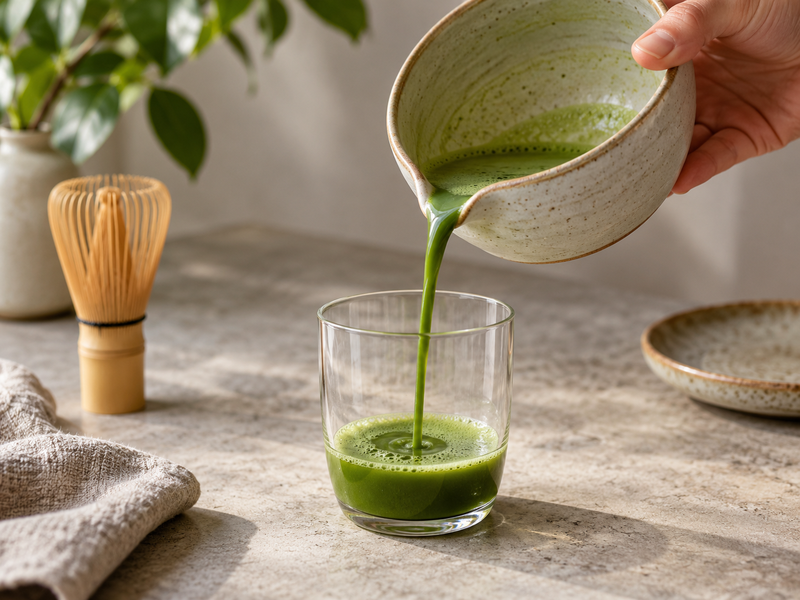
Some bowls have a shallow dip in the rim; others have a pronounced lip or short channel. The visible size of the spout does not establish its performance. Test each with the same measured amount of matcha concentrate and the same receiving vessel. Begin the pour slowly, increase to normal pace, and finish without a sudden wrist flick. Watch whether the stream leaves the spout as one ribbon or separates into side runs. A phone video viewed from the front is more useful than memory.
Repeat after the bowl has been rinsed and left slightly damp. A surface film can alter the way the last liquid leaves the rim. If the bowl is intended for retail, include instructions about its actual pouring behavior rather than claiming “drip free” from one trial. The supplier should be able to show representative production units, because minor changes in lip profile can change a pour.
| Spout feature | What to observe | Buying implication |
|---|---|---|
| Entry into spout | Does liquid gather centrally? | Side spill may start before the lip |
| Exit edge | Does stream separate cleanly? | Poor break creates outside drips |
| Channel depth | Does concentrate remain trapped? | Residue raises cleaning effort |
| Left-right symmetry | Does one side release first? | Sample variation may affect staff |
3. How does the bowl work with a whisk?
Keep the working floor separate from the pouring lip
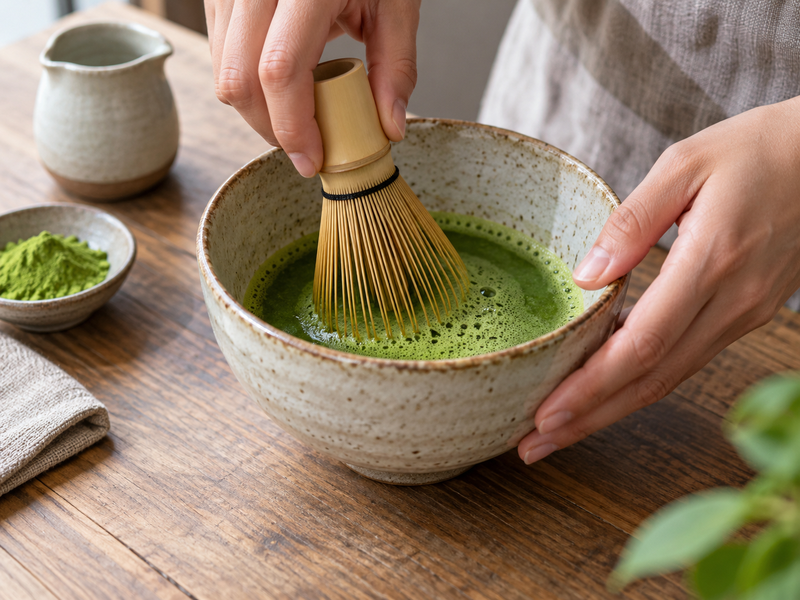
A spout does not compensate for a narrow inner floor. Measure the clear opening away from the spout, the flat or gently curved area at the base, and the distance to the rim. Make your standard recipe with the standard whisk. Listen and feel for repeated contact between whisk tips and ceramic. If the whisk catches at the transition into the spout, staff may change their stroke to avoid it, altering preparation. The bowl should allow the same motion every time.
Try a small and large batch only if both are part of the menu. A wide bowl can help an open whisking motion but may make a small concentrate shallow and difficult to gather. Note visible clumps after whisking, but test powder, water, dose, and whisk consistently so the bowl is the variable. The result is a station-specific working range, not a claim that one bowl makes superior foam in every recipe.
4. What capacity prevents splash and waste?
Measure usable capacity, not brim capacity
Catalog capacity is often measured to the top edge, where no operator can whisk safely. Mark the liquid level used in service and the height reached during the most vigorous normal whisking. Include any foam head that forms. Then pour without topping up; a bowl used for a single latte should be judged at the actual recipe volume. If it also serves batch preparation, test the maximum planned amount separately. Avoid treating “holds 400 mL” as a 400 mL working capacity.
The cup receiving the matcha matters too. A steep pour from a tall bowl may splash over a low glass; a lower lip may let the operator bring the spout closer. Create a simple station card showing the approved liquid range and receiving cup. Recheck if the recipe changes, especially if a new concentrate is more viscous. Capacity belongs to a bowl-and-recipe combination, not just an item listing.
| Measurement | Sample record | Why it matters |
|---|---|---|
| Brim volume | Fill with measured water | Descriptive only |
| Working liquid volume | Normal recipe before whisking | Real service load |
| Foam clearance | Highest normal level below rim | Splash margin |
| Poured yield | Liquid reaching receiving cup | Tracks spout retention and waste |
5. Where does the last drop go?
Test the return movement
The first stream can look excellent while the final drop runs down the outside. After each pour, hold the bowl over the cup for one second, then return it upright in the way staff naturally do. Look for a drip at the underside of the spout, a track down the wall, and a ring on the worktop. Repeat without deliberately “perfecting” the technique. If the bowl needs a flourish to stay clean, it may be a poor choice for a busy station.
Weighing the bowl before and after pouring can show retained liquid, but a simple marked cup and wipe test may be enough for a small purchase. Decide what is acceptable: a small amount held in the bowl may matter little for one beverage but more when the recipe is tightly costed. Evaluate the pour with and without foam. A spout that handles plain water is not automatically effective with suspended matcha particles.
6. How should staff grip the bowl?
Include wet hands and a warm vessel
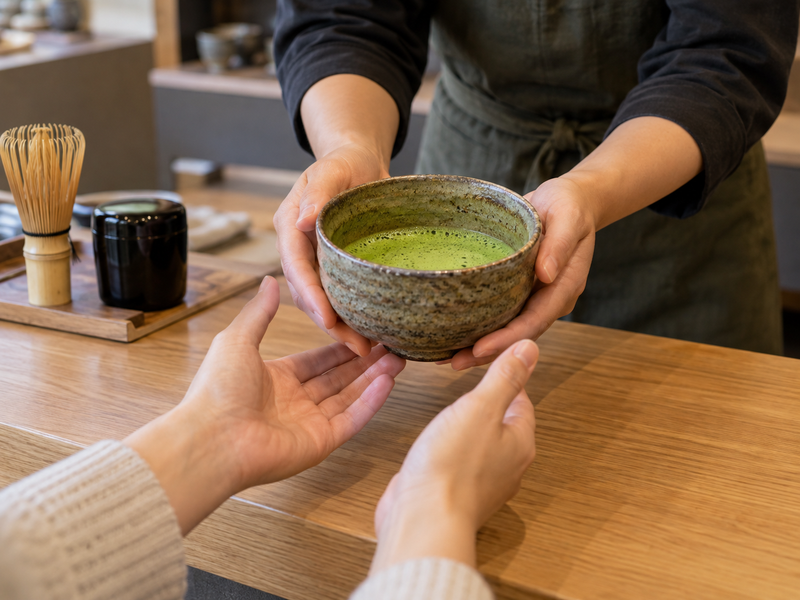
Ask two operators to perform the full sequence: whisk, lift, pour, set down, rinse. Note whether the bowl can be gripped securely at its normal filled weight. The operator should not need to place fingers on the food-contact rim or under a hot base. A groove, foot, or textured exterior may help, but only a trial with the actual bowl establishes this. Check whether right- and left-handed staff can orient the spout comfortably without twisting around a scale or milk pitcher.
Place the bowl on the intended mat and lightly push near the rim before lifting. A stable foot matters during fast whisking. If the exterior glaze is very smooth, test with damp hands as well as dry ones. Do not solve a poor grip by instructing staff to hold a towel around the bowl unless that is a deliberate and clean part of the service procedure. Document one natural lift and pour, then ask a new team member to reproduce it.
| Handling point | Trial action | Watch for |
|---|---|---|
| Filled lift | Pick up at normal recipe weight | Pinched or slipping grip |
| Pour angle | Tip into normal cup | Wrist strain or blocked view |
| Return | Set down on station surface | Drip under spout or unstable foot |
| Left-handed use | Repeat station sequence | Awkward reach or cup position |
7. Can the spout be cleaned and inspected?
Pay attention to the small channel
Whisk a normal drink and leave the bowl for the longest realistic delay before washing. Rinse and clean it by the proposed method, then inspect the spout under a task light. Look into the inner corner and underneath the lip. Dried matcha can hide in a sharp transition even when the main bowl looks clean. Ask the maker whether any brush, machine cycle, detergent, or soak is disallowed. A cleaning instruction designed for a home collector may not suit a café’s repeated use.
The FDA Food Code describes cleaning and sanitizing principles for food-contact utensils in US food service; actual local requirements and the maker’s care limits both need checking. Do not claim a spout is hygienic simply because the glaze is glossy. If staff cannot see or reach the channel using the established procedure, choose a simpler profile or a different tool.
8. Will the rim survive normal service?
Treat the projecting lip as a contact point
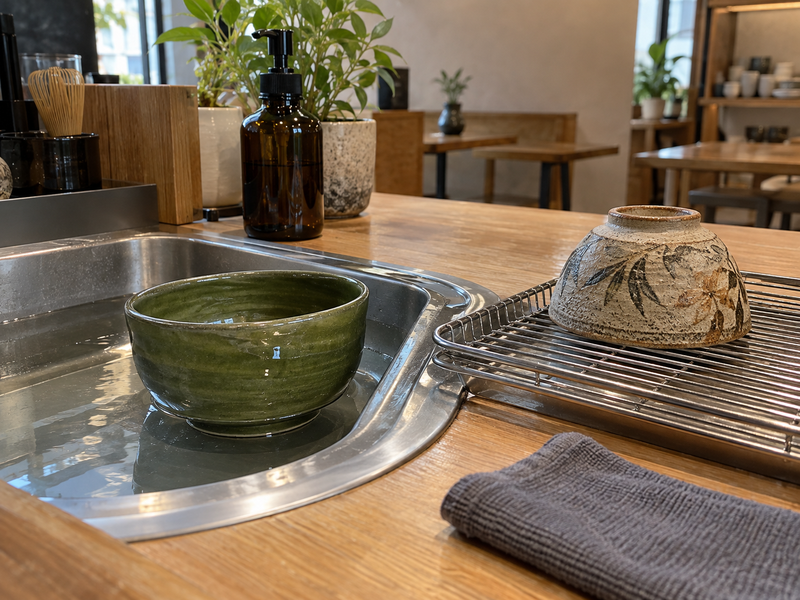
A pronounced spout may be the first part to touch the next bowl in a rack or the edge of a sink. Trial several units through ordinary washing, drying, and shelving. Record any chips or abrasion by position. Do not deliberately drop the bowl and call the result a durability rating. Everyday contact patterns are more relevant to replacement cost. If a retailer ships the bowl, test the actual insert and outer carton around that projecting point.
Ask the supplier whether the spout is thrown, formed, or attached and how much its shape varies between units. The manufacturing method does not by itself prove strength; inspect production samples. Take a side photograph of the approved profile and state what counts as an unacceptable chip at receiving. If the spout is fragile in your workflow, a wider plain-lip bowl plus a separate pouring jug may be cheaper over time.
| Risk location | Routine exposure | Receiving or trial check |
|---|---|---|
| Spout tip | Rack and shelf contact | Inspect edge in bright light |
| Spout root | Repeated cleaning | Check for cracks or roughness |
| Opposite rim | Grip and whisk movement | Check glaze and chips |
| Foot | Worktop and tray | Check for wobble and abrasion |
9. What should a supplier document?
Match the paperwork to the actual SKU
Request the material description, food-contact documentation for the destination market, care instructions, dimensional range, packaging details, and replacement process. Make sure any report identifies the applicable glaze and decoration. The FDA guidance on lead-glazed pottery explains why a decorative finish should not be accepted on appearance alone; it is not a substitute for product-specific evidence. Ask how a change of glaze, pigment, or firing method would be communicated.
For a handmade or small-batch spout, define acceptable variation in the pour as well as dimensions. A vendor may reasonably promise a design family rather than identical lips. That works if the buyer’s trial has identified a tolerant profile. Store photographs and notes with the SKU so the next order is not compared with an unrelated showroom sample. Avoid promises about lead-free status or machine compatibility unless supported by the supplied documentation.

10. How do you select a final sample?
Score performance in the order it matters
Create a short scorecard before viewing prices. For a latte bar, put clean pour, working whisk area, grip, cleanability, and replacement availability near the top. For gift retail, packaging and appearance may have greater weight while the item must still be suitable for its stated use. Test at least several samples per design if manufacturing variation is expected. Run the same recipe and station sequence for all of them, with the same operator where possible.
Reject a sample that fails a non-negotiable requirement, even if its average score looks high. A spout that drips onto the operator’s hand should not be rescued by attractive glaze. When two designs pass, calculate the cost per usable bowl including freight, packaging, observed damage, and staff time. Order a manageable first lot, inspect against the approved sample, and retrain only if the delivered profile differs. The final purchase decision should be reproducible by someone who did not attend the initial tasting.
| Criterion | Pass evidence | Decision rule |
|---|---|---|
| Pour control | Video of standard concentrate pour | No unacceptable outside run |
| Whisk clearance | Standard recipe preparation | No repeated wall strike |
| Cleaning | Normal wash and visual inspection | No inaccessible residue |
| Handling | Two-operator trial | Secure natural grip |
| Supply | Written SKU and variation terms | Reorder fit documented |
FAQ
Q1. Is a matcha bowl with spout necessary for lattes? No. It is useful when the normal workflow transfers whisked matcha into another cup and the spout reduces mess or time in a trial.
Q2. Can a spouted bowl also serve traditional matcha? Yes, if its opening, rim, balance, and appearance fit that service. Evaluate drinking comfort separately from pour control.
Q3. Does a deeper spout always pour better? No. Stream break, rim geometry, liquid thickness, and operator movement all affect the result. Compare samples with the actual recipe.
Q4. What is the main cleaning concern? The narrow transition at the spout can retain residue. Confirm it can be reached and inspected with your approved wash process.
Q5. What should be written on the purchase order? Identify the approved design, dimension range, food-contact documents, care method, spout variation, packaging, and defect criteria.
Buy the pour you observed
Select a matcha bowl with spout only after its pour, whisking area, grip, and cleaning have passed at the intended station. Keep the approved sample and a short video of its performance. Those are more useful to the next buyer than a description of the glaze alone.