
A matcha bowl and whisk set succeeds only when the two pieces work together in the hands of its intended user. A narrow bowl can crowd a wide whisk; a delicate whisk can be damaged by an awkward interior. Trial the pair with your powder, water and service method before committing to retail packaging. Strabella’s set guide discusses consumer choice; a B2B order also needs dimensional, care and replacement controls.
Contents
- 1. Who will prepare matcha with the set?
- 2. How wide should the working opening be?
- 3. What bowl interior supports the whisk stroke?
- 4. How should tine design be compared?
- 5. What does a paired preparation trial reveal?
- 6. Which bowl materials and finishes need review?
- 7. Should the bowl serve or pour the tea?
- 8. What care routine keeps both pieces usable?
- 9. How should the pair be packed and replaced?
- 10. When is the paired set approved for sale?
1. Who will prepare matcha with the set?
Define the customer’s skill and use
A beginner at home needs room to learn a whisking motion and clear instructions. A trained café worker may prioritize quick handling and wash access. A tea-room instructor may choose a bowl for a particular practice that a general retail kit should not claim to teach on its own. Decide which customer the set serves and whether the tea is drunk from the bowl or poured into another cup.
Test without coaching. Give a proposed pair to a person in the intended group, along with the recipe card. Observe grip, splashing, whisk movement and how the bowl is set down afterward. Record any borrowed tool, such as a scale or sifter. The pairing should make the intended preparation possible without hidden equipment. Urasenke’s utensil guide identifies bowl and bamboo whisk as distinct tea implements; a commercial kit should describe its own practical use accurately.
A buyer comparing two sets should hold the powder and water constant while changing only one part at a time. Start with one bowl and two whisks, then test the preferred whisk in two bowls. This simple matrix makes the result more useful than comparing two completely different kits. Record who prepared each bowl and how they handled the rim and whisk. The method will not produce a universal ranking, but it will show which pair fits the intended customer and training method.
2. How wide should the working opening be?
Measure the usable space
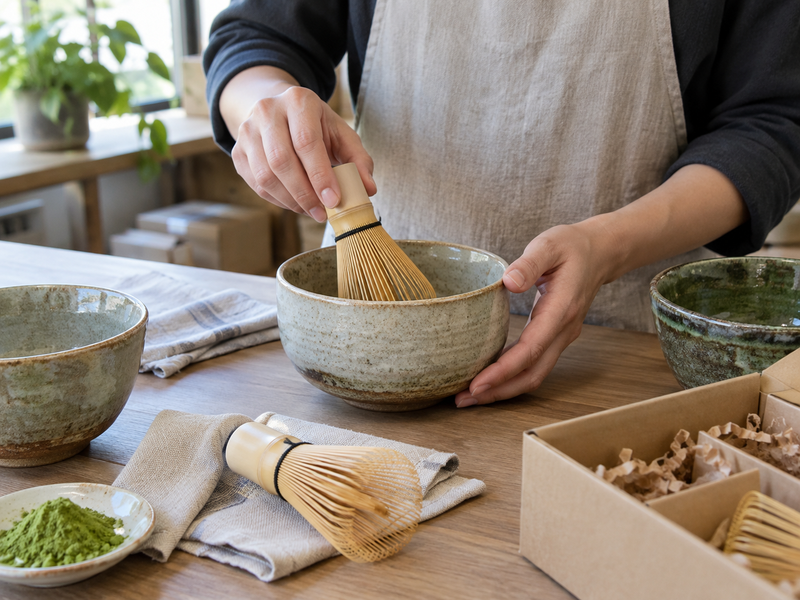
An advertised bowl diameter often measures the outside rim. Whisking depends on the inside opening and the space available below the rim where the tines move. Measure that area alongside the selected whisk’s spread. Test whether the whisk can move briskly without repeated wall contact and whether powder can be added without landing on a steep side.
Check several units. Handmade or molded bowls can vary. Ask for dimensional tolerances and inspect samples from the proposed production method. A wide opening may help a beginner see clumps, but a very shallow bowl can splash under the same stroke. Trial the pair at the actual powder and water dose, not empty. If the set will be used by a café, watch how staff lift the bowl from a wet counter. The selected opening should support both whisk clearance and everyday handling rather than match an arbitrary number from a product listing.
| Dimension | Measure where | Why |
|---|---|---|
| Inner opening | Below rim | Whisk clearance |
| Working floor | Inside base | Stroke area |
| Rim height | From interior floor | Splash control |
3. What bowl interior supports the whisk stroke?
Inspect shape under movement
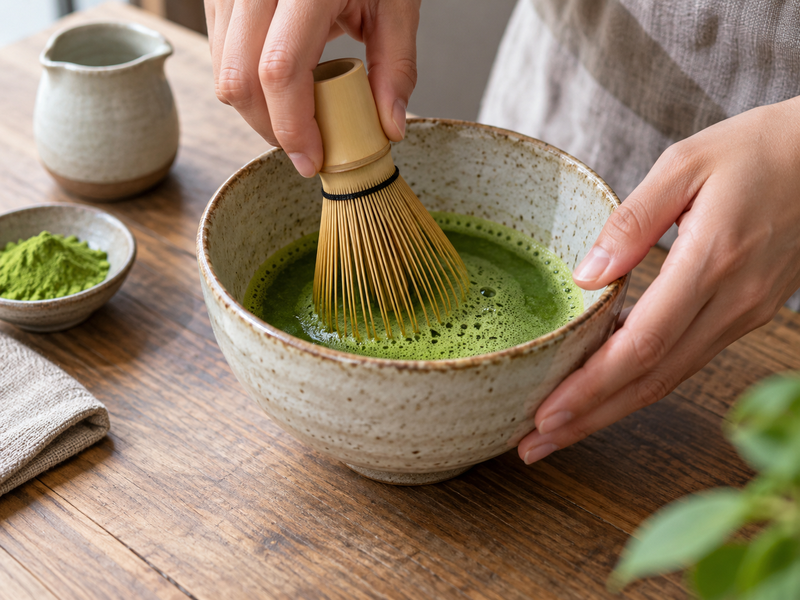
The bottom can be flat, rounded or steeply curved. Each shape changes where powder collects and how close the whisk tips come to ceramic. Use a consistent whisking method in candidate bowls and listen for repeated scraping. Check whether the operator can reach the mixture at the base without forcing the bamboo against a hard edge.
Look at what stays behind. After pouring or drinking, inspect unmixed powder around the wall-floor junction. A bowl that looks beautiful from above may leave dry pockets where staff cannot reach easily. Evaluate the glaze for rough patches that might snag tines and for interior marks that make cleaning difficult. A product’s external style should not dictate its working geometry. If the set is meant as a gift, include a preparation card suited to that interior rather than assuming all bowls respond to one motion.
4. How should tine design be compared?
Treat count as one feature
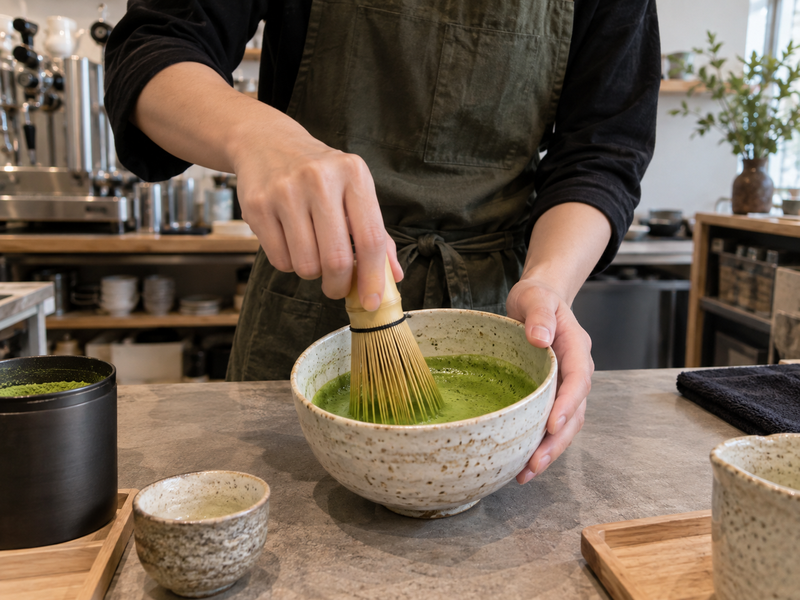
Whisks differ in tine number, spread, flexibility and handle shape. A printed count may help identify a model but cannot tell you how it behaves in your bowl. Inspect a sample for even cuts, secure binding and undamaged tips. Try the whisk with your powder and water, then compare drink texture and operator comfort. A whisk suited to one bowl may strike the side of a smaller one.
Use the pair, not separate catalogues. Select two or three plausible whisks and test each in the same bowl; then repeat the preferred whisk in another bowl. This reveals whether a result comes from the whisk, the bowl or their interaction. Record splashing, clumps and tine contact. Follow the whisk maker’s use limits for liquids and care. Ippodo’s chasen guidance addresses a bamboo whisk used with matcha and water; do not generalize its instructions to every synthetic or bamboo model.
| Whisk feature | Paired check | Possible problem |
|---|---|---|
| Tine spread | Wall clearance | Repeated contact |
| Flex | Stroke comfort | Operator fatigue |
| Handle | Wet-hand grip | Slipping |
5. What does a paired preparation trial reveal?
Make the test repeatable
Use one matcha lot, weighed dose, water volume, temperature and operator sequence for each pair. Prepare multiple bowls rather than one demonstration. Record visible clumps, foam, mouthfeel, splash and time. Then ask a second operator to repeat the trial from written instructions. The result should be a usable specification for the combination, not a broad claim about a bowl color or tine count.
Include the final customer behavior. If tea is served in the bowl, observe grip and drinking comfort. If it is poured into a cup, test whether the rim spills and whether powder remains at the bottom. Compare results after the normal service delay. A pair that makes an attractive fresh foam but leaves lumps or an awkward handoff may not fit the program. Keep photographs under one light and a signed sample of the chosen bowl and whisk. Future lots can then be checked against a known combination.
6. Which bowl materials and finishes need review?
Check the exact food-contact surface
Ceramic, porcelain and other materials can all appear in matcha sets. Ask for the bowl maker’s material, glaze and intended-market food-contact documentation for the product being sold. Inspect production samples for chips, rough rim points, unstable feet and finish variation. A general pottery description or decorative brand story does not replace product-specific information.
Test the washing route. Ask whether the maker permits dishwasher use and compare that instruction with the business’s normal cleaning method. Some decorative finishes may require gentler care. Run a controlled wash and inspect appearance and texture afterward. If a bowl is intended only for hand washing, that limit should be printed clearly on a retail kit and considered before café rollout. A bowl can be attractive and still unsuitable for a high-volume wash station. Keep the approved finish and color sample with procurement records.
| Bowl check | Evidence | Buyer use |
|---|---|---|
| Contact surface | Maker documents | Destination review |
| Foot and rim | Physical sample | Stable service |
| Cleaning | Care instructions and trial | Staff routine |
7. Should the bowl serve or pour the tea?
Decide the final vessel
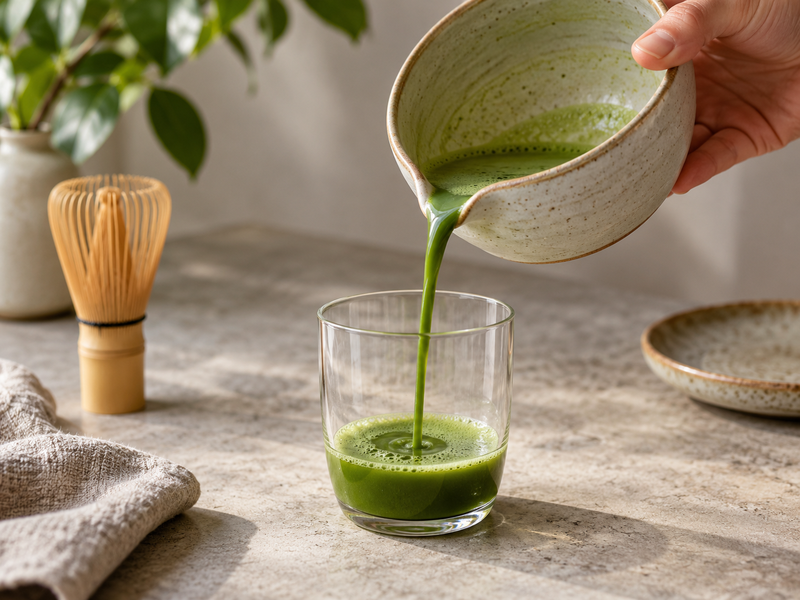
In a traditional bowl presentation, the guest drinks from the chawan. Some commercial programs whisk in a bowl and pour into smaller cups. Ippodo’s group-serving guidance discusses using a bowl with a spout for several portions. That is a product example, not a universal requirement for every service.
Trial the handoff. If customers drink from the bowl, assess weight, rim comfort and whether staff can carry it safely. If the drink is poured, check spout shape, drips and portion consistency across multiple cups. A bowl with a spout may be useful for a café but less aligned with a gift customer expecting to drink directly from it. State the purpose in the product description. The bowl’s function affects size, glaze, packaging and the training card, so resolve it before placing a bulk ceramic order.
8. What care routine keeps both pieces usable?
Give different instructions for bamboo and ceramic
The bowl and whisk should not receive one generic care line. Follow the exact bowl maker’s washing guidance. For bamboo, Ippodo advises wetting its chasen before whisking, rinsing promptly and air drying it; its page also describes replacing a whisk with broken tips. A whisk holder may support drying if it fits the selected model. Test the full routine with a new user.
Look for a storage mismatch. A gift box protects dry components during shipping but may be the wrong place for a damp whisk. Explain that distinction. Check whether the bowl has completely dried before it is packed after a café event or demonstration. For a high-volume operation, count bowls and whisks needed while used pieces are being cleaned. The care plan should be possible in the intended setting, not only in a well-equipped studio. A pairing that cannot be cleaned and stored properly will not deliver consistent service for long.
| Item | Care question | Operating response |
|---|---|---|
| Bowl | Which wash method is allowed? | Follow maker |
| Whisk | Where can it air dry? | Allocate space |
| Holder | Does it fit? | Trial with wet whisk |
9. How should the pair be packed and replaced?
Protect each component differently
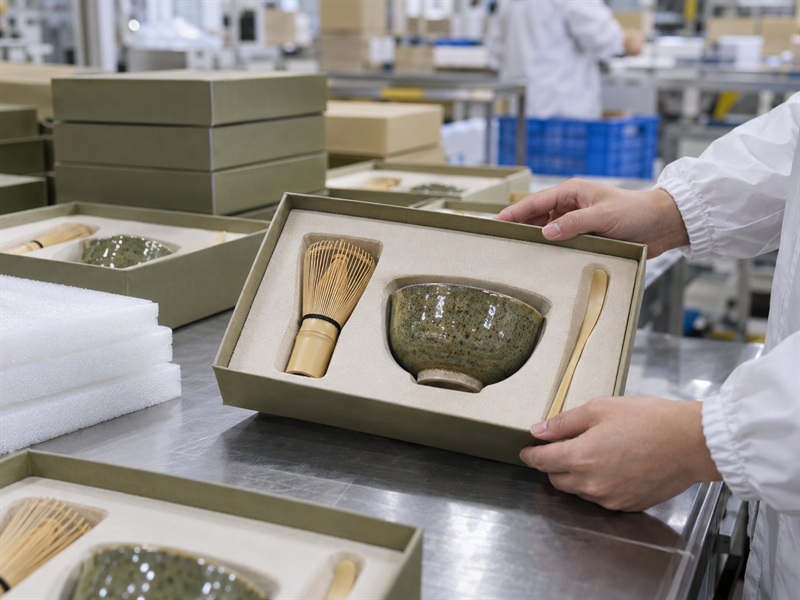
Ceramic needs impact protection; bamboo tines need clearance from crushing. Ask the supplier for an assembled production pack and test it through representative parcel or carton handling. Inspect the bowl rim, foot, glaze and whisk tips after transit. A beautiful inner box may not protect the set when stacked under other cartons.
Plan unequal wear. The whisk may need replacement while the bowl remains useful. Ask whether compatible whisks can be bought separately and whether future shipments will keep the same geometry. A broken bowl may also require a single-piece replacement rather than an entire new kit. Record component identifiers so a retailer can order the right part. If a supplier changes bowl dimensions or whisk spread, repeat the paired trial. A kit is more credible when customers can keep using it after one component fails.
10. When is the paired set approved for sale?
Close geometry, use and supply gates
The purchase record should name the bowl’s working dimensions, finish and care limits alongside the whisk’s model, spread and maker instructions. Attach a signed pair, preparation results, packaging sample and defect criteria. If the box includes matcha, approve its ingredient identity, lot documents and label separately. Matcha Village’s company materials mention tea and gift-set combinations; a particular bowl-and-whisk configuration still needs current confirmation.
Set a substitution rule. A visually similar bowl may have a narrower interior; a different whisk may strike its wall. Require a new paired trial when either component changes in a way that could affect use. Receiving teams should sample across cartons for size, damage and complete contents. Approve the set when a typical customer can prepare the intended drink, care for both pieces and obtain a compatible replacement. Those outcomes matter more than the number of accessories printed on the box.
| Gate | Evidence | Owner |
|---|---|---|
| Pairing | Prepared-bowl trial | Product |
| Materials | Bowl and whisk documents | Quality |
| Continuity | Replacement and change terms | Procurement |
For production approval, record a dimensional range for both parts as a pair. Check inner bowl opening and whisk spread on samples from different cartons, then prepare tea with the closest-clearance combination. That test catches a fit problem that average measurements can hide. Store one accepted pair at receiving for comparison. If handmade variation is part of the product story, define which variation is cosmetic and which would change preparation.
FAQ
Q1. Can any matcha bowl work with any whisk? Test inner clearance, floor shape and the chosen whisk together.
Q2. Is a higher tine count automatically better? No. Compare the actual drink and operator handling in the selected bowl.
Q3. Should the bowl have a pouring spout? Only if the intended service pours tea into another cup.
Q4. Can the wet whisk go back in the gift box? Follow maker care; bamboo whisks generally need open-air drying.
Q5. What should a wholesale sample include? Ask for the packed production pair, care card, material details and replacement terms.
Send suppliers the customer use case and require a working bowl-and-whisk sample, not separate attractive components. Prepare multiple drinks, wash the pair and inspect it after shipping. The best matcha bowl and whisk set is the one whose parts still work together after the gift box is opened.