
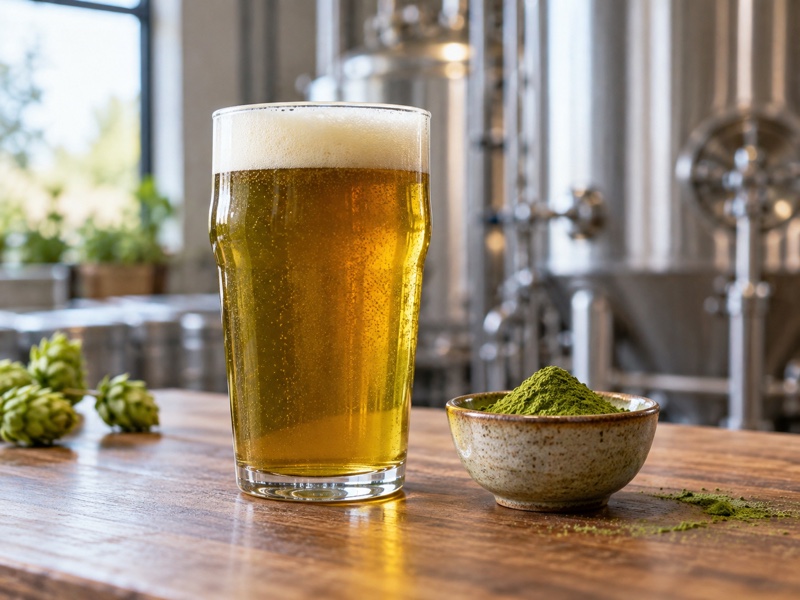
Matcha beer is beer made or served with powdered green tea. The idea sounds simple until suspended tea clouds the glass, a hoppy base competes with vegetal flavor, or a late addition changes packaging behavior. A brewer needs a sensory and process pilot, plus a regulatory review for the intended market. A news report on Japan’s matcha beer trend appears in current search results, but trend interest is not a formula. Start with one beer base and a measured tea addition, then test flavor, haze, foam, stability, and legal description before scaling.
1. What kind of beer should carry matcha?
Choose a base whose own flavor leaves space for tea. A lightly hopped wheat beer or clean lager may reveal matcha quickly, but can also make its astringency obvious. A roasty stout may hide tea flavor while producing a novel dark-green story that customers cannot taste. An IPA introduces hop bitterness and green aroma, which may be interesting yet difficult to distinguish from tea. Run bench additions into at least two finished beers before dedicating a tank. Keep all samples at equal temperature and carbonation.
Write a target that goes beyond “green beer.” Should the aroma signal tea before hops? Should the aftertaste be dry or soft? Do you accept visible haze? Taste the base alone and the dosed sample blind. If tasters cannot name a tea character without seeing the color, a matcha claim may be weak. A successful pilot should preserve beer identity and make tea noticeable at a dose that is viable for cost and stability.
| Base style | Potential fit | Risk to test |
|---|---|---|
| Clean lager | Clear platform for tea | Astringency exposed |
| Wheat beer | Soft body | Haze becomes hard to interpret |
| Pale ale | Botanical overlap | Hop bitterness dominates |
| Stout | Roasty contrast | Matcha disappears |
2. Which matcha should enter a brewing trial?
Buy a pure, food-grade powder with documented identity and lot traceability. Do not assume a ceremonial grade will outperform a culinary grade in beer. Fermentation, carbonation, chill, and hops create a matrix unlike hot water or a latte. Ask for samples of two grades, and test both at the same mass per liter in the same finished base. Then adjust doses to equal perceived tea strength and compare cost, color, sediment, and aftertaste. The second comparison prevents a low invoice price from concealing a high use rate.
Request ingredient and quality documents appropriate to the market and your quality plan. Matcha Village describes bulk pure matcha for food and beverage manufacturers, but the actual beer trial decides suitability. Keep unopened sample material for a repeat test if a production lot later changes. Cold beer can make tea particles feel more prominent than a warm tasting slurry, so evaluate chilled samples in the intended glass.
3. When should matcha be added?
Possible points include a bench blend into finished beer, a controlled addition after fermentation, or an earlier process addition. Each has different consequences for aroma, sanitation, color, and material losses. A late addition preserves more of the immediate tea character but introduces a handling step close to packaging. An early addition exposes powder to fermentation and other process conditions that may dull the flavor or change sediment. Do small trials before changing a production vessel. Record the addition point and every subsequent transfer or filtration step.
Do not copy a café method of whisking powder into a glass and assume it scales to packaged beer. A service-only drink can be stirred and served immediately. A kegged or canned beer must hold flavor and appearance through storage and distribution. If a slurry is used, document water source, concentration, sanitation control, and how it is introduced without excessive oxygen pickup. Keep a base beer control from the same tank so changes are attributable to tea rather than normal batch variation.
| Addition path | Main question | Pilot sample |
|---|---|---|
| At service | Does the cup taste good now? | Immediate and delayed glass |
| After fermentation | Can the tank mix evenly? | Top, middle, and bottom draws |
| Before fermentation | What survives process? | Finished beer versus control |
4. How much matcha should the pilot use?
Start with a small dose ladder in measured finished beer. Record matcha mass per liter, beer volume, mixing method, and tasting interval. Blind tasting reduces the pull of a greener glass. Assess tea aroma, bitterness, mouthfeel, color, head retention, and sediment separately. The best dose may be lower than one chosen by appearance. If a dose creates an appealing green tint but a chalky finish, stop increasing it and investigate powder or dispersion. A meaningful tea note matters more than a dramatic color.
Move from glass to process trial
Scale the favored bench dose into a small process run. Check whether tank mixing distributes powder evenly and whether subsequent filtration removes the flavor you intended to add. A simple arithmetic scale-up can fail because agitation and residence time change. Sample from different tank points and after packaging. Count the actual grams used per saleable liter, including what remains in the vessel or filter. That figure belongs in the cost model and ingredient record.
5. What does matcha do to haze, foam, and sediment?
Matcha is finely ground leaf, so it can contribute suspended solids. In a wheat beer, some haze may be acceptable; in a pale lager, it can look like a process defect. Define the intended appearance before choosing filtration. Examine the glass immediately after pour, after a short hold, and after gentle movement. Photograph sediment at the base of a can or bottle during package tests. If a shake restores color but creates excessive foam, the pack may be unsuitable for the proposition.
Head behavior deserves its own check. Tea particles, added water, and process changes can affect the foam a brewer sees at service, but the direction and size of any effect must be measured in the chosen beer. Use identical clean glasses and pour methods. Compare head height and collapse time with the undosed control. A green surface may be visually strong while the head falls quickly. Avoid making a claim that matcha improves foam without product-specific evidence.
| Observation | Record | Decision |
|---|---|---|
| Haze | Photo against fixed background | Fits style or looks faulty |
| Sediment | Amount after storage and movement | Package acceptance |
| Head | Height and persistence | Service quality |
| Mouthfeel | Blind tasting | Chalkiness limit |
6. How will bitterness and aroma behave with hops?
Taste tea against the exact hop profile, not a generic beer of the same style. Hop bitterness and matcha astringency can combine into a dry finish that some drinkers like and others find harsh. Botanical aromas can overlap or compete. Build a triangle test with plain beer, low tea, and high tea. Ask tasters to describe differences before they see the samples. If the higher dose is identified only as “more bitter,” the beer may need a different base rather than more tea.
Do not mask a poor balance with sugar before you understand it. Sweetening changes beer character and may affect stability and regulatory treatment. Check the finish at serving temperature and as the glass warms. A beer that tastes crisp at the first cold sip can grow coarse by the last. Save written sensory notes from more than one tasting session because novelty can inflate early scores. Repeatability matters for a seasonal release that buyers will reorder.
7. What stability work belongs before a packaged launch?
Use the actual keg, can, or bottle route. Test color, aroma, sediment, carbonation, flavor, and microbiological controls over the planned distribution interval. Store samples under realistic cold-chain and display conditions. A clear glass pilot on brew day cannot predict a packaged product weeks later. If oxygen exposure dulls the tea color or aroma in your trial, adjust the process or packaging and retest. Do not promise a shelf-life period from a bench blend alone.
Maintain traceable records for beer and tea lots, process stage, mixing, packaging date, and retained samples. When a buyer reports sediment, compare the returned package with a retained unit from the same lot and storage condition. If the proposal is only for immediate taproom service, write that scope into the launch decision and keep it distinct from later wholesale packaging. A successful taproom glass is a starting point, not proof of shelf stability.
| Release gate | Taproom | Packaged channel |
|---|---|---|
| Sensory | Same-day pour | Through distribution life |
| Sediment | Glass after service wait | Pack after storage |
| Safety | Service procedure | Full process validation |
8. Does US formula or label approval apply?
Have the brewery’s regulatory specialist classify the exact product and process before commercial production. The US Alcohol and Tobacco Tax and Trade Bureau’s formulation guidance says beer or malt beverages may require formula approval, commonly when flavoring or coloring materials are added. TTB also lists ingredients and processes exempt from brewery formula requirements; exemptions depend on the ingredient and circumstances. Do not infer that every tea addition is exempt or that every matcha addition requires the same filing. Use the current TTB tools and get a determination for your specific formula if uncertain.
Review the finished label
Label class and type, ingredient and allergen implications, alcohol statements, and claims require market-specific review. A product sold outside the US needs that jurisdiction’s rules. If matcha affects caffeine content, do not guess a number from powder mass; obtain reliable ingredient data and review any required or voluntary statement with counsel. Make no health or energy promise merely because tea is present. A brewer can market flavor and craft without turning a sensory pilot into a wellness claim.
9. What should purchasing require from the tea supplier?
Specify powder identity, particle performance, relevant testing, lot coding, packaging, and delivery timing. Ask for enough sample to run a process pilot, not only a small tasting cup. Define the approved beer application and compare incoming lots in that beer. A supplier may have excellent foodservice material yet an unsuitable profile for a hoppy ale. Agree on how a changed lot will be reviewed before it reaches a tank. Tea is a small ingredient by mass but can change an entire batch’s appearance.
Consider pack size after opening. Powder exposed repeatedly during slow production may lose aroma or change color before use. A brewhouse producing occasional seasonal runs may prefer smaller sealed units than the lowest-cost bulk sack. Calculate cost per finished saleable liter and include losses during dosing, transfer, filtration, and rejected packages. Matcha Village’s bulk matcha service can be evaluated through sample and document requests, with grade approval reserved for the actual beer process.
| Procurement field | Evidence | Pilot use |
|---|---|---|
| Exact grade and lot | Supplier record | Traceability |
| Ingredient and test documents | Quality review | Market release |
| Pack format | Open-pack trial | Aroma retention |
| Dose cost | Actual process yield | Margin |
10. What makes a matcha beer pilot worth scaling?
Require four gates: a recognizable beer and tea flavor, acceptable haze and sediment, a workable production route, and a completed regulatory review. Add a fifth gate for packaged sales: stability through the intended distribution route. Taste against the undosed base and a retained approved pilot. Run service staff through pouring and explanation so the customer hears what “matcha beer” means in this product. Record the objections as carefully as praise; novelty purchases alone do not prove repeat demand.
If the pilot passes, ask the tea supplier for a supply plan and lot controls before scheduling a larger brew. If it fails, change one part of the design, such as base style or addition point, and repeat the relevant comparison. A small, well-documented trial protects much more beer than a full-scale green experiment. It also gives sales staff a credible answer when a distributor asks how the tea will taste after shipping.
FAQ
Q1: Will matcha make beer bright green? Color depends on dose, base beer, process, and storage. Test the finished beer, not only a freshly mixed glass.
Q2: Is matcha beer always hazy? Suspended powder can add haze or sediment. Whether that is acceptable depends on style and package tests.
Q3: Does adding tea require a US TTB formula? Requirements depend on the exact ingredient and process. Use current TTB guidance or seek a determination.
Q4: Can a taproom trial be canned unchanged? Packaging needs separate stability, process, and regulatory review.
Q5: Does matcha make the beer an energy drink? Tea may contribute caffeine, but that description or a numerical claim needs evidence and legal review.