
A matcha bamboo whisk is a working utensil, not a permanent ornament in a starter kit. A café needs one that fits its bowls, prepares its drinks at a repeatable pace, and can be cared for between uses. A retailer needs to explain what the customer is buying without claiming that more tines guarantee better matcha. These ten checks cover the whisk’s construction, trial performance, cleaning, and replacement plan.
Contents
- 1. Which drink will the whisk prepare?
- 2. What does tine count actually tell you?
- 3. Does the whisk fit the chosen bowl?
- 4. How should you inspect construction?
- 5. What preparation test is fair?
- 6. How do staff rinse and dry it?
- 7. When should a whisk be replaced?
- 8. How many whisks does service need?
- 9. What belongs in a retail kit?
- 10. What should a supplier sample prove?
1. Which drink will the whisk prepare?
Begin with the recipe and service volume
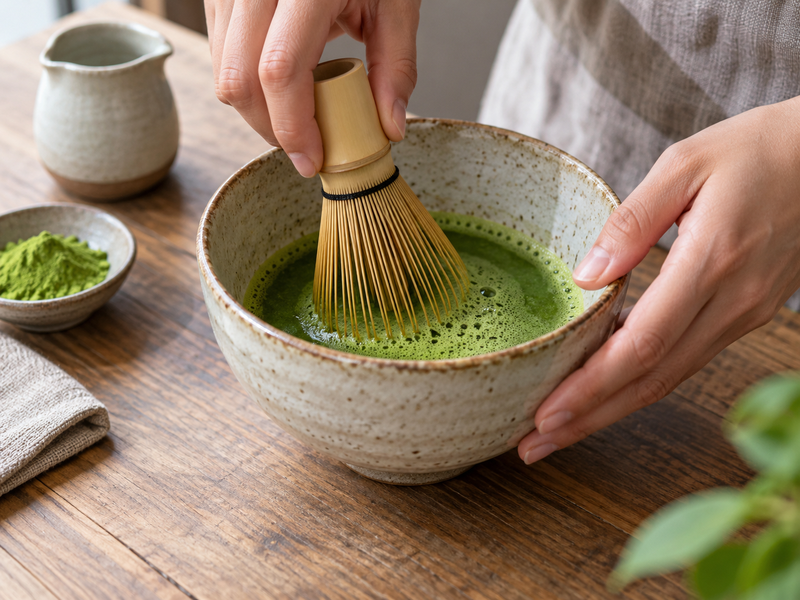
Write down whether the whisk will make thin matcha served in a bowl, a concentrated base for lattes, or occasional thick tea. The powder dose, liquid volume, and desired finish differ. A whisk that feels comfortable for a small bowl service may be cumbersome when staff make short concentrate shots for dozens of iced drinks. Describe the intended motion and preparation time before comparing products. The goal is a tool that works in your recipe, not a prestige item selected by a single number.
Watch an experienced operator and a new operator prepare the same drink. Where do they grip the handle? Do the tines move freely? Are clumps left at the edge? Ask which steps cause delay: sifting, adding water, whisking, or rinsing. A different whisk cannot solve inconsistent powder weighing or a poorly shaped bowl. The Luna Matcha chasen guide is a useful introduction to whisk options; a business still needs its own station trial.
2. What does tine count actually tell you?
Treat the number as one design variable
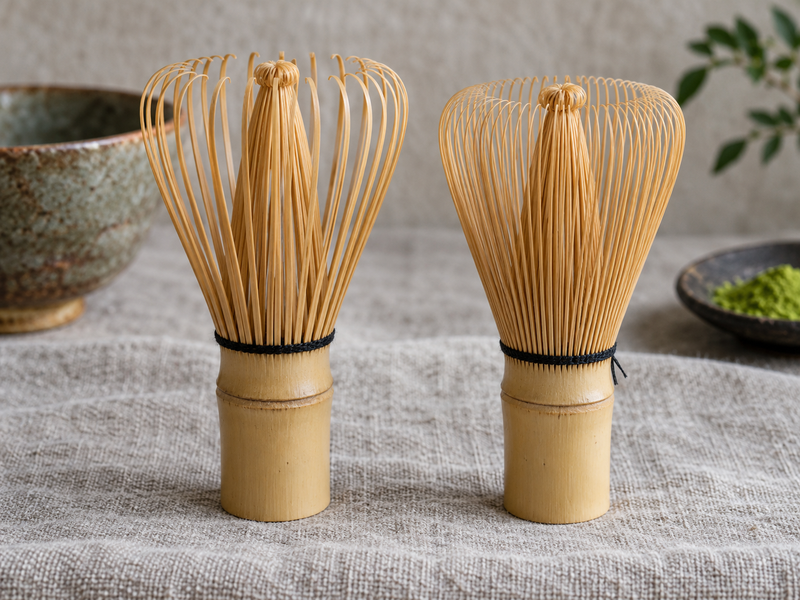
Tine count describes how many bamboo strips form the whisk head, but it does not fully describe their thickness, shape, flexibility, or durability. Two “80-prong” products can behave differently because the handle, splitting, curl, and overall diameter differ. Ask the supplier how the count is defined and verify a sample visually. Do not assume that 120 is categorically better than 80. Test count alongside the bowl, dose, and whisking style you actually use.
If a menu offers both a light frothy usucha and a thicker concentrate, compare at least two designs under controlled conditions. Keep matcha, water, operator, and bowl the same. Record preparation time, visible clumps, texture, and ease of cleaning. A lower-count whisk may be easier to handle for one preparation, while a finer head may suit another. The conclusion belongs to the trial, not the product label.
| Whisk feature | What it may affect | How to verify |
|---|---|---|
| Advertised tine count | Head density | Inspect actual sample |
| Tine thickness | Flex and contact feel | Prepare same recipe |
| Outer diameter | Bowl clearance | Measure against inner opening |
| Handle shape | Staff grip | Two-operator trial |
3. Does the whisk fit the chosen bowl?
Leave space for the working stroke
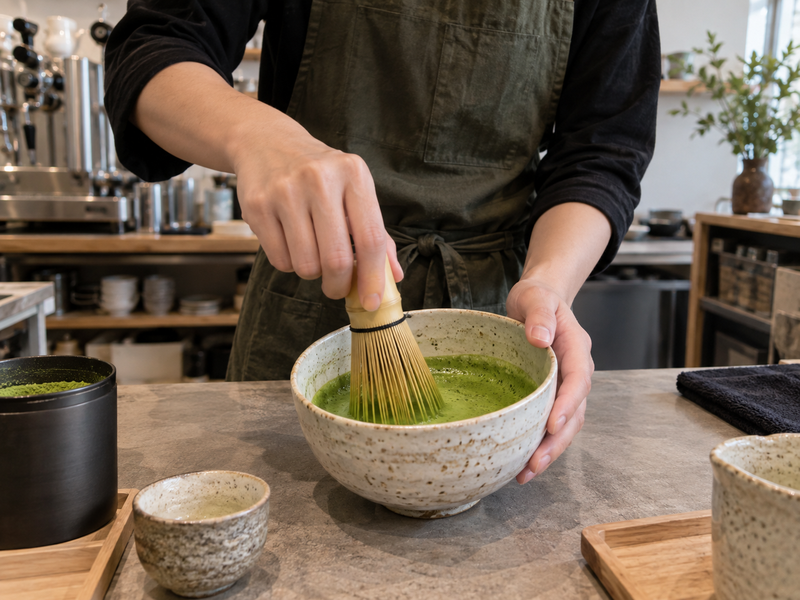
Place the whisk in the normal preparation bowl with the intended liquid amount. Move it as staff would during service. Tines should not repeatedly strike a steep wall or get trapped in a tight base curve. Measure both the whisk head’s widest diameter and the bowl’s clear working area, because a nominal rim diameter does not reveal the usable floor. A comfortable fit makes it easier for staff to reproduce the recipe without compensating for the vessel.
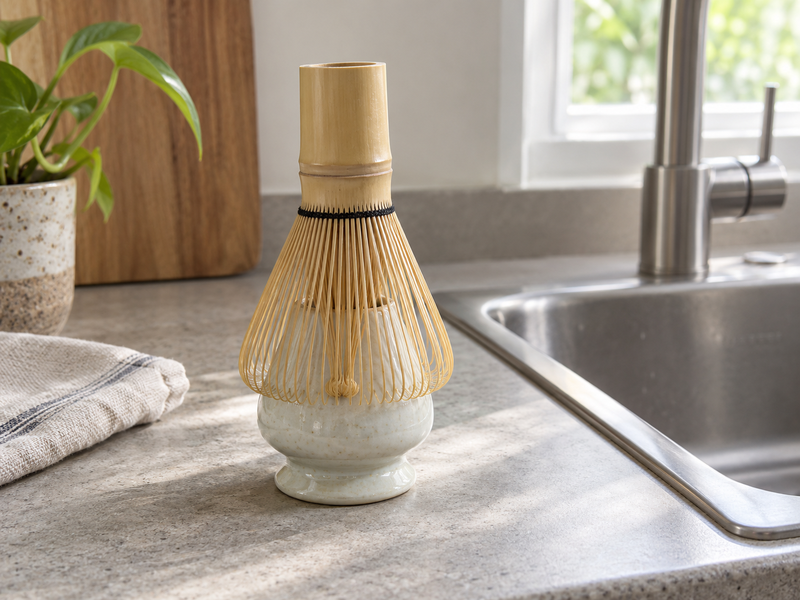
Check the match after several uses as well. Bamboo tines may spread or change shape with use, so a whisk that barely fits on day one can become awkward later. A holder, if included, must also fit without forcing the head. Photograph the successful whisk-bowl pairing with a ruler and keep that information for replacement orders. A new bowl line should trigger a new tool test rather than inheriting the previous whisk specification automatically.
4. How should you inspect construction?
Look at the parts staff will touch
Inspect several units from the supplier’s normal production. Look for split or broken tines, rough handle edges, loose binding, and obvious asymmetry that changes movement. A handmade whisk need not be visually identical to its neighbor, but functional defects should be defined. Ask where and how the whisk is made if origin will appear in marketing. “Japanese style” and “made in Japan” are different claims. Keep the maker’s exact wording and evidence rather than inferring origin from packaging.
Check how the whisk is protected in transit. Tines should not be crushed by a tight sleeve or pressed against other accessories. Open a sample carton and inspect units from the top and bottom. If a retailer sells a set, the packaging should prevent a ceramic bowl from contacting the bamboo head. Define incoming defects photographically so both buyer and supplier understand what will be rejected.
| Inspection point | Acceptable observation | Investigate when |
|---|---|---|
| Tines | Intact and usable | Broken, split, or sharply bent |
| Binding | Secure under normal handling | Loose strands or movement |
| Handle | Comfortable finish | Splinters or rough edges |
| Packaging | Head supported | Tines crushed on arrival |
5. What preparation test is fair?
Change one tool at a time
Use one matcha lot, weighed powder, measured water, the same bowl, and the same operator for initial comparison. Prepare several drinks with each candidate whisk, then repeat with a second operator. Record the time from first water addition to a defined finished appearance. Observe clumps and texture immediately and after the normal time before the drink reaches a customer. Do not assign a “foam score” without defining what the menu actually needs.
For a latte, assess the final drink as well as the concentrate. Fine foam in a small bowl can disappear under milk and ice; smooth dispersion may matter more. For bowl service, drinking directly from the chawan makes the surface and mouthfeel more visible. Ask staff which whisk feels controlled without excessive force. This is a practical trial method, not a scientific measurement of every whisk type. Keep notes so a replacement SKU can be compared later.
6. How do staff rinse and dry it?
Use the maker’s care instructions
Ask the maker for written cleaning guidance. The Ippodo chasen care instructions explain why bamboo tines need gentle handling; the care instructions for your specific product still take precedence. Train staff to rinse promptly after preparation, inspect for remaining powder, remove excess water gently, and place the whisk in its assigned drying location. Do not store it damp in a closed container or leave it standing in a bowl of water.
Commercial operations must also meet their local cleaning and sanitation requirements. The FDA Food Code is a US model reference for food-contact utensils, not an all-market permission to use a particular bamboo tool. If the product’s care limitations conflict with the operation’s approved process, select a different preparation method or utensil. A care card should be short enough to follow during service.
| Care stage | Staff action | Check |
|---|---|---|
| After whisking | Follow maker rinse guidance | No visible matcha trapped |
| Drying | Place in assigned airy position | No standing water |
| Storage | Keep away from crushing contact | Head retains usable shape |
| Inspection | Check before next drink | Broken tines removed |
7. When should a whisk be replaced?
Use condition and performance, not a universal calendar
There is no defensible fixed replacement interval for every café. Frequency of use, care, bowl surface, and the whisk’s construction all affect its working life. Set observable removal criteria: broken tines, splits, persistent roughness, a head that no longer prepares the drink to standard, or a condition that cannot be cleaned by the approved process. Train staff to report those conditions instead of quietly changing their technique to compensate for a worn tool.
Record the date each whisk enters service and when it leaves. A few weeks of data across several stations will show whether damage clusters at one bowl, one cleaning step, or one storage shelf. That may reveal a process problem more valuable than switching brands. Keep a spare supply so staff are not pressured to use a damaged chasen. A replacement policy grounded in observation is more credible than a promise that every whisk lasts a named number of months.
8. How many whisks does service need?
Count work, cleaning, and drying time
Observe the busiest regular interval. Count whisks actively preparing drinks, awaiting cleaning, drying, and held as spares. If one barista uses a whisk continuously, a second may be needed while the first is washed or inspected. If several stations run at once, assign tools by station to avoid an unclear clean/used status. The correct number depends on actual service flow and local hygiene procedures, not on a published ratio.
Include storage capacity in the count. Eight whisks crammed into a narrow rack can touch and bend tines. Check that each has a defined place and that clean tools are separated from used ones. If the menu has both bowl tea and latte concentrate, consider whether two whisk types are justified by the controlled trial. More SKUs increase training and replacement complexity, so the difference in service should be clear before adding them.
| Demand point | Count during busy period | Decision |
|---|---|---|
| Active preparation | Simultaneous operators | Minimum working tools |
| Cleaning cycle | Whisks temporarily unavailable | Rotation allowance |
| Drying space | Safe individual positions | Maximum practical inventory |
| Spares | Observed damage rate | Local reserve, not generic promise |
9. What belongs in a retail kit?
Pair tools that have actually been tested together
If a kit includes a bowl, whisk, scoop, and holder, test the full set. The whisk needs working clearance in the bowl and a comfortable fit on the holder. The scoop should be described as a serving tool, not a guaranteed gram measure. Include a concise preparation card with a weighed recipe example and clear care instructions, identifying what can vary by taste. Do not promise that the kit will reproduce a café drink without specifying powder and water amounts.
Package the bamboo head so it cannot be crushed by the ceramic. Show the included items plainly on the product page. State the whisk’s origin only if documented, and avoid unsupported claims about food safety or lifetime. For wholesale, ask whether replacement whisks can be purchased separately. A kit that forces customers to replace every component when one whisk wears out may create needless frustration and returns.

10. What should a supplier sample prove?
Write the decision in a repeatable scorecard
An approved sample should demonstrate sound construction, bowl fit, recipe performance, cleanability under the chosen method, suitable packaging, and predictable ordering details. Ask for several units rather than one showroom whisk. Count defects on arrival, then use the remaining units in a controlled preparation trial. Retain one unused sample for later comparison. If the supplier changes tine design, bamboo source, binding, or packaging, request another evaluation.
Calculate cost per usable whisk from purchase price, shipping, arrival defects, and observed replacement, using your own data. An expensive whisk may be justified for a particular tea service; an inexpensive one may be appropriate for a high-volume station if it meets the requirements. Neither conclusion can be drawn from tine count alone. Put the agreed specification and defect examples in the purchase order so a reorder can be inspected by someone who did not run the first trial.
| Approval field | Evidence | Recheck trigger |
|---|---|---|
| Construction | Multiple inspected samples | New production batch |
| Bowl fit | Tested preparation pair | Bowl SKU changes |
| Drink result | Standard recipe trial | Recipe changes |
| Care | Maker instructions and local process | Cleaning method changes |
| Supply | Written SKU and packaging | Vendor changes design |
FAQ
Q1. Is a higher tine count always better? No. Count is one feature; thickness, shape, bowl fit, and preparation method also affect performance.
Q2. Can a bamboo whisk make latte concentrate? Yes, if a trial shows it disperses the chosen matcha dose efficiently in the chosen bowl and staff can clean it properly.
Q3. How long should a café keep a whisk? Replace it when condition or drink performance fails the operation’s standard. Track actual wear instead of relying on a universal calendar.
Q4. Does a whisk holder repair tines? No. It can support the shape during storage, but broken bamboo must be assessed for replacement.
Q5. What is the most useful supplier question? Ask for a representative production sample, its construction and origin details, care instructions, and replacement availability.
Let the recipe choose the whisk
Select a matcha bamboo whisk by testing it with the actual bowl, powder, and service routine. Document what passes and when to replace it. That turns a delicate traditional utensil into a manageable commercial tool without overstating what any tine count can guarantee.