
Matcha baklava asks a bakery to balance tea flavor with nuts, fragile pastry layers and syrup. Adding more powder is rarely the only development decision: the nut grind, layer arrangement and syrup application all affect the finished bite. Start with one established baklava base and place matcha in the filling, where the first comparison is easiest to control.
1. What should matcha baklava look and taste like? · 2. Which ingredients need the closest purchasing attention? · 3. How much matcha belongs in the first nut-filling trial? · 4. How fine should the nut filling be? · 5. What keeps phyllo manageable during assembly? · 6. How should the pan be layered and cut? · 7. How can syrup be controlled without drowning the pastry? · 8. What should cooling and packaging trials measure? · 9. How should the bakery compare costs between versions? · 10. What belongs in the production handover?
1. What should matcha baklava look and taste like?
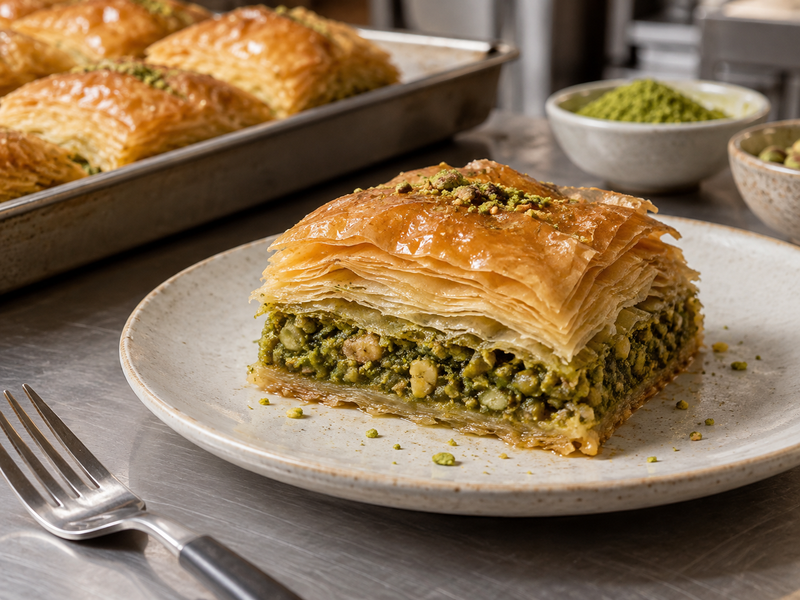
Set a cross-section target
A finished piece should show the pastry structure and a distinct nut filling. Decide how much green you want customers to see when a piece is cut. A vividly green loose filling may look much darker once surrounded by baked pastry and syrup.
The Caramelized Life’s lavender matcha baklava is one published example of tea mixed into a nut filling. Its lavender syrup is a separate flavor choice. For an initial commercial trial, leave floral flavoring out so the team can judge the matcha and nuts without another strong aroma.
Describe the intended eating experience in ordinary terms: how easily a fork cuts through, whether layers separate, and how much syrup remains on the plate. Those observations are more useful to production than a demand for premium texture.
Choose the sales format early. A small gift-box portion needs to lift cleanly without flooding its paper case. A plated dessert can tolerate a different presentation. Develop against the format the customer will receive rather than a tray that only looks good before cutting.
2. Which ingredients need the closest purchasing attention?
Keep phyllo and nuts identifiable
Order phyllo by its actual sheet size, pack format and supplier instructions. Similar-looking packs may contain different sheet counts or dimensions. A recipe based only on one packet can become unreliable when purchasing changes suppliers.
Specify the nuts by type and preparation. Whole nuts, chopped nuts and nut meal require different preparation work. If a blend is used, record each component rather than describing it as mixed nuts. This also keeps ingredient information tied to the product actually made.
| Ingredient | Record on the pilot sheet | Why it affects production |
|---|---|---|
| Phyllo | Sheet dimensions and count | Pan fit and layering |
| Nuts | Species and preparation | Filling distribution |
| Fat | Exact product | Brushing and flavor |
| Matcha | Unsweetened powder and lot | Tea comparison |
Use a matcha ingredient whose composition is clear. A sweetened blend complicates a filling that will later receive syrup.
Cost the nuts after any sorting and chopping losses. The cheapest bag may not produce the cheapest usable filling if it contains pieces that your bakery removes. Save a small sample of the approved chop beside the working instructions.
3. How much matcha belongs in the first nut-filling trial?
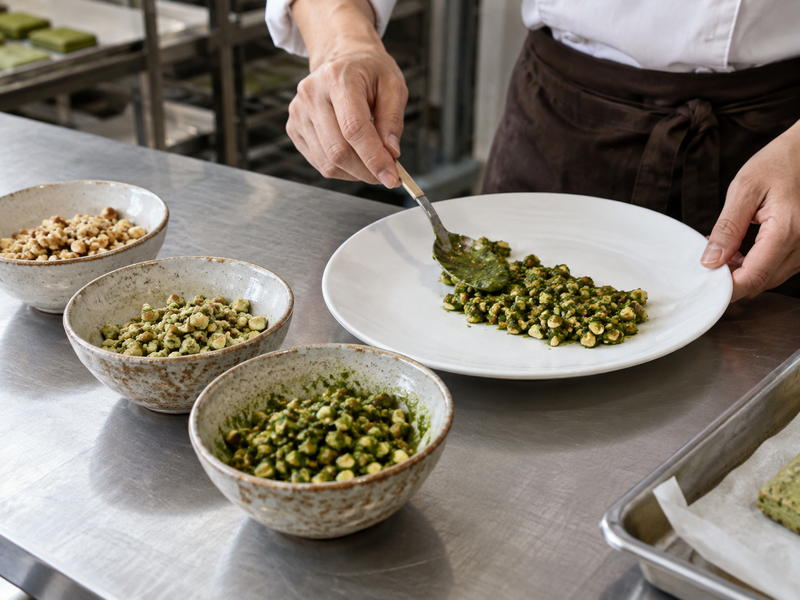
Use a narrow addition comparison
As a proposed screening exercise, compare 1, 1.5 and 2 grams of matcha for each 100 grams of the same prepared nut blend. These are unvalidated trial additions. Keep nut composition, syrup and pastry structure unchanged while tasting the results.
Sift the matcha and distribute it through the nuts before layering. Scrape the bowl and examine a spoonful spread thinly on a white plate. A green pocket can create a sharply different bite even when the average dose is modest.
Make a plain nut-filling control in a separate marked pan or clearly separated trial portion. The control shows what the matcha contributes after baking and syrup application. Do not compare a freshly assembled tea batch with an older plain batch that has absorbed syrup for longer.
Use equal-size finished pieces for tasting. Ask the team to describe tea presence, nut flavor and any drying or bitter finish. If the strongest sample tastes less balanced, record that result without assuming a more expensive tea would automatically solve it. First confirm the dose and the base recipe are appropriate for the intended customer.
4. How fine should the nut filling be?
Compare particles inside a baked slice
A finely processed filling and a visibly chopped filling produce different cross-sections. Choose the one that suits your bite and cutting requirements. Avoid processing a large batch continuously while waiting for every piece to become identical; inspect the mixture frequently and keep the intended texture in view.
Prepare two small chop styles from the same nut supply for a focused comparison. Hold the matcha addition constant. Once baked and finished, examine whether the filling stays in place when a portion is lifted.
| Filling observation | What it may mean for service | Next check |
|---|---|---|
| Large pieces fall out | Untidy transfer into cases | Chop consistency |
| Dense compact layer | Heavy bite | Filling depth |
| Tea appears in pockets | Uneven blending | Premixing method |
| Cut edges crumble | Portioning losses | Particle size and cutting |
Do not judge the grind only by a photograph of loose nuts. The useful test is the finished piece handled with the utensil staff will use.
Record how the processor was loaded and how the operator checked progress. A small development bowl and a large production bowl may need different handling to arrive at the same visible particle distribution.
5. What keeps phyllo manageable during assembly?
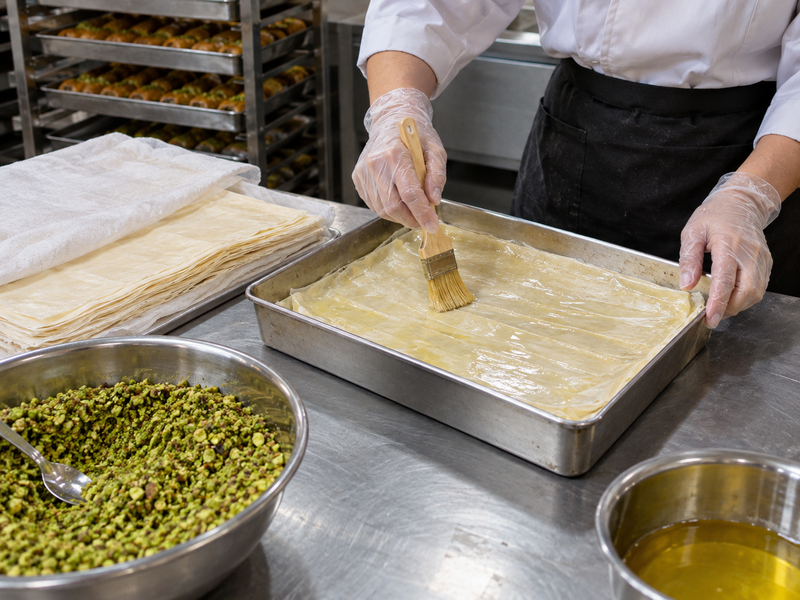
Prepare the bench before opening the pack
Have the pan, measured filling, fat and brush ready before exposing the pastry sheets. Follow the phyllo supplier’s thawing and handling instructions. A worker searching for a missing brush while sheets sit uncovered introduces avoidable handling variation.
Athens Foods’ phyllo method covers unused sheets with plastic wrap and a slightly damp towel. That is a useful manufacturer example of protecting the stack during assembly. Follow the instructions for your specific product rather than assuming every pastry behaves alike.
Trim sheets to the intended pan with a planned use for suitable offcuts. Keep the top presentation layers separate from pieces designated for inner layers during the pilot. If the team uses damaged sheets, document where they go instead of leaving the choice to whoever assembles the tray.
Apply fat consistently according to the established base method. Watch for pools at the pan edge and dry-looking patches on broad areas of pastry. The aim of the pilot is a repeatable arrangement, so record sheet counts and filling placement as the tray is built rather than reconstructing them from memory afterward.
6. How should the pan be layered and cut?
Map the tray before adding filling
Use a written layer plan based on your proven baklava base. Count sheets in small groups as they are placed, and weigh the filling allocated to each layer. A full bowl disappearing into one tray is not enough information to reproduce the same depth next time.
Mark the intended portion layout before cutting. Check the size of edge pieces as well as center pieces. Diamond cuts can look attractive but may create portions that differ enough to complicate fixed-price gift boxes.
| Layout choice | Pilot check | Commercial decision |
|---|---|---|
| Filling placement | Even depth across the tray | Repeatable distribution |
| Top layers | Clean cut appearance | Presentation standard |
| Portion pattern | Center and edge sizes | Saleable piece count |
| Pan dimensions | Fit with pastry sheets | Trim and labor cost |
Use a sharp suitable knife and the cutting stage specified by your chosen base method. Keep the pastry stable instead of dragging layers out of alignment.
Retain photographs of the tray before baking and after portion removal. They show whether the planned cuts translated into saleable pieces, including corners that may need a separate serving use.
7. How can syrup be controlled without drowning the pastry?
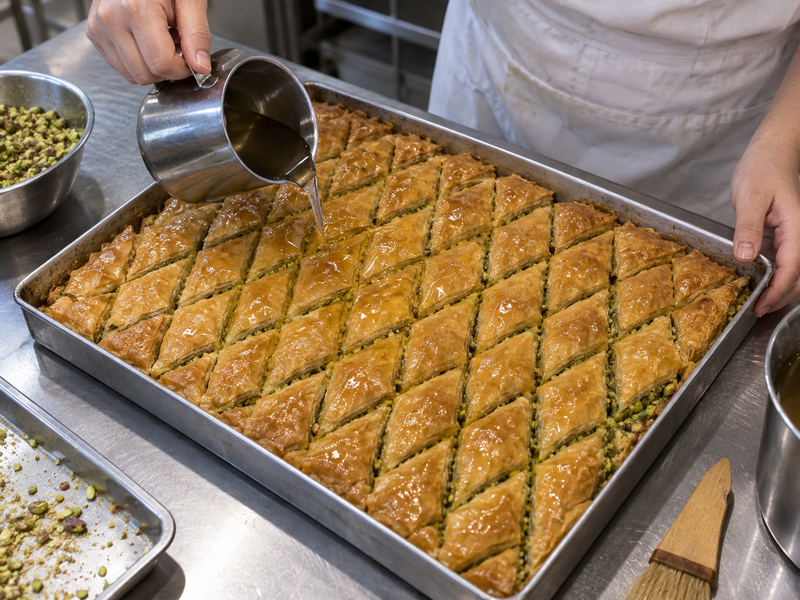
Measure the application, not just the syrup pot
Prepare syrup from an established recipe and keep its identity fixed during the tea trial. The relevant record includes the amount actually applied to the tray. Weigh the application container before and after use so residue in the pot does not disappear from the calculation.
Follow one defined finishing method for the pastry and syrup conditions. Published baklava recipes use different sequences; choosing bits from several methods can make the result difficult to interpret. Test any change separately.
Observe where the syrup collects and whether all portions receive similar exposure. A tray sitting on an uneven bench may produce different edge and center pieces. Photograph the base of a lifted portion as well as its attractive top.
For a proposed follow-up comparison, reduce or increase your established syrup application by a small documented amount while keeping the recipe itself unchanged. The size of that adjustment should come from the chef’s baseline. Judge the finished pieces at the same assessment point, since comparing one immediately and another much later confuses absorption with formulation.
A syrup trial is a texture study. It does not by itself establish shelf stability or a permitted unrefrigerated sales period.
8. What should cooling and packaging trials measure?
Lift a portion into the real case
Follow your approved cooling and handling plan, then transfer portions with the tool intended for service. Note whether the base stays together, the nut layer slides or the top shatters. These are practical release criteria for a product sold by the piece.
Test paper cases and tray inserts with finished syrup-treated samples. A case that looks suitable with dry pastry can soften or stain after contact with the actual product. Ask packaging suppliers for suitability information for the intended conditions.
| Pack check | Observation | Reason to change the pack |
|---|---|---|
| Base support | Piece bends during lifting | Insufficient stiffness |
| Grease or syrup marks | Visible staining | Poor presentation |
| Headspace | Top layers touch the lid | Flake damage |
| Separation | Neighboring pieces stick | Difficult serving |
Evaluate packaging after the expected handling route, within approved food-safety conditions. Do not translate a home recipe’s room-temperature advice into a commercial expiry statement.
Any shelf-life decision needs the final formulation, process and packaging. Matcha, syrup and nuts do not independently guarantee the safety or keeping quality of the assembled dessert. Keep the launch specification open until the required validation is complete.
9. How should the bakery compare costs between versions?
Use saleable portions as the denominator
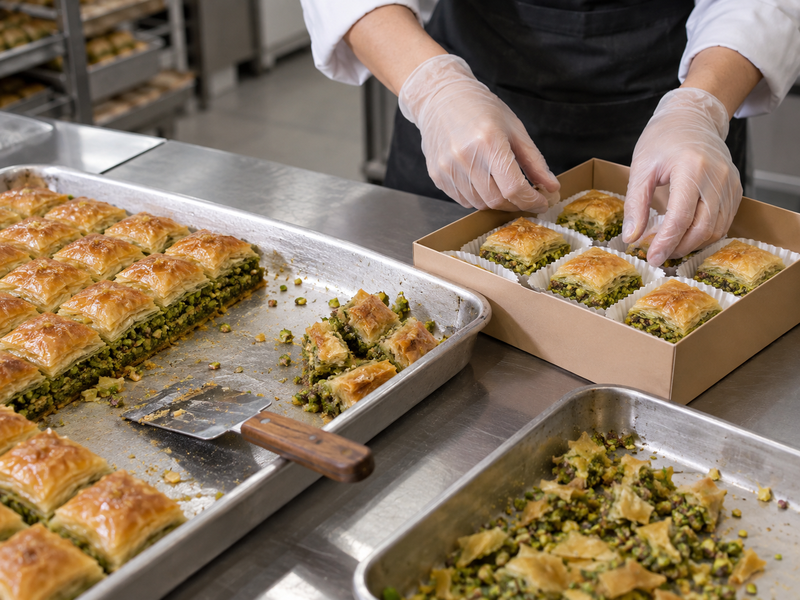
Record pastry trim, nut preparation losses, syrup residue and broken portions. Add assembly and cutting time. Baklava contains several small repeated operations, so a change that saves ingredient weight can still increase total labor.
A hypothetical tray costing 36 currency units and producing 30 acceptable portions has a direct cost of 1.20 per portion. If a more elaborate cut leaves only 24 pieces suitable for the planned box, the same tray costs 1.50 per saleable piece. Those figures are arithmetic examples, not price benchmarks.
Compare nut blends on both flavor and usable yield. A stronger tea addition should not be used merely to conceal a nut supply the team already finds unsuitable. Record the reason for selecting each ingredient so future purchasing changes can be evaluated against the same brief.
For matcha inquiries, provide the proposed nut composition and baked sample notes. The site’s culinary matcha guide can support the discussion with Matcha Village. Ask for a Chinese matcha option tested by your bakery in this filling, at the intended dose and with the chosen syrup.
10. What belongs in the production handover?
Give the next operator the tray plan
The handover should include the pan, pastry sheet count, filling distribution, cut pattern and syrup application method. Photograph a finished slice showing its layers and a packed portion showing the intended presentation. Those references let another worker compare structure, not merely color.
Keep optional lavender, citrus or other flavoring as a separate version until approved. Adding a floral syrup on a busy shift changes the product’s flavor and ingredient information even if the matcha filling is unchanged.
| Handover record | What it prevents | Confirmation |
|---|---|---|
| Sheet and layer count | Different pastry-to-filling ratio | Assembly tally |
| Nut preparation sample | Uncontrolled grind changes | Visual comparison |
| Syrup application weight | Unequal finishing | Recorded delivery |
| Portion and pack sample | Variable saleable yield | Closed-box check |
Review allergen information across nuts, pastry and fat. Vegan or other claims must follow the complete selected recipe and its supply documentation; they cannot be borrowed from the inspiration recipe.
Before committing to a large order, have a second operator build one tray from the written plan alone, then compare the corner, edge and center portions after packaging.
FAQ
Q1: Does matcha belong in the syrup?
It can be studied as a separate version, but a nut-filling addition makes the first tea trial easier to compare against an established baklava base.
Q2: Must lavender be included?
No. It is a flavor choice in the reference recipe. Begin without it if you want to understand the tea-and-nut combination.
Q3: Can any pack of phyllo replace the approved one?
Check sheet size, count and handling instructions. A different pack can change the layer plan, trim and finished yield.
Q4: How should matcha dosage be chosen?
Use small comparative batches and taste finished pieces with syrup. Powder color alone cannot determine the preferred dose.
Q5: Does a high sugar content prove shelf stability?
No. Establish storage conditions and shelf life for the complete commercial product through appropriate validation.