
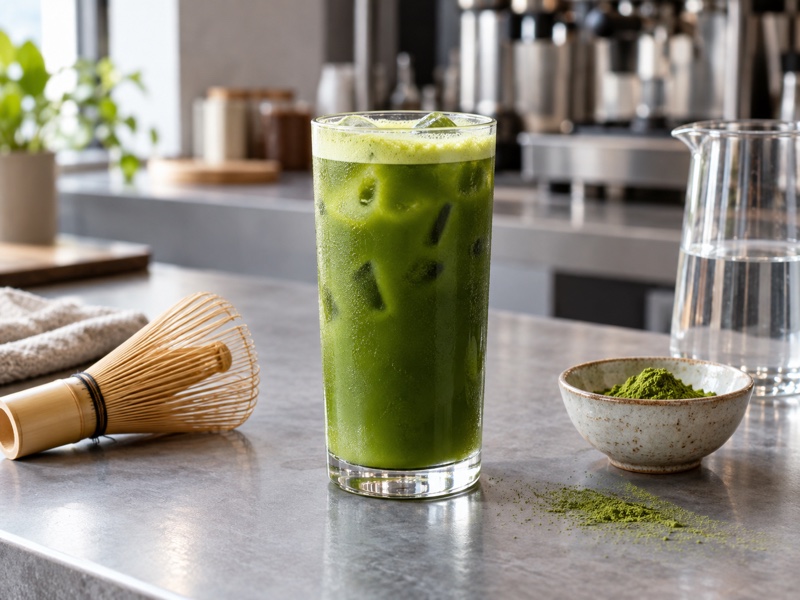
A matcha americano is matcha whisked with water and served as a longer, often iced drink without milk. A café has little sweetness or dairy to cover poor powder, clumps, or stale water. The practical route is to specify a drink profile and run a controlled service test with the exact water, ice, cup, and tool staff will use. The iced matcha americano example from My Vegan Minimalist reflects consumer interest in an airy, refreshing build. A commercial menu also needs a repeatable tea dose, a clear naming convention, and acceptable flavor through the last sip.
1. What should “americano” mean on this menu?
The term borrows the long-drink idea from coffee, but customers may interpret it differently. Some expect only matcha and water. Others assume espresso is present because “americano” usually appears on a coffee menu. Put the actual ingredients in the menu description and train staff to explain them. If you choose to include espresso, treat that as a separate drink with its own flavor and caffeine assessment. For a pure matcha version, the selling point is a direct tea taste at an approachable concentration.
Define hot and iced versions separately. Ice changes dilution while a hot drink changes aroma and how quickly powder settles. In an iced cup, the green foam and suspended powder provide the visual. A long clear cup may show a natural settling line after a wait; decide how much is acceptable and whether staff should advise a quick stir. Do not promise perfect “clarity” in the sense of a filtered liquid, because matcha is a suspension of fine tea particles.
| Menu decision | Choice to document | Guest-facing effect |
|---|---|---|
| Ingredients | Tea and water, or tea plus coffee | Avoids name confusion |
| Temperature | Iced or hot | Changes dose and dilution |
| Sweetness | Plain or optional syrup | Preserves tea profile |
| Serving cup | Clear cup or opaque vessel | Changes visible settling |
2. Which matcha deserves a place in an unsweetened drink?
Taste candidates in water, not only in a latte. Dairy can soften astringency that becomes obvious in a long unsweetened cup. Ask for pure matcha, a current lot sample, ingredient statement, and relevant quality documents. Compare powders blind at the same dose and water conditions. Judge aroma, vegetal sweetness, umami, bitterness, mouthfeel, and the aftertaste after a few minutes. A bright dry powder that tastes rough in the finished drink should not pass on color alone.
Matcha Village names premium and ceremonial options as sampling points for straight drinks. Those labels are useful for screening, but a grade name is not an independent sensory standard. The winning lot should match your menu’s desired intensity at a workable cost per cup. Keep a retained approved sample so a later delivery can be prepared next to it. Whisk both with the same water and service tool before deciding whether a difference is material.
3. How much matcha and water should the test use?
Build a small dose matrix. Choose one tea amount, then compare two final water volumes; choose one water volume, then compare two tea amounts. This separates dilution from powder quality. Weigh both components. A barista scoop can drift when powder compacts or a different employee levels it differently. Write the final serving mass, because an iced cup with more ice has less liquid even if it looks equally full. Record tasting notes immediately and after the normal customer pickup interval.
Do not chase a very dark green cup solely for photographs. More powder can increase sediment and make an unsweetened drink feel heavy. A lighter concentration may suit customers seeking a refreshing tea, while a smaller concentrated serving can support a premium tasting experience. Put those concepts under different menu names if both are offered. For a pilot, choose one clear target and make it repeatable before adding customization. This is especially relevant to chains comparing units with different cup and ice equipment.
| Trial | Tea | Final water | Question |
|---|---|---|---|
| A | Baseline | Baseline | Reference taste |
| B | Same as A | More | Is the cup too thin? |
| C | More | Same as A | Does intensity improve? |
| D | Less | Same as A | Is the lighter drink more refreshing? |
4. Does water quality change the taste?
Yes, water makes up most of this drink and can carry its own flavor. Test with the filtered or treated water each store actually dispenses. Compare that water against the development kitchen’s source in matched, coded cups. A powder that seems clean in one location can taste flat or sharp in another. Record water temperature used for initial dispersion and the temperature at handoff. Avoid assuming one universal temperature is best for every powder; a gentle warm-water whisk may disperse it more easily, while excess heat can produce a harsher sensory result.
Standardize store water
Water also changes the operating procedure. If a café uses a small warm concentrate over ice, measure the concentrate and final water separately. If staff whisk with cold water, test whether lumps or a chalky mouthfeel increase. Include ice made from the same approved water source in the tasting, since melting ice becomes part of the recipe. A one-site lab test cannot establish chain consistency if water treatment differs across outlets.
5. How should matcha be mixed for speed and texture?
Compare a bamboo whisk, electric frother, shaker, and approved café mixing tool under real order volume. Each introduces a different amount of air and may leave a different sediment pattern. The whisk can produce attractive surface foam, but it requires a wide vessel and a cleaning routine. A shaker may blend quickly yet make larger bubbles that disappear before handoff. An electric tool may splash a small concentrate or heat the mixture if operated too long. Pick the method that delivers the desired cup reliably, not the most theatrical demonstration.
Specify powder into liquid or liquid onto powder, vessel shape, mixing duration, and a visual endpoint. Check the bottom of the vessel for undispersed green paste before pouring. If a batch concentrate is allowed, compare the first and last servings drawn from it and define remixing. The service sheet should be short enough to survive a busy bar while precise enough that two employees produce comparable foam and flavor.
| Tool | Best pilot observation | Potential issue |
|---|---|---|
| Bamboo whisk | Fine surface foam | Training and cleaning |
| Electric frother | Fast single serving | Splashing or inconsistent air |
| Shaker | Closed, quick mixing | Coarse bubbles |
| Batch vessel | High-volume prep | Settling between pours |
6. How much ice belongs in the iced version?
Weigh ice or use a calibrated scoop and measure its melt under the expected service wait. “Fill cup with ice” changes from employee to employee and makes dose comparisons meaningless. Prepare identical matcha concentrate for cups with low, standard, and high ice loads. Measure the actual liquid available at handoff and taste after several minutes. More ice can hold a drink cold longer but leaves less beverage in the cup; less ice can dilute faster as it melts and warm during delivery. Cup shape matters too.
If a customer asks for light ice, train staff whether water replaces the missing volume or the cup is served less full. Either choice changes concentration or perceived value. Record a policy and price it accordingly. A clear matcha drink gives customers an unobstructed view of fill level, floating foam, and sediment, so visual consistency matters. Use the same cup and lid during testing, including a straw or sip opening that does not scoop all foam off the top.
7. Why does the drink separate or settle?
Matcha consists of ground leaf particles suspended in water. Some settling is normal. The operational question is how quickly it becomes objectionable in your recipe and service route. Photograph a poured drink at handoff and at the longest expected pickup time. Look for large clumps at the bottom, a clear upper layer, and coarse material on the tongue. If a simple stir restores the drink, that may be acceptable for an in-store cup; a bottled product needs a separate technical development path.
Do not describe the drink as “fully dissolved” or “filtered clear” if powder remains in suspension. Finer powder and better dispersion may improve the experience, but a transparent cup can still show gradual separation. Test alternative mixing methods before adding gums or sweeteners, which would change the clean unsweetened proposition. An iced americano can be straightforward to make only when staff know what a normal settled cup looks like and when a lumpy cup should be remade.
| Observation | Possible cause | Trial response |
|---|---|---|
| Green clump | Poor premix | Change mixing sequence |
| Rapid clear layer | Settling or dilution | Compare powder and ice |
| Chalky final sip | Coarse particles or high dose | Blind powder and dose test |
8. Should the café offer syrup or flavored versions?
Offer sweetness as a deliberate option, not a quiet default. An unsweetened drink lets tea character lead and makes the menu simpler. Syrup may increase accessibility for some customers but can conceal weak powder or create an uneven first sip if poured after mixing. Test the proposed syrup in the fully iced cup. Record syrup type and mass per pump, because “two pumps” differs by dispenser. For fruit or citrus versions, check the combined flavor and color; acid can make the green appear dull or the tea taste sharper.
Keep menu versions distinct
If an americano menu includes both plain and sweet variants, name them clearly. A customer ordering plain should not receive a sweetened matcha blend or premix. Keep the ingredient declaration from any purchased blend accessible to staff. When communicating caffeine, avoid promising a number from powder weight alone unless the specific ingredient and finished serving have been tested or calculated from reliable data. The product’s main value is taste and refreshment, not an unsupported wellness claim.
9. What does a chain need from its supplier?
Request lot-level specification, ingredient identity, sample availability, packing format, and documents appropriate to the destination market. Ask the supplier to advise which grades suit water-only drinks, then test them under the chain’s actual water and ice conditions. Agree on a sensory control: the new lot prepared in the approved recipe beside an accepted lot. Color, aroma, taste, and sediment should be judged together. A single dry-powder photograph cannot protect menu consistency.
Consider service packaging as well as bulk price. A 1 kg pack can suit a busy shop but may expose powder repeatedly in a slow outlet; a smaller sealed format may reduce waste there. Matcha Village supports bulk and sample requests for B2B buyers. Ask for the information your quality team needs before approving a shipment, rather than assuming every grade has the same certifications or test results. Confirm any market-specific claim against the actual lot documents.
| Buyer question | Evidence | Commercial effect |
|---|---|---|
| Does it taste right in water? | Coded cup tasting | Menu approval |
| Can stores repeat the mix? | Line trial | Training and labor |
| Does the pack fit turnover? | Open-pack use test | Waste |
| Are documents available? | Lot-specific supplier records | Import and release |
10. What should the launch gate look like?
Run the final candidate in several ordinary shifts. Include a new employee, a rush period, and a drink that waits for pickup. Compare each cup with an approved reference for dose, foam, taste, fill, and visible settling. The recipe should specify when to remake a cup, especially after a green lump or large underfill. Cost tea and cup supplies per saleable serving, including rejected drinks. Then confirm the menu description accurately identifies what is in the beverage.
The best matcha americano for a café is the one that remains pleasant after the ice has started to melt and staff can make it consistently. Begin with a water-only version and one approved powder lot. If the beverage performs, add flavored variations as separate pilots. The plain cup gives buyers and customers a clear view of the tea they are paying for; it also exposes weak ingredients and loose procedures quickly.
FAQ
Q1: Does a matcha americano contain espresso? It depends on the menu. State the ingredients plainly; this guide tests matcha and water.
Q2: Is settling a defect? Some settling is natural for ground tea. Large clumps or a gritty final sip need investigation.
Q3: Can staff mix a large concentrate in advance? Only after a hold and remix test under your operating and food safety procedures.
Q4: Should the drink be sweetened? Let the menu promise guide the choice. Keep a plain version genuinely unsweetened.
Q5: Which grade should a buyer sample? Start with beverage grades suited to straight drinks, then choose by blind tasting in your water and cup.