
Mango matcha is easy to sell with a photograph and harder to serve well ten times in a row. Ripe fruit changes from delivery to delivery, purée can sink or streak, and a sweet mango base can make the tea vanish. A café needs a recipe that tastes coherent after a customer stirs it, not only one that looks good before the first sip. The Paper & Tea mango matcha recipe in current search results uses mango purée, ice, milk, and whisked matcha. That combination is a sound starting point. This guide turns the idea into a measured service test for cafés and drink developers.
1. What should mango matcha taste like?
The first sip should identify both ripe mango and green tea. Mango brings sweetness and a dense, sometimes floral fruit note; matcha brings vegetal depth and a slight savory edge. Milk rounds the join between them. If the customer can taste only fruit syrup, the drink is effectively a mango latte with green decoration. If the tea tastes bitter after stirring, a stronger powder dose is not automatically the cure. The powder, sweetness, water temperature, and fruit base all deserve a check.
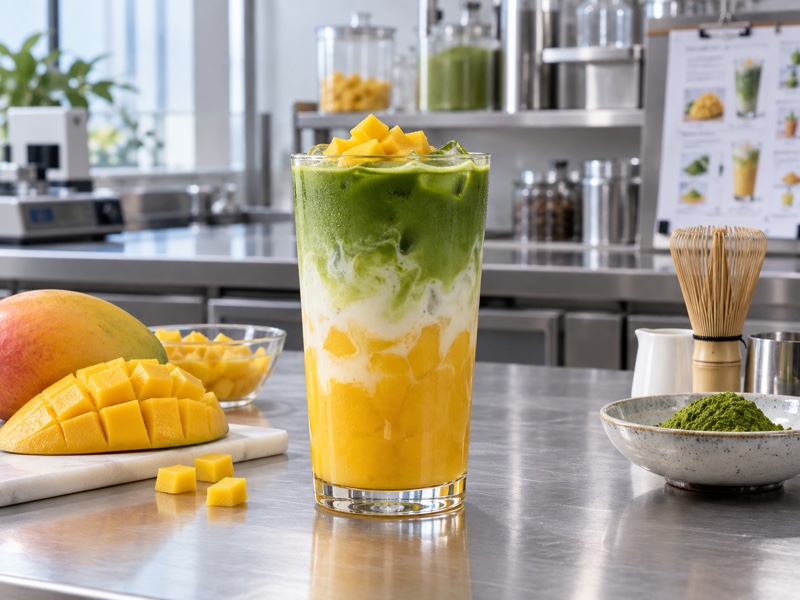
Set a brief before testing: fruit-forward with a detectable tea finish, or tea-forward with mango as an accent. Both can work, but staff cannot hit both targets from the same vague instruction. Taste the drink immediately, after five minutes of melting ice, and after it is fully stirred. The layered photograph matters for ordering; the mixed cup determines whether someone orders it again. Include people who do not already love matcha in the tasting group.
| Sensory point | Fruit-forward target | Tea-forward target |
|---|---|---|
| First aroma | Fresh mango | Matcha with light fruit |
| First sip | Mango, then tea | Tea, then mango |
| After stirring | Balanced and clean | Distinct tea finish |
| Sweetness | Clearly sweet | Moderate |
2. Which mango base works in a busy café?
Fresh diced mango, in-house purée, refrigerated commercial purée, and shelf-stable fruit preparations behave differently. Fresh fruit can be excellent when a team has time to sort ripeness and blend daily. A commercial purée may reduce preparation time and variation, but its ingredient list can include sugar, acid, stabilizers, or flavoring. Read the actual specification. “Mango” on a package front does not tell you the fruit percentage or how much sweetness the product brings to the glass.
Run a side-by-side trial with your likely supply formats. Weigh each base rather than using a ladle. Note whether pulp gathers at the bottom, whether the base pours at refrigerator temperature, and whether a straw clogs. Photograph the mixed drink as well as the layered one. If an in-house purée requires straining, include that labor and loss in the costing. A frozen purée may solve seasonality, though thawing procedure and holding life need their own controls. Choose the format that fits your service volume and cold-storage space.
3. How can a team establish a starting recipe?
Begin with one cup size and use grams for ingredients that staff can weigh, then translate the approved formula into a service tool. For a pilot in a roughly 350 ml cup, try 55 g unsweetened mango purée, 110 g milk, a tea concentrate made from 2 g matcha and 50 g water, and enough ice to fill the intended cup. This is a trial formula, not a nutritional or safety specification. If the purée is already sweetened, start without extra syrup. If a smaller cup is sold, scale the complete formula and retest its sensory balance rather than only shrinking the ice.
Make three controlled cups: one with the baseline mango, one 15 g lower, and one 15 g higher. Keep matcha and milk fixed. A blind tasting will tell you whether the extra fruit improves the drink or merely adds sugar and cost. Then adjust tea dose in a separate trial. Changing everything at once is fast at the bar and slow in development because nobody knows which change mattered.
| Trial cup | Mango purée | Matcha | Milk | Question |
|---|---|---|---|---|
| A | 40 g | 2 g | 110 g | Is fruit still clear? |
| B | 55 g | 2 g | 110 g | Does tea remain distinct? |
| C | 70 g | 2 g | 110 g | Does added fruit justify cost? |
4. What matcha powder should be tested with mango?
Taste a powder in the finished recipe, not only as plain tea. Mango and milk can soften a powder’s sharp edges, while a delicate tea can disappear behind the fruit. Ask suppliers for lot-linked samples and the product specification. Prepare each candidate at the same dose, with the same water, milk, purée, cup, and ice. Compare flavor after stirring; a photograph of bright green powder cannot answer whether it will taste balanced.
Keep a retained sample of the approved powder and document its required sensory range. If a buyer asks for “ceremonial” matcha, ask what the customer expects in the cup. That grade term alone is a weak purchasing specification. Particle behavior, flavor at the chosen dose, color after service holding, pack size, and repeat availability matter more to a café chain. A lower price per kilogram can become expensive if the powder needs an extra gram in every serving to remain audible beside mango.
5. Why do mango matcha layers mix too quickly?
Layering depends on density, viscosity, temperature, and the force of the pour. A thick mango base generally belongs at the bottom, followed by ice and milk, with the tea poured gently above. A watery mango preparation can rise in streaks, while a concentrated syrup can create an intensely sweet bottom sip. The goal is attractive separation for the short period between finishing and handoff. Do not promise that layers will survive a delivery ride or a customer’s walk to the office.
Make the tea concentrate smooth before it reaches the glass. Sift the powder if clumping is an issue, then whisk or mix with water at a consistent temperature. Pour over the back of a spoon only if that method survives a real rush. Staff may prefer a standard pitcher and pour point that gives slightly softer layers but reliable speed. Test both. Repeat with the cup material, ice size, and milk that will actually be sold. A studio glass can flatter a formula that looks muddy in a takeaway cup.
| Visible problem | Likely variable to inspect | Useful trial |
|---|---|---|
| Fruit rises immediately | Purée viscosity or pour force | Thicker base, slower milk pour |
| Green streaks through milk | Tea concentrate volume | Reduce water, keep powder fixed |
| Bottom tastes like syrup | Sweetened fruit base | Reduce base or switch format |
| Powder specks on top | Poor dispersion | Sift and whisk before pouring |
6. Which milk gives the cleanest fruit-and-tea balance?
Dairy milk, oat, soy, and coconut drinks each change sweetness, mouthfeel, and allergen statements. Coconut can flatter mango but may dominate a mild matcha. Oat drinks often bring their own cereal sweetness. Soy can add body without the same fruit association. Test the products you can reliably buy, not an abstract milk category. Two oat drinks with different sugar or fat levels can behave less alike than an oat and dairy sample.
For the pilot, compare milks at the same weight and temperature. Taste with the layers intact and after stirring. Record separation, perceived sweetness, and whether the milk dulls the green layer. If plant-based options carry a surcharge, explain it on the menu and cost it explicitly. Allergen handling should follow the café’s existing process; staff need a clear method for shared pitchers, blenders, and utensils. A “dairy free” or “vegan” claim depends on the complete recipe and service controls, including the fruit base and toppings.
7. How should mango matcha be prepared during service?
The service specification should fit on one bar card. State cup size, fruit weight, ice fill, milk weight, powder weight, water weight and temperature range, mixing method, pour order, and topping. A new staff member should be able to make the approved drink without watching the developer’s hands. Measure prep time over several orders, including one during a real queue. If fruit purée must be shaken or stirred before every pour, that step belongs on the card.
Separate safe batch prep from final assembly. A café might prepare a measured matcha concentrate for short service periods, but the holding time needs validation in its own cold-handling system. Once the tea has been mixed with water, the clock and storage conditions differ from dry powder. Similarly, a house fruit purée has its own date mark and handling plan. Keep raw or unwashed fruit away from ready-to-serve ingredients. Ask the food-safety lead to approve preparation and holding rules for the market and site.
8. What changes after the cup sits for ten minutes?
Ice melt dilutes tea and fruit, and the glass loses its sharp layers. That is normal; a successful formula should still be pleasant. Make a fresh control, then hold one sample for five minutes and one for ten in the actual cup. Weigh the ice before filling and, if practical, after a defined hold. Taste both with a straw from top and bottom before stirring, then mix and taste again. This exposes a common problem: an attractive top half and a dense, overly sweet bottom.
For takeaway, test a lid and straw together. A straw that ends in the bottom purée gives the customer a different first impression than a wide mouth sip. If the drink is delivered, test travel and temperature under the expected route before adding it to delivery menus. A drink that works only in a clear glass at the counter can still be valuable as an in-store special; it should be marketed honestly for that service mode.
| Check time | What to record | Possible decision |
|---|---|---|
| At handoff | Layers, cup fill, first taste | Service appearance |
| Five minutes | Melt, color, sweetness spread | Ice or concentrate change |
| Ten minutes | Mixed flavor and temperature | Takeaway suitability |
| After travel trial | Leak, separation, straw experience | Delivery listing |
9. How can a café cost the drink without hiding waste?
Cost every saleable cup from the approved formula. Include fruit purée yield after any straining, matcha at the actual gram dose, milk, syrup, garnish, ice, cup, lid, straw, and prep labor. If a special fruit base expires before the next delivery, allocate the waste to the menu item. Calculate price from a realistic sales mix rather than the cheapest possible purée and a perfect no-waste week.
Run a small sensitivity check. How does the cost per cup change if the powder price rises, the purée yield falls, or staff add an extra scoop? A recipe that uses exact weights can absorb supplier changes more intelligently than one built from “a splash.” For a multi-site business, add pack size and lead time to the purchase brief. The lowest ingredient quote is of little use if half the purée spoils at a slow location or matcha deliveries arrive after a menu promotion begins.
10. When is a mango matcha ready for the menu?
Approve a cup when people outside the development team can make and sell it consistently. Give the card to staff on another shift, compare five cups, and weigh the expensive ingredients. Ask tasters to identify the fruit and tea after the drink is stirred. Check the menu description against the actual ingredients. If the base is flavored syrup with little fruit, do not call it a fresh mango drink. If a cup contains dairy, its menu and allergen information must say so.
Launch with a small window of observation. Log orders, remakes, complaints about sweetness, and the amount of fruit base discarded. Keep a photo of an approved cup, but use tasting notes and weight records to decide changes. If customers enjoy the flavor yet repeatedly leave dense purée at the bottom, revise viscosity or portion before increasing the tea dose. The next useful action is a three-cup trial with your actual mango supply and matcha lot; the photograph can wait until the recipe holds up.
FAQs
Can frozen mango be used? Yes, if the fruit is handled safely and blended to a repeatable purée. Record thawing, yield, and holding rules for the prepared base.
Does mango matcha need added sugar? It depends on fruit ripeness and whether the purée is sweetened. Taste the complete drink before adding syrup.
Can matcha be blended directly with mango? It can, but the drink loses its distinct layers and may need a different powder dose. Treat it as a separate recipe.
Why does the tea taste bitter beside sweet mango? Check powder dose, water temperature, and the finished mixed cup. More sugar may mask the issue without fixing it.
Is this drink suitable for delivery? Only after a route trial shows that its taste, temperature, packaging, and appearance meet the café’s target.