
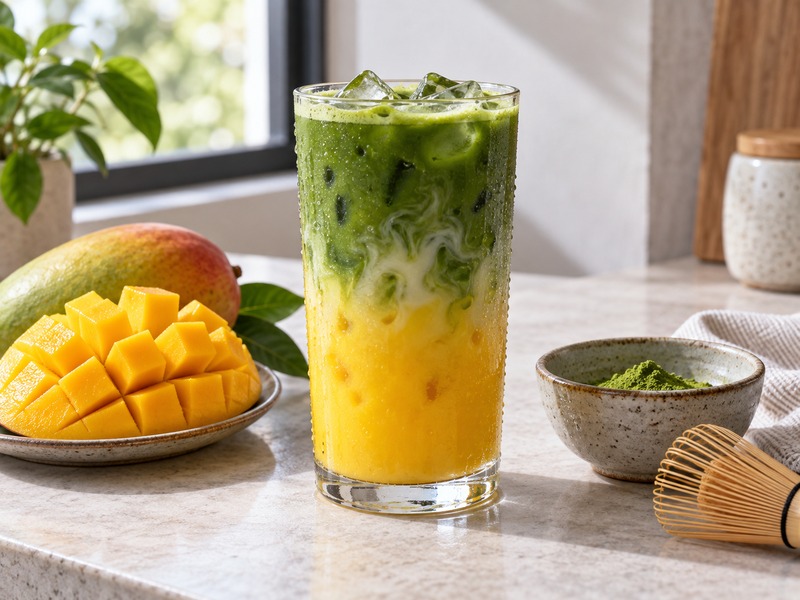
Mango matcha combines fruit, milk and matcha in one glass. The vivid yellow and green layers catch attention, but a café should judge the drink after the photograph: is the mango still clear, does the tea taste like tea, and can staff build it during a queue? Paper & Tea’s iced mango matcha latte demonstrates the home-drink concept with mango purée, milk, matcha and water. A commercial version needs controlled fruit solids, portioning, service method and shelf-life decisions.
This guide is for beverage developers, café operators and ingredient buyers. All formulation suggestions are pilot starting points; the final recipe and food safety plan must be validated for the actual ingredients and market.
1. What should a mango matcha taste like?
Set a sensory target before choosing ingredients
The product should offer recognizable mango aroma and a matcha finish, not two unrelated flavors that happen to share a glass. Mango brings sweetness and acidity. Milk softens both, while matcha contributes tea aroma and slight bitterness. Write a short target description for each phase: fruit taste at the start, balanced tea in the middle, and no chalky or sour finish. Decide whether a customer should stir the drink or enjoy the layers in sequence. A product that tastes balanced only after vigorous stirring needs instructions or a different build.
Use the whole glass. Taste at handoff, after several minutes, and after the expected takeaway interval. A tall glass can preserve attractive stripes while leaving dense purée at the bottom. If most fruit remains below the straw, the guest may drink sweet fruit first and diluted matcha last. Record both appearance and flavor by sip position. Compare with a stirred sample so the team knows whether visual layering helps or hurts the intended drinking experience.
| Target | At handoff | After stirring |
|---|---|---|
| Fruit | Clear mango aroma | Present without jammy sweetness |
| Tea | Distinct green layer | Still recognizable beside fruit |
| Texture | Smooth, pourable phases | No pulp clumps or dry matcha |
2. Which mango input works for a café line?
Compare fresh fruit, purée and concentrate in service
Fresh mango can make a lively bench drink, yet ripeness, trimming yield and labor vary by delivery. A chilled purée can simplify portioning if its solids, acidity, sugar and pack size are consistent. Concentrate may reduce storage volume but needs a careful dilution and flavor trial. Ask for ingredient statements and lot specifications rather than relying on a generic “mango” description. Some commercial purées already contain sugar or stabilizers, which changes the recipe and the label.
Weigh the usable portion. Test the fruit input at the same finished-cup target, not equal spoonfuls. Record viscosity, pour time, settling and waste from an opened pack. A thick purée may hold an attractive bottom layer but resist drinking through a narrow straw. A thin one may disperse into milk before the cup reaches the counter. Include the intended storage and use plan in the comparison; a technically good fruit pack is poor value if an individual store discards half of it at close.
| Fruit input | Strength | Main check |
|---|---|---|
| Fresh mango | Fresh texture and flexible flavor | Ripeness and prep yield |
| Chilled purée | Faster measured service | Open-pack handling and viscosity |
| Concentrate | Compact inventory | Dilution accuracy and cooked notes |
3. What matcha profile survives mango and milk?
Taste the tea in the final formula
Mango can dominate a delicate powder. Stronger tea may hold its identity but taste harsh if the customer reaches a concentrated matcha layer near the end. Prepare candidate powders at a fixed mass per serving, with the same water and fruit batch. Taste each alone and in the completed drink. Avoid deciding from dry-powder shade; hydrated matcha seen through milk and yellow fruit can look different. Ask suppliers for traceable samples and specifications appropriate to the buying program.
Calculate cost at the accepted dose. A cheaper powder that requires substantially more grams per serving may not save money. Also inspect whether it disperses smoothly enough for a rush-hour station. One pilot should include powder from a second lot if available, because the menu’s color promise will be judged against real repeat supply. Retain a photo and sensory reference from the accepted glass. Staff should not compensate for a weak lot by adding an unmeasured extra scoop.
4. Which milk gives the right body and appearance?
Choose for the drink, not the milk trend
Dairy milk, oat drink, soy drink and coconut drink can each work, but they change sweetness, body, allergens and how quickly the layers mix. A heavily flavored plant drink may bury the mango. A thin milk may let fruit rise in streaks; a thicker one may make the cup seem like a smoothie. Decide whether the beverage is meant to be light and refreshing or closer to a dessert latte. Test each milk with the chosen fruit and matcha rather than treating milk as a plug-in substitute.
Check label and service reality. If stores offer more than one milk, write separate recipes where the volume or sweetness needs adjustment. Train staff to distinguish dairy and non-dairy utensils according to the operation’s allergen-control plan. Photograph the finished cup in the proposed transparent vessel; a milk that tastes good may obscure the yellow-green contrast the product depends on. A blind tasting alongside the visual check prevents the team from choosing a weak drink because it photographs well.
5. How should the layers be assembled?
Use density without relying on luck
Paper & Tea’s consumer example places mango purée first, then ice, milk and matcha. The sequence provides a useful prototype, but ingredient density and ice shape vary across commercial formulas. Test the chosen purée and milk at the actual serving temperatures. Pouring matcha rapidly into the center can puncture the milk layer. Pouring too slowly may make the station impractical. Define a measured pour location and sequence that a new barista can reproduce without a special camera angle.
Time a normal service build. Stage the purée, milk and matcha exactly as a store would, then prepare several drinks in a row. Watch for purée stuck in a pump, dry matcha at the bottom of a mixing vessel or melted ice while staff wait for a layer to settle. A controlled training photograph should show both an accepted glass and an unattractive but drinkable one. That distinction helps stores decide whether to remake a cup or serve it after a simple stir.
| Build step | Standardize | What it prevents |
|---|---|---|
| Fruit dose | Gram or calibrated pump | Variable sweetness |
| Ice | Fill line and shape | Unpredictable dilution |
| Milk | Volume and temperature | Poor contrast |
| Matcha | Dispersion and pour point | Clumps or broken layers |
6. What can go wrong during a busy service?
Diagnose the component before changing the recipe
Three common failures are weak tea, inaccessible fruit and a cloudy blended appearance. Weak tea may come from dose, powder selection or excessive ice melt. Fruit stranded at the bottom may reflect purée viscosity or straw design. Cloudiness may come from a thin fruit input or a forceful pour. Treat these as separate process problems. Changing everything at once makes it impossible to know why the next glass improved.
Keep a defect log. Photograph failed drinks at the same elapsed time after preparation. Ask staff to note the ingredient lot, glass, ice quantity and who assembled the cup. Include drinks that look good but receive taste complaints. A stable layer is not an acceptable result if the last third tastes like concentrated mango paste. Conversely, a slightly blurred layer may be fine for a delivery product if flavor and texture remain balanced. Use the intended sales channel to set the acceptance rule.
| Symptom | First variable to inspect | Trial response |
|---|---|---|
| Tea disappears | Matcha dose and milk sweetness | Blind compare powder levels |
| Fruit will not sip | Purée viscosity and straw | Trial pack and dilution |
| Layers collapse | Density and pour technique | Hold ingredients at fixed temperature |
| Gritty finish | Powder dispersion | Mix before adding ice |
7. How should a takeaway version be tested?
Follow the cup through the real route
The drink continues changing after it leaves the counter. Ice melts, dense fruit settles and the lid may trap foam or press against the top layer. Use the actual cup, lid and straw for the expected walking or delivery interval. Check leakage, condensation, color at arrival and whether the customer can stir without spilling. A photo-ready dine-in glass does not prove the same formula is suitable for sealed delivery.
Validate safe handling. Fruit purée and milk have their own storage and open-pack requirements. The operation’s quality team should set and verify limits for the final formula and local rules. Do not copy a home recipe’s refrigerator advice into a commercial shelf-life claim. If a store batches the matcha base, inspect settling and define a remixing procedure. If it batches fruit portions, monitor temperature and identification. The best takeaway design may accept less visual separation in exchange for a more balanced sip on arrival.
8. What should the buyer request from suppliers?
Connect paperwork to a finished-cup test
Request matcha specifications, lot-linked analysis and traceability information required by the destination market and company program. For mango purée, ask for the formulation, soluble solids or other relevant consistency indicators, ingredient statement, pack format, storage conditions and change-notice procedure. Milk and alternative-milk suppliers should provide allergen and ingredient records. These documents support review; they do not replace tasting and handling tests in the actual drink.
Hold an incoming standard. Keep samples or controlled records of the matcha and fruit lots approved in development. A new fruit lot may be sweeter or thicker without causing a formal out-of-spec result, yet it can change the cup. A simple incoming trial can compare color, pour and finished taste against the retained reference. Give stores a clear escalation route when the fruit pump clogs or matcha shade changes. A purchasing contract should support that response instead of leaving staff to improvise.
| Supplier item | Evidence | Decision |
|---|---|---|
| Matcha | Lot records and cup sample | Tea flavor and appearance |
| Mango | Formulation and consistency data | Pump and fruit layer |
| Milk | Ingredient and allergen statement | Menu and service controls |
| Pack | Lid and straw trial | Takeaway suitability |
9. What does a sellable serving cost?
Count waste and preparation time
Fruit cost can look low on a formula sheet while open-pack waste is high in quiet stores. Matcha may be lost in a mixing cup; fruit may remain in a pump or dispense inconsistently. Calculate cost per accepted drink from a timed store pilot, including cup, lid, straw and the labor required to assemble layers. Compare at least two service volumes because a high-traffic store may use a purée pack efficiently while a small site cannot.
Price against the experience. The combination of visible fruit, tea and milk may justify a higher menu price than a standard latte, but only if the cup tastes deliberate from start to finish. Check competitor positioning separately from ingredient cost. Set a maximum preparation time that stores can meet without rushing the pour. A beautiful drink that needs repeated remakes during a lunch queue will damage margin more than a slightly higher-grade powder.
10. How should a brand approve mango matcha for rollout?
Run a controlled, small pilot
Shortlist one mango input, one matcha powder and the intended milk choices. Prepare the exact proposed formula with several baristas, then measure build time, reject rate, appearance after holding and full-cup taste. Test in the actual cup and lid. If the product will ship, include a real route trial. Keep a retained photo and written sensory standard. Evaluate the drink after stirring as well as layered, since customers may use it either way.
Approve the repeatable cup. The release sheet should state grams and volumes, ingredient lots, mixing order, ice fill, acceptable appearance, food safety controls and supplier documents. When a result fails, change one variable and repeat. A first purchase order should support a limited rollout with enough volume to test the routine, not assume that a bench drink already proves chain-wide execution.
Reference
Paper & Tea, “Iced Mango Matcha Latte Recipe” is a consumer reference for the fruit, milk and matcha concept. Commercial checks above are separate proposed tests.
FAQ
Q1: Can mango matcha be prepared with plant milk?
Yes. Test each milk in the complete formula and review its allergen and ingredient information.
Q2: Should a café use fresh mango or purée?
Compare taste, service time, usable yield and open-pack waste in the intended store format.
Q3: Why does the mango stay at the bottom?
Dense purée naturally settles; check viscosity, straw design and whether the customer is expected to stir.
Q4: How can matcha flavor remain clear?
Choose powder and dose through full-cup tasting against the selected fruit and milk.
Q5: Can this drink be batched for delivery?
Only after testing appearance, taste and safe handling through the actual packaging and route.