
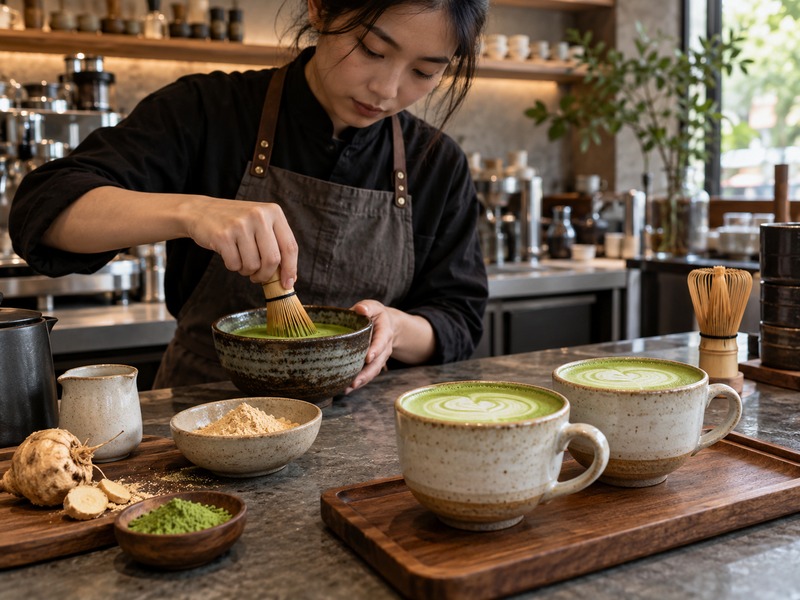
A maca matcha latte combines powdered green tea, maca root, milk or a plant-based alternative, and a measured sweetener. The formulation challenge is balancing maca’s earthy flavor with tea while keeping powders evenly dispersed. This article gives beverage teams a practical development path without making unsupported wellness promises. Search-intent reference: Maca Matcha Latte: Your New Go-To Beverage; the commercial recipe and controls here are independently developed.
1. What should a maca matcha latte promise customers?
Sell flavor and convenience plainly
The drink can offer a layered, earthy flavor with a tea finish and a creamy texture. That is a useful product description for a café or packaged beverage. Maca and matcha also attract wellness language, but a menu should not imply a specific effect without a substantiated claim that fits the sales market. Avoid turning ingredient folklore into a performance or hormone promise. Define the customer experience instead: hot or iced, sweet or restrained, dairy or plant-based, and whether fine sediment is acceptable. The brief should also say what the drink must taste like after a normal holding period.
Decide whether the formula targets made-to-order service, a powder sachet, or a ready-to-drink pack. Each route calls for different mixing, ingredient declarations, and shelf-life work. A café latte can be whisked before handoff; a retail bottle may sit for weeks and requires a separate stability and safety plan. Write the serving size, target cost, route to market, and label position before sampling powders. This prevents a team from approving a delicious bench cup that cannot be mixed, priced, or declared in the planned format.
2. What is a sensible bench formula for one latte?
Start with controlled doses
For a 300 ml hot café trial, start with 2 g matcha, 3 g maca powder, 40 ml warm water, 220 ml milk or selected plant beverage, and 10 to 15 ml defined syrup. These are trial quantities, not nutrition or safety guidance. Disperse the powders separately or together in the water, then blend with warmed milk. Taste at the serving temperature. Maca flavor can dominate quickly, so evaluate its dose before increasing sweetener. A larger cup may need more milk without a proportional increase in maca; test rather than scaling every ingredient blindly.
Develop an iced version on its own. Ice dilution and lower temperature can mute sweetness while revealing powder texture. Measure the volume after ice and use a fixed cup and scoop. If a sweetened milk base already contains sugar, adjust syrup accordingly. Log each trial with powder lots, milk brand, water temperature, mixing time, and panel notes. A one-line recipe cannot explain why a cup succeeded. Give the winning formula a tolerance range only after repeated prep by different staff shows how much normal variation it can accept.
| Component | Trial amount | Main check |
|---|---|---|
| Matcha | 2 g | Tea flavor and color |
| Maca powder | 3 g | Earthy flavor and sediment |
| Warm water | 40 ml | Powder dispersion |
| Milk or plant beverage | 220 ml | Body and sweetness |
| Syrup | 10–15 ml | Final balance |
3. How should maca powder be selected?
Specify identity and process
Ask whether the ingredient is raw, gelatinized, or supplied in another processed form, then compare samples in the intended drink. Processing affects flavor, behavior in water, and supplier documentation. The term “gelatinized” describes a treatment of starch and does not by itself mean the ingredient contains gelatin; confirm the actual ingredient declaration. Request a specification for identity, origin, particle size, microbial criteria, storage, allergen statements, and lot traceability. Ask what tests accompany each shipment. A certificate should correspond to the delivered lot rather than a generic marketing sheet.
Smell the powder before mixing, then taste it in the complete latte at a fixed dose. An earthy note can suit matcha; a dusty, harsh, or stale note may not. Check whether powder clumps after opening and whether its packaging protects it from moisture. For multi-site use, select a pack size that turns over under your normal demand. Record approved color and aroma in plain language. If you switch supplier or process type, run the finished-drink test again because a similar name on the invoice does not mean equivalent sensory performance.
4. Which matcha grade pairs with maca?
Assess the combined finish
A matcha that tastes pleasant alone may become astringent beside maca. Compare candidates at the same tea dose in the complete milk system. Look for visible green, clean tea aroma, workable dispersion, and a finish that does not turn chalky. Choose for the application rather than assuming the highest-priced grade works best. In a strongly flavored latte, subtle top notes may be hidden. A sample with slightly more tea body can perform better, provided bitterness stays controlled. Evaluate hot and iced cups if both are on the menu.
Ask your supplier for lot-specific documentation and a sample from the proposed commercial grade. Confirm origin, pack format, storage instructions, and any market-specific test needs before approving packaging copy. Matcha Village supplies matcha grades and blends for beverage use; a buyer can request application-matched samples through Matcha Village. Keep a sealed reference from an approved lot and compare incoming material under the same recipe. Color viewed in a dry bowl is not a sufficient acceptance test for a milk drink.
| Criterion | Bench method | Decision question |
|---|---|---|
| Color | View final latte in chosen cup | Does it meet menu appearance? |
| Flavor | Blind tasting with maca | Is the tea still clear? |
| Texture | Check after normal hold | Are clumps or grit objectionable? |
| Supply | Review pack and lot files | Can it support repeat orders? |
5. Which milk system gives the intended texture?
Use the actual service milk in trials
Dairy milk, oat beverage, soy beverage, and other plant options differ in sweetness, fat, protein, flavor, and foam. A barista-format plant beverage may perform differently from a shelf product of the same base ingredient. Select one standard milk for formulation, then make separate variants if the menu offers substitutions. Do not assume a single syrup dose works across them. Warmed oat beverage can make the latte taste sweeter than an unsweetened dairy cup, while soy may add its own finish. Taste each version at the intended serving temperature and after a realistic wait.
Check ingredient declarations and allergen communication for every milk option. Shared steam wands and pitchers require procedures that fit your allergen plan. For a premix, milk powder or creamer creates different labeling, solubility, and sourcing questions from fresh milk. For a ready-to-drink format, the dairy or plant base has a major effect on processing and microbial controls. Choose the channel before selecting stabilizers or a heat process. A milk substitute made during a purchasing shortage should trigger a short approval check, not an undocumented service improvisation.
6. What mixing process prevents a chalky latte?
Wet the powders before full dilution
Weigh matcha and maca using a scale suitable for small doses. Add the specified warm water and whisk into a uniform slurry. Scrape the side of the vessel where dry powder can hide. Add a small share of milk, stir again, then finish with the remaining milk. If a steam wand is used, train staff on the approved temperature and hygiene procedure for the selected milk. Excess heat may change flavor and foam. A blender can disperse powders rapidly but adds foam and may slow service, so trial it with the actual order volume.
For iced service, make the slurry before ice enters the cup. Adding powder directly to chilled milk leaves floating clusters that staff may mistake for a bad lot. For a dry sachet, test how consumers will mix it with a spoon, shaker, or machine; a lab blender can hide a reconstitution problem. In a packaged drink, long-term settling needs formulation and process work beyond a strong initial mix. Record the equipment, speed, and time during pilot runs. If texture changes after scale-up, those records narrow the cause.
| Format | Critical step | Visible failure |
|---|---|---|
| Hot café cup | Make smooth slurry | Dry specks near rim |
| Iced café cup | Mix before ice | Floating clumps |
| Powder sachet | Consumer reconstitution | Grit after stirring |
| Packaged latte | Validated suspension system | Hard sediment layer |
7. How should a tasting panel compare versions?
Ask narrow questions
Serve coded samples in identical cups and keep temperature consistent. Ask panelists to score tea clarity, maca earthiness, sweetness, creaminess, and powder texture separately. A broad “favorite” vote can choose a sweeter cup without revealing that the maca has disappeared. Test at handoff and after the expected drinking delay. For iced drinks, include the effect of melt. Keep trial order balanced so the last cup does not always suffer from palate fatigue. Record comments in the panelists’ own words rather than rewriting them into a marketing claim.
Change one factor per round. If the drink is too earthy, lower maca dose before adding more sugar. If it is flat, review matcha quality, dose, and milk flavor. If it is gritty, review powder particle size and mixing method. Make a small confirmatory batch after selecting a winner and ask another operator to prepare it from the written card. That step tests whether the formula lives outside the developer’s hands. The panel result should feed a specification with tolerances, not a recipe based on memory.
8. How can the latte be costed without losing quality?
Calculate per finished serving
Use supplier quotes and measured doses for both powders. Add milk, syrup, cup, lid, labor, and expected waste. Include the effect of powder trapped in a mixing vessel or discarded during prep. If a candidate matcha costs more per kilogram but needs less powder for the same sensory target, compare cost per cup. Maca dose also affects cost, but reducing it below the point where customers can taste it may remove the reason for the product. Costing must sit beside the approved flavor brief.
Run at least two volume cases: a small launch and expected steady demand. Smaller ingredient packs may cost more per kilogram but protect opened-pack quality and working capital during early sales. A café with low turnover can lose savings if a large bag grows stale. For a manufactured drink, add processing, testing, packaging, freight, and rejected units. Ask for commercial lead times and minimum order quantities before finalizing a price. A cost sheet with only raw ingredients understates the delivered product cost and makes later margin corrections painful.
| Input | Basis | Check |
|---|---|---|
| Matcha | Price per kg × g per cup | Approved grade |
| Maca | Price per kg × g per cup | Approved process type |
| Milk | Price per liter × ml per cup | Actual service brand |
| Waste | Pilot loss per served cup | Prep and remakes |
9. What food safety and claim checks belong before launch?
Separate ingredient evidence from marketing
Review supplier specifications, allergens, lot traceability, microbiological documentation, and storage instructions for each powder. Confirm the destination market permits the ingredients and proposed labeling. Matcha naturally contributes caffeine, so consider whether caffeine information or customer guidance belongs on the menu under local rules. Maca is often marketed with broad wellness language; do not repeat physiological claims without legal and scientific review. The business can describe taste, ingredients, and serving format clearly without suggesting a medical result.
A packaged latte needs a validated process and shelf-life study for its final recipe and container. Milk systems raise specific microbial and allergen concerns. A powder blend needs moisture control, blend uniformity, and a packaging barrier suited to its shelf-life target. For café service, set clean-utensil rules, opened-pack practices, holding limits, and allergen procedures. Assign a named person to sign off claims before menu artwork or packaging goes to print. If an ingredient source changes, review both the technical file and customer-facing text.
10. What pilot proves the recipe is ready for purchase?
Test the drink under real service conditions
Choose one standard milk and one hot or iced format for the initial pilot. Train staff with a weighed recipe and observe several operators making the drink. Record preparation time, visible clumps, returned cups, powder usage, and customer comments tied to specific attributes. Taste a reference cup at the start of each shift. Compare cups made with the opening and closing portion of a prepared powder blend if you use one. That check can reveal segregation during handling. A formula that works only when one developer makes it is not ready for a chain.
After the pilot, lock the ingredients, lots or approved equivalents, pack sizes, cost sheet, allergen statement, and build card. Request samples and specifications that match the production route. Matcha Village can discuss matcha and blend supply for this application. Give the supplier the planned market, serving format, volume range, and target taste. Keep the approval decision written: launch, revise one defined variable, or stop. If the product later moves into retail packaging, start a separate processing and stability program.
| Gate | Evidence | Owner |
|---|---|---|
| Texture | Hot and iced hold cups | Product lead |
| Claims | Approved menu copy | Compliance lead |
| Supply | Matched lot documents | Buyer |
A maca matcha latte earns a menu place through flavor, texture, repeatable preparation, and accurate labeling. Start with measured powder doses and the actual service milk, then test hot and iced formats separately. Purchase against an approved sensory and documentation standard rather than a broad ingredient story.
FAQ
- Q1: Does a maca matcha latte need added sugar?
- No, but a low-sugar version needs separate tasting because reduced sweetness exposes earthy and bitter notes.
- Q2: Can the powders be premixed?
- Yes, after checking blend uniformity, moisture protection, reconstitution, and lot traceability.
- Q3: Does maca contain gelatin?
- “Gelatinized” maca usually refers to starch processing. Confirm the supplier’s actual ingredient and allergen declarations.
- Q4: Can one recipe cover dairy and plant milk?
- Use separate sensory checks and syrup settings. The bases differ in sweetness, texture, and allergens.
- Q5: What claims can a brand make?
- Ingredient and taste descriptions are a starting point. Any health or performance claim needs market-specific evidence and review.