
Japanese hojicha is roasted green tea made from processed tea leaves or stems. For a café buyer, that short definition leaves a long purchasing problem: two brown samples can behave quite differently in a latte, bottled drink, or cake. This guide turns the category into a workable specification. It draws on Japan’s Ministry of Agriculture, Forestry and Fisheries description of hojicha and on current supplier practice, then separates documented facts from trials your own team must run.
1. What makes Japanese hojicha a distinct tea?
Roasting changes the buying conversation
Hojicha names a roasting method, not a separate tea plant. Japan’s Ministry of Agriculture, Forestry and Fisheries describes it as tea made by roasting sencha or kawayanagi, a larger-leaf tea. The Japan Hojicha Association likewise distinguishes hojicha, a process description, from kukicha, a description of plant material. That distinction matters when a buyer asks for “authentic hojicha” without naming a base tea or target flavor. A seller can legitimately offer different raw materials, roast levels, and particle sizes under one category name.
Start with the cup. Decide whether your product needs a gentle toasted scent, a deeper cocoa-like note, or a dry roast that remains audible through milk. Then ask how the proposed material produces that profile. Origin alone cannot predict sensory performance. Document the country of cultivation and manufacture separately; a Chinese manufacturer may supply hojicha-style roasted tea powder without claiming Japanese origin. For an import label, that distinction deserves exact wording and documentary support.
| Term | Describes | Buyer question |
|---|---|---|
| Hojicha | Roasting of prepared tea | Which base tea and roast? |
| Sencha | Japanese steamed leaf tea | Is it the input or the finished SKU? |
| Kukicha | Tea stems and stalks | What proportion of stems? |
| Powder | Physical format | How does it disperse? |
2. Which leaves and stems go into Japanese hojicha?
Material selection controls texture and aroma
Sencha-derived hojicha, bancha-derived hojicha, and roasted stems can all be credible choices. The raw material sets a starting point for body, astringency, yield, and price, while roasting changes what survives in the finished drink. A leaf-heavy sample may give a fuller infusion; a stem-heavy sample may taste lighter and more aromatic. Those are tasting hypotheses, not guaranteed rules.
Ask for the blend sheet. At minimum, request the material description, leaf-to-stem policy, seasonal substitution rules, and whether every lot follows the same roast target. For a transparent loose-leaf line, stem shape and leaf size also become visible product attributes. For a powder destined for dairy, appearance of the dry leaf matters much less than mouthfeel and consistency. In either case, ask a supplier to identify the base tea accurately. Marketing copy that presents all hojicha as one uniform ingredient obscures the very variables a product developer needs to control.
3. How does roasting change flavor and color?
Specify the sensory result, not only the roast label
Heat produces toasted aroma and shifts processed green tea toward an amber or brown appearance. Roast intensity is not a universal industry scale: one producer’s “medium” can smell darker than another producer’s “dark.” Trial samples side by side under the same brew recipe, then retain a reference sample for later deliveries.
Watch the finish. A sweet cereal note may work in an unsweetened drink; a sharper char note may become harsh after refrigeration; a delicate sample can disappear behind oat milk. Record dry aroma, wet aroma, infusion color, taste at serving temperature, and aftertaste after several minutes. Include a sample brewed too strong, because a café operator will occasionally over-dose. The most useful specification describes acceptable outcomes and tolerances. A photograph of powder color, an approved infusion standard, and a retained control sample do more work than a loose adjective such as “premium.”
| Check | Light | Medium | Deep |
|---|---|---|---|
| Plain infusion | Tea character | Balance | Roast finish |
| Milk drink | Risk of fade | Blend test | Risk of char |
| Cold hold | Aroma retention | Sediment | Bitterness |
4. Should a buyer choose Japanese hojicha as leaf, extract, or powder?
Match format to production equipment
Loose leaf suits brewed service and clear packaged tea, where filtration can remove particles. Powder suits lattes, bakery fillings, ice cream, and dry mixes, where the roasted tea itself remains in the product. An extract can simplify dosing in a liquid line, but its concentration, carrier, preservation method, and sensory profile need their own qualification.
Map the line before ordering. A café whisk station can handle a powder that a high-speed bottling line rejects for sediment. A bakery may accept visible flecks that make a shelf-stable beverage look unstable. Ask for particle-size information and test dispersion in your actual fluid, at your actual temperature and shear. If the drink contains acid or plant protein, repeat the test in that full formula. For loose leaf, set a sieve or filter specification and calculate tea loss at service. Buying “the best” powder without a defined process tends to create an expensive workaround later.
5. How should a team taste Japanese hojicha samples?
Use one repeatable benchmark recipe
Put coded samples on the table before showing prices. Brew each loose-leaf lot with the same water, mass, volume, temperature, and time. For powder, weigh the same grams into the same liquid volume and use an identical mixing procedure. Write those conditions on the score sheet so another evaluator can repeat them.
Keep two scorecards. One card covers a plain tea preparation, the other the intended finished application. A sample with a charming plain aroma may not survive a sweetened milk base. Record aroma descriptors in ordinary language: toast, cocoa, cereal, smoke, green leaf, or stale oil. Also record defects such as burnt edge, coarse grit, clumping, and lingering bitterness. Include procurement and operations staff in the tasting; the recipe must remain workable during a busy service period. Select a shortlist only after blind tasting, then compare price and paperwork.
| Field | Method | Decision use |
|---|---|---|
| Aroma | Dry and prepared | Match menu target |
| Color | Fixed cup and light | Set reference |
| Dispersion | Timed mix and hold | Check line fit |
| Aftertaste | Cold and warm | Reject defects |
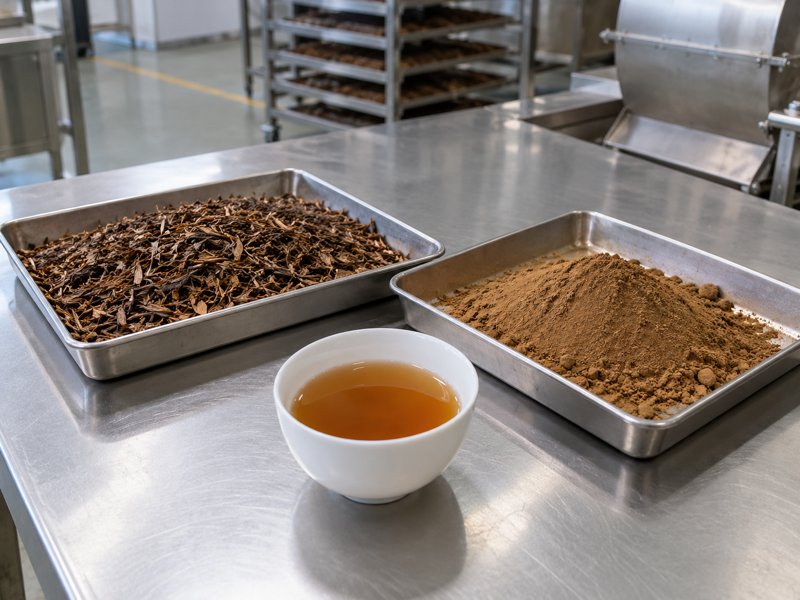
6. Where does Japanese hojicha work in a commercial menu?
Design for the application, not the trend
A roasted tea latte is an obvious starting point, but it is not the only useful one. In a coffee shop, a short hojicha concentrate can support hot and iced drinks while controlling service time. In a bakery, powder can flavor buttercream or pastry filling without adding free water. In ice cream, the roast may read as nutty or caramel-like beside dairy fat.
Run the ingredient through the whole recipe. Sugar, milk, fat, freezing, and storage change perceived tea intensity. A syrup prototype that tastes strong on day one may lose top notes after a week. A powder that tastes smooth in hot milk may leave sediment in a cold cup. Put each candidate through a small but realistic pilot, including the final container and intended hold time. Measure grams per serving, waste, mixing time, and consumer-facing color. That converts a creative menu idea into a formulation the purchasing team can price.
7. What belongs in a Japanese hojicha purchasing specification?
Write what can be inspected at receiving
A purchase order should identify tea material, roast or sensory reference, form, ingredient statement, packaging, storage conditions, shelf life, and lot identification. For powder, add a particle-size or dispersion target that fits the application. For a beverage powder blend, state whether sugar, creamer, flavor, or carriers are present; “hojicha powder” should never conceal a formulated premix.
Request a lot packet. A typical packet can include a certificate of analysis, microbiological results, pesticide and heavy-metal data suited to the destination market, origin documents, and an allergen statement. Specify which documents are mandatory before shipment and which accompany every lot. Do not assume a factory certificate applies automatically to every SKU or shipping batch. Review the actual product and lot. Matcha Village can discuss ingredient formats, formulation and packaging options, but any specific certification or test claim should be checked against the current product document before publication or import.
| Field | Requested evidence | Acceptance owner |
|---|---|---|
| Identity | Composition and origin | Regulatory |
| Sensory | Approved reference sample | R&D |
| Safety | Lot-specific test package | Quality |
| Supply | MOQ, lead time, pack size | Purchasing |
8. How should Japanese hojicha origin claims appear on labels?
Separate flavor style from geographic origin
“Japanese hojicha” can signal a tea produced in Japan, while “Japanese-style roasted tea” may describe a style produced elsewhere. The exact claim depends on the product and destination rules. Have regulatory counsel or the importing partner approve wording against invoices, origin declarations, and ingredient records.
Read every noun. A latte powder may contain tea alongside sweetener and milk ingredients; its front panel should not imply that the entire pack is pure roasted tea. In the United States, FDA food labeling guidance requires truthful ingredient and allergen information for applicable products. Other markets have their own rules. Avoid “caffeine free” or a fixed caffeine figure unless the finished product has suitable evidence, since tea material and serving recipe can vary. A truthful specification protects the café menu as much as the retail pack. Train sales staff to use the approved language, including origin and composition, rather than improvising a story from a supplier photograph.
9. How can a buyer compare real landed cost?
Price each sellable serving
A quote per kilogram is only the start. For powder, calculate dose cost from grams per drink, then add any syrup, labor, packaging, freight, duty, and expected loss. For loose leaf, include brew yield, filter loss, and whether spent leaf must be discarded after one extraction.
Run a low and high case. A cheaper ingredient that requires a larger dose can cost more per cup. A darker roast may allow a smaller dose in milk, yet lose sales if customers find it burnt. Use a controlled pilot to establish dose rather than assuming every product behaves alike. Include both trial and mature volumes in the RFQ: minimum order, sample cost, lead time, pallet configuration, and seasonal capacity may change at scale. For private-label packs, add packaging artwork, minimum print run, and inventory exposure. A good purchasing decision balances taste, process fit, documentation, and a believable landed cost.
| Input | Unit | Calculation |
|---|---|---|
| Ingredient price | Currency/kg | Multiply by dose in kg |
| Freight and duty | Currency/kg | Add to ingredient cost |
| Preparation loss | % | Adjust usable yield |
| Drink contribution | Currency/serving | Selling price minus variable cost |
10. What is a sensible Japanese hojicha supplier trial before launch?
Move from bench approval to repeatable supply
Ask two or three candidates for clearly labeled samples and supporting specifications. Record lot codes on arrival. Have R&D test a plain preparation and the actual finished recipe, while quality reviews documents and purchasing confirms replenishment terms. Keep a signed approval sample under controlled storage.
Then stress the process. Make the recipe with the equipment and staff who will run it, including a peak-service or pilot-line simulation. Check cold and warm hold where relevant, and compare a second production lot before committing to a launch forecast. Set an escalation route for any mismatch in aroma, color, moisture, or powder behavior. The supplier should explain process controls, change notification, and how complaints trace back to a batch. A local café might need one reliable 1 kg pack; a beverage brand might need drums and scheduled deliveries. The trial should mirror that future reality, not a perfect laboratory cup.
Japanese hojicha offers a useful roasted-tea platform, but its base material, roast, and format must match the finished product. Ask for coded samples, a documented specification, and a second-lot check. If your team is developing lattes, bakery items, or private-label tea, send Matcha Village the target recipe and market so a suitable hojicha powder can be evaluated against your own acceptance criteria.
FAQ
Q1: Is hojicha always grown in Japan?
No. Hojicha describes roasted tea; Japanese origin requires separate evidence. State cultivation and processing locations clearly.
Q2: Is hojicha powder the same as a latte mix?
No. Pure roasted tea powder and sweetened premixes have different ingredient statements, costs, and preparation methods.
Q3: Can one hojicha serve drinks and desserts?
Sometimes, but test both applications. Sweetness, fat, temperature, and particle feel alter performance.
Q4: Does darker color prove a better roast?
No. Color is one quality attribute; taste, aroma, defects, and repeatability decide fit.
Q5: What should a buyer request before ordering?
Request composition, origin, sensory reference, lot documents, pack details, minimum order, and a second-lot sample.
Sources: Japan Ministry of Agriculture, Forestry and Fisheries, Uji Tea; Japan Hojicha Association, tea categories; US FDA, Food Labeling Guide.