
Kuki hojicha is roasted tea made primarily from tea stems and stalks. It can be a thoughtful ingredient for a light toasted infusion, yet a name on a sample bag does not reveal the stem proportion, roast, or behavior in milk. Buyers need a definition they can turn into an RFQ. This guide uses the Japan Hojicha Association’s distinction between plant part and processing method, then shows how to qualify a stem-led product without assuming that every lot tastes alike.
1. What exactly does kuki hojicha mean?
Two descriptors, one finished tea
“Kuki” points to stems or stalks, while “hojicha” points to roasting. Japan Hojicha Association explains this distinction directly: hojicha is a processing category and kukicha is a plant-part category. A roasted stem tea therefore sits at the intersection.
Check the label carefully. A lot containing some stems may still be sold as hojicha, but a buyer seeking a stem-forward flavor should ask for a written composition target. Ask whether the material comes from sencha, bancha, or another tea production stream and whether leaf fragments are intentionally included. The source crop and separation method can affect visual uniformity and infusion strength. This is a tea ingredient, not a wood infusion; the “twig” description refers to tender parts of the tea plant. If a brand claims Japanese origin, verify that claim independently through origin documents. A producer in another country can make a roasted stem tea but should describe its origin honestly.
| Name | What it identifies | What it does not prove |
|---|---|---|
| Kukicha | Stem-led tea material | That stems were roasted |
| Hojicha | Roasted tea | That stems dominate |
| Kuki hojicha | Roasted stem-led tea | One fixed stem percentage |
| Karigane | Stem tea term often linked with shaded tea | One universal roast profile |
2. Why is kuki hojicha made from stems?
Stem material offers a different flavor route
Stems are separated during tea manufacture because leaf size and stem pieces handle differently in many products. They remain usable tea material. Roasting them produces an ingredient with its own aroma and visual character. That does not make every stem lot cheap or low grade: sorting, raw-material quality, and a controlled roast all cost money.
Look past the “by-product” story. Ask for stem proportion, cut size, foreign-material control, and whether the blend recipe changes when tea harvests change. Whole pieces may matter in a loose-leaf retail pack, while a powder maker cares more about roast uniformity and particle feel. A sample made from light stems and dark leaf chips can brew differently from a uniform stem lot. Inspect a representative production sample under good light and keep photos tied to its lot code. That evidence helps receiving staff identify an unexpected composition shift before it reaches the café bar.
3. How does the roast affect kuki hojicha?
Roast targets must be tested in the intended cup
A lighter roast can preserve more tea character, while a deeper roast may push toward toasted cereal or char. Those descriptions are useful for tasting but do not replace a measured supplier process. Request a roast reference sample and ask how the producer controls batch size, temperature, time, and cooling.
Smell the dry material. Fresh toasted aroma should be distinct from stale, dusty, or burnt notes. Brew the sample at a fixed ratio and assess it plain before adding other ingredients. Compare the same lot after a short storage interval in its intended package, because a vivid opening aroma may not persist. A blend of stems and leaves may respond unevenly during roasting if pieces differ greatly in size or moisture. The buyer cannot infer process capability from a product photo, so use repeated lots and an agreed sensory standard. Record the roast in terms that your panel can recognize rather than relying only on “light,” “medium,” or “dark.”
| Stage | Record | Concern |
|---|---|---|
| Dry sample | Color and aroma | Patchy or stale material |
| Hot infusion | Toast, body, finish | Burnt edge |
| Cold infusion | Aroma retention | Flat or woody note |
| Stored pack | Change over time | Rapid aroma loss |
4. What should kuki hojicha taste like?
Set a target that a panel can repeat
Descriptions such as nutty, toasted, or lightly sweet can help a buyer shortlist samples, but they are not specifications. Stem-led samples can taste toasty and nutty, but leaf-to-stem balance can shift the cup. Use a controlled tasting rather than treating one sample as a promise about future shipments.
Build your own vocabulary. Give each assessor a coded sample and ask for three positive notes and any defects. Some stems may produce a gentler body than a leaf-heavy hojicha. If the intended drink includes milk, assess whether the tea note survives at the planned dose. If it is a bottled clear tea, look for a clean finish and consistent color. Test warm and chilled portions from the same brew; cooling can alter what a panel notices. Retain the selected lot as a reference. When a later lot differs, that retained cup standard gives supplier and buyer a concrete basis for discussion.
5. How should a buyer run a fair brewing test?
Hold the variables still
Weigh each dry sample, use the same water, and brew in identical covered vessels. Record water temperature, steep time, agitation, and filtration method. A single “spoonful” is an unreliable dose because stems and fine leaf chips pack differently.
Measure the yield. Log the infusion volume after straining and note how much liquor remains trapped in the material. For a foodservice account, run a small batch at realistic service size, then repeat with fresh staff. If a menu will serve the drink iced, test dilution from ice rather than tasting an undiluted hot concentrate. If the product will be brewed in a bag or cartridge, test that exact hardware; long stems can affect packing and extraction. A recipe card should specify grams, water, steep time, and expected serving volume. Only compare cost per serving after these values are stable. A low purchase price can vanish when an ingredient needs more grams to reach the same sensory target.
| Variable | Write down | Why it matters |
|---|---|---|
| Tea mass | Grams, not scoops | Stems have variable bulk density |
| Water | Source and volume | Changes extraction |
| Time | Start and stop | Changes strength |
| Filter | Type and yield | Changes clarity and cost |
6. Where does kuki hojicha fit commercially?
Choose products that welcome its lighter structure
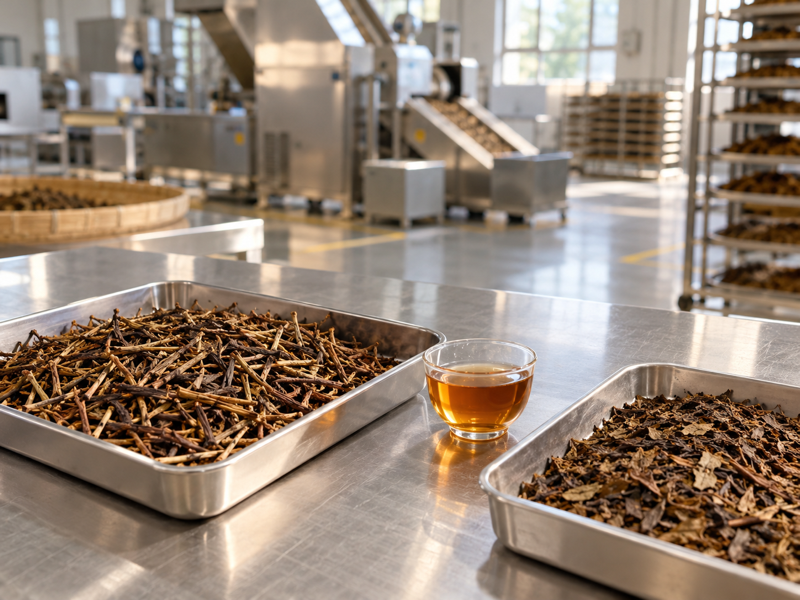
A loose-leaf tea line can show stems visibly and tell a precise sourcing story. A café can offer it as a brewed tea, a tea tonic, or a concentrate for a milk drink. A dessert developer can use a milled version in cream or sponge, provided the texture works.
Make each application earn its place. A stem-led infusion may lose character against heavy syrup, while a deeper leaf blend could perform better. Conversely, a delicate clear tea may benefit from a lighter stem-forward profile. Test flavor after the full manufacturing step: heat treatment for a ready-to-drink product, freezing for ice cream, or baking for a cake. Some aromatic notes can fade under process conditions. For a multi-site chain, speed and reproducibility also matter; a beautiful brew that demands several judgment calls is hard to scale. Document a simple process, train operators, and check results at more than one site before committing packaging to a flavor promise.
7. Is kuki hojicha low in caffeine?
Do not turn a tendency into a fixed claim
Stem-led teas are often discussed as lower-caffeine options, and roasting is often credited with reducing caffeine. The size of that difference varies with raw material, blend, roast, extraction, and serving size. A cup value borrowed from another supplier is not a defensible value for your drink.
Ask for a finished-product number. If caffeine content affects positioning, commission a suitable laboratory test on the specific formula and serving, or request credible lot-specific data with a method description. A powder-based latte consumes the whole powder rather than only an extracted infusion, so a brewed-tea estimate may not transfer. Avoid “caffeine free” unless evidence and local labeling rules support it. For an internal menu comparison, show measured milligrams per serving and the recipe used. This keeps marketing language honest and gives staff a useful answer when customers ask about the drink.
| Question | Needed record |
|---|---|
| Which material? | Lot, blend, and form |
| Which serving? | Tea grams and final volume |
| Which process? | Brew or full powder consumption |
| Which evidence? | Test method and date |
8. What documents should an importer request?
Match paperwork with the shipment
Request a product specification identifying composition, form, origin, packaging, shelf life, storage conditions, and lot code format. Quality records should fit the importing market and product use. Depending on the customer and market, that may include microbiological tests, pesticide residues, heavy metals, and an allergen statement.
Check scope. A factory certification may show a management system, yet it does not replace the certificate or test record for the actual lot. For a powder, ask whether any carrier, anti-caking agent, flavor, or sweetener is included. A café buying bulk tea and a retail brand ordering a sweetened mix need different ingredient disclosures. Confirm labeling claims with the importing partner or qualified regulatory reviewer. Align document names and lot numbers with invoice and packaging before goods leave the factory. A missed mismatch is easier to correct at the supplier desk than at a port or a retail distribution center.
9. How should kuki hojicha be priced against leaf hojicha?
Compare usable flavor, not tea weight alone
Ask each supplier for price at sample, launch, and forecast volumes, then calculate cost at the tested grams per sellable cup or finished kilogram. Include freight, duties, packaging, preparation loss, and any additional blending ingredient.
Price the rejected cups too. If a stem-heavy lot gives variable extraction, staff may remake drinks or increase the dose. Those costs belong in the comparison. At retail, a distinctive stem presentation may support a different pack size and shelf story than a conventional leaf tea, but that commercial case needs customer testing rather than an assumed premium. For private label, inspect the minimum print run and finished-goods inventory exposure. For food manufacturing, request the lead time for repeat lots and a change-notification rule. Stable supply can justify a higher unit price when it reduces production interruptions. Keep sensory acceptance and economics on the same evaluation sheet so procurement does not buy a bargain the product team cannot use.
| Measure | Supplier A | Supplier B |
|---|---|---|
| Approved dose per serving | Enter tested grams | Enter tested grams |
| Delivered cost per kg | Enter quote | Enter quote |
| Document package | Pass / gap | Pass / gap |
| Second-lot match | Pass / gap | Pass / gap |
10. What should a kuki hojicha qualification trial include?
Demand a repeatable result across lots
Begin with coded samples from several producers, each accompanied by a basic specification. Run the same brew protocol for all. Shortlist based on the target drink, not solely a plain tea tasting. Ask finalists for a larger sample from a production lot and repeat the recipe using service or pilot equipment.
Recheck on arrival. Compare a later lot against the retained control for appearance, aroma, brew yield, and finished-product flavor. Have quality review documents while purchasing verifies order minimums and lead times. Agree how the supplier will announce changes in base material, roast process, milling, or packaging. If the ingredient is marketed with an origin or caffeine statement, put that claim through a separate evidence check. Matcha Village can supply hojicha powder for application trials; request the exact product composition and test packet for the SKU under consideration. Qualification ends when the product, paperwork, and replenishment plan all work together.
Kuki hojicha can create a distinct roasted-tea cup, but stem proportion and roast must be specified rather than guessed. Send a target drink, serving size, and destination market with your sample request. The resulting trial should tell you whether a stem-led tea truly fits your menu or formulation.
FAQ
Q1: Is kuki hojicha the same as kukicha?
Kukicha is stem tea; kuki hojicha identifies a roasted stem-led version.
Q2: Must it contain only stems?
No universal percentage is implied by the name. Put your required composition in the contract.
Q3: Can stem tea become a latte powder?
Yes, if a producer mills a suitable roasted lot; test dispersion and flavor in the full recipe.
Q4: Can it be called caffeine free?
Do not assume so. Use product-specific evidence and check local claim rules.
Q5: What makes a supplier sample convincing?
A repeatable sensory result, clear composition, matching lot documents, and a workable replenishment plan.
Sources: Japan Hojicha Association, hojicha and kukicha definitions; Japan Ministry of Agriculture, Forestry and Fisheries, Uji Tea; US FDA, Food Labeling Guide.