
An iced hojicha latte has two jobs: it must look appealing at handoff and still taste of roasted tea when the ice has partly melted. This café development guide covers a weighed powder slurry, cup and ice geometry, a repeatable layered pour, and a ten-minute sensory check. The quantities below are trial starting points, not a commercial shelf-life or safety specification.
1. What makes an iced hojicha latte worth listing?
Product brief
A clear cup can make the roasted-tea layer visible, but visual contrast is not evidence of good taste. The home recipe uses cold milk and whisked tea. A commercial version needs a fixed fill line and a drinkable result after layers mix. The target unit is one finished cold cup. Describe where roasted aroma should appear, which texture matters and how a control without tea should compare. The linked home recipe Iced Hojicha Latte is useful as application context, not evidence that a commercial formula has been validated.
Define the menu promise in language a customer can test. “Roasted tea latte” should taste recognizably of tea after the first sip, not merely look brown above the milk. Make a no-tea control with the same milk and syrup, and ask a blind panel to identify which drink contains hojicha. Then taste both cups after ten minutes with ice. A clear layer can sell the item visually, but most customers eventually stir it or drink through the lower milk layer first. If the mixed cup is weak, fix tea strength or sweetness before spending time on pour theatrics. Keep the product brief to three sensory points and one price target so every subsequent trial has a decision rule.
2. Which iced-latte channel and cup fit?
Channel decision
Single-store cafés can train a deliberate two-step pour. A high-volume chain may prefer a premixed tea concentrate if it passes separate holding and safety checks. Specify whether customers are expected to stir the drink before tasting. For café and tea-chain teams, the immediate route is a made-to-order summer café drink. A bottled latte requires a separate technical brief. Record buyer questions about portion, pack and intended eating or drinking state before ordering ingredients.
Treat nominal cup volume as packaging information, not liquid yield. Weigh the café’s normal ice portion in its actual cup, then measure the space available below the lid. A starting bench build for a 16-ounce service cup might use 3 g hojicha powder, 52 g slurry water, 150 g cold milk, 15 g syrup, and 130 g ice. These are illustrative weights that must be adjusted to the selected cup and ingredients. Mark an acceptable fill line and lid clearance. Test the same build with the ice machine’s regular cubes; crushed or unusually small ice changes the drinking trajectory. A cup that staff finish with an unmeasured milk splash cannot be costed or reproduced.
| Item | Working choice | Check |
|---|---|---|
| Layered handoff | Pour slurry onto central ice cube | Photograph at 0 and 2 minutes |
| Mixed service | Combine before handoff | Taste and color after stirring |
| Delivery | Closed lidded cup | Leak and streak test after walk |
3. Which hojicha powder works in a cold latte?
Ingredient specification
Test tea powder in the actual cold base. A sample with a strong dry aroma may float, settle or become muted behind a sweet plant base. Obtain lot identity and the plain-powder ingredient declaration before selecting a supplier. The proposed tea ingredient is fine roasted-tea powder. Judge it after contact with milk or a selected plant base, because that matrix determines perceived flavor and physical behavior. Record differences against the approved lot.
Prepare each sample in the same milk at the same powder mass. Check the dry ingredient declaration first: pure roasted tea and a sweetened beverage premix require different dose calculations. Then record clumps, surface float, grit, bottom sediment after five minutes, roast aroma, and color against a white card. Ask for supplier lot identification, specification, pack size, and a sample large enough to repeat the trial on another day. A finer grind may disperse better yet feel dusty in a full-milk cup. Reject a sample only after trying the intended whisk or frother, because equipment affects the result. Keep the two best lots for a peak-hour service simulation, not merely a quiet bench tasting.
4. How should an iced latte trial be weighed?
Trial design
Keep ice mass and cup geometry constant during the initial matrix. Their effect on dilution can hide the tea-dose comparison. Weigh added water in the initial slurry and include it in total liquid volume. Try 2, 3 and 4 g of plain hojicha powder in an otherwise fixed 300 ml cup, with sweetness and ice held constant. Record the purpose of each sample before tasting, then decide which variable to change next.
Use a scale and a single controlled variable. Mix one tea slurry from 3 g powder and 52 g water, then prepare a lower- and higher-dose cup while holding milk, ice, syrup, vessel, and pour order fixed. Record the water temperature and mixing tool. The Hojicha Co. recipe uses 60 ml water at 80°C with two teaspoons of powder; its spoon measure is not precise enough for a multi-site specification. If the stronger cup is harsh, vary water or milk before raising sweetness. Photograph and taste the cup at handoff and after ten minutes. Record the mass of ice remaining to estimate dilution, and make the final decision on the mixed drink rather than the first undisturbed sip.
| Item | Working choice | Check |
|---|---|---|
| Tea powder | 3 g starting point | Compare lower and higher dose |
| Slurry water | 52 g starting point | Hold temperature constant |
| Milk / syrup | 150 g / 15 g | Check sweetness after melt |
| Ice | 130 g starting point | Weigh remaining ice at 10 minutes |
5. How can staff build the same layered cup?
Process method
Use equipment that the outlet can reproduce. A bench frother may create a smooth tea layer while a hand whisk used during a rush leaves clumps. Run a timed rehearsal with the service team. Disperse powder in a measured small liquid portion before it meets cold milk; pour over a consistent ice mass and document layer order. Watch another operator follow the written sequence and revise unclear instructions.
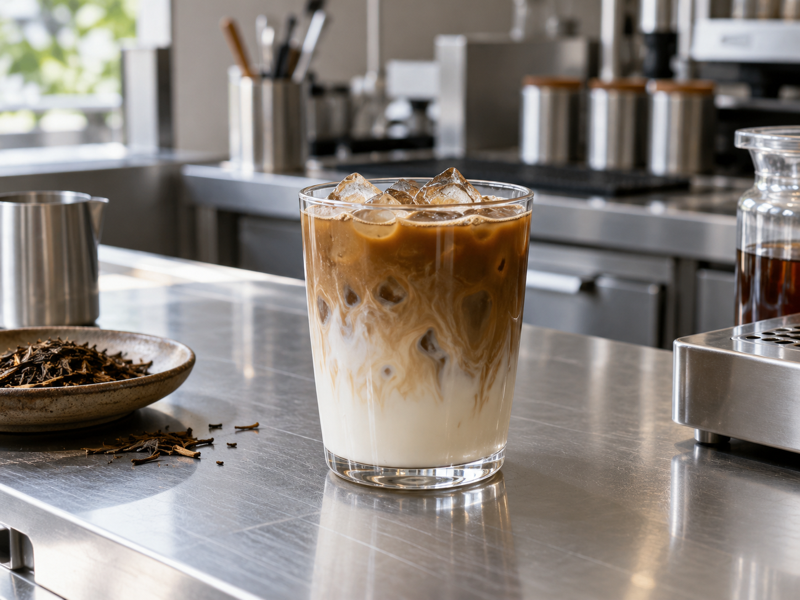
Write a station sequence that a new barista can execute. Weigh powder into a clean vessel, add a small portion of water and whisk out dry pockets, then add the remaining water. Put measured ice and cold milk in the service cup, add syrup in the specified location, and pour the tea slurry slowly onto a central ice cube if a layer is desired. The recipe describes that ice-cube pour. Measure its effect with the selected milk; different viscosity and temperature can erase the layer. Time three consecutive builds at a normal service pace. Check the tool for retained powder and assess whether cleaning between orders is practical. Prebatched slurry needs a separate holding review before adoption.
6. How should an iced latte be tasted?
Sensory evaluation
Taste immediately and after a realistic drinking interval. If the beverage looks layered but tastes bland when mixed, the visual design is winning over the formulation. Blind-code cups and record actual serving temperature. For this item, score tea aroma, milk balance, dilution after ten minutes, visible sediment and the appearance after stirring. Taste at the actual serving state rather than relying on an attractive production sample.
Taste at three moments: freshly built, fully stirred, and ten minutes after handoff. Use coded cups so the panel does not know the powder dose. Record roasted aroma, milk body, sweetness, chalkiness, visible sediment, and aftertaste on a simple five-point scale, plus a short description of any defect. Let the same ice mass melt in each cup. If all panelists prefer the strongest tea only when the drink is freshly made, check whether the larger dose becomes bitter as the milk warms or ice dilutes it. A delivery test also matters: walk the closed cup for several minutes, then inspect streaking and taste. The winning cup is the one that survives ordinary use.
| Item | Working choice | Check |
|---|---|---|
| Roast aroma | Score 1–5 | Must remain recognizable |
| Texture | Grit or clumps noted | No dry powder |
| Sweetness | Score at 0 and 10 minutes | No syrup-dominated finish |
| Sediment | Inspect cup bottom | Set an acceptance photograph |
7. Why do iced latte pilots separate or settle?
Defect diagnosis
A pale top layer often signals dilution or insufficient tea concentration; a sandy final sip suggests poor dispersion. Change one variable per test and check whether the defect appears before or after ice begins to melt. Look specifically for fast dilution, a weak tea layer, powder on the surface and grit at the bottom. Each symptom should trigger a narrow experiment with an unchanged control.
Diagnose the point at which the defect appears. Dry islands immediately after whisking mean the wetting step needs work; a dark ring at the bottom after five minutes suggests particle suspension or inadequate agitation; a pale, bland mixed cup points to dilution or an underdosed tea phase. Record one change per repeat trial. Do not automatically add more powder: extra solids can increase grit while leaving a syrup-heavy cup cloying. For a separated plant-based option, test that base as its own formula rather than borrowing the dairy recipe. Keep photographs of acceptable and rejected cups on the training card so a shift supervisor can catch an obvious fault before serving.
8. What cold-drink safety and label checks apply?
Food safety and labeling
Cold dairy, plant bases and ice introduce handling obligations. A service trial is not a shelf-life study, and a bottled version needs an entirely separate process and validation plan. The format requires review of milk handling, ice hygiene, shared equipment and any plant-base allergens. Verify the actual market and process before approving any claim or date code.
Map the actual cold-drink operation: receiving milk or plant base, cold storage, slurry preparation, utensil cleaning, ice handling, handoff, and disposal of unused portions. The FDA Food Code is a model for retail; local adoption determines the applicable rule. A home recipe or one-day taste trial cannot establish a safe holding period for prepared slurry or a bottled latte. For U.S. menus and packaged products, check the complete ingredient list against FDA allergen guidance: dairy milk is a major allergen, and plant bases may introduce soy or tree nuts. Verify shared-tool controls before describing any option as dairy-free.
| Item | Working choice | Check |
|---|---|---|
| Recipe revision | Weights, temperature, sequence | R&D owner |
| Ingredient list | Milk, syrup, powder SKUs | Purchasing owner |
| Handling plan | Cold storage and utensil cleaning | Food-safety owner |
| Training check | Three consecutive cups per operator | Store lead |
9. How should a chain cost the finished latte?
Unit economics
Costing must include actual cup fill and waste from each pour. A higher tea dose may be less valuable than a clearer base and tighter ice specification. Order a second lot before committing to national menus. The cost model must capture ice, cup size, milk volume, powder lost in the mixing jug and service time. Use actual sellable yield rather than theoretical batch weight.
Cost a sellable cup from weighed use, including milk, syrup, powder, ice, packaging, and expected remake waste. Divide delivered powder price by usable grams, not the advertised pack size if there is unavoidable loss. Include a lid suitable for the intended channel and the labor time of the slurry step. Compare the formula with a lower-priced powder only after checking whether the alternative clumps or requires more tea to reach the same sensory score. A cheap powder that drives remakes can be costly. Track the exact ice and liquid fill during the pilot; overpouring milk to hide an underfilled cup changes both margin and flavor. Retest cost when a supplier changes pack size or concentration.
| Item | Working choice | Check |
|---|---|---|
| Tea | Powder grams × landed cost/g | Include unusable residue |
| Base | Milk and syrup weighed cost | Adjust for alternative milk |
| Pack | Cup, lid, straw | Use delivery lid if needed |
| Waste | Observed remake rate | Count clumpy and underfilled cups |
10. What belongs on the iced-latte launch checklist?
Five buyer FAQs
Ask staff to make the drink from the station card without help. Confirm a sensory target, full ingredient list and supplier specification. Track paid orders as well as positive comments during the pilot. The pilot should show that layered iced latte remains consistent across operators and a second ingredient lot. Keep final decisions in a signed launch file.
Release a concise card with approved powder and milk SKUs, ingredient masses, water temperature range, mixing tool, ice weight, cup and lid SKU, pour order, acceptable fill line, and a photo of the finished cup. Add a second photo of the fully mixed state, because that is how many customers drink it. Give two staff members who did not develop the recipe only the card and ask them to make three consecutive cups. Weigh the outputs, time them, and taste them after ten minutes. Revise unclear instructions before training a wider team. Maintain a dated formula revision and retest the relevant step if tea lot, milk, ice shape, or cup geometry changes.
Q1: Can the tea powder be shaken with cold milk?
Test it with the selected powder and equipment; a measured pre-dispersion step often gives a clearer starting point.
Q2: Do the layers need to stay separate?
No. Visual layering can help presentation, but taste the mixed drink because customers often stir it.
Q3: Can one formula serve dairy and oat versions?
Treat each base as a separate sensory and allergen trial.
Q4: Does an iced cup have a standard holding life?
No. Set handling rules through the outlet’s validated food-safety program.
Q5: What should the supplier sample include?
Request lot ID, ingredient declaration, specification and enough powder for repeated cold-base trials.
Ask Matcha Village for a traceable fine roasted-tea powder sample suitable for layered iced latte trials. Send the planned one finished cold cup, target roast and destination market with the request so the sample conversation begins with an actual application.