
Hojicha milk tea can be a plain roasted-tea drink or a bubble-tea cup with pearls. The topping changes the liquid yield, sweetness, labor, and eating experience. This guide helps tea-shop teams choose between leaf infusion and powder, measure a complete topped cup, and keep the roasted tea identifiable after ice and pearls are added. All trial quantities need local sensory and food-safety validation.
1. What distinguishes hojicha milk tea on a menu?
Product brief
The linked home recipe is a bubble-tea recipe, which reflects how consumers encounter the drink. For a professional menu, milk tea and pearl topping should be evaluated separately so the tea does not vanish under texture and sweetness. The target unit is one finished takeaway cup. Describe where roasted aroma should appear, which texture matters and how a control without tea should compare. The linked home recipe Hojicha Bubble Tea is useful as application context, not evidence that a commercial formula has been validated.
Put the menu decision first. A customer searching “hojicha milk tea” may expect a smooth iced tea-and-milk drink; a bubble-tea customer may also expect a chewy topping. Those are related but distinct menu promises. Sell a plain cup and a pearl cup only if both have a clear use case, or choose one after a pilot. Use the Hojicha Co. bubble-tea recipe as evidence of the consumer application, not as proof of a commercial formula. Prepare a milk-and-syrup control with no hojicha. After toppings are added, blind tasters should still find a recognizable roasted-tea note rather than identifying the product solely by its brown color or caramel syrup.
2. Which milk-tea format fits the buyer?
Channel decision
A tea shop can sell a plain version and a pearl version from one controlled tea base. A packaged-beverage brand has a different processing challenge. State the primary customer and selling format before optimizing toppings. For bubble-tea chains and beverage brands, the immediate route is a made-to-order bubble-tea menu item. A sealed retail beverage requires a separate technical brief. Record buyer questions about portion, pack and intended eating or drinking state before ordering ingredients.
Choose the service model before specifying a base. A made-to-order tea shop can brew or disperse tea during service; a high-volume chain might consider a controlled tea concentrate; a packaged beverage involves a different processing and shelf-life problem. For the shop pilot, define one cup size, one default sweetness, whether pearls are included, and the maximum acceptable preparation time. Record ingredient grams and final served mass in each version. If both versions use the same tea base, confirm that the base remains strong enough once the pearl cup loses liquid volume to toppings. A bottled milk tea must not inherit the shop recipe’s handling assumption without its own technical validation.
| Item | Trial choice | Decision point |
|---|---|---|
| Plain milk tea | No topping | Base roast must be clear |
| Pearl cup | Measured cooked pearls | Balance tea against topping syrup |
| Packaged drink | Separate process design | Validate stability and labeling |
3. Should a milk tea use powder or infusion?
Ingredient specification
Powder offers a direct route to roasted flavor but may settle; a leaf infusion can reduce visible particles but changes extraction workflow. Compare both in the final milk and sweetener system, not as plain tea. The proposed tea ingredient is roasted-tea powder or a documented leaf infusion. Judge it after contact with dairy milk, a plant base or creamer system, because that matrix determines perceived flavor and physical behavior. Record differences against the approved lot.
Compare powder and leaf infusion as separate systems. Pure hojicha powder brings tea solids and potentially stronger roast, but it can leave sediment. Loose leaf can make a clean, strained tea phase, but a weak infusion may vanish in milk. Weigh leaves or powder, and keep milk and syrup fixed while testing each route. For an infusion, record dry leaf mass, water charged, filtered yield, brew time, and temperature; the final yield matters more than the starting water volume. For powder, record dispersion time, grit, and settling. Ask suppliers for ingredient declarations and lot information. Do not assume one gram of leaf produces the same flavor as one gram of powder; the extraction paths are different.
4. How should a shop run a cup trial?
Trial design
A fixed cup volume is misleading when large pearls displace liquid. Record grams of tea phase, base, sweetener, ice and toppings. Choose a preference target before changing the sugar level. Compare tea levels in a fixed 450 ml drink before adding pearls; weigh sweetener and ice for every sample. Record the purpose of each sample before tasting, then decide which variable to change next.
Build a trial matrix that measures the whole cup. For a first 16-ounce cup, try 160 g chilled tea-and-milk phase, 15 g syrup, 100 g ice, and, for the topped version, 45 g cooked pearls; adjust to the actual vessel. Split the 160 g phase according to the chosen tea format and desired milk body. Make a plain cup with zero pearls and a pearl cup with the measured topping while holding sweetness target constant. Record total served weight and the liquid amount left once toppings displace it. Set the tea level based on the complete drink, not a sample spooned before pearls are added. These illustrative numbers are not a finished recipe or safe holding instruction.
| Item | Trial choice | Decision point |
|---|---|---|
| Tea-and-milk phase | 160 g illustrative | Weigh filtered tea within phase |
| Syrup | 15 g illustrative | Adjust after topping test |
| Ice | 100 g illustrative | Keep cube size fixed |
| Cooked pearls | 0 g or 45 g | Measure displacement and chew |
5. How should the tea base and toppings be assembled?
Process method
Pearls bring a separate preparation and portioning step. Train staff to measure them consistently and keep a documented food-safety process for the topping. Brewed tea or powder slurry requires its own handling rules. Prepare the tea phase, add the chosen base and sweetener, then add measured ice and toppings under a written sequence. Watch another operator follow the written sequence and revise unclear instructions.
Separate the workflows for the tea phase and the topping. Brew and strain leaf tea, or fully disperse powder, then combine with the measured milk and syrup. Portion cooked pearls with a dedicated utensil according to the topping supplier’s preparation instructions and the shop’s approved handling procedure. Add the topping, then ice and tea phase in the documented order; if a sealed shaker is used, specify whether pearls remain outside it to prevent texture damage. Check the straw diameter against pearl size and the cup seal against vigorous shaking. Train staff to weigh a topping portion at intervals, because a heaped scoop can change serving cost and crowd out the liquid that carries hojicha flavor.
6. What does a complete-cup tasting need to measure?
Sensory evaluation
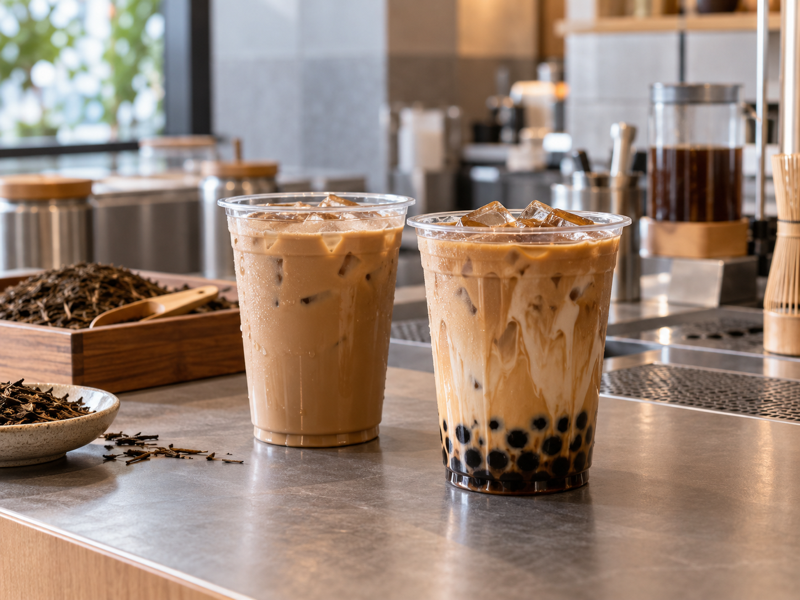
Ask tasters to judge the plain drink, then the complete drink with pearls. A strong plain tea can become balanced after toppings; a borderline plain tea may disappear. Record both outcomes. For this item, score roasted-tea recognition, sweetness, mouthfeel, pearl contribution, dilution and sediment. Taste at the actual serving state rather than relying on an attractive production sample.
Taste plain milk tea and the final topped cup separately. The plain drink shows whether the tea base is sound; the topped cup shows what the customer actually buys. Score roast recognition, sweetness, milk body, pearl chew, aftertaste, and the balance after ice has melted for several minutes. Brown-sugar-coated pearls can make an otherwise balanced drink sweeter, so do not decide syrup dose by tasting the liquid alone. Ask panelists whether they would still call the product hojicha if the menu name were hidden. If a pearl version needs more tea, set a distinct recipe and cost for it. A shared base is operationally convenient only when both finished cups meet the target.
| Item | Trial choice | Decision point |
|---|---|---|
| Roast recognition | Score both versions | Do not judge tea phase alone |
| Sweetness | Score after pearls | Brown-sugar coating may dominate |
| Texture | Rate milk and pearl chew | Record straw and shake effects |
| After melt | Taste at ten minutes | Check tea persistence |
7. Why do milk-tea pilots lose roasted flavor?
Defect diagnosis
If syrup masks roasted aroma, test less syrup before adding tea. If powder settles, evaluate dispersion and particle size. If pearls dominate, reduce the topping portion rather than calling the tea formula weak. Look specifically for tea hidden by syrup, chalky texture, inconsistent pearl portions or separation during service. Each symptom should trigger a narrow experiment with an unchanged control.
When roast disappears, identify the masking component before adding tea. Run a syrup ladder at fixed tea strength; if lower syrup restores the roast, the tea supplier is not the problem. If brown-sugar pearls dominate, trial an unflavored topping or smaller pearl portion. If an infusion loses flavor in milk, compare filtered tea strength and liquid ratio. If powder tastes strong at first but settles, review wetting and agitation rather than simply increasing grams. Record the chosen adjustment on the cup card. Tea shops often taste a fresh sample without a full topping load; that shortcut hides the reason the sold cup underperforms. A blind complete-cup test is the deciding evidence.
8. What safety and allergen checks apply to toppings?
Food safety and labeling
Tea base, creamer, milk and topping can each introduce different declarations. A menu board description is not a substitute for a documented ingredient and allergen list. The format requires review of dairy and soy declarations, topping preparation, potable water and chilled holding. Verify the actual market and process before approving any claim or date code.
Treat cooked pearls, milk or creamer, syrup, and tea as separate incoming ingredients with separate handling needs. Follow the topping manufacturer’s cooking and holding instructions and the outlet’s approved procedures; a recipe article cannot set a universal safe time. The FDA Food Code is a retail model whose local adoption varies. Review ingredient declarations for milk, soy, nuts, sesame, or other relevant components using FDA’s allergen information. A plant-based milk does not make a drink automatically allergen-free, and shared scoops or shakers need a cross-contact procedure. Bottled milk tea with pearls demands a separate process and stability assessment.
| Item | Trial choice | Decision point |
|---|---|---|
| Pearl lot | Cooking and handling record | Store lead |
| Milk or creamer | Ingredient and allergen review | Purchasing |
| Tea phase | Brew or dispersion record | Beverage lead |
| Equipment | Scoops and shakers cleaned | Shift lead |
9. How should a shop cost a topped cup?
Unit economics
Cost per cup should reflect displacement: pearls and ice change how much milk tea is actually served. Compare contribution margin between plain and topped versions rather than assuming the topped cup is always better. The cost model must capture topping portion, tea concentration, cup and seal cost, ice displacement and labor. Use actual sellable yield rather than theoretical batch weight.
Cost the plain and pearl versions as separate sellable units. Use actual tea or powder mass, filtered infusion yield, milk, syrup, cooked-pearl portion, ice, cup, seal, straw, and observed waste. Raw pearl purchase cost is only part of the topping cost: cooking yield and unsold cooked stock affect the real number. Calculate contribution per cup at the menu price and compare it with the extra service time. If pearls displace 45 g of drink, do not silently cost the topped cup as though it contains the same liquid as the plain cup. Conversely, if staff overfill the cup to maintain liquid, measure that added cost. Review order mix before deciding whether two versions are worth the station complexity.
| Item | Trial choice | Decision point |
|---|---|---|
| Tea phase | Mass or filtered yield × cost | Calculate plain and pearl cups |
| Pearls | Cooked portion × true yield cost | Include unsold stock |
| Milk and syrup | Actual measured mass | Topping may alter syrup need |
| Service pack | Cup, seal and suitable straw | Check diameter and labor |
10. What should a milk-tea pilot settle?
Five buyer FAQs
Pilot both versions with normal service staff. Record order mix, remake rate, tea recognition and preparation time. Request a powder lot that performs in the chosen milk system. The pilot should show that hojicha milk tea with optional tapioca remains consistent across operators and a second ingredient lot. Keep final decisions in a signed launch file.
Approve a card for each sold variation. It should identify tea format and approved lot, exact tea-phase preparation, milk and syrup masses, cooked topping portion, ice load, cup and straw, assembly order, and an acceptable filled-cup photograph. Include a sensory reference for a fully mixed cup with pearls. Pilot with staff who did not create the recipe and ask them to prepare three consecutive orders from the card. Weigh the pearls and liquid, time each order, and collect customer or panel feedback on whether the roast survives the topping. Resolve ambiguous instructions and cost changes before rollout. Recheck the formula if a supplier alters pearl size, milk sweetness, tea roast, or cup geometry.
Q1: Are tapioca pearls required?
No. Keep a plain milk-tea control and offer pearls only if they improve the target menu.
Q2: Can loose leaves replace powder?
Yes as a separate infusion design, with its own yield and handling tests.
Q3: Should sweetness change with toppings?
Test the complete cup and adjust deliberately; do not infer a level from the plain tea.
Q4: Can a store hold prepared pearls indefinitely?
No. Follow validated local procedures for the exact topping.
Q5: What should purchasing request?
Ask for a consistent tea specification and traceable samples tested in the selected base.
Ask Matcha Village for a traceable roasted-tea powder or a documented leaf infusion sample suitable for hojicha milk tea with optional tapioca trials. Send the planned one finished takeaway cup, target roast and destination market with the request so the sample conversation begins with an actual application.