
A hot matcha latte seems simple: tea powder, water, and milk. In service, small changes in dose, dispersion, milk, and holding produce a different drink. Café buyers need a formula that survives busy shifts and replacement lots, not a photograph of one good cup. This guide gives a practical trial method for a hot matcha latte and the supply questions that keep it repeatable.
Contents
- What defines a hot matcha latte?
- Which matcha powder works in hot milk?
- How should a café set its starting formula?
- Why does whisking matter before milk is added?
- How do different milks change the result?
- What temperature and service controls belong in the SOP?
- How should sweetness and flavor be standardized?
- How can a chain test consistency across sites?
- What belongs in the product cost calculation?
- What should buyers request from a matcha supplier?
1. What defines a hot matcha latte?
A drink specification starts with the cup
A hot matcha latte combines dispersed matcha with heated milk or a milk alternative. Water often starts the tea slurry, because dry powder dropped directly into milk can leave visible specks and inconsistent flavor. The result should be described by target cup size, powder dose, liquid volumes, sweetness, and service temperature. “One scoop” cannot serve as a specification unless the scoop’s delivered mass is measured. A café using a pre-sweetened latte mix also needs its ingredient composition, since one scoop of that mix contains less tea than the same mass of pure matcha.
The Yamamasa Koyamaen processing guide explains how tencha becomes matcha. It does not set a universal latte recipe, and neither does any retailer’s menu. Treat the recipe below as a pilot starting point for a medium cup, then decide by sensory testing and food cost. Record the final formula in grams or milliliters and train staff against that version. A recipe which depends on one barista’s visual estimate will drift as soon as shifts change.
2. Which matcha powder works in hot milk?
Judge the powder inside the drink
Milk softens bitterness, but it also covers some tea aromas. A powder that looks bright when dry may disappear in a large sweet latte. Compare candidate powders at the exact same dose in the same milk. Score tea visibility, color after blending, bitterness, grassy notes, mouthfeel, and the finish as the drink cools. Taste a plain whisked sample too; it can reveal off-notes that sugar conceals. If a chain wants a distinct matcha taste, a more expensive powder can be economical if a smaller dose achieves the target. That must be measured, not assumed.
Ask suppliers whether samples are pure matcha, a sweetened latte powder, or another blend. Confirm origin, ingredients, allergen information, lot code, and pack size. Grade labels alone do little for a beverage buyer because suppliers define them differently. The winning powder is the one that meets the drink standard at a feasible delivered cost, with repeatable lots and documents the importer can use. A side-by-side bench tasting should precede any blanket decision based on “ceremonial” or “culinary.”
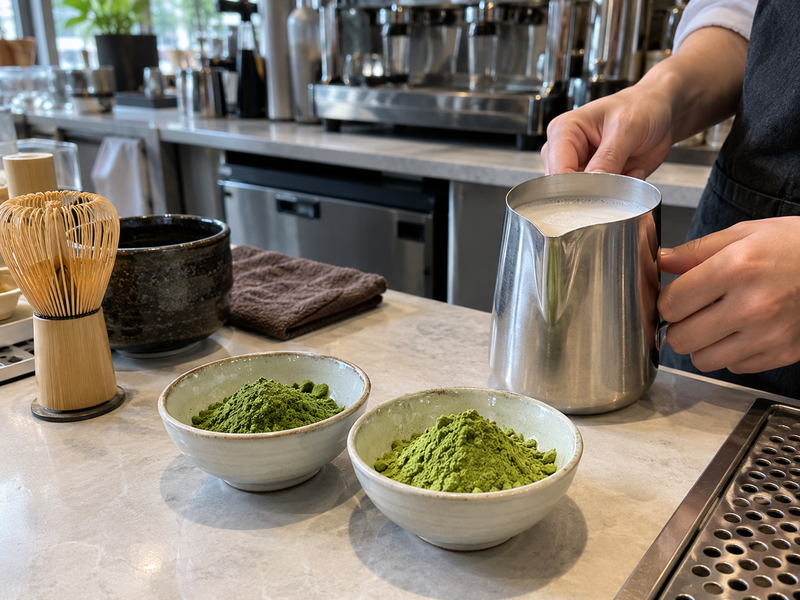
| Candidate | Trial question | Accept if |
|---|---|---|
| Pure matcha A | Does tea remain distinct under milk? | Flavor and color meet cup target |
| Pure matcha B | Can a lower dose achieve the same result? | Blind panel agrees at lower cost per cup |
| Latte premix | Does convenience offset formula restrictions? | Sweetness and ingredients suit the menu |
| Organic option | Does certification fit the intended claim? | Scope, paperwork, and drink quality pass |
3. How should a café set its starting formula?
Make the pilot measurable
For an illustrative 240 ml served drink, a team might trial 2 g of pure matcha, 30 ml of warm water, and enough heated milk to reach the target fill. That is a bench starting point, not a claim that every powder or cup should use those quantities. Test several tea doses around the chosen point and keep milk type, cup size, and sweetener constant. Weigh powder on a scale; volume spoons vary with density and how they are filled. If a premix contains sugar, calculate its tea contribution from the supplier’s disclosed composition before comparing it with pure matcha.
Record the water temperature range your equipment can deliver, slurry time, milk texture, and serving time. A small training batch should be reproducible by a new employee after reading the SOP. Run at least one test with the actual takeaway cup and lid, because aroma, foam, and perceived sweetness can change during a short carry. For tasting, label cups with codes rather than product names. Then compare the same formula across candidate powder lots if the supplier can provide them.
4. Why does whisking matter before milk is added?
Dispersion affects every sip
Matcha is a suspension of fine tea particles, not a soluble flavor syrup. Water helps wet powder evenly before milk enters the cup. Sifting can reduce dry clumps; a whisk, mechanical frother, or properly validated shaker can disperse the slurry. Choose a method that works with your service volume and can be cleaned consistently. A bamboo whisk may suit a specialty counter, while a chain might need a defined electric tool. Test both for cup quality and cycle time instead of treating one tool as automatically authentic or efficient.
Watch the bottom of the cup after five minutes. Heavy sediment, dry islands, or grainy mouthfeel are meaningful failures even if the first sip looks good. Staff should know the order of operations: dose, wet, disperse, add milk, finish. If prebatching slurry is being considered, the operator needs a validated food-safety plan for storage time and temperature. A counter jug that sits warm through a shift should not become standard because it saves seconds. The FDA Food Code is a model reference for U.S. retail foodservice controls, with local rules governing actual operations.
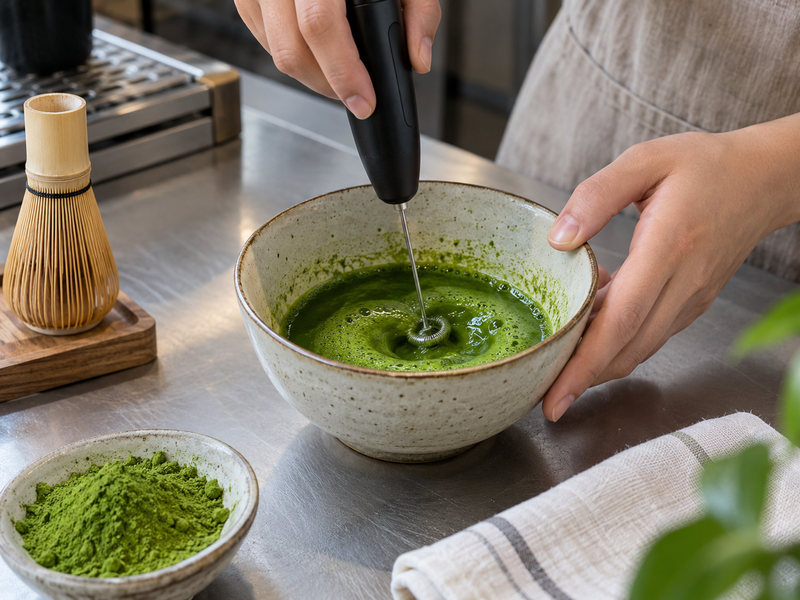
| Step | Failure to watch | Practical control |
|---|---|---|
| Dose | Cup-to-cup strength drift | Weigh training doses and calibrate scoop |
| Wet powder | Dry clumps | Use a defined small water volume |
| Disperse | Sediment and specks | Time and tool standard |
| Add milk | Inconsistent fill or foam | Graduated pitcher and cup line |
| Serve | Long wait before tasting | Record service window |
5. How do different milks change the result?
Run separate recipes, not one automatic substitution
Dairy milk brings its own sweetness, proteins, and texture. Oat, soy, and other plant drinks differ in flavor and heat behavior; individual brands within one category may also perform differently. A formula that tastes balanced in whole milk can become thin with another liquid. Test each menu milk with the same powder and cup size. Adjust only one variable at a time, such as powder dose or sweetener, so the team knows what caused the result. Record the exact milk SKU and any foam method in the standard recipe.
This is also a labeling and allergen decision. Milk and soy are among the major allergens named by the FDA. A plant-based menu option should be described accurately, including how shared tools are handled. A supplier’s matcha powder may be pure tea, while a latte premix may contain milk solids or other ingredients. Do not infer allergen status from a front-of-pack phrase. Request the ingredient and allergen declaration for the particular SKU and discuss cross-contact controls with the supplier and the café’s own food-safety lead.
6. What temperature and service controls belong in the SOP?
Separate sensory targets from safety rules
The best milk temperature for flavor and texture is a recipe-development choice. Food-safety holding limits are a different issue. The FDA Food Code is a model code, not a universal regulation adopted verbatim everywhere. It provides reference points for time and temperature control for safety foods. Operators should apply the rules adopted in their jurisdiction and their validated handling procedures. A freshly made latte served promptly differs from milk held in a pitcher for extended service.
Put measurable steps in the SOP: milk start condition, heating endpoint, maximum time between preparation and handoff, treatment of unused milk, pitcher cleaning, and what to do after equipment failure. Train with a thermometer during rollout even if experienced baristas later use an approved routine. Review the drink at handoff and after a typical customer wait. Hot matcha can taste harsher as it cools, while poorly dispersed powder can settle. The service specification should address the full drinking window, not only the moment the photograph is taken.
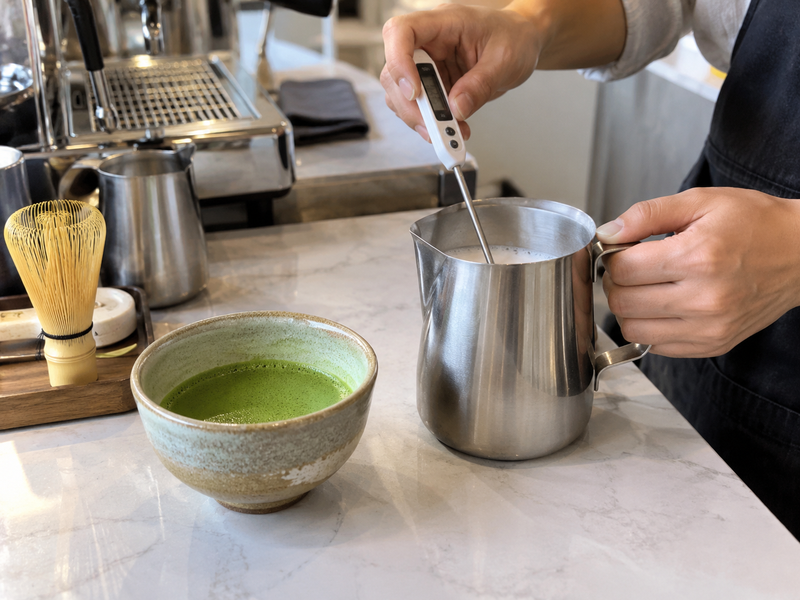
| Control point | Record in SOP | Verification |
|---|---|---|
| Milk heating | Approved temperature range | Thermometer during training and audit |
| Tea slurry | Water volume and mixing time | Visual clump check |
| Cup fill | Target volume | Marked cup or measured pour |
| Delay | Handoff window | Timed service trial |
| Reuse | Discard or safe holding rule | Manager check against local code |
7. How should sweetness and flavor be standardized?
Offer choice without changing the base by accident
A sweetener changes how tea bitterness reads. It can also conceal a weak powder during a quick tasting. Begin with an unsweetened control and add a measured sweetener dose in separate cups. If a menu offers “less sweet,” define what that means in the POS and recipe. For syrup, record the pump’s actual delivered volume; pump designs and viscosity vary. A chain should not publish sweetness or nutrition information from a laboratory cup that differs from its operating recipe. Any nutrition calculation needs the real supplier ingredient data and actual fill amounts.
Vanilla, honey, brown sugar, and other flavors can sit well with matcha, but each creates a new SKU-level test. A strong flavored syrup may let a lower tea dose appear acceptable in one drink while causing an unflavored latte to taste empty. Separate base-matcha approval from seasonal flavor approval. If a premix is used, learn what sweeteners it already contains before adding more. For private label powder, get the full formula and test whether it behaves consistently in hot milk and at the café’s standard mixing speed.
8. How can a chain test consistency across sites?
Take the formula into real service
Bench tasting identifies promising powders. A short site trial tests whether employees can make the drink repeatedly during peak periods. Give several stores the same written recipe and calibrated tools. Ask each store for a few coded drinks from different staff members and times, then compare color, tea strength, fill, texture, and customer wait. Collect operational data too: preparation time, waste, equipment cleaning effort, and how often a cup must be remade. If drinks vary, identify whether the powder, milk, dosing tool, or training step caused it.
Use a second supplier lot when possible. A sample that performs well once does not show how later production will behave. Agree on sensory and analytical acceptance criteria before ordering at scale. Retain an approved reference sample under suitable conditions for comparison. If demand spans countries, check import documentation and local recipes for each market; the same milk brand may not be available everywhere. The objective is a transferable process, not a claim that every customer tastes the drink identically.
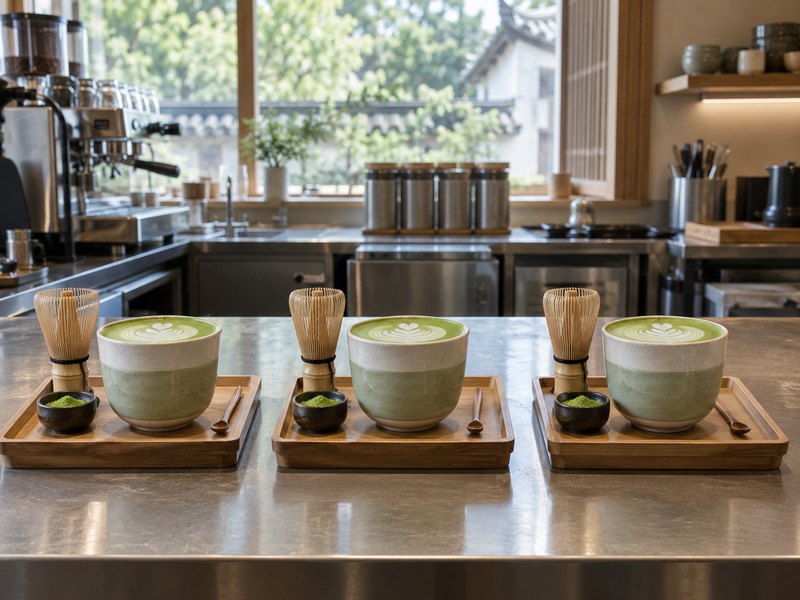
| Trial layer | What it answers | Evidence to keep |
|---|---|---|
| Bench | Which powder and dose meet flavor target? | Coded score sheet |
| Site | Can staff repeat it in service? | SOP audit and cup samples |
| Multi-lot | Does supply stay in range? | Lot-linked sensory record |
| Market | Does label and ingredient fit destination? | Regulatory review |
9. What belongs in the product cost calculation?
Cost the finished cup
Powder price per kilogram is one input. Calculate powder cost at the approved dose, then add milk, water, sweetener, cup, lid, labor assumptions, normal waste, and freight or duty where they matter. A powder that costs more per kilogram may cost less per acceptable cup if its flavor holds at a smaller dose. The reverse can also happen. Keep that calculation tied to a sensory-approved recipe; otherwise a spreadsheet can make an under-strength drink look profitable.
Ask for delivered price at realistic volume breaks, not only an ex-factory quote. Packaging affects freshness and back-of-house handling. Large packs may be cheap per kilogram yet wasteful if opened powder moves slowly at individual sites. Compare case sizes, shelf-life evidence, storage directions, and reorder lead times. Forecast growth with a range, then ask the supplier what lot and shipment schedule can support it. A café launch succeeds when purchasing, quality, and operations agree on one formula and one set of documents.
10. What should buyers request from a matcha supplier?
Give the supplier a specific use case
Tell the supplier that the intended product is a hot matcha latte, with target cup size, milk types, sweetener range, expected volume, destination country, and whether pure matcha or a premix is acceptable. Request a specification, full ingredient and allergen statement, certificate of analysis for sample lots, shelf-life and storage information, packaging options, lead time, and any certificates needed for the intended market. If the buyer needs organic status, confirm certificate scope for the exact SKU and transaction rather than assuming a factory-level statement covers every product.
Matcha Village can then recommend candidates for a controlled trial across its matcha and latte powder range. Buyer and supplier should agree on the standard used to approve color, taste, dispersion, and cost. Keep an approved sample and a written change-notification process for material differences. Those steps make the next order easier to judge: production powder must perform like the powder that earned the menu slot. Finish the trial by signing off the recipe, operator method, and lot specification together.
| Request | Why the buyer needs it | Owner |
|---|---|---|
| Sample and COA with lot code | Link tasting to supplied material | Quality |
| Ingredient and allergen statement | Menu and label accuracy | Regulatory |
| Pack size and storage instructions | Site handling and waste | Operations |
| Delivered pricing and lead time | Cost and replenishment | Purchasing |
| Change notification terms | Protect approved recipe | Quality and purchasing |
A reliable hot matcha latte comes from one tested formula and a supplier who can reproduce the approved powder. Run the drink in its real cup, milk, and service window, then request lot-linked samples and documents from Matcha Village before scaling it across a menu.
FAQ
Q1: How much matcha goes in a hot latte? Start with a measured trial dose, such as 2 g for a medium pilot cup, then adjust against cup size, milk, sweetness, and desired tea strength.
Q2: Should matcha be mixed with water before hot milk? A small water slurry can wet powder and reduce clumps. Validate the mixing tool and sequence in the actual café workflow.
Q3: Can a café use ceremonial grade for lattes? It can, but the grade label alone does not prove value. Compare sensory performance and cost per approved cup.
Q4: Is a matcha latte premix the same as pure matcha? No. A premix may contain sugar, milk ingredients, or other components. Read the exact SKU specification and ingredient statement.
Q5: What should a chain test before buying in bulk? Test a coded powder comparison, real-site preparation, multiple lots where available, complete documents, and the finished cup cost.